How to Turn on Eco Mode on a Jeep Cherokee

Contents
- 1 Key Takeaways
- 2 📑 Table of Contents
- 3 Unlocking Efficiency: Your Complete Guide to Jeep Cherokee Eco Mode
- 4 What Exactly is Eco Mode and How Does it Work?
- 5 Method 1: The Classic Button Press (The Easiest Way)
- 6 Method 2: Navigating the Uconnect Infotainment System
- 7 When and Why Should You Use Eco Mode?
- 8 Eco Mode vs. Other Drive Modes: Understanding the Lineup
- 9 Troubleshooting: What If My Eco Mode Isn’t Working?
- 10 Advanced Tips for Maximizing Your Eco Mode Benefits
- 11 Conclusion: Drive Efficiently, Drive Confidently
- 12 Frequently Asked Questions
Car Neck Pillow

Car Back Support Cushion

Car Scratch Remover

Car Tissue Holder
Turning on Eco Mode in your Jeep Cherokee is a simple process that can significantly improve your fuel economy. You can activate it using a dedicated button on the center console or via the vehicle settings in the Uconnect infotainment system. This mode adjusts throttle response, transmission shifting, and climate control to prioritize efficiency, making it perfect for daily commuting and highway cruising. Understanding how and when to use Eco Mode is key to getting the most out of your Cherokee’s capabilities.
Key Takeaways
- Eco Mode is a fuel-saving feature: It optimizes throttle response, shift points, and climate control to maximize miles per gallon (MPG) in your Jeep Cherokee.
- Two primary activation methods: Use the physical “Eco” button on the center console or navigate through the Uconnect system’s “Vehicle Settings” menu.
- Model-year variations exist: The exact button location and menu options can differ slightly between model years, so consult your owner’s manual if unsure.
- Eco Mode affects driving feel: Acceleration is softer and the transmission holds gears longer for efficiency, which some drivers may find less responsive.
- It works with most driving conditions: Eco Mode is beneficial for city and highway driving but is less effective in severe off-road or high-performance scenarios.
- You can turn it off anytime: Simply press the Eco button again or select a different drive mode (like Sport) to return to normal operation instantly.
- Not all Cherokees have a dedicated button: Some base models may only offer Eco Mode through the Uconnect touchscreen interface.
📑 Table of Contents
- Unlocking Efficiency: Your Complete Guide to Jeep Cherokee Eco Mode
- What Exactly is Eco Mode and How Does it Work?
- Method 1: The Classic Button Press (The Easiest Way)
- Method 2: Navigating the Uconnect Infotainment System
- When and Why Should You Use Eco Mode?
- Eco Mode vs. Other Drive Modes: Understanding the Lineup
- Troubleshooting: What If My Eco Mode Isn’t Working?
- Advanced Tips for Maximizing Your Eco Mode Benefits
- Conclusion: Drive Efficiently, Drive Confidently
Unlocking Efficiency: Your Complete Guide to Jeep Cherokee Eco Mode
Welcome, fellow Jeep enthusiast! If you’re reading this, you’re probably looking to squeeze every last drop of efficiency from your trusty Jeep Cherokee. You’ve come to the right place. Whether you’re a new owner navigating the dashboard for the first time or a seasoned driver wanting to master all your vehicle’s features, understanding Eco Mode is a game-changer. It’s one of the most accessible and impactful tools in your Cherokee’s arsenal for saving money at the pump without sacrificing the capability you expect from a Jeep.
First, let’s clear up a common point of confusion. While this article is about the Jeep Cherokee, and you are in the “Ford” category on our site, it’s important to note that Jeep is a brand under the Stellantis umbrella (formerly Fiat Chrysler Automobiles), separate from Ford. However, the principle of an “Eco” or efficiency driving mode is universal across modern automotive brands, including Ford’s own EcoBoost technology philosophy. Our goal here is to provide you with precise, model-specific instructions for your Jeep. So, let’s dive in and make your Cherokee work smarter, not harder.
What Exactly is Eco Mode and How Does it Work?
Before we get to the “how,” let’s quickly cover the “why.” Eco Mode is not a magic button that turns your Cherokee into a hybrid. Instead, it’s a sophisticated software setting that recalibrates several of your vehicle’s core systems to prioritize fuel economy over immediate performance. Think of it as putting your Cherokee on a gentle, energy-saving diet.

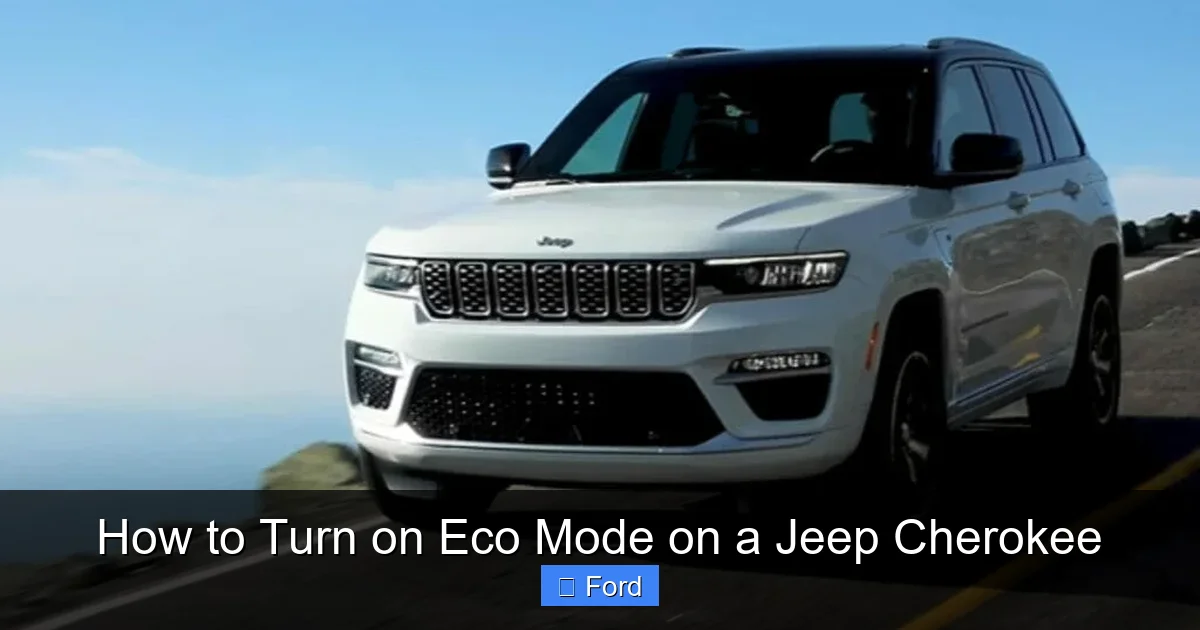
Visual guide about How to Turn on Eco Mode on a Jeep Cherokee
Image source: jeepmodified.com
The Science Behind the Savings
When you activate Eco Mode, your Jeep’s computer makes a series of coordinated adjustments:
- Throttle Response: The gas pedal becomes less sensitive. You’ll need to press it further down to achieve the same acceleration as in normal mode. This discourages aggressive, fuel-hungry driving and encourages smoother, more gradual inputs.
- Transmission Shifting: The automatic transmission (typically a 9-speed in recent models) is programmed to upshift sooner and downshift later. It aims to keep the engine in a lower, more efficient RPM range, reducing fuel consumption during steady-state driving.
- Climate Control: The HVAC system may reduce the output of the air conditioning compressor and adjust fan speeds to lessen the load on the engine, saving a noticeable amount of fuel, especially in stop-and-go traffic.
- Other Systems: On some models, Eco Mode can also slightly adjust the power steering assist and even the behavior of the stop/start system (if equipped) to further enhance efficiency.
The result? A measurable improvement in your real-world MPG. While the exact gain depends on your driving style and conditions, many Cherokee owners report a 1-3 MPG increase, which adds up significantly over thousands of miles. It’s a small change with a big cumulative impact.
Method 1: The Classic Button Press (The Easiest Way)
For the vast majority of Jeep Cherokee models from the early 2010s onward, there is a physical, dedicated button. This is the fastest and most intuitive method. You don’t even need to start the engine for this to work (though the ignition must be in the “ON” or “RUN” position).

Visual guide about How to Turn on Eco Mode on a Jeep Cherokee
Image source: jeepmodified.com
Finding the Button: A Tour of Your Center Console
Take a look at your center console, just below the infotainment screen and climate controls. You’re searching for a small button labeled with a stylized leaf icon—the universal symbol for ecology and efficiency. On most Cherokees (KL model, 2014-2023), this button is located in the switch panel to the right of the climate control knobs/buttons or integrated into the lower part of the dashboard trim near the shifter.
Visual Cues: The button is usually green or features a green leaf symbol. It might say “ECO” or have the leaf icon alone. On some higher-trim models with the drive mode selector (like Trailhawk or Limited), the Eco Mode might be part of a rotary dial or a series of buttons that also include “Sport” and “Snow” modes. In that case, you’d simply rotate the dial or press the corresponding button until “ECO” illuminates on the instrument cluster or screen.
Step-by-Step Activation
- Enter your Cherokee and ensure the ignition is in the “ON” position (all dash lights on, but engine not necessarily started).
- Locate the green “ECO” button on your center console.
- Press the button firmly. You should immediately see an indicator light on the button itself (if it’s illuminated) and, more importantly, a message or icon appear on your instrument cluster behind the steering wheel or on the Uconnect screen.
- The message typically reads “Eco Mode Activated” or shows a green leaf icon. You’re all set!
To deactivate it, simply press the same button again. The indicator will disappear, and your Cherokee will return to its standard throttle and shift programming. It’s that simple. This method works like a charm on everything from a 2015 Jeep Cherokee Sport to a 2022 Jeep Cherokee Limited. If you can’t find the button, your model might rely solely on the Uconnect system, so proceed to Method 2.
For base-model Cherokees or certain model years that forgo the physical button, Eco Mode lives within the digital menus of your Uconnect system. This method is also useful if you want to see any additional settings related to efficiency.

Visual guide about How to Turn on Eco Mode on a Jeep Cherokee
Image source: jeepmodified.com
Accessing the Vehicle Settings Menu
The Uconnect interface has evolved over the years, but the general path remains consistent. You’ll be looking for a “Settings” or “Vehicle” icon, usually represented by a gear or a car symbol.
- Start your Cherokee or turn the ignition to “ON.”
- Press the “Settings” button on your Uconnect touchscreen. On older systems (like Uconnect 4), it’s a physical button; on newer ones (Uconnect 5), it’s a touchscreen icon.
- Select “Vehicle” from the settings menu list.
- Look for an option called “Eco Mode,” “Drive Mode,” or “Efficiency Mode.”
- Toggle the setting to “On.”
- Confirm the activation. You should see the same Eco Mode indicator on your instrument cluster as you would with the physical button.
Pro Tip: Some Uconnect systems allow you to set Eco Mode as the default mode that activates every time you start the vehicle. Check within this menu for a “Auto-Engage” or “Default Mode” option if you want to make efficiency your Cherokee’s permanent state of mind.
When and Why Should You Use Eco Mode?
Knowing how to turn it on is only half the battle. Knowing when to use it is what truly unlocks its value. Eco Mode is designed for specific driving scenarios where maximum efficiency is the goal.
Ideal Scenarios for Eco Mode
- Daily Commuting: Stop-and-go traffic and suburban driving are where Eco Mode shines. The softer throttle response helps prevent unnecessary acceleration, and the early upshifts keep RPMs low, reducing fuel waste in traffic jams.
- Long Highway Cruises: At steady, legal highway speeds, the transmission’s optimized shift logic will keep your engine in its sweet spot for efficiency, potentially giving you that extra 50-100 miles of range on a long trip.
- Running Errands: For multiple short trips around town where you’re not in a hurry, Eco Mode promotes a calm, efficient driving style that saves fuel and reduces wear on your drivetrain.
- Fuel-Saving Missions: When you’re trying to set a personal MPG record or simply stretch a tank of gas to the next station, Eco Mode is your best co-pilot.
When to Avoid or Turn Off Eco Mode
Eco Mode is not a one-size-fits-all solution. There are times when its efficiency-focused tuning can be a hindrance:
- Merging onto Highways: The delayed throttle response can feel sluggish when you need a quick burst of power to safely merge with fast-moving traffic. Switch to Normal or Sport mode for these situations.
- Passing Other Vehicles: Similarly, attempting to pass on a two-lane road requires decisive acceleration. The soft throttle in Eco Mode can make this maneuver feel hesitant and unsafe. Disable it for passing.
- Hilly or Mountainous Terrain: On steep inclines, the early upshifts can cause the engine to struggle, forcing it to downshift repeatedly and potentially using *more* fuel. Normal mode provides more predictable power delivery for climbs.
- Towing or Heavy Loads: If your Cherokee is equipped to tow, always use Normal or Sport mode when pulling a trailer or carrying a heavy payload. Eco Mode’s shift patterns are not designed for the constant high-load demands of towing and can cause excessive transmission wear.
- Off-Road Adventures: While your Cherokee is capable, Eco Mode’s lazy throttle response is the opposite of what you want for precise, controlled low-speed maneuvers over rocks or through mud. Use the appropriate Off-Road mode (like “Rock” or “Sand” on Trailhawk models) or simply stay in Normal mode.
Remember: The beauty of Eco Mode is its simplicity. You can toggle it on and off as often as you like, mid-drive, with a single button press. Use it as a tool—engage it for efficiency, disengage it for performance and safety when needed.
Eco Mode vs. Other Drive Modes: Understanding the Lineup
If your Jeep Cherokee is a higher trim (such as Limited, Trailhawk, or Overland), you likely have more than just Eco and Normal modes. Understanding the full suite helps you choose the right tool for the job. While your specific model might have different names, the concepts are similar across the industry. For instance, if you’ve ever driven a Dodge Charger, you might be familiar with its distinct Sport mode, which is the polar opposite of Eco. You can learn more about activating that aggressive mode on a different vehicle here.
The Common Cherokee Drive Modes
- Eco Mode: As detailed, prioritizes fuel economy with soft throttle and early shifts.
- Normal Mode: The balanced, all-around default setting. It offers a good blend of responsive acceleration and efficient shifting for everyday driving.
- Sport Mode: This is Eco Mode’s fun-loving cousin. It holds gears longer, provides sharper throttle response, and often tightens the steering feel. It’s for when you want a more engaging drive, but it will reduce your MPG. If you’re curious about how Sport mode works in other popular vehicles like the Toyota Corolla, you can find a great breakdown here.
- Snow/Mud/Sand (Trailhawk Models): These are off-road optimized settings. They alter throttle response, transmission behavior, and traction control systems for better traction in low-grip conditions. They are not for daily on-road efficiency.
Learning to seamlessly switch between these modes based on your driving conditions is a hallmark of an expert Cherokee owner. It allows your single vehicle to adapt to your needs, whether you’re commuting, carving a backroad, or exploring a trail.
Troubleshooting: What If My Eco Mode Isn’t Working?
It’s rare, but you might encounter a situation where pressing the Eco button does nothing, or the mode won’t stay on. Don’t panic—there are a few common culprits.
Check the Obvious First
Ensure your vehicle is in “Park” or “Neutral” when you try to activate it via the button (some models require this). Verify the ignition is in the “ON” position, not just “ACC.” Also, check if any warning lights are illuminated on your dash. A check engine light or transmission warning can sometimes disable drive mode selections as a safety precaution.
The “Service Eco Mode” Message
If your instrument cluster displays a message like “Service Eco Mode” or the Eco light flashes, it indicates the system has detected a fault. This is almost always related to the throttle control system or a sensor that the Eco Mode software relies on. Common issues include:
- A faulty throttle position sensor (TPS)
- An issue with the electronic throttle control (ETC) system
- A loose or damaged wiring harness related to the throttle
What to do: The best course of action is to have a qualified mechanic or dealership technician scan your Cherokee’s computer for diagnostic trouble codes (DTCs). They can pinpoint the exact sensor or component causing the Eco Mode to disengage. Driving with this light on is generally safe, but you will not have access to the fuel-saving benefits until the underlying issue is repaired.
Eco Mode Not Available on My Model?
As mentioned, some very base-model Cherokees from certain years might not have been equipped with the Eco Mode feature at all. If you’ve searched high and low for the button and menu option to no avail, consult your official owner’s manual. The manual will definitively list all available features for your specific VIN and trim level. If it’s not listed, your vehicle simply doesn’t have it. Aftermarket solutions are not recommended and can cause more harm than good.
Advanced Tips for Maximizing Your Eco Mode Benefits
You’ve turned the switch on. Now, let’s talk about how to drive in a way that synergizes with Eco Mode to achieve the absolute best fuel economy your Cherokee is capable of.
Drive Like a Hybrid (Even Though You’re Not)
The most significant factor in fuel economy is your driving style, and Eco Mode is just an aid. To truly maximize its effect:
- Anticipate Traffic: Look far ahead. If you see a red light or slowing traffic, take your foot off the gas early and coast. Eco Mode’s soft throttle makes this smoother, but you have to do the anticipating.
- Gentle Acceleration: Resist the urge to “test” the Eco Mode by mashing the pedal. It’s counterproductive. Press the gas pedal smoothly and progressively. Imagine there’s an egg under your foot.
- Use Cruise Control on Flat Highways: Once at speed, engaging cruise control helps maintain a constant velocity, which is far more efficient than the slight speed fluctuations from your foot. Eco Mode will work in harmony with cruise control.
- Keep Tires Properly Inflated: Under-inflated tires create more rolling resistance, killing fuel economy. Check your pressure monthly. The recommended PSI is on a sticker inside your driver’s door jamb.
Combine Eco Mode with Other Efficiency Features
Your Cherokee likely has other tech that pairs well with Eco Mode:
- Stop/Start System: If equipped, this system automatically shuts off the engine at long stops (like red lights) and restarts it when you release the brake. It works in all modes but is often more seamless in Eco Mode. Ensure it’s turned on (usually a separate button with an “A” inside a circle).
- Tire Pressure Monitoring: Don’t ignore the TPMS light! As stated, proper inflation is critical. If you need to reset the light after adjusting pressure, our site has guides for various models, like how to turn off the tire pressure light on a Honda Civic, which illustrates the general process here.
- Regular Maintenance: A clean air filter, fresh spark plugs, and the correct oil viscosity are foundational to any fuel-saving strategy. Eco Mode can’t overcome neglected maintenance.
By combining mindful driving, Eco Mode, and proper vehicle care, you’ll see the best possible results from your Jeep Cherokee.
Conclusion: Drive Efficiently, Drive Confidently
Mastering your Jeep Cherokee’s Eco Mode is a small step that yields consistent, tangible rewards. It’s a testament to modern automotive engineering—a simple software switch that quietly works in the background to save you money and reduce your environmental footprint. Whether you engage it with the satisfying click of a green button on your console or navigate to it through the Uconnect menu, the principle remains the same: you are taking control of your driving experience and optimizing it for efficiency.
Remember, Eco Mode is a tool, not a restriction. Use it wisely for your commutes and cruises, but don’t hesitate to switch to Sport or Normal mode when the situation calls for more power or responsiveness. Your Cherokee is a versatile vehicle, and understanding these driving modes is key to unlocking its full potential. Now that you know exactly how to find and use Eco Mode, go ahead and give it a try on your next drive. Pay attention to the difference in your fuel gauge over the next few tanks. You might just be pleasantly surprised at how such a simple feature can make your journeys—and your wallet—feel a little bit better.
Frequently Asked Questions
Will Eco Mode damage my Jeep Cherokee’s engine or transmission?
No. Eco Mode is a carefully engineered software setting designed by Jeep engineers. It uses the same engine and transmission hardware but changes their control parameters. It does not cause any additional wear and tear; it simply prioritizes different performance characteristics (efficiency over sportiness).
Can I leave Eco Mode on all the time?
You technically can, but it’s not recommended for all driving scenarios. While it’s perfectly fine for daily commuting, you’ll miss out on the more responsive acceleration of Normal or Sport mode when merging onto highways or passing. For the best balance of efficiency and drivability, toggle it based on your current driving needs.
Does Eco Mode work in a Jeep Cherokee with a manual transmission?
No, Eco Mode is a feature exclusive to automatic transmission models. Manual transmission drivers control their own shift points and throttle response, so the system has nothing to automate. The Eco Mode button will not be present in a manual-transmission Cherokee.
My Eco Mode light comes on, but I don’t feel any difference. Is it working?
Yes, it’s likely working. The changes in throttle response and shift points can be subtle, especially if you’re used to driving gently. The most noticeable effect is often on the transmission’s shift pattern—you might feel it upshift sooner. The best way to confirm it’s working is to monitor your fuel economy over several tanks with Eco Mode on versus off.
Does using the air conditioning heavily cancel out Eco Mode savings?
The climate control system is the single biggest drain on your engine’s power and fuel economy. Eco Mode does reduce A/C compressor load, but if you have the temperature set very low and the fan on high, you will still see a significant drop in MPG. For maximum efficiency, use the “Eco” setting for the A/C (if available), use the fan instead of extreme cooling when possible, and consider using the ventilated seats (if equipped) instead of the A/C.
Is Eco Mode available on all Jeep Cherokee model years and trims?
Almost all automatic-transmission Cherokee models from the 2014 redesign (KL platform) onward have Eco Mode, either via a button or the Uconnect menu. However, some very base models from early years might lack the dedicated button and only have it through Uconnect, or in rare cases, may not be equipped with the feature at all. The best way to be certain is to check your owner’s manual or look for the green leaf icon on your console or in the vehicle settings menu.