
What Type Transmission Fluid for Ford F150

Using the correct transmission fluid for your Ford F150 is not optional—it’s critical for performance and longevity. The required fluid changes dramatically based on your truck’s model year and transmission type, from legacy Dexron fluids to modern Mercon LV and specialized 6R/10R fluids. Using the wrong fluid can cause slipping, harsh shifts, and catastrophic transmission failure, so always verify your specific needs via the owner’s manual or dipstick label before any service.
Key Takeaways
- Your F150’s fluid depends entirely on its model year and transmission. A 2002 model uses a completely different fluid than a 2021, and mixing them is dangerous.
- Always consult your owner’s manual or dipstick for the definitive specification. Ford’s official abbreviations (like Mercon LV, WSS-M2C948-B) are the only reliable guide.
- Capacity varies by transmission and whether you’re doing a drain-and-fill or a full flush. Typical ranges are 6 to 13 quarts, but exact figures are model-specific.
- Never mix different fluid types or brands unless explicitly stated as compatible. incompatibility can lead to chemical reactions, loss of friction properties, and internal damage.
- Signs of using incorrect fluid include delayed engagement, erratic shifting, shuddering, and leaks. These symptoms often appear shortly after a fluid change.
- Maintenance intervals are typically every 30,000 to 60,000 miles for severe service. “Lifetime” fluid claims often refer to the warranty period, not the transmission’s life.
- When in doubt, pay for a professional diagnosis. A transmission shop can identify the correct fluid and perform the service correctly, saving you from a costly rebuild.
[FEATURED_IMAGE_PLACEHOLDER]
📑 Table of Contents
- Your Ford F150’s Lifeline: Why the Right Transmission Fluid is Non-Negotiable
- Decoding Transmission Fluid: More Than Just “ATF”
- Finding Your Fluid: A Year-by-Year & Transmission Guide
- Capacity, Intervals, and the “Lifetime” Myth
- The Red Flags: Symptoms of Using the Wrong Transmission Fluid
- Doing It Right: How to Check and Change Your Fluid
- Conclusion: Your Fluid, Your Truck’s Future
Your Ford F150’s Lifeline: Why the Right Transmission Fluid is Non-Negotiable
Let’s be real for a second. Your Ford F150 is a workhorse. It’s built to haul, tow, and tackle everything from job sites to jungle gyms. But under all that steel and power, there’s a complex dance of hydraulics happening inside your transmission. The fluid isn’t just oil—it’s the hydraulic fluid, lubricant, coolant, and cleaner all in one. Get it wrong, and that dance turns into a stampede. I’ve seen too many F150s with perfectly good transmissions grenade themselves because someone used the “wrong but close enough” fluid. This guide will strip away the confusion. We’re going to dig into the exact transmission fluid for Ford F150 trucks, broken down by era and transmission. No guesswork. Just the facts you need to keep your rig shifting smoothly for the long haul.
Decoding Transmission Fluid: More Than Just “ATF”
Before we talk specific F150s, you need to understand what makes transmission fluid special. It’s not like engine oil, where a good synthetic covers a wide range. Transmission fluid is engineered for specific friction properties. The clutches and bands inside your transmission rely on a precise coefficient of friction to engage smoothly. Too slick, and they slip. Too grippy, and they chatter. The fluid also contains specific additives for wear protection, foaming resistance, and seal conditioning.
Visual guide about What Type Transmission Fluid for Ford F150
Image source: d2n97g4vasjwsk.cloudfront.net
The Great Fluid Schism: Dexron vs. Mercon vs. WS
For decades, the world was divided. General Motors had its Dexron spec. Ford had its Mercon spec. They were not interchangeable. Using Dexron in a Mercon-designed transmission (or vice versa) would cause shifting problems. This is the core reason you cannot just grab any red ATF off the shelf. Starting in the late 1990s, Ford began evolving its specs. Mercon became Mercon V, then Mercon LV (Low Viscosity), and finally the modern World Standard (WS) fluid for its 6- and 10-speed automatics. Each step changed the chemistry. This history is why your 1999 F150 and your 2018 F150 need entirely different fluids.
Finding Your Fluid: A Year-by-Year & Transmission Guide
This is the meat of the matter. Your F150’s transmission fluid is determined by two things: the model year (which dictates the transmission family) and the specific transmission model. Ford used several different automatics over the years. Let’s break it down in chunks.
Visual guide about What Type Transmission Fluid for Ford F150
Image source: i.ytimg.com
The E4OD and 4R100 Era (1997-2003)
If your F150 is from the late 90s to early 2000s, you likely have the legendary E4OD (electronically controlled 4-speed) or its heavier-duty sibling, the 4R100. These are robust transmissions, but they require a specific fluid. For these models, Ford specified MERCON® ATF. This is the original red fluid. It’s crucial to use a fluid that meets the Ford specification MERCON, not just any “Dexron/Mercon” generic. Many aftermarket brands label theirs as “MERCON V,” but for these early transmissions, true MERCON (or a high-quality equivalent like Mobil 1 Synthetic ATF for older Mercon applications) is what you need. Capacity for a drain-and-fill is about 5-6 quarts, while a full flush can require up to 12-14 quarts.
The 4R75E & 4R70E Transition (2004-2008)
For the 2004-2008 F150s with the 4-speed automatics (4R75E for half-tons, 4R70E for heavier), Ford updated the specification to MERCON® V ATF. This is a different, more advanced fluid than the original MERCON. It’s still typically red but has different additive packages. You must use MERCON V in these transmissions. Using older MERCON can lead to performance issues, and using later Mercon LV or WS will cause problems. Capacity remains similar to the previous generation, around 6 quarts for a pan drop. Always check your dipstick; it should be clearly labeled “MERCON V.”
The 6R80 Revolution (2009-2017)
This is where everything changed. In 2009, Ford introduced the 6-speed 6R80 automatic for most V8 and some V6 F150s. This transmission required a completely new, lower-viscosity fluid: MERCON® LV ATF. It’s often yellow or amber in color. The shift from a 4-speed to a 6-speed with more complex clutch-to-clutch shifting demanded a fluid with different friction characteristics. Using anything other than MERCON LV in a 6R80 will result in poor shift quality, slippage, and potential damage. Capacity for a service is about 8-10 quarts for a drain-and-fill, but the total system capacity is higher. The 6R80 was also paired with the “Tow/Haul” mode, which places extra stress on the fluid, making correct specification even more vital.
The 10R80 & Modern Era (2018-Present)
The current F150s (2018+) with the 10-speed 10R80 transmission use the latest Ford fluid: Ford® World Standard (WS) ATF. This is a very specific, ultra-low-viscosity fluid, typically a light brown color. It is not the same as Mercon LV. The 10-speed’s incredibly fast, seamless shifts are calibrated around this exact fluid’s properties. Using Mercon LV or any other fluid in a 10R80 is a one-way ticket to transmission problems. Capacity for a pan drop is roughly 7-8 quarts, but a full flush requires closer to 13-15 quarts. The dipstick (if equipped—many newer models are “sealed” and require a shop to check) will specify “WS.”
Important Notes for 4×4 Models & Transfer Cases
If you have a 4×4 F150, you have a second fluid to worry about: the transfer case. This is a separate unit that sends power to the front axle. Its fluid specification is different from the transmission’s. For most 1997-2006 4×4 F150s, it’s Motorcraft® Transfer Case Fluid or a compatible equivalent. For 2007-2017 models, it’s often Motorcraft® Transfer Case Fluid** (a specific formulation). For 2018+ models, consult your manual, but it’s typically a specific Motorcraft fluid. Never use transmission fluid in your transfer case. They have different friction requirements. Neglecting this service can lead to noisy, stiff 4×4 engagement and eventual failure. This is a great example of where a resource like our guide on hydraulic fluid types reinforces that all vehicle fluids are highly specific to their application.
Capacity, Intervals, and the “Lifetime” Myth
Knowing the fluid is step one. Knowing how much and how often is step two.
Visual guide about What Type Transmission Fluid for Ford F150
Image source: m.media-amazon.com
How Much Fluid Does It Take?
This is a common trick question. The “capacity” depends entirely on the service type:
- Drain-and-Fill (Pan Drop): This is what most DIYers do. You remove the pan, replace the filter, and refill. This replaces about 40-50% of the total fluid. Capacity for this is typically 6-10 quarts, depending on the transmission.
- Complete Flush: This uses a machine to push new fluid through the entire system, including the torque converter and cooler lines. This replaces nearly 100% of the fluid. Capacity can be 12-16 quarts.
Always start with the amount specified in your owner’s manual for a drain-and-fill. You add fluid, check the dipstick (with the engine running and warmed up, in park), and add more until it’s at the “Full Cold” or “Full Hot” mark as specified. Overfilling is just as bad as underfilling.
Service Intervals: Debunking “Lifetime”
Many modern F150 manuals say the transmission fluid is “lifetime.” This is a legal and marketing term that typically means “lifetime of the power-train warranty” (e.g., 5 years/60,000 miles). It does not mean “lifetime of the vehicle.” Transmission fluid degrades. It loses its friction properties, its ability to protect against wear, and its resistance to heat. For severe service—which includes towing, hauling, dusty conditions, and frequent short trips—changing the fluid every 30,000 to 60,000 miles is a wise insurance policy. For a truck that’s mostly highway cruising, you might stretch it to 80,000-100,000 miles, but why risk it? A fluid change is cheap insurance against a $3,000-$5,000 transmission repair.
The Red Flags: Symptoms of Using the Wrong Transmission Fluid
How do you know if the wrong fluid is in your F150? The symptoms often appear quickly after a fluid change or gradually as the wrong fluid degrades. Listen and feel for these warning signs:
- Delayed Engagement: You shift into Drive or Reverse and there’s a 2-3 second delay before the truck moves.
- Harsh, Jarring Shifts: Shifts feel like a kick or a clunk, especially between 1-2 and 2-3.
- Transmission Shudder/Vibration: A constant vibration or shudder at steady speeds (like 40-50 mph), often felt in the seat and steering wheel. This is a classic sign of incorrect friction properties.
- Slipping: The engine RPMs rise without a corresponding increase in speed. You feel like the truck is struggling to find gear.
- Failure to Shift: The transmission may “lock” in one gear (often failsafe or “limp” mode) or refuse to shift out of a gear.
- Fluid Leaks: Some aftermarket fluids have different seal-swell properties and can cause new leaks where seals weren’t previously leaking.
If you experience any of these after a fluid service, do not run the truck. Have it towed to a transmission shop. Continuing to drive with the wrong fluid will cause irreversible wear. The cost of a tow and fluid swap is nothing compared to a rebuild.
Doing It Right: How to Check and Change Your Fluid
For many DIYers, a transmission fluid change is a manageable Saturday project. Here’s how to do it correctly.
Step 1: Identify Your Exact Fluid Spec
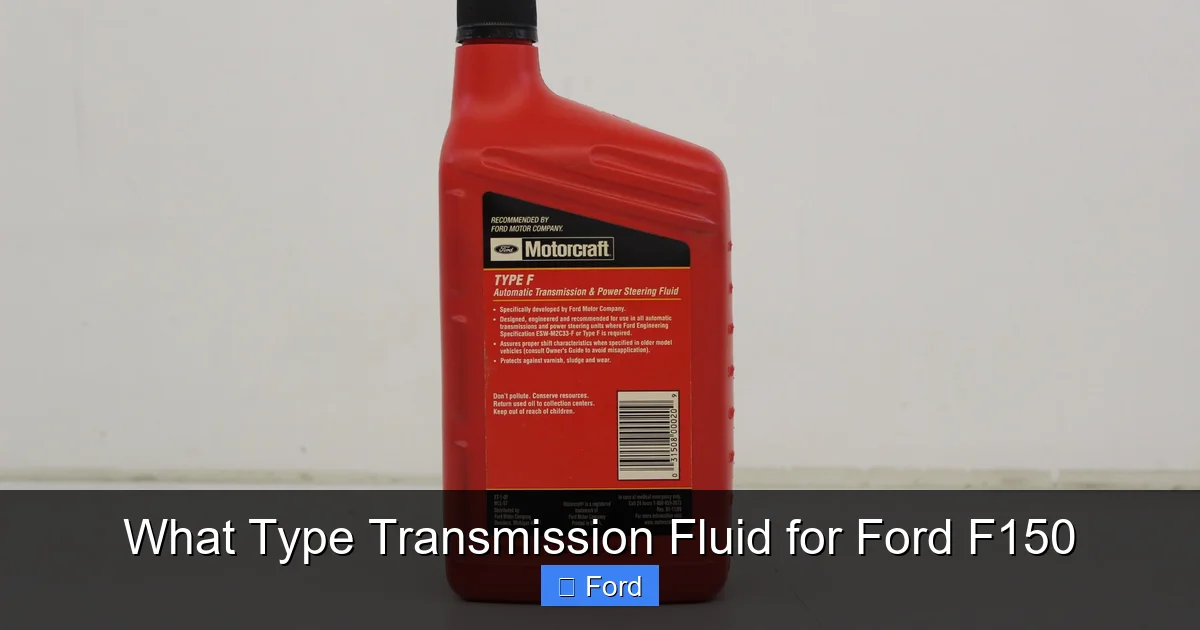
Do not guess. Find your owner’s manual. Look at the transmission dipstick—it’s often printed on the dipstick handle or the dipstick tube. The spec will be something like “MERCON LV,” “WS,” or a specific Ford part number like “WSS-M2C948-B.” Write it down exactly. Then, buy fluid that meets that exact specification. Major brands like Motorcraft (Ford’s OEM brand), Valvoline, and Pennzoil make fluids that meet these specs. Look for the Ford specification on the bottle.
Step 2: The Drain-and-Fill Process
You’ll need: the correct fluid, a socket to remove the pan bolts, a new pan gasket/filter kit, a fluid catch pan, a funnel, and gloves. The steps are: 1) Warm up the transmission by driving for 15-20 minutes. 2) Park on level ground, set parking brake. 3) Remove the drain plug (if equipped) or loosen the pan bolts and let it drain. 4) Replace the filter and clean the pan. Install new gasket and tighten pan bolts to spec (usually in a criss-cross pattern). 5) Reinstall the drain plug if you had one. 6) Through the dipstick tube, add the specified amount of new fluid (start with 4-5 quarts). 7) Start the engine, let it idle, shift through all gears and back to Park. 8) With the engine still running, check the dipstick. Add fluid until it reaches the “Full Hot” mark. 9) Take the truck for a short drive, then re-check when hot and top off if needed.
Step 3: When to Call a Pro
Some trucks (like 2011-2014 models with the sealed “no-dipstick” 6R80) require a professional with a scanner to monitor transmission temperature and fluid level. This is not a DIY job. Also, if you suspect contamination (wrong fluid, coolant leak into fluid), a simple drain-and-fill won’t fix it. A full flush or even a rebuild may be necessary. A professional diagnosis is worth every penny. While you’re thinking about professional maintenance, consider other systems too. For example, ensuring your battery is healthy is crucial, as a weak battery can cause voltage issues that affect transmission solenoid performance.
Conclusion: Your Fluid, Your Truck’s Future
The takeaway is simple but powerful: the transmission fluid for your Ford F150 is a precise, non-negotiable specification. It’s tied to the engineering of your specific transmission. A 2005 F150 with a 4R75E and a 2020 F150 with a 10R80 are separated by a chasm of technological evolution, and that chasm is defined by their fluid. Ignoring this doesn’t just risk a rough shift—it courts a total transmission failure. Take the time to look, to verify, and to use only the fluid that wears the Ford specification badge. Your future self, holding a $4,000 repair bill, will thank you. And remember, proper fluid maintenance is just one part of holistic truck care. Just as you’d research the best tires for your Ford F150 for traction and safety, using the correct fluid is about internal traction and safety for your drivetrain. It’s the simplest, most cost-effective way to ensure your F150 is ready for the next job, the next trail, and the next decade.
Frequently Asked Questions
Can I use Dexron or Mercon V fluid in my newer Ford F150?
No. Dexron is for older GM vehicles and pre-2003 Ford trucks. Mercon V is specifically for 2004-2008 4-speed automatics. Using either in a 6R80 (2009-2017) requires Mercon LV, and using anything other than WS fluid in a 10R80 (2018+) will cause serious damage. Always use the exact fluid specified for your model year and transmission.
What happens if I accidentally mixed a small amount of the wrong fluid?
Even a small amount of incorrect fluid can contaminate the entire system and alter the friction properties. If you’ve added the wrong fluid, do not start the engine. Have the truck towed to a shop where they can drain and flush the system completely. Running it, even briefly, can cause clutch damage.
How often should I really change my transmission fluid?
Ignore the “lifetime” claim. For a truck used for towing, hauling, or in severe conditions (hot climate, dusty roads), change it every 30,000 to 60,000 miles. For mostly highway, gentle use, you might extend to 80,000-100,000 miles, but this is pushing your luck. Changing it proactively is far cheaper than a transmission rebuild.
How do I check the fluid level correctly?
The engine must be at operating temperature. Park on level ground, set parking brake, and run the engine at idle. Shift through all gears, ending in Park. With the engine still running, pull the dipstick, wipe it clean, reinsert it fully, and pull it out again. Read the level against the “Full Hot” mark. If no dipstick exists (common on 2011+ models), a scan tool is required to check the level via the transmission temperature sensor.
Are aftermarket transmission fluids like Valvoline or Pennzoil safe to use?
Yes, if they meet the exact Ford specification (e.g., “meets Ford MERCON LV specification” or “meets Ford WS specification”). Brands like Valvoline, Pennzoil, and Amsoil produce high-quality fluids that are licensed to meet these specs. The key is the specification on the bottle, not the brand name. Motorcraft (Ford’s brand) is always a guaranteed match.
My F150 is shifting fine. Why should I bother with a fluid change?
Transmission fluid degrades over time due to heat and shear stress. Its additives that protect against wear and provide the correct friction wear out. By the time you feel a shift problem, internal wear has likely already begun. A fluid change is a preventative measure. It’s like changing your engine oil—you do it before the damage happens to maintain optimal performance and extend the transmission’s life.