How to Turn Off Tesla Location

Contents
- 1 Key Takeaways
- 2 📑 Table of Contents
- 3 Understanding Tesla’s Location Tracking: More Than Just a Dot on a Map
- 4 The Two Main Methods to Disable Location Sharing
- 5 What Happens When You Turn Off Location: The Feature Impact Analysis
- 6 Privacy Implications: What Data Are You Actually Stopping?
- 7 When and Why You Might Want to Turn Off Location
- 8 How to Re-Enable Location Services and Restore Features
- 9 Advanced Considerations and Troubleshooting
- 10 Conclusion: Making an Informed Choice
- 11 Frequently Asked Questions

Car Inverter

Bluetooth FM Transmitter

Octane Booster

Car Back Support Cushion
Turning off your Tesla’s location services is a straightforward process done primarily through the Tesla mobile app, with an additional setting inside the vehicle’s touchscreen menu. Disabling location sharing enhances your privacy by preventing Tesla from collecting your driving data and stopping real-time tracking in the app. However, it’s crucial to know that this action will disable critical features like navigation, Sentry Mode, and automatic crash detection, so it’s best suited for specific situations rather than everyday use.
Key Takeaways
- Primary Control is the Tesla App: The most effective way to turn off location sharing is via the “Privacy & Security” settings in your Tesla mobile app, which stops data transmission to Tesla’s servers.
- In-Vehicle Menu is Secondary: The car’s touchscreen also has a location setting under Controls > Safety & Security, but this primarily affects in-car services like navigation and may not fully stop all telematics.
- Feature Trade-Offs Are Significant: Disabling location will deactivate navigation, Sentry Mode, real-time car finder, and automatic emergency services, significantly impacting convenience and safety.
- It’s About Data Collection, Not GPS: This setting controls telematics data sharing, not the GPS signal your car uses for driving directions, which is a separate, offline system.
- Temporary vs. Permanent: You can toggle location services on and off as needed for privacy-sensitive trips, rather than committing to a permanent change.
- Different from Guest Mode: Turning off location is not the same as enabling Guest Mode, which limits driver profiles but does not stop all vehicle telemetry.
- Check for Software Updates: Tesla frequently updates its app and vehicle software, so menu paths and option names may change slightly over time.
📑 Table of Contents
- Understanding Tesla’s Location Tracking: More Than Just a Dot on a Map
- The Two Main Methods to Disable Location Sharing
- What Happens When You Turn Off Location: The Feature Impact Analysis
- Privacy Implications: What Data Are You Actually Stopping?
- When and Why You Might Want to Turn Off Location
- How to Re-Enable Location Services and Restore Features
- Advanced Considerations and Troubleshooting
- Conclusion: Making an Informed Choice
Understanding Tesla’s Location Tracking: More Than Just a Dot on a Map
When you think about your Tesla knowing its location, you probably picture that little blue dot moving on the screen in your app. But the reality of Tesla’s location tracking is a layered system that serves many purposes, from enabling your daily navigation to powering the company’s vast fleet learning database. For many owners, the idea of a car constantly reporting its whereabouts feels invasive. The good news is that you have control. Learning how to turn off Tesla location services is about making an informed choice between convenience and privacy. This guide will walk you through every method, explain exactly what happens when you flip the switch, and help you decide if it’s the right move for you.
First, it’s vital to understand what “location” means in a Tesla context. Your vehicle is a rolling computer with multiple GPS and connectivity modules. The primary system is the GPS receiver that provides coordinates for the built-in navigation system. This works independently and does not require an internet connection or data sharing with Tesla. The location tracking you can turn off refers to the telematics data sent over the car’s cellular connection (LTE/5G) to Tesla’s servers. This data stream powers the Tesla app’s real-time location, speed, and charging status displays. It also feeds into features like Sentry Mode alerts, trip logging, and the massive dataset Tesla uses to improve Autopilot and develop Full Self-Driving. So, when you disable location sharing, you are severing that specific data pipeline to the cloud, not disabling the GPS chip itself.
The Two Main Methods to Disable Location Sharing
You have two primary avenues to stop your Tesla from sharing its location with Tesla’s servers: the mobile app and the vehicle’s touchscreen. The app method is the most comprehensive and is what most privacy-conscious owners use. The in-car setting is more limited in scope. We’ll cover both in detail.

Visual guide about How to Turn Off Tesla Location
Image source: carstale.com
Method 1: Using the Tesla Mobile App (Most Effective)
This is the definitive method to halt all location-based telematics from your vehicle. The setting lives within the app’s privacy controls and, once changed, sends a command directly to your car to disable the transmission of its location data. Here is the step-by-step process:
- Open the Tesla App: Launch the application on your smartphone and ensure you are logged into the correct account linked to your vehicle.
- Access Settings: Tap on your vehicle’s name/icon at the bottom center of the screen to enter the main vehicle control interface.
- Navigate to Privacy: Look for a menu button (often three horizontal lines or “More”) and select Safety & Security or Privacy & Security. The exact label can vary slightly with app updates.
- Find Location Sharing: Within the privacy menu, you will see an option called “Share Location Data” or “Location Sharing”. This toggle controls whether your car sends its real-time coordinates to Tesla.
- Toggle Off: Switch the toggle to the OFF position. You may be prompted with a warning explaining which features will be disabled. Confirm your choice.
- Confirmation: The change should propagate to your car within a few moments. The app will likely show a message like “Location Sharing Disabled.” You can verify by checking if the real-time location map in the app no longer updates.
Important Note: This setting is account-specific. If multiple drivers have access to your Tesla via the app, each must change this setting on their own device to fully prevent location sharing from any linked account.
Method 2: Using the Vehicle’s Touchscreen (Limited Effect)
Inside your Tesla, there is a setting that influences location services, but its effect is narrower than the app toggle. This setting primarily manages in-car features that rely on an internet connection for map data and points of interest.
- On the Touchscreen: Go to Controls (the car icon at the bottom).
- Navigate to Safety & Security: Select Safety & Security from the menu.
- Locate the Setting: Scroll down to find the “Location” or “Allow Location Access” toggle. In some software versions, this might be under a sub-menu like Data & Location.
- Toggle Off: Switch it off. A warning will appear about losing navigation capabilities that require a live internet connection (like satellite view, live traffic, or searching for nearby Superchargers via the internet).
Critical Distinction: Disabling location here does not necessarily stop the car from reporting its GPS coordinates to Tesla for telematics, trip logging, or fleet learning. Its main function is to disable the car’s ability to send its location to the navigation system’s backend for enhanced services. For a complete block of data transmission to Tesla’s servers, you must use the mobile app method described above. Think of the in-car setting as disabling “location-based services” (like finding a coffee shop) while the app setting disables “location reporting.”
What Happens When You Turn Off Location: The Feature Impact Analysis
Disabling your Tesla’s location reporting is not a benign toggle. It severs a critical communication link between your car and Tesla’s network, and several beloved features will cease to function. Understanding these consequences is key before you make the change.
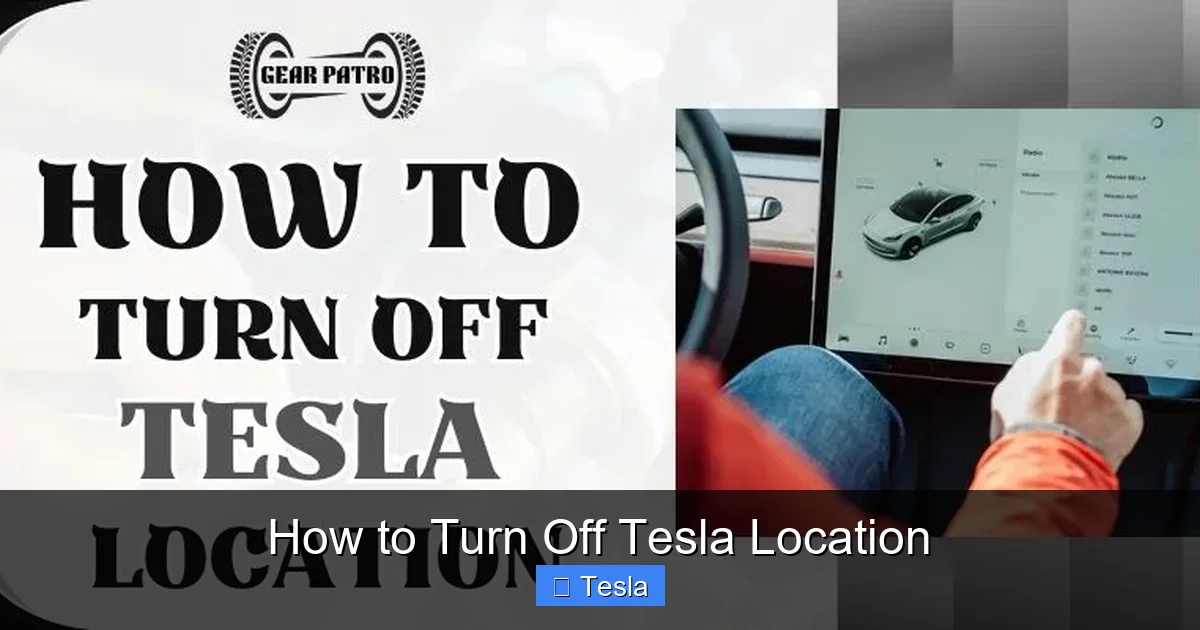
Visual guide about How to Turn Off Tesla Location
Image source: gearpatro.com
Navigation and Real-Time Services Go Dark
The most immediate impact is on the in-car navigation system. While the GPS will still plot your course, features that require a live data connection will fail. You will lose:
- Live Traffic Visualization: No more red and yellow lines on the map showing congestion.
- Satellite Map View:
- Online Search & Points of Interest: You cannot search for “restaurants near me” or “gas stations” through the navigation bar. You must input exact addresses.
- Supercharger Availability & Routing: The car cannot show real-time stall availability, wait times, or optimize routes to include charging stops based on current network status. You’ll see Superchargers on the map, but without live data.
The detailed aerial imagery will be unavailable, reverting to the standard road map.
Essentially, your navigation reverts to a basic, offline GPS unit, similar to what you might have had in a car 15 years ago. It will still get you from Point A to Point B, but without the smart, internet-connected perks.
Sentry Mode Becomes a Local Storage System
Sentry Mode, Tesla’s 360-degree camera surveillance system, relies heavily on a constant cellular connection to alert you instantly of a potential threat. With location sharing turned off:
- No Push Notifications: Your phone will not receive the urgent “Sentry Mode Alert” with a clip of the event. The car will still record the event to its internal USB drive (if one is inserted), but you won’t know about it until you physically check the car.
- Loss of Remote Live View: You cannot use the app’s “Live Camera” feature to see around your car in real-time from anywhere.
- No Automatic Clip Upload: Clips are typically uploaded to Tesla’s servers for storage and easy access in the app. This process will likely fail, making the USB drive the sole repository of footage.
Sentry Mode transforms from a proactive, remote security system into a passive, local DVR. Its deterrent value is greatly reduced because potential thieves are not being recorded and streamed to your phone in real-time.
Automatic Emergency Services and Car Finder Are Disabled
This is the most serious safety-related consequence. Tesla’s automatic crash detection system uses a combination of accelerometers, airbag deployment signals, and location data to determine if a severe collision has occurred. If it triggers:
- No Automatic 911 Call: Tesla’s emergency response center will not be notified, and they will not call local authorities to dispatch help to your vehicle’s last known location.
- No Location for First Responders: Even if a passenger manually calls 911, without the car actively reporting its GPS coordinates, providing an accurate location (especially on a highway or rural road) becomes much more difficult and delays response times.
Additionally, the “Honk” and “Flash” lights feature in the app, which helps you locate your car in a crowded parking lot by making it beep and blink, requires a location handshake to work. This feature will be non-functional.
Privacy Implications: What Data Are You Actually Stopping?
Turning off location sharing is a powerful privacy step, but it’s important to have clear expectations about what it does and does not prevent. Tesla’s data collection is multifaceted.

Visual guide about How to Turn Off Tesla Location
Image source: teslord.com
The Data You Stop Sending
With location reporting disabled via the app, you immediately stop the transmission of:
- Real-Time GPS Coordinates: Your car’s exact latitude and longitude, updated every few seconds while driving or parked.
- Trip History: The detailed log of where you drove, when, and for how long, which normally appears in the “Trips” section of the app.
- Speed and Heading Data: Information about your speed and direction of travel tied to a timestamp and location.
- Charging Session Locations: The specific address of every Supercharger or third-party charger you use, linked to your account.
This data is primarily used for the app’s features, for improving navigation (e.g., learning traffic patterns), and for Tesla’s fleet learning to understand real-world driving scenarios. For users concerned about being tracked or creating a detailed log of their movements, disabling this is highly effective.
The Data That May Still Be Collected
It’s a common misconception that turning off location makes your Tesla a “black box.” Certain data collection continues, as it is often anonymized or required for core vehicle operation and safety:
- Anonymized Fleet Learning Data: Tesla may still receive data from your vehicle’s Autopilot/FSD computer about road conditions, signs, and other vehicles, but this data is typically stripped of any identifying GPS coordinates before upload. It’s used to improve the neural networks.
- Diagnostic Data: The car will continue to send system health reports, error codes, and performance metrics to Tesla for warranty and service purposes. This data usually does not include precise location.
- Service-Related Data: If you schedule a service appointment, your vehicle may transmit its current location to facilitate roadside assistance or mobile service dispatch, but this is a one-time, purpose-specific transmission.
- Crash Data: In the event of a severe airbag deployment, the car will attempt to transmit its location and crash data to Tesla’s emergency response center, regardless of your location sharing setting, as this is considered a critical safety override. However, if the cellular connection is completely severed (which is not the case here), this may fail.
In essence, you are opting out of the “user-facing” location services and trip logging, but not the broader, anonymized data streams that are fundamental to Tesla’s business model of improving its driver-assist systems.
When and Why You Might Want to Turn Off Location
Given the significant feature trade-offs, disabling location sharing is not a “set and forget” setting for most daily drivers. It’s a tactical tool for specific privacy or security scenarios.
Privacy-Conscious Trips and Sensitive Locations
This is the most common reason. If you are visiting a doctor’s office, a place of worship, a private residence, or any location you do not want associated with your Tesla account, turning off location for that specific trip is a simple safeguard. You can toggle it off before you leave, and toggle it back on when you return home to restore full functionality. This prevents that specific journey from ever appearing in your Tesla app’s trip log or being stored on Tesla’s servers.
Corporate or Fleet Vehicle Use
For companies that use Teslas as fleet vehicles, employee privacy can be a concern. Disabling location sharing on company cars can prevent the employer from having a detailed record of an employee’s movements outside of work hours, provided the vehicle is not being used for business tracking via other means. It’s a basic privacy measure within a corporate policy.
Testing in Competitive or Sensitive Areas
Journalists, reviewers, or individuals testing vehicles in areas where they do not wish to disclose their precise path (e.g., proving grounds, private property, or locations with security concerns) may disable location to prevent any data leakage about their presence or route.
General Data Minimization Philosophy
Some users adhere to a strict “data minimization” principle—they only share data they deem absolutely necessary. For them, the convenience of remote features does not outweigh the principle of not having their movements logged by a corporation. They may leave location sharing permanently off, accepting the reduced feature set as the cost of privacy.
How to Re-Enable Location Services and Restore Features
Turning location back on is as simple as reversing the steps you took to disable it. The feature set will be restored almost immediately.
- Via the App: Go back to Safety & Security (or Privacy & Security) in the Tesla app and toggle “Share Location Data” back to ON.
- In the Car: Go to Controls > Safety & Security and toggle the “Location” setting back on.
Once re-enabled, you should see your car’s location reappear on the app map within a minute or two. Navigation will regain live traffic and online search. Sentry Mode alerts will once longer push to your phone. Trip logging will resume. It’s a seamless restoration. If you do not see the location return, try locking and unlocking the car via the app, or power cycling the vehicle (put it in Park, then use the touchscreen to power off, wait 30 seconds, and press the brake pedal to wake it). This forces a re-establishment of the data connection.
Advanced Considerations and Troubleshooting
Even after toggling the setting, some users report persistent location updates or confusion about what is still active. Here are deeper insights and solutions.
“Location Still Shows in the App!”: Understanding Delays and Caching
The app may show a cached location for a short period after you disable sharing. The last known coordinates before the toggle took effect might remain visible for up to 5-10 minutes. This is a display artifact, not an indication that new data is being sent. Force-close the app and reopen it to see the true status. If the map continues to update hours later, double-check that you toggled the correct setting in the app and that the change was successfully sent to the car (you should see a confirmation message). Also, ensure no other user on your Tesla account has location sharing enabled on their device, as any one active account can report the car’s location.
The Relationship Between Location and “Always Allow” Mobile Access
On iOS and Android, the Tesla app requests “Always” location permission to function properly with features like phone-as-key and summon. This is a separate permission from the in-app toggle. Even if you deny the phone’s operating system location permission, the car can still report its location via its own cellular modem if the in-app “Share Location Data” toggle is ON. Conversely, you can grant the app “Always” permission on your phone but have the in-app toggle OFF, which is the correct configuration for disabling Tesla’s telematics while still allowing features like phone-as-key to work (which uses Bluetooth, not GPS). Do not confuse the two.
Guest Mode vs. Location Disabling
Tesla’s Guest Mode is a useful but different privacy tool. When enabled, it creates a restricted driver profile that limits access to certain features (like saved addresses, voice commands, and the rear screen). However, Guest Mode does NOT disable location reporting. The car will still transmit its location and trip data to the owner’s account. To stop that, you must use the location sharing toggle. Use Guest Mode to protect your personal settings and data within the car, and use the location toggle to protect your movement data from being sent to Tesla.
Conclusion: Making an Informed Choice
Knowing how to turn off Tesla location services empowers you as an owner to balance the incredible convenience of a connected car with your personal privacy preferences. The process is simple: use the Tesla mobile app to toggle off “Share Location Data” for a complete stop to telematics transmission. Be prepared for the loss of live navigation features, instant Sentry Mode alerts, and automatic emergency response. This is not a permanent scarlet letter; it’s a switch you can flip as your needs change—on for daily driving with full features, off for a sensitive errand or a privacy-focused weekend.
The modern vehicle is a data-generating machine, and Tesla is at the forefront of leveraging that data. By understanding exactly what data you are sharing and what you are stopping, you move from being a passive subject to an active participant in your own privacy. Take the time to explore your vehicle’s settings, weigh the trade-offs, and configure your Tesla to align with your comfort level. After all, the best feature of any car is that it serves you, not the other way around.
Frequently Asked Questions
Will turning off location services disable my Tesla’s GPS navigation?
No. The GPS chip will still work for basic turn-by-turn directions. What you lose are internet-dependent features like live traffic, satellite map view, and online search for destinations. You can still enter an exact address and be guided there.
Can I still use Summon and Phone-as-Key with location turned off?
Yes. These features rely on Bluetooth and a local connection between your phone and the car, not on the car reporting its GPS location to Tesla’s servers. Disabling location sharing does not affect them.
Does turning off location affect Autopilot and Full Self-Driving?
No. The core functionality of Autopilot/FSD uses the car’s local sensors (cameras, radar) and does not require a live location data feed to Tesla. However, features like navigating on Autopilot (which uses live traffic and map data) will be degraded without an internet connection.
If I turn off location, will my car still be tracked if it’s stolen?
This is a critical consideration. With location sharing disabled, you will not be able to see your car’s real-time location in the Tesla app. The “Track” feature in the app will not work. You would need to rely on local law enforcement and potentially Tesla’s own internal tracking systems, which may still have limited last-known location data, but you cannot actively monitor it. For theft protection, keeping location enabled is strongly advised.
Is there a way to turn off location for just one user profile?
No. The location sharing toggle in the Tesla app is tied to your Tesla account, not to a specific driver profile within the car. If you share your Tesla with other drivers who have app access, they must also disable location sharing on their own devices to prevent the car from reporting its location to any of the linked accounts.
Will turning off location save my battery life?
The impact is negligible. The cellular modem used for telematics consumes a very small, constant amount of power regardless of whether it is actively sending location packets. You will not notice a meaningful increase in range or battery preservation by disabling this feature. Any savings would be fractions of a percent per day.