
How to Reset Jeep Grand Cherokee Oil Life

Resetting the oil life monitor on your Jeep Grand Cherokee is a simple, crucial step after every oil change. This system calculates oil degradation based on engine run time and conditions, not just mileage. Failing to reset it leads to false service warnings and can mask genuine maintenance needs. The process typically involves using your vehicle’s digital menu or a specific button sequence, taking less than 30 seconds. By resetting correctly, you ensure accurate maintenance reminders and help extend your engine’s life.
That little oil can icon glowing on your Jeep Grand Cherokee’s dashboard isn’t just a nuisance—it’s your vehicle’s way of having a serious conversation with you about engine health. But here’s the thing most owners miss: after you’ve diligently changed the oil and filter, that conversation doesn’t end on its own. You have to hit the “reset” button, both literally and figuratively. Welcome to the essential, often overlooked, ritual of how to reset Jeep Grand Cherokee oil life. This isn’t just about silencing a light; it’s about calibrating your car’s brain to start fresh, ensuring your next service reminder is accurate and trustworthy. Let’s dive deep into everything you need to know, from what that percentage actually means to the exact button presses for your specific model year.
Key Takeaways
- Oil Life Monitors track degradation: Your Jeep’s system calculates oil condition using algorithms based on engine cycles, temperature, and driving habits, not just mileage.
- Reset is mandatory after every oil change: Skipping this step causes the system to continue counting down from the old oil’s life, leading to inaccurate alerts.
- Methods vary by model year: Newer Grand Cherokees (2014+) use the Uconnect touchscreen menu, while older models (2013 and prior) require a precise button/ignition sequence.
- No special tools are needed: The entire reset process is performed from the driver’s seat using only the ignition key and vehicle controls.
- Incorrect reset causes confusion: If the light doesn’t go out, you likely missed a step or the system needs a moment to register the command—wait and try again.
- It’s part of proactive maintenance: Resetting the oil life is as important as the oil change itself for maintaining your engine’s health and your vehicle’s diagnostic accuracy.
📑 Table of Contents
- Demystifying the Oil Life Monitor: It’s Not a Guessing Game
- Why Resetting is Non-Negotiable: The Consequences of “Forgotten” Reset
- Preparing for the Reset: A Quick Checklist
- The Step-by-Step Reset Procedures: By Generation
- Troubleshooting: When the Reset Just Won’t Work
- Beyond the Reset: Your Complete Engine Health Protocol
- Conclusion: Your Simple Act of Engine Stewardship
Demystifying the Oil Life Monitor: It’s Not a Guessing Game
Gone are the days of the simple, rigid “change oil every 3,000 miles” rule. Your modern Jeep Grand Cherokee is equipped with a sophisticated Oil Life Monitor (OLM), a software-driven system that thinks about your oil’s health in real-time. Understanding this is the first step to mastering its reset.
How the System Actually Works
The OLM doesn’t dip a sensor in your oil sump to test viscosity. Instead, it’s an algorithm. It tracks key parameters: engine run time (how long the engine has been on since the last reset), engine revolutions (how hard the engine is working), and operating temperature. A week of bumper-to-bumper traffic in freezing weather degrades oil differently than a week of steady highway cruising in warm climates. The system accounts for this. It starts at 100% “new oil” life and counts down, often triggering a service alert around 15-20% remaining. This personalized approach is far more accurate than a generic mileage interval, saving you money on unnecessary changes while protecting against delayed ones.
The “Percentage” Explained
When you see “Oil Life 40%,” it means the system calculates your current oil has 40% of its useful life remaining before it should be considered depleted. It’s a countdown to depletion, not a countdown to a change. The reset tells the computer, “The old oil is gone, new oil is in. Start the countdown over from 100%.” If you don’t reset it, the system thinks the same, degraded oil is still in the engine and will continue counting down from, say, 40%, potentially alerting you far too early or, worse, not alerting you at all if you change the oil but never reset the counter.
Why Resetting is Non-Negotiable: The Consequences of “Forgotten” Reset
You might think, “I’ll just ignore the light until my next change.” This is a critical mistake with real consequences.
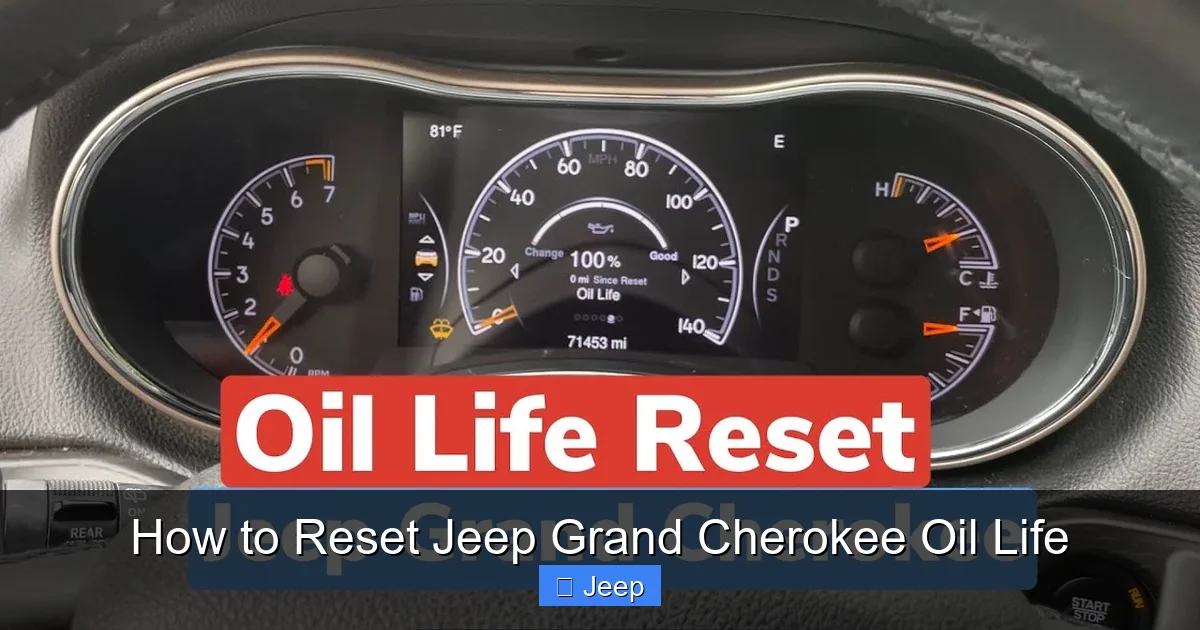
Visual guide about How to Reset Jeep Grand Cherokee Oil Life
Image source: adventurejeep.com
False Alarms and Ignored Warnings
The most immediate effect is a permanently inaccurate service reminder. If you change your oil at 5,000 miles when the light comes on at 15% life, but don’t reset, the system will still show 15% life with fresh oil. This confuses future maintenance planning. More dangerously, if you reset the system but the oil change was poor or you have a leak, the system will accurately count down from 100% on bad oil, giving you a correct warning later. Without the reset, you lose this vital feedback loop.
Impact on Other Systems
On many modern vehicles, the OLM is integrated with the broader Powertrain Control Module (PCM). Some diagnostic routines and emission tests can be influenced by maintenance history stored in the system. While a single missed reset won’t brick your Jeep, maintaining a complete and accurate service record in the vehicle’s computer is part of holistic care. It also ensures that if you ever sell your Grand Cherokee, a clean, logical service history in the digital menu is a positive signal to a savvy buyer.
Preparing for the Reset: A Quick Checklist
Before you touch anything, a two-minute prep ensures a smooth process.
Visual guide about How to Reset Jeep Grand Cherokee Oil Life
Image source: koala.sh
- Complete the Oil Change First: This seems obvious, but never reset the monitor before the new oil and filter are properly installed and the drain plug is tightened. Resetting with old oil or an empty sump is useless.
- Ensure the Ignition is “ON”: You do not need to start the engine, but the ignition must be in the “ON” or “RUN” position (all dash lights on). The engine should be off.
- Know Your Model Year’s Method: This is the most important variable. The procedure changed significantly around the 2014 model year with the introduction of the Uconnect infotainment system. We’ll break it down clearly next.
- Patience is a Virtue: The system may take 5-10 seconds to recognize your reset command after you hold the button. Don’t rush it.
The Step-by-Step Reset Procedures: By Generation
Here is the core of your mission. Identify your Grand Cherokee’s approximate model year and follow the corresponding instructions exactly.

Visual guide about How to Reset Jeep Grand Cherokee Oil Life
Image source: dashboardlightreset.com
For 2014-2021 Models (With Uconnect 4/5/6/7/8.4 Systems)
If your Jeep has a large touchscreen, this is your method. It’s menu-driven and intuitive.
- Start with the ignition in the “OFF” position.
- Press the “START/STOP” button once without touching the brake pedal to put the vehicle in “ON/RUN” mode. All dash lights should illuminate.
- Using the steering wheel controls or the touchscreen, navigate to the Vehicle Info or Settings menu. The exact path can be: “Apps” > “Vehicle Info” or “Settings” > “Vehicle” > “Oil Life.”
- Select Oil Life or Oil Life Remaining. The current percentage will display.
- With the percentage displayed, press and hold the “OK” or “Set/Reset” button on the steering wheel (or the corresponding button on the touchscreen interface) for approximately 5-10 seconds.
- You should see the display change to “Oil Life Reset” or “Oil Life 100%.” The system will confirm the reset.
- Turn the ignition off and then back on to verify the oil life now reads 100%.
Pro Tip: If you have a 2022+ Grand Cherokee (WL platform), the process is similar but may be found under “Settings” > “Vehicle” > “Service” > “Reset Service Indicator.” Always consult your owner’s manual for the definitive path for your specific VIN.
For 2011-2013 and Earlier Models (With Gauge Cluster Buttons)
These models use the “pedal dance” method, interacting directly with the instrument cluster.
- Turn the ignition to the “ON/RUN” position (do not start the engine). The odometer should be displaying on the dash.
- Fully depress the accelerator pedal (gas pedal) three times within 10 seconds. You need to press it all the way to the floor and release it quickly each time. You might hear a chime, and the oil life percentage will begin to blink.
- After the third press, the display should change to show “Oil Life 100%” or a similar confirmation message.
- Turn the ignition off. The reset is complete.
Critical Note: This method must be done with the engine off and the key in the “ON” position. If your odometer is showing trip A or B instead of the main odometer, press the reset button on the dash (near the speedometer) until the main total mileage is displayed before starting the pedal sequence.
Troubleshooting: When the Reset Just Won’t Work
You followed the steps perfectly, but the oil life percentage remains stubbornly unchanged. Don’t panic. Here’s your diagnostic flowchart.
Common Pitfalls and Fixes
- “I pressed the button, but nothing happened.” You likely didn’t hold it long enough. The confirmation usually takes a solid 5-10 second hold. Try again, counting slowly to 10.
- “My 2015 model doesn’t have that menu option.” Uconnect software versions differ. Explore sub-menus under “Vehicle Info,” “Settings,” or even “System Check.” The option is there; it might just be labeled “Service” or “Maintenance.”
- “The pedal dance on my 2012 didn’t trigger a reset.” Ensure the odometer is showing the *total vehicle mileage*, not a trip meter. Use the dash button to cycle displays. Also, make sure the ignition is in “ON” but the engine is *not* running.
- “I have a check engine light on. Will that prevent reset?” Often, yes. An active, stored diagnostic trouble code (DTC) can lock certain service functions. You must address the check engine issue first. For complex electrical issues that might arise after a battery disconnect, you can refer to our comprehensive guide on how to reset Jeep after battery change, as some modules may need reinitialization.
When to Consider a Scan Tool
In rare cases, a faulty Body Control Module (BCM) or a software glitch can prevent the manual reset from being accepted. If you’ve tried the correct procedure multiple times over two separate ignition cycles and it fails, a professional mechanic with a proper OBD2 scan tool (like the Autel, Launch, or professional-grade Mopar WiTECH) can force the reset through the vehicle’s diagnostic port. This is also the method used if you’ve replaced the PCM or BCM.
Beyond the Reset: Your Complete Engine Health Protocol
Resetting the oil life is one piece of a larger puzzle. Doing it right means nothing without the right foundation.
Always Use the Correct Oil and Filter
Your Grand Cherokee’s engine—whether the 3.6L V6, 5.7L V8, or the turbocharged 2.0L—has specific oil requirements. Using the wrong viscosity (e.g., 5W-20 vs. 5W-30) or specification (API SP, Chrysler MS-6395) can trigger premature oil degradation, causing your OLM to count down faster and potentially void your warranty. The reset assumes you used the correct product. The owner’s manual is your bible here.
Reset Immediately After the Change
Make resetting the oil life the absolute last step of your oil change procedure, right after you check for leaks and lower the vehicle. Do it while the fresh oil is still top-of-mind. This prevents the “I’ll do it later” forgetfulness that plagues so many of us.
Understanding the “15% Rule”
Most Jeep models are programmed to illuminate the service wrench or oil can icon when oil life reaches 15%. This is your “soft” warning. The “hard” warning (often a more urgent message or chime) may come at 5%. Plan your oil change appointment as soon as you see the 15% warning. The reset should happen immediately after the new oil is in.
A Note on Other Vehicles
While the Jeep procedure is specific, the concept of an oil life monitor is universal across modern cars. The steps, however, differ wildly. For instance, the process to reset oil life on a Honda Civic involves a different button sequence entirely, and resetting a Dodge Caravan may use a key-cycle method. Always consult the specific guide for your vehicle’s make and model. For a broader look at the process after any oil change, our article on how to reset the car after oil change provides excellent general principles that apply to all vehicles, including your Jeep.
Conclusion: Your Simple Act of Engine Stewardship
Resetting the oil life on your Jeep Grand Cherokee is more than a chore; it’s a fundamental act of communication with your vehicle. You’re telling its computer, “The old oil is gone. Start fresh.” This simple, 30-second task ensures the sophisticated Oil Life Monitor can do its job correctly, providing you with accurate, personalized maintenance reminders that protect your engine and save you money. It bridges the gap between the physical act of changing oil and the digital intelligence of your modern SUV. By mastering the correct sequence for your model year—whether it’s a few taps on a Uconnect screen or the classic three-pedal-press dance—you take full control of your Jeep’s service schedule. Pair this with using the right oil and filter, and you’re following the exact protocol the engineers designed. Now, go enjoy your Grand Cherokee with the confidence that comes from a job well done and a dashboard that’s telling you the truth.
Frequently Asked Questions
How often should I reset my Jeep Grand Cherokee’s oil life?
You should reset the oil life monitor immediately after every single oil change, regardless of mileage. It must be reset to 100% to begin an accurate new countdown cycle for your fresh oil.
Can I reset the oil life without actually changing the oil?
Technically yes, you can perform the reset procedure without changing the oil. However, this is strongly discouraged as it completely defeats the purpose of the system. The oil life percentage will be inaccurate, leading to either premature or delayed service alerts, which can harm your engine.
What does it mean if my oil life is at 15% but the light isn’t on?
Some Jeep models illuminate the service light only at lower thresholds (e.g., 5-10%). The 15% reading on your digital display is an early warning. It’s your signal to start planning an oil change soon. Do not wait for the light to come on if you see a low percentage on the display.
My oil life won’t reset after multiple attempts. What’s wrong?
First, double-check you are using the correct procedure for your exact model year. Second, ensure the ignition is in the “ON” position but the engine is off. Third, an active check engine light or stored diagnostic trouble code can sometimes inhibit the reset. Addressing the underlying issue is required before the system will accept a new oil life value.
Will disconnecting the battery reset the oil life automatically?
No. Disconnecting the battery may clear some electronic memory, but it will not reset the oil life monitor. The OLM is stored in non-volatile memory within the Body Control Module (BCM) or Powertrain Control Module (PCM) and retains its value even when power is removed. You must perform the specific reset procedure.
Is there a difference between resetting “Oil Life” and resetting the “Oil Change” light?
On most Jeep Grand Cherokees, these terms refer to the same system and the same reset procedure. The “Oil Change” light is the physical indicator (a wrench or oil can icon), while “Oil Life” is the digital percentage value in the menu. Resetting one resets the other. For other brands like certain Dodges, the terminology can differ slightly, but the principle is identical.
