
How to Reset Check Engine Light Without Disconnecting Battery on Toyota Corolla

You can safely reset your Toyota Corolla’s check engine light without disconnecting the battery by using an OBD2 scanner or performing a specific ignition key cycle. These methods preserve your vehicle’s radio presets and ECU settings, unlike a battery disconnect. However, resetting the light is only a temporary fix—you must diagnose and repair the underlying problem to prevent the light from returning.
Hey there, fellow Toyota Corolla owner! That little yellow engine-shaped icon on your dashboard glowing steadily or, worse, blinking is enough to make anyone’s stomach drop. Your first instinct might be to pop the hood, find the battery, and yank the negative cable to make the annoying light go away. But hold on! That old-school battery disconnect trick is a sledgehammer approach that can cause more headaches than it solves, erasing precious learned data from your car’s computer. The great news is, you have several clean, effective, and battery-friendly ways to reset check engine light without disconnecting battery on Toyota Corolla. Let’s dive into the why, the how, and what to do after the light goes out.
Key Takeaways
- Safety First: Only reset the light after diagnosing and fixing the problem. Ignoring the root cause can lead to serious engine damage.
- OBD2 Scanner is King: This is the most reliable, manufacturer-approved method to clear trouble codes and reset the light on your Corolla.
- Key Cycle is a Trick, Not a Cure: The ignition trick works for minor, intermittent issues but often fails for stored or hard codes.
- Drive Cycles Reset Monitors: After clearing codes, the car must complete a specific drive cycle for all emissions monitors to set and keep the light off.
- Battery Disconnect is Outdated: This old method erases all adaptive learning data and can cause multiple new lights (radio, clock, etc.).
- Know Your Model Year: Procedures can vary slightly between Corolla generations. Always consult your owner’s manual for specifics.
- Professional Help is Smart: If the light returns immediately or you can’t diagnose the code, a mechanic is essential for proper repair.
📑 Table of Contents
- Understanding Your Check Engine Light: It’s Not Just a “Check”
- Why You Should Never Disconnect the Battery (The “Nuclear Option”)
- Method 1: The Professional Way – Using an OBD2 Scanner
- Method 2: The Ignition Key Cycle Trick (The “No-Tool” Method)
- Method 3: The Natural Reset – Completing a Drive Cycle
- When Resetting Isn’t Enough: Diagnosis is Non-Negotiable
- Conclusion: A Reset is a Tool, Not a Solution
Understanding Your Check Engine Light: It’s Not Just a “Check”
Before we talk reset, we need to talk reason. The check engine light (CEL), or malfunction indicator lamp (MIL), is your Corolla’s way of saying, “Hey, something in the engine or emissions system isn’t performing as the computer expects.” It’s not a direct warning of imminent doom, but it is a serious message you should never ignore. The light illuminates when the Engine Control Module (ECM) detects a problem it can’t correct automatically and stores a corresponding Diagnostic Trouble Code (DTC).
Common Triggers for the Check Engine Light
These codes can range from minor to major. Some of the most frequent culprits on Corollas include:
- A loose or faulty gas cap: Seriously! A cap that doesn’t seal properly can trigger an evap system code. This is the easiest fix.
- Oxygen sensor (O2 sensor) failure: These sensors monitor exhaust gases. A bad one hurts fuel economy and emissions.
- Catalytic converter issues: A failing cat can reduce performance and cause the light to blink (which means stop driving!).
- Mass Airflow Sensor (MAF) problems: This sensor measures incoming air. Contamination or failure throws off the fuel mix.
- Spark plug or ignition coil issues: Worn plugs or bad coils cause misfires, which can trigger a blinking CEL.
- Faulty wiring or connectors: Corrosion or damage to sensor harnesses is a common source of false codes.
The key takeaway: the light is a symptom, not the disease. Resetting it without addressing the cause is like turning off a smoke alarm without checking for fire. The problem will return, often quickly. Always, always read the codes first. You can get a free code read at many auto parts stores like AutoZone or Advance Auto Parts. For a deeper understanding of common Toyota issues, resources on resetting other lights, like the battery light on a Toyota Corolla, can provide context on your vehicle’s warning systems.
Why You Should Never Disconnect the Battery (The “Nuclear Option”)
Let’s address the elephant in the garage: the battery disconnect. While it technically clears the check engine light by resetting the ECM, it’s a terrible idea for modern vehicles like your Corolla. Here’s why:
Visual guide about How to Reset Check Engine Light Without Disconnecting Battery on Toyota Corolla
Image source: lightcheckup.com
It Erases Vital “Learned” Data
Your car’s computer isn’t just a dumb box; it’s a smart system that learns and adapts over time. It stores data in what’s called “keep-alive memory” (KAM). This includes fuel trim adjustments, idle speed calibrations, transmission shift points, and even the status of various emissions monitors. Pulling the battery wipes this slate clean.
The Consequences of a Full Reset
After a battery disconnect, your Corolla will go through a painful “re-learning” process. You’ll notice:
- Rough idle and poor driveability: The engine doesn’t know how to idle properly anymore. It may stall or shake for the first 20-50 miles of driving.
- Harsh transmission shifts: The transmission control module (TCM) also loses its memory, leading to jerky, uncomfortable shifts until it re-learns your driving style.
- Multiple new warning lights: Besides the CEL going out, you’ll likely have to manually reset the clock, radio presets, and power window/mirror settings. Some models might even see the tire pressure monitoring system (TPMS) light activate, requiring a specific reset procedure.
- Failed emissions test: The car must complete a full “drive cycle” to set all its emissions monitors again. This can take several days of varied driving. You cannot pass an emissions test with incomplete monitors.
In short, you trade one problem (the check engine light) for a whole week of annoying quirks and potential test failures. The methods we discuss next are surgical, not destructive.
Method 1: The Professional Way – Using an OBD2 Scanner
This is the gold standard. Every car sold in the US since 1996, including your Corolla, has an OBD2 (On-Board Diagnostics, Second Generation) port. This port allows external tools to communicate with the car’s computers. Using a scan tool is the only way to truly and reliably clear the codes and reset the light while preserving other systems’ data.
Visual guide about How to Reset Check Engine Light Without Disconnecting Battery on Toyota Corolla
Image source: lightcheckup.com
What You’ll Need
- An OBD2 scanner/code reader that can clear codes (not all cheap readers can do this).
- Your Corolla’s owner’s manual (to find the port location).
Note: For a comprehensive, model-specific guide on using these tools on your Corolla, be sure to check out our dedicated article on how to reset the check engine light on a Toyota Corolla.
Step-by-Step Guide
- Locate the OBD2 Port: It’s almost always under the dashboard, to the left of the steering column, near the driver’s knees. It’s a trapezoidal 16-pin connector. Your owner’s manual will confirm.
- Connect the Scanner: Turn the ignition to the “ON” position (do not start the engine). Plug the scanner’s cable firmly into the OBD2 port.
- Power Up the Scanner: Turn the scanner on. It will communicate with the car and may ask for vehicle info (year, make, model, engine size). Enter it.
- Read the Codes FIRST: THIS IS THE MOST IMPORTANT STEP. Navigate the menu to “Read Codes” or “Trouble Codes.” Write down all the codes (e.g., P0171, P0420) and their descriptions. This tells you what’s wrong. If the code is “pending” or “incomplete,” it may not set the light yet.
- Clear the Codes: Navigate to “Clear Codes,” “Erase Codes,” or “MIL Off.” Confirm the action. The scanner will communicate with the ECM to wipe the stored faults.
- Verify: The check engine light should go out immediately. You can often re-read codes to confirm the memory is clear.
- Disconnect and Go: Turn off the scanner, unplug it, and turn off the ignition.
Pro Tips for Scanner Use
- Invest in a Good Scanner: Basic code readers ($20-$50) can read and clear generic codes. For more advanced Toyota-specific codes and system tests (like testing oxygen sensors), consider a mid-range scanner like an Autel, Launch, or a professional-grade tool. Some even have “One-Click” fixes for common maintenance lights, similar to resetting the maintenance required light on a Toyota.
- Check for Freeze Frame Data: Advanced scanners show “freeze frame” data—a snapshot of engine conditions when the code set. This is invaluable for diagnosis.
- It May Not Work: If the problem is severe and active (e.g., a misfiring cylinder), the ECM may detect it immediately and turn the light back on seconds after you clear it. This is a clear sign the issue needs repair.
Method 2: The Ignition Key Cycle Trick (The “No-Tool” Method)
If you don’t have a scanner, your Corolla’s ignition system has a built-in, limited capability to clear some codes. This method works best for minor, intermittent issues like a loose gas cap that has since been tightened. It’s not guaranteed for all codes, especially hard faults.
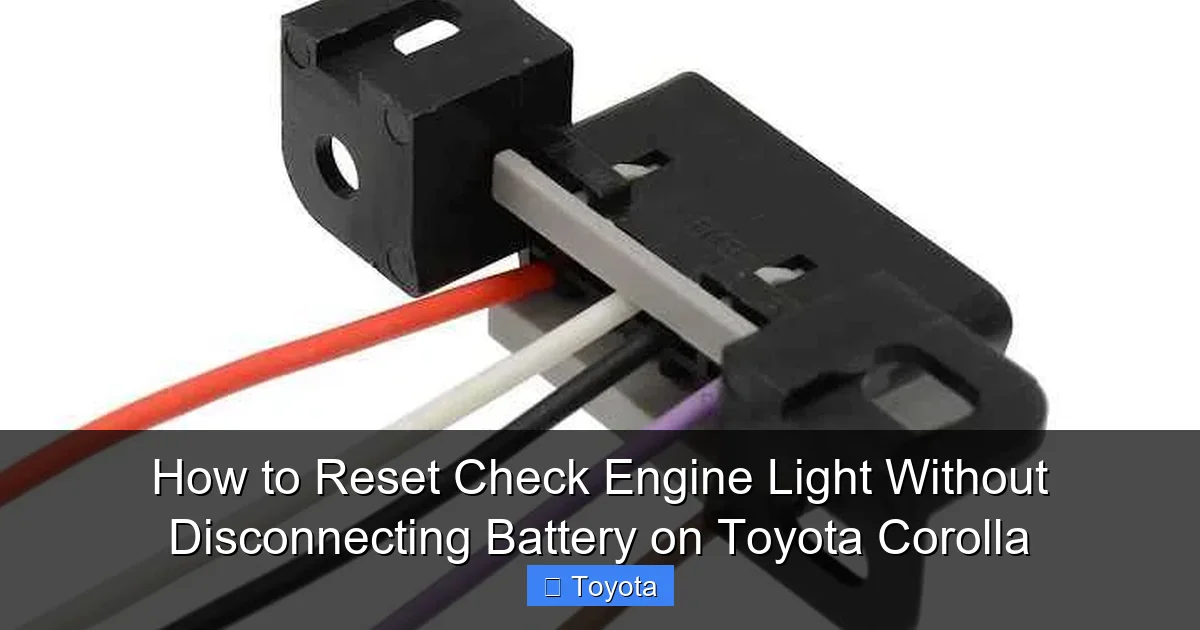
Visual guide about How to Reset Check Engine Light Without Disconnecting Battery on Toyota Corolla
Image source: lightcheckup.com
The Toyota Key Cycle Procedure
This sequence simulates a “soft reset” of the ECM without losing all memory. The steps are precise:
- Ensure the Problem is Fixed: Tighten the gas cap, ensure the oil level is correct, etc.
- Insert the Key: Place your key in the ignition.
- Cycle to “ON”: Turn the key to the “ON” position (where the dashboard lights come on, but do not start the engine).
- Cycle to “OFF”: Turn the key back to the “OFF” position.
- Repeat: Perform this ON-OFF cycle three to five times in quick succession (about 1 second per position). The final position should be “ON.”
- Start the Engine: Turn the key to “START” and run the engine for a minute.
- Check the Light: Turn the engine off and then back on. The check engine light should be off if the ECM re-checked the system and found no faults.
Why This Sometimes Works (And Often Doesn’t)
The ECM runs a series of self-tests every time you cycle the ignition. If a sensor reading is back within normal range during these tests, the ECM may clear a “pending” code before it becomes active. However, for a stored “hard” code (one that has already turned the light on), this method usually fails. The ECM requires a more definitive “clear” command, which only a scanner can provide. Think of this as a gentle nudge, not a reset button. For a quick-reference guide to similar steps for your specific Corolla model year, a resource on quick and easy steps for the Corolla might be helpful.
Method 3: The Natural Reset – Completing a Drive Cycle
Here’s a crucial concept: clearing the codes does not always mean the light will stay off. Modern cars have stringent emissions systems. The ECM has multiple “monitors” (like for the oxygen sensor, catalytic converter, and evap system) that must complete a successful self-test. If a monitor is “incomplete,” the ECM may still allow the light to stay off, but you will fail an emissions test. More importantly, if the underlying problem was fixed but the monitor hasn’t re-run yet, the light might stay off. But if the problem returns during the re-test, the light will come back on.
What is a Drive Cycle?
A drive cycle is a specific sequence of driving conditions (speed, acceleration, engine temperature, etc.) that forces all the onboard monitors to run and set. It’s the car’s way of proving it’s clean. Toyota’s exact drive cycle varies by model and year, but a general pattern for a Corolla includes:
General Toyota Corolla Drive Cycle Steps
- Cold Start: Start with a cold engine (soaked for at least 4 hours). Idle for 2-3 minutes.
- Low-Speed Cruise: Drive at a steady 30-40 mph for 5-10 minutes on level ground.
- Medium-Speed Cruise: Accelerate to and maintain 50-60 mph for 5-10 minutes.
- Deceleration: Slow down smoothly without braking (if safe) to about 20 mph, then idle for 1-2 minutes.
- Accelerate: Gently accelerate to 50-60 mph, then cruise for a few minutes.
- Final Step: Let the engine idle for 5-10 minutes with all accessories (A/C, lights) OFF. Then turn the engine off.
After this cycle, all monitors should be “complete” or “ready.” You can check this status with an OBD2 scanner under a menu like “I/M Readiness” or “Monitor Status.” The light should remain off if no faults are detected during the cycle.
When Resetting Isn’t Enough: Diagnosis is Non-Negotiable
Let’s be brutally clear: if the check engine light comes back on immediately or within a few drive cycles after you reset it, you have an active, unresolved problem. Resetting is not a fix; it’s just clearing the error message. You must diagnose the actual fault.
How to Properly Diagnose
- Read the Code: This is step zero. A code like P0301 tells you it’s a misfire on cylinder 1. P0171 is a lean fuel mixture. The code is your starting point, not your conclusion. A code points to a system, not always a specific part.
- Research the Code: Look up the specific code for your Corolla’s model year and engine (e.g., 2.0L, 1.8L). Forums like Toyota Nation or Corolla-specific groups are goldmines of real-world experience.
- Perform Basic Checks: For an evap code (P0440 series), check the gas cap and its seal. For a lean code (P0171), inspect for vacuum leaks (cracked hoses, intake manifold gasket). For misfire codes (P030X), check spark plugs, coils, and wires.
- Use Live Data: A good scanner can show “live” sensor data (oxygen sensor voltages, fuel trim numbers, coolant temp). Abnormal readings here confirm the diagnosis.
- Know When to Call a Pro: If the diagnosis points to complex components like the catalytic converter, internal engine issues, or intricate electrical gremlins, it’s time for a certified mechanic. They have advanced scan tools and expertise.
The Blinking Light Emergency
If your check engine light is blinking (not solid), STOP DRIVING. A blinking CEL indicates a severe misfire that is dumping raw fuel into the exhaust, which can overheat and destroy the catalytic converter in minutes. This is an urgent repair. Tow the car to a shop.
Conclusion: A Reset is a Tool, Not a Solution
So, there you have it. You now know how to reset check engine light without disconnecting battery on Toyota Corolla using the proper OBD2 scanner method, the ignition key cycle trick, or by completing a drive cycle after a repair. The scanner is your best friend for a clean, permanent reset that preserves your car’s learned intelligence. The key cycle is a handy trick for very minor, self-resolving issues. And understanding drive cycles is key to ensuring your car stays compliant and the light stays off for good.
Remember, the ultimate goal is not just a dark dashboard. The goal is a healthy, reliable, and efficient Corolla. Never use a reset to mask a problem. Read the codes, diagnose the cause, make the repair, and then use these methods to clear the light and let your car’s computer re-verify that all is well. Your faithful Corolla will thank you with thousands more miles of smooth, worry-free driving. For more model-specific guides, including how to handle other Toyota warning lights, explore our library of automotive resources.
Frequently Asked Questions
Is it safe to reset the check engine light without fixing the problem?
No, it’s not safe. Resetting only turns off the warning light; it does not fix the underlying mechanical or emissions issue. The problem will persist, potentially causing more damage, poor fuel economy, or catastrophic failure (like a ruined catalytic converter from an untreated misfire). Always diagnose and repair first.
Will the check engine light come back after I reset it?
It absolutely will if the original problem hasn’t been repaired. The ECM constantly monitors all sensors. If a fault reappears during a drive cycle, it will store a new code and illuminate the light again, often within a few miles or days. A permanent off state only occurs after a successful repair and completion of all monitors.
Do I absolutely need an OBD2 scanner to reset the light?
For a guaranteed, complete reset that preserves other system data, yes, a scanner that can clear codes is the only reliable method. The ignition key cycle trick may work for very minor, transient issues but frequently fails for stored codes. Without a scanner, you’re guessing and likely won’t succeed.
What is a drive cycle and why do I need to do one?
A drive cycle is a specific pattern of driving (speeds, temperatures, accelerations) that forces all the car’s emissions system monitors to run and set their “ready” status. After clearing codes, you must complete a drive cycle for the ECM to fully validate that all systems are functioning correctly. Without it, you may fail an emissions test even if the light is off.
My check engine light came on after I filled my gas tank. What do I do?
This is a classic evap system code, often caused by a loose or faulty gas cap. First, tighten the cap firmly until it clicks. Then, drive the car for a few days (completing a basic drive cycle). The light may go out on its own if the cap was the only issue. If it doesn’t, you’ll need to read the code to confirm and potentially replace the cap or check for other evap leaks.
How much does it cost to have a professional reset the check engine light?
If you just want the light reset with no diagnosis, many shops may charge a small fee ($50-$100) or do it for free if you buy parts from them. However, this is pointless without a diagnosis. A proper diagnostic scan to read and interpret codes typically costs $80-$150 at a repair shop. This fee is usually waived if you proceed with the recommended repair at that shop. The real cost is in the repair, which can range from $50 for a gas cap to over $1000 for a catalytic converter.
