
How Many Miles Can You Drive When the Gas Light Comes on in a 2009 Toyota Camry?

When the gas light illuminates in a 2009 Toyota Camry, you typically have between 30 to 50 miles of driving range remaining. This “reserve” is not a precise figure and is heavily influenced by your driving style, terrain, and traffic conditions. Pushing this limit risks damaging your fuel pump and leaving you stranded. Always treat the warning light as a critical alert to find a gas station immediately, not as a suggestion to keep driving.
Key Takeaways
- Reserve Fuel Exists: Your Camry’s gas light comes on when there are roughly 2-3 gallons of fuel left, providing a safety buffer you should not rely on regularly.
- Mileage is a Variable Estimate: The 30-50 mile range is an average. Aggressive driving, city traffic, and hills can drastically reduce it, while gentle highway cruising may extend it slightly.
- Significant Risks of Ignoring It: Running the tank completely dry can overheat and destroy the in-tank fuel pump, introduce sediment into the system, and cause dangerous, sudden stalls.
- Your Specific Range May Differ: Factors like tire pressure, vehicle load, and fuel quality can add or subtract several miles from your personal “miles to empty” estimate.
- Immediate Action is Required: The correct response to the gas light is to plan your route to the nearest fuel station calmly and efficiently, without panic or speeding.
- Know Your Tank’s True Capacity: Understanding your Camry’s total fuel tank size (approximately 15.9 gallons for the base model) helps contextualize the warning light’s trigger point.
- It’s a Warning System, Not a Gauge: The low fuel light is a simple switch-based warning, not a precise measurement tool. Consulting your owner’s manual provides the manufacturer’s official reserve estimate.
📑 Table of Contents
- That Dreaded Glow: Understanding Your 2009 Toyota Camry’s Gas Light
- How the Low Fuel Light Actually Works: It’s Not Magic
- The 2009 Toyota Camry Specifics: What’s in the Tank?
- Real-World Variables: Why Your Mileage Will Fluctuate
- The Very Real Risks of “Running on Empty”
- Smart Strategies: What to Do When the Light Comes On
- Frequently Asked Questions (FAQs)
That Dreaded Glow: Understanding Your 2009 Toyota Camry’s Gas Light
It happens to the best of us. You’re cruising along, maybe lost in thought or enjoying the drive in your reliable 2009 Toyota Camry, when a small, amber icon suddenly lights up on your dashboard. It’s the gas pump symbol, often accompanied by the words “Low Fuel” or simply a glowing orange light. A wave of mild panic or annoyance might wash over you. The immediate thought is usually, “How far can I actually go?” It’s a critical question, and the answer isn’t as simple as a single number. For your specific 2009 Camry, understanding this system is key to avoiding costly repairs and the immense inconvenience of running out of gas.
The gas light is your car’s most direct form of communication about fuel status. It’s not a polite suggestion; it’s a firm, last-chance warning. Unlike a digital “miles to empty” readout (which some modern cars have), the 2009 Camry uses a simpler, more robust system. This system is designed with a specific purpose: to get your attention before you’re stranded. But how much buffer does it actually give you? We’re going to dive deep into the mechanics, the math, the real-world variables, and the absolute best practices for dealing with this situation in your trustworthy sedan.
How the Low Fuel Light Actually Works: It’s Not Magic
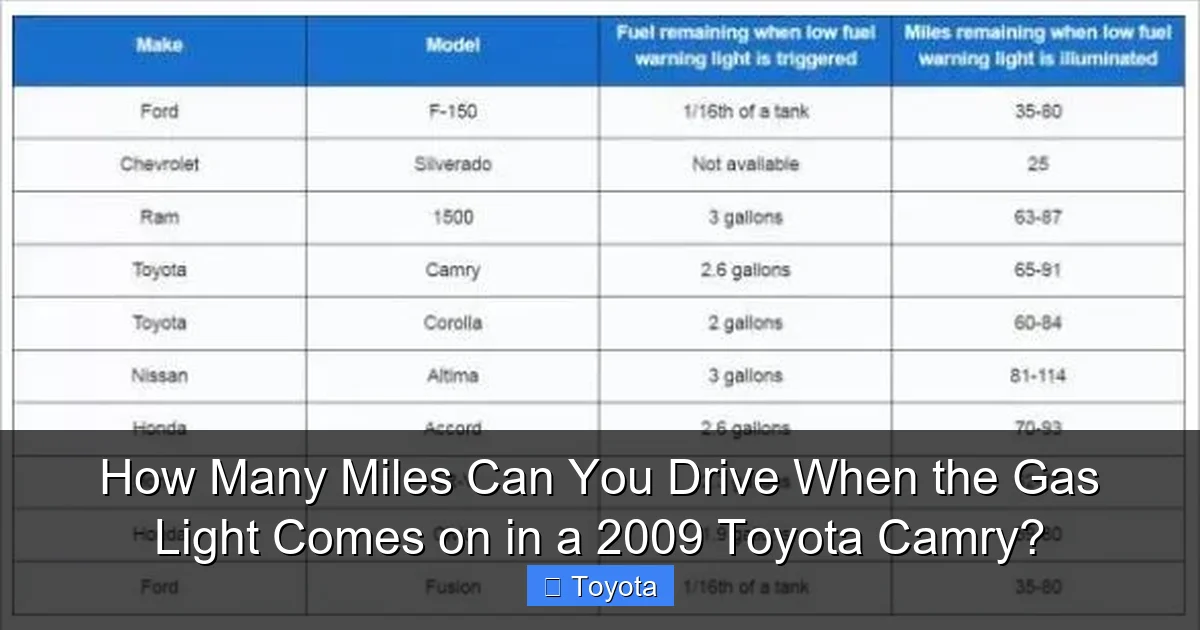
To understand the range, you first need to understand the trigger. The system in your 2009 Camry is elegantly simple. Inside the fuel tank, there is a fuel level sender unit. This unit has a float that rises and falls with the fuel level, connected to a variable resistor. As the fuel drops, the float sinks, changing the resistance in the circuit. This signal is sent to the instrument cluster. The gas light is programmed to illuminate when the sender reaches a specific, pre-set resistance value—corresponding to a critically low fuel level.
Visual guide about How Many Miles Can You Drive When the Gas Light Comes on in a 2009 Toyota Camry?
Image source: automotivian.com
The “Reserve” is Intentional
Automakers, Toyota included, deliberately set this trigger point to leave a reserve. This isn’t an accident or a design flaw. It’s a crucial safety and convenience feature. The reserve accounts for several things: fuel slosh (which can make the float jump erratically on corners), the fact that you might not drive perfectly straight to a station, and the simple reality that gas stations aren’t always exactly where you want them. This reserve is your car’s way of saying, “You need to refuel very soon,” not, “You have plenty of time.”
It’s a Switch, Not a Calculator
It’s vital to remember that this light is a switch-based warning. It turns ON at one specific fuel level and turns OFF when you add enough fuel to raise the level past a different, higher threshold. It does not continuously calculate your distance to empty based on your recent mileage. That’s why the “miles remaining” can be such a moving target. Your driving habits right after the light comes on will be the primary determinant of how far you actually go. For a precise understanding of your tank’s capacity, you can consult resources that detail how many gallons a Toyota Camry gas tank holds, which provides the total volume you’re working with.
The 2009 Toyota Camry Specifics: What’s in the Tank?
Now, let’s talk numbers specific to your model year. The 2009 Toyota Camry came with different engine options, but the fuel tank capacity was generally consistent across most trims.
Visual guide about How Many Miles Can You Drive When the Gas Light Comes on in a 2009 Toyota Camry?
Image source: thecarhow.com
Tank Size and The Light’s Trigger Point
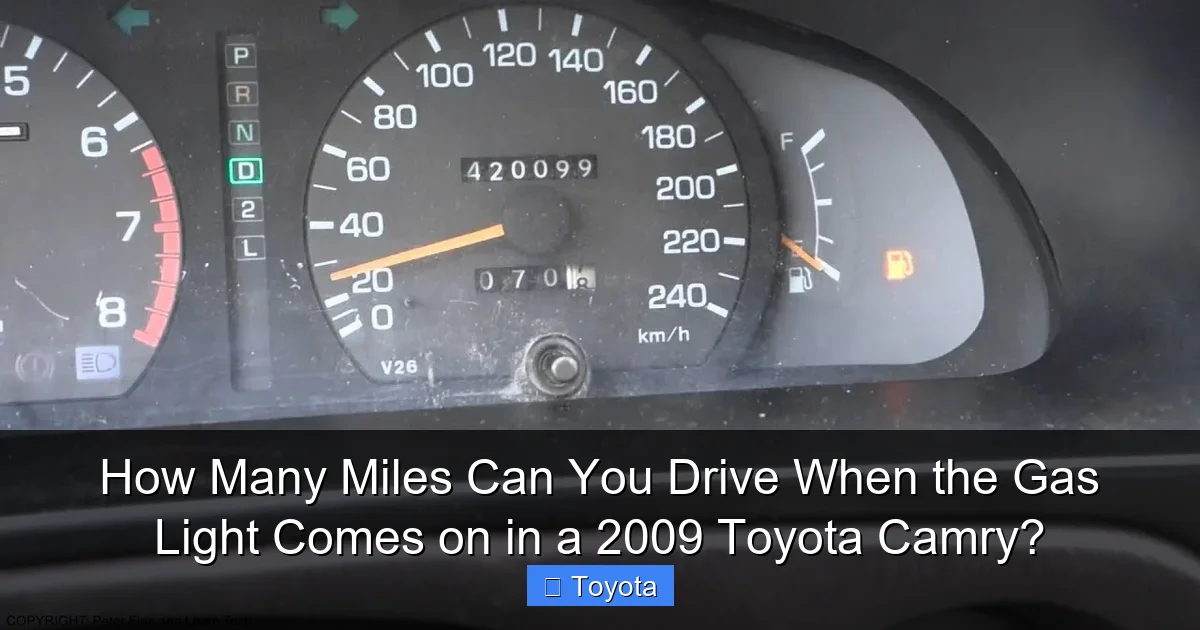
The standard fuel tank capacity for the 2009 Camry (with the 2.4L 4-cylinder or 3.5L V6) is 15.9 gallons. This is a figure you can verify through your owner’s manual or a reputable automotive database. The low fuel light is designed to come on when approximately 2.0 to 2.5 gallons of fuel remain in the tank. This means your “usable” fuel after the light illuminates is in that 2-2.5 gallon range.
Crunching the Theoretical Numbers
To get a theoretical maximum distance, we use the EPA fuel economy estimates for the 2009 Camry. The 4-cylinder model was rated at 21 mpg city / 31 mpg highway. The V6 was rated at 19 mpg city / 28 mpg highway. Let’s do some math for a conservative, real-world scenario:
- For a 4-cylinder Camry: Using a blended, real-world average of 26 mpg (between city and highway), 2.25 gallons (mid-point of reserve) x 26 mpg = approximately 58.5 miles.
- For a V6 Camry: Using a blended average of 23 mpg, 2.25 gallons x 23 mpg = approximately 51.75 miles.
Important: These are best-case, theoretical calculations under ideal conditions. They assume perfect, steady-state highway driving with no traffic, a perfectly maintained vehicle, and level ground. In the real world, you should never count on achieving these numbers. The widely accepted, safe rule of thumb for a 2009 Camry is 30 to 50 miles after the light comes on. The lower end of that range is far more common in daily driving.
Real-World Variables: Why Your Mileage Will Fluctuate
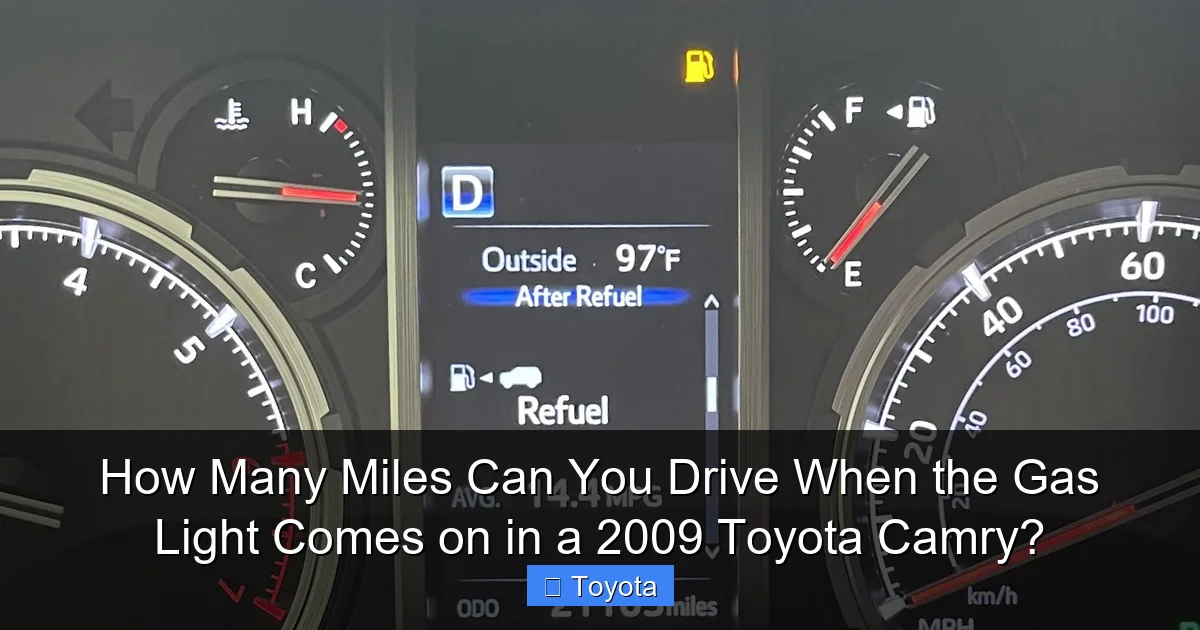
Why is there such a gap between the theoretical 58 miles and the practical 30-mile warning? Because your driving is not a lab test. Every factor below will eat into your precious reserve fuel.
Visual guide about How Many Miles Can You Drive When the Gas Light Comes on in a 2009 Toyota Camry?
Image source: i.redd.it
Driving Style: The Biggest Factor
This is the number one variable. If you’re driving on the highway with a light foot, maintaining a steady 65-70 mph, you might squeeze every last drop and get closer to 50 miles. However, if you’re in stop-and-go city traffic, constantly accelerating from red lights, your fuel economy can plummet to 15-18 mpg or worse. That same 2.25 gallons might only get you 35 miles or less. Aggressive acceleration and heavy braking are the enemies of fuel efficiency.
Terrain and Traffic
Driving in hilly or mountainous areas forces your engine to work harder on inclines and provides less regenerative braking on declines. This significantly increases fuel consumption. Similarly, being stuck in bumper-to-bumper traffic with the engine idling and constantly moving a few feet burns fuel without covering distance, drastically reducing your miles-per-gallon.
Vehicle Condition and Load
Is your Camry fully loaded with passengers and cargo? Extra weight means more work for the engine. Are your tires properly inflated? Under-inflated tires increase rolling resistance, lowering fuel economy by several percent. A dirty air filter or overdue oil change also makes the engine less efficient. A well-maintained Camry will always go farther on its last drops than a neglected one.
Fuel Quality and Climate
Lower-quality gasoline can sometimes have less energy content, providing slightly fewer miles per gallon. Using the correct fuel octane for your engine (regular unleaded for most 2009 Camrys) is optimal. Extreme temperatures also play a role. In very cold weather, the engine takes longer to reach optimal operating temperature, and you might use the heater and defroster more, putting a slight extra load on the engine.
The Very Real Risks of “Running on Empty”
You might be tempted to think, “My Camry is a tank, it can handle it.” This is a dangerous and costly misconception. Making a habit of driving long distances with the gas light on, or worse, until the engine sputters, causes serious damage.
Damage to the Fuel Pump
This is the most significant and expensive risk. Your Camry’s electric fuel pump is located inside the fuel tank. The fuel itself acts as a coolant and lubricant for the pump. When fuel levels get very low, the pump can start to suck in air and run partially dry. This causes it to overheat prematurely. An overheating fuel pump will eventually fail, and replacing it requires dropping the fuel tank—a labor-intensive and expensive repair (often $800-$1200). The reserve fuel is there, in part, to keep the pump submerged and cool.
Sediment and Debris
Over time, tiny particles of rust, dirt, and sediment can accumulate at the bottom of your fuel tank. When you run the tank extremely low, the fuel pickup tube starts sucking this debris from the bottom. This grit can clog your fuel filter, foul your fuel injectors, and potentially damage the fuel pump itself. Regularly driving on very low fuel guarantees you’ll circulate more contaminants through your engine’s fuel system.
Safety and Convenience Hazards
The most obvious risk is stranding yourself. Running out of gas on a busy highway, a deserted road, or in a dangerous neighborhood is a major safety hazard. It also puts you at risk of being hit by other vehicles if you’re forced to stop in an ill-advised location. Furthermore, it causes immense inconvenience, potential towing fees, and the stress of being late or missing appointments.
Smart Strategies: What to Do When the Light Comes On
So, the amber icon is glowing. Don’t panic. Here is your step-by-step action plan for handling this situation intelligently and safely.
Step 1: Assess Calmly and Immediately
Take a quick, calm look at your surroundings. Do not speed up frantically. Note your current location and use your GPS or smartphone to find the nearest gas station. Most navigation apps will show you stations within a 5, 10, or 15-mile radius. Your goal is to identify the closest, most accessible one. If you’re on a highway, note the next exit.
Step 2: Adjust Your Driving for Efficiency
Once you know where you’re going, drive to get there using the least fuel possible. This means:
- Maintain a steady, moderate speed. Use cruise control on the highway if traffic allows. Avoid speeding, as aerodynamic drag increases exponentially with speed.
- Drive gently. Anticipate traffic lights and stop signs to coast and brake smoothly. Avoid jackrabbit starts.
- Turn off unnecessary accessories. The air conditioner puts the biggest load on the engine. If weather permits, turn it off. Roll down windows at lower speeds, but at highway speeds, the drag from open windows might be worse than a lightly used AC.
- Avoid idling. If you’re stuck in a long traffic jam and not moving, consider turning off the engine if it’s safe to do so.
Step 3: Plan Your Route, Don’t Guess
Do not drive around aimlessly hoping to “find” a station. Use your navigation tool to plot a direct course. If the closest station is 8 miles away, you have a reasonable chance of making it in a Camry with a light foot. If it’s 25 miles away, you are almost certainly pushing your luck. In that case, look for the next closest option, even if it means a slight detour. It’s better to drive an extra 2 miles efficiently than to risk a breakdown 20 miles from help.
Step 4: Refuel and Reset Your Mind
When you pull into the station, fill the tank fully. This not only gets you back on the road but also helps settle any sediment that may have been stirred up. Once you’ve refueled, the gas light will turn off automatically as the fuel level rises past the sensor’s “off” point. Take a moment to mentally reset. Try to make a habit of refueling when your tank reaches the 1/4 mark, not when the light comes on. This simple habit extends the life of your fuel pump and gives you peace of mind.
Frequently Asked Questions (FAQs)
Is the 30-50 mile estimate the same for all 2009 Camry models?
While the reserve fuel volume (2-2.5 gallons) is generally the same, the V6 engine will have a slightly shorter range than the 4-cylinder because it consumes fuel at a higher rate. Your personal driving habits will have a larger impact than the engine choice itself.
Can I reset or disable the low fuel light?
No. The low fuel light is an automatic, hard-wired warning system controlled by the fuel level sensor and the vehicle’s computer. It cannot be “reset” like a maintenance light. It will illuminate when the fuel level drops and turn off only after you add sufficient fuel. Attempting to disable it is dangerous and requires modifying the vehicle’s wiring, which is not advisable.
Does the gas light behave differently in extreme temperatures?
Extreme cold can cause fuel to contract slightly and may affect the fuel sender’s readings, potentially causing the light to come on a tiny bit earlier or later. Extreme heat can cause fuel to expand. However, these effects are minimal. The primary impact of temperature is on your fuel economy, not the light’s trigger point. You’ll get fewer miles from your reserve in extreme cold due to poorer efficiency.
What if the gas light starts flashing?
A steadily illuminated gas light is the standard warning. If your gas light is flashing, it indicates a different, more urgent problem—typically a fault in the fuel level sensor circuit itself. This is a diagnostic trouble code (often P0461 or similar) and means the car cannot accurately read fuel level. You should have this checked by a mechanic soon, as you are now relying on your own trip meter and judgment, not a dashboard warning.
How does the Camry’s range compare to other Toyotas like the Corolla or Sienna?
Is it ever okay to drive with the gas light on regularly?
No. Making a habit of this is a direct path to premature fuel pump failure. While occasionally driving 10-15 miles on reserve won’t immediately destroy the pump, consistently doing so will shorten its lifespan. The best practice is to refuel when your gauge shows about 1/4 tank remaining, giving you a comfortable buffer and protecting your fuel system.
Frequently Asked Questions
Is the 30-50 mile estimate the same for all 2009 Camry models?
While the reserve fuel volume (2-2.5 gallons) is generally the same, the V6 engine will have a slightly shorter range than the 4-cylinder because it consumes fuel at a higher rate. Your personal driving habits will have a larger impact than the engine choice itself.
Can I reset or disable the low fuel light?
No. The low fuel light is an automatic, hard-wired warning system controlled by the fuel level sensor and the vehicle’s computer. It cannot be “reset” like a maintenance light. It will illuminate when the fuel level drops and turn off only after you add sufficient fuel.
Does the gas light behave differently in extreme temperatures?
Extreme cold or heat has minimal effect on the light’s trigger point. The primary impact is on your fuel economy. You’ll get fewer miles from your reserve in extreme cold due to poorer efficiency from a cold engine and heater use.
What if the gas light starts flashing?
A steadily illuminated gas light is the standard warning. If your gas light is flashing, it indicates a fault in the fuel level sensor circuit. This means the car cannot accurately read fuel level, and you should have it diagnosed by a mechanic soon.
How does the Camry’s range compare to other Toyotas like the Corolla or Sienna?
Most modern Toyotas are designed with a similar reserve fuel strategy (about 2-3 gallons). A Corolla, being more fuel-efficient, might go slightly farther on its reserve than a Camry, while a larger, less efficient Sienna might go a bit less. The principle remains the same: treat the light as a 30-50 mile warning.
Is it ever okay to drive with the gas light on regularly?
No. Making a habit of this is a direct path to premature fuel pump failure. The best practice is to refuel when your gauge shows about 1/4 tank remaining, giving you a comfortable buffer and protecting your fuel system.
