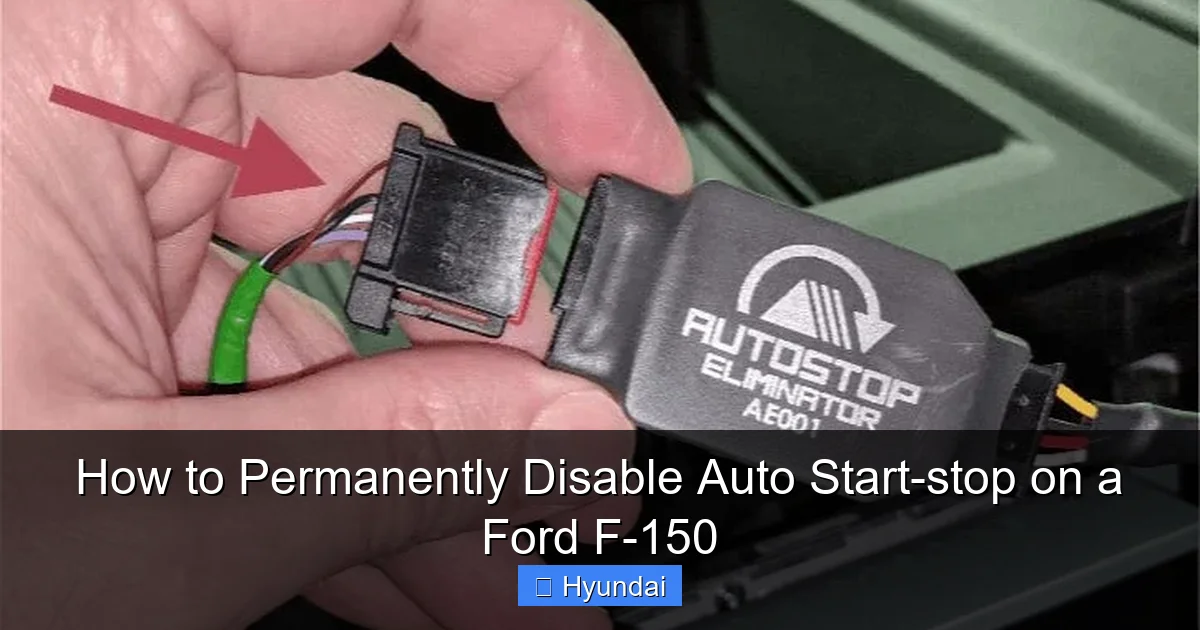
How to Permanently Disable Auto Start-stop on a Ford F-150

Contents
- 1 Key Takeaways
- 2 📑 Table of Contents
- 3 Understanding the Auto Start-Stop System in Your Ford F-150
- 4 Why Disable It? Separating Fact from Fiction
- 5 Method 1: The Temporary Button Press (Why It’s Not Enough)
- 6 Method 2: The Fuse Pull (Semi-Permanent, Low-Tech)
- 7 Method 3: The Permanent Solution – Aftermarket Programmers/Tuners
- 8 Pros and Cons of a Permanent Disable
- 9 What About Other Ford Models? A Quick Comparison
- 10 Conclusion: Making the Right Choice for Your Truck
- 11 Frequently Asked Questions


Yes, you can permanently disable the auto start-stop system on your Ford F-150, but it requires more than just pressing a button each time. The most effective permanent solutions involve either removing a specific fuse or, more reliably, using an aftermarket programmer/tuner to reprogram the vehicle’s computer. Be aware that disabling the system may slightly impact your official fuel economy ratings and could potentially affect your warranty, depending on your dealer’s policies.
Key Takeaways
- The auto start-stop system is designed for fuel efficiency, not driver convenience. It automatically shuts off the engine at stops to save fuel and reduce emissions.
- Pressing the “Auto Start-Stop” button is only a temporary fix. The system will re-engage on the next drive cycle (usually after the vehicle is restarted).
- Fuse removal is a semi-permanent, low-cost method. Pulling the designated fuse (often F75 or F101) disables the system until the fuse is replaced, but it may also disable other features like the backup camera.
- Using an aftermarket programmer/tuner is the most reliable permanent solution. Devices from brands like FordCal or SCT allow you to permanently turn off the feature via the vehicle’s computer.
- Disabling start-stop may void part of your warranty. While unlikely to void the entire vehicle warranty, it could be denied for related powertrain or emissions claims. Always check with your dealer.
- You will likely see a small decrease in real-world fuel economy. The system is calibrated for city driving; disabling it might cost 1-2 MPG in stop-and-go traffic.
- The process varies by model year. F-150s from 2015-2020 use different fuse locations and computer protocols than 2021+ models. Always verify for your specific truck.
📑 Table of Contents
- Understanding the Auto Start-Stop System in Your Ford F-150
- Why Disable It? Separating Fact from Fiction
- Method 1: The Temporary Button Press (Why It’s Not Enough)
- Method 2: The Fuse Pull (Semi-Permanent, Low-Tech)
- Method 3: The Permanent Solution – Aftermarket Programmers/Tuners
- Pros and Cons of a Permanent Disable
- What About Other Ford Models? A Quick Comparison
- Conclusion: Making the Right Choice for Your Truck
Understanding the Auto Start-Stop System in Your Ford F-150
That frustrating moment when your brand-new Ford F-150—a symbol of power and capability—shuts off at a long red light, only to jolt back to life when you creep forward, is a common experience. This is the Auto Start-Stop system, a piece of technology mandated by emissions regulations. Its primary goal is to reduce fuel consumption and exhaust emissions during city driving by automatically turning off the gasoline engine when you come to a complete stop, then restarting it the moment you take your foot off the brake. While clever on paper, many F-150 owners find it intrusive, especially in heavy traffic, on steep hills, or when towing, where immediate engine response is crucial. The system uses a robust starter motor, a beefier battery, and sophisticated software to manage the cycle, but the constant cycling can feel anything but smooth.
How It Actually Works
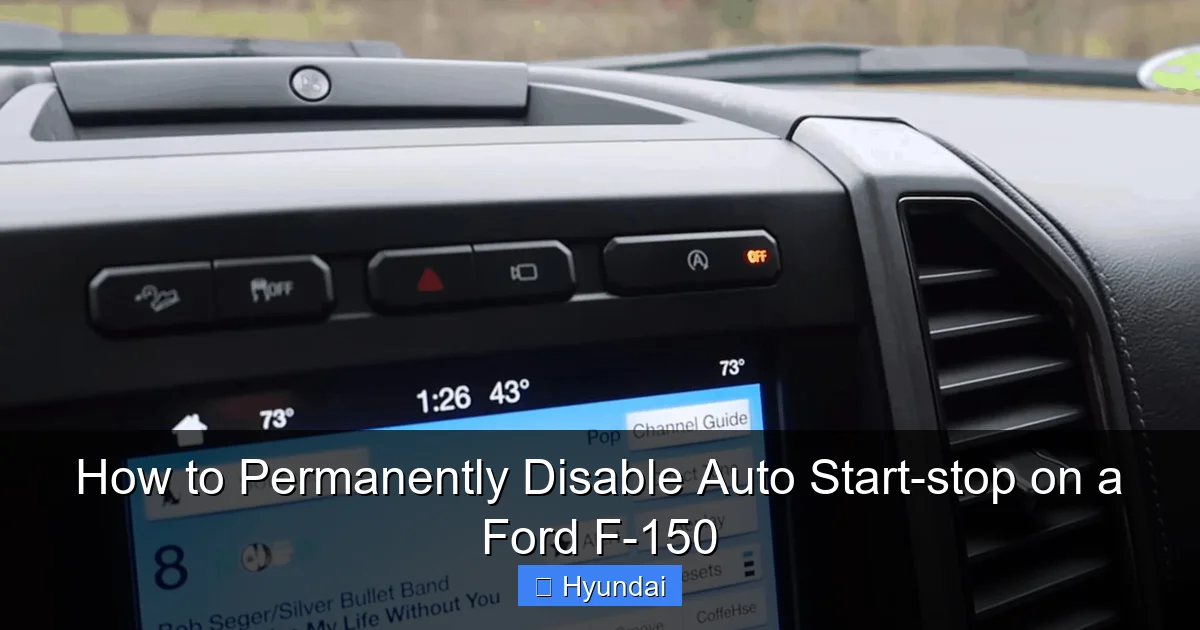
The system is activated by default every time you start your truck. It relies on a network of sensors: the brake pedal sensor tells it you’ve stopped, the engine coolant temperature ensures the engine is warm enough to shut off, and the battery management system confirms there’s enough charge to restart and power accessories. When conditions are met, the engine dies, and the battery keeps the radio, lights, and HVAC running. Lifting your foot from the brake pedal sends a signal to the starter motor, which fires the engine back up. In your F-150, you can temporarily override this by pressing the “Auto Start-Stop” button (usually with an “A” with a circular arrow icon) on the dash or center console. However, as you’ve likely discovered, this setting resets every time you turn the truck off and back on. For many, this temporary override is not enough. The desire for a permanent, one-time fix is strong.
Why Disable It? Separating Fact from Fiction
Before we dive into the “how,” let’s talk about the “why.” The decision to disable your F-150’s start-stop system is personal, but it’s usually driven by a few common complaints. Understanding these will help you decide if the modification is right for you and set realistic expectations.
Visual guide about How to Permanently Disable Auto Start-stop on a Ford F-150
Image source: thegeekpub.com
The Annoyance Factor and Driving Dynamics
Let’s be honest: the system can be a nuisance. In stop-and-go traffic, the constant engine cycling—the quiet, then the sudden restart vibration and noise—is jarring. It disrupts the smooth, powerful feel you expect from a truck. For those who tow or haul, the system’s logic can be problematic. When stopped on a hill with a trailer, the engine shutting off can compromise braking stability and delay the immediate torque needed to move again. Many drivers also report that the restart can be slower than they’d like when trying to merge into fast-moving traffic, creating a moment of anxiety.
The Fuel Economy Myth
Here’s the critical point: the EPA fuel economy ratings for your F-150 were achieved with the start-stop system active. Ford engineers tuned the entire vehicle—engine, transmission, and this system—to meet those numbers. If you permanently disable start-stop, your real-world city MPG will almost certainly drop. How much? Estimates from owners range from 0.5 to 2 MPG depending on driving conditions. In pure highway driving, the impact is negligible since the system rarely activates. But if your commute is all city streets, you will burn a little more gas. It’s a direct trade-off: convenience for a small cost at the pump.
Wear and Tear Concerns
A persistent myth is that the start-stop system causes excessive wear on the starter motor and battery. This is largely false. The F-150 is equipped with a heavy-duty starter designed for hundreds of thousands of cycles and a more robust AGM (Absorbent Glass Mat) battery to handle the frequent deep cycling. However, no system is perfect. Some owners in extremely hot climates with heavy traffic use report slightly shorter battery life, but this is anecdotal. The real wear concern is philosophical: many simply don’t like the idea of their engine shutting off thousands of extra times per year, regardless of engineering specs.
Method 1: The Temporary Button Press (Why It’s Not Enough)
As mentioned, your F-150’s dash has a dedicated button to disable Auto Start-Stop for the current drive. It’s a simple press, and an icon on your instrument cluster will confirm it’s off. This is perfect for a single trip where you know you’ll be in heavy traffic or towing. The problem is its impermanence. Ford’s logic is that for emissions compliance, the system should be the default. Therefore, every time you start the truck, the system re-initializes and turns itself back on, regardless of the previous setting. This behavior is baked into the vehicle’s software and cannot be changed through the standard infotainment menus. So, while this method works, it requires active, conscious effort every single time you drive. For those seeking a “set it and forget it” solution, we must look elsewhere.
Visual guide about How to Permanently Disable Auto Start-stop on a Ford F-150
Image source: s1.cdn.autoevolution.com
Method 2: The Fuse Pull (Semi-Permanent, Low-Tech)
This is a popular, hardware-based method that has been used on Ford vehicles for years. It involves locating and removing a specific fuse that powers the start-stop system’s control module. The advantage is that it’s cheap (a fuse costs dollars) and doesn’t require any special tools or computer knowledge. The disadvantage is that it’s not perfectly clean and can sometimes have side effects.
Visual guide about How to Permanently Disable Auto Start-stop on a Ford F-150
Image source: carglassadvisor.com
Identifying the Correct Fuse
The fuse location and number vary by model year and engine. For the popular 3.5L EcoBoost V6 and 5.0L V8 engines in 2015-2020 F-150s, the fuse is almost always F75 or F101 in the under-hood fuse box. This is the most critical step: you must confirm for your specific truck. The best way is to consult your owner’s manual’s fuse diagram. The diagram will label the fuse as “Auto Start-Stop,” “Start Stop System,” or “SS.” If the manual is unclear, a quick search for “[Your Year] F-150 start-stop fuse location” on reputable truck forums will yield definitive answers with photos. For the 2021+ models with the new digital dash, the logic is sometimes different, and the fuse method may not work or could affect other systems.
The Removal Process and What to Expect
Once you’ve identified the correct fuse (it’s usually a 10-20 amp blue or yellow mini-fuse), use a fuse puller or needle-nose pliers to gently remove it from the box. Store it somewhere safe, like the glove compartment. Start your truck; the Auto Start-Stop icon should not illuminate, and the system will be inactive. The “semi-permanent” part comes in because the truck’s software may occasionally detect the missing fuse and log a diagnostic trouble code (DTC). While this usually won’t trigger a check engine light, a dealer’s scan tool might see it. More importantly, on some models, this fuse also powers other convenience items. The most common side effect is the disabling of the rearview camera (since it’s considered a safety system that must work when the engine is off). On rare occasions, it might affect the radio presets or the auto-dimming rearview mirror. You must test all your truck’s functions after pulling the fuse to ensure nothing critical is lost.
Method 3: The Permanent Solution – Aftermarket Programmers/Tuners
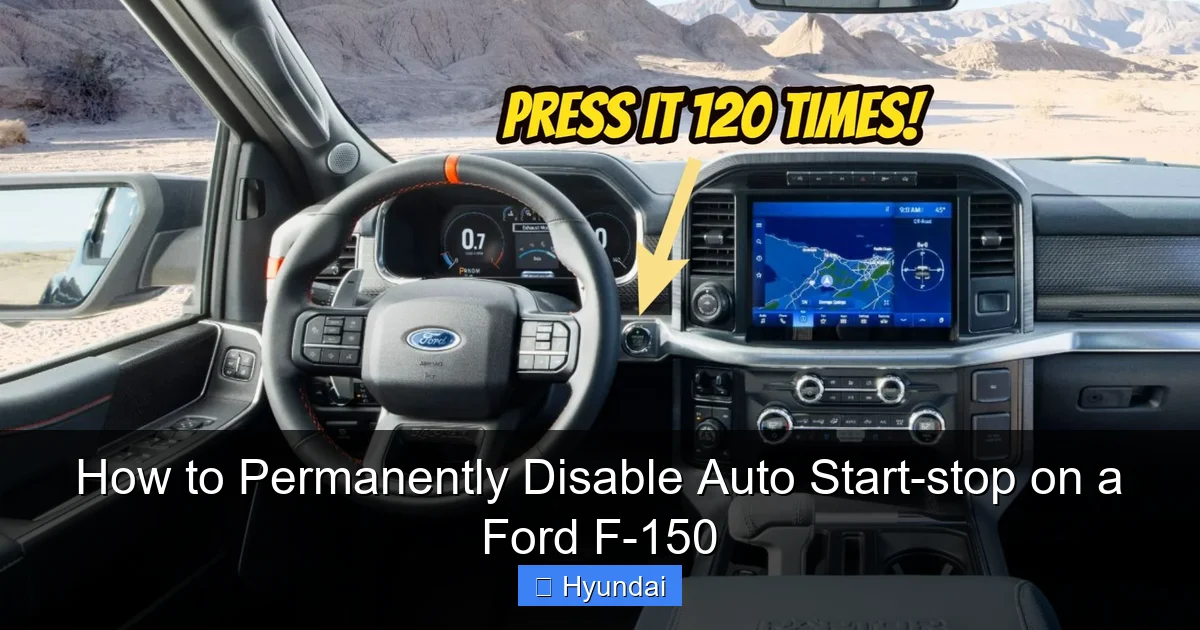
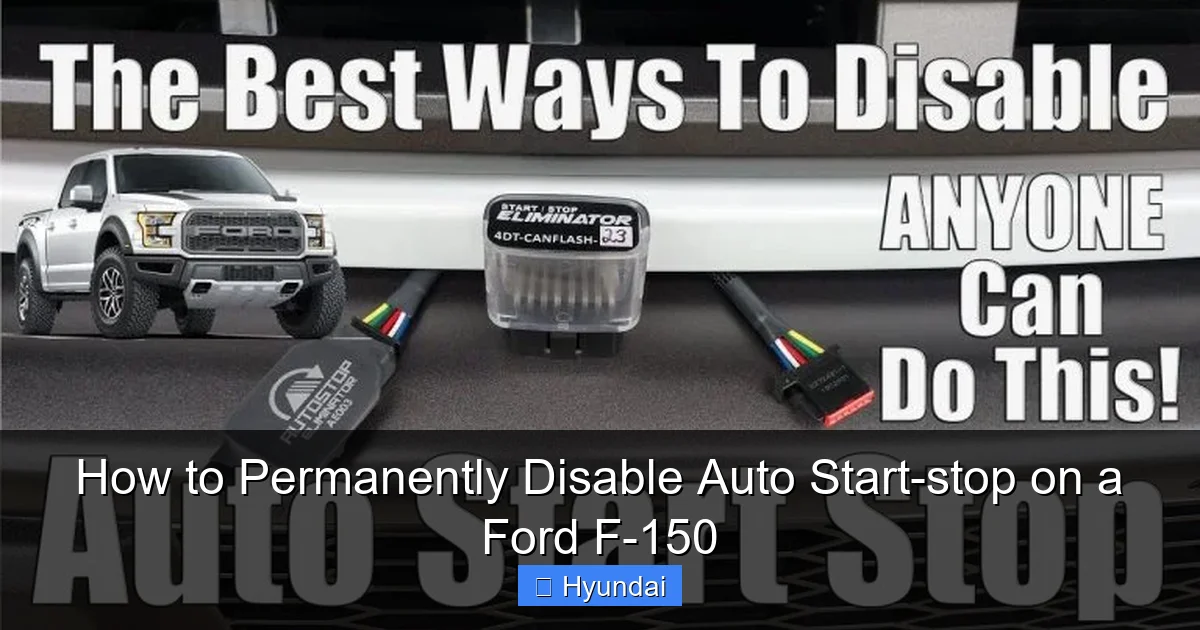
This is the cleanest, most reliable, and truly permanent method for disabling Auto Start-Stop on a Ford F-150. It involves using a device that plugs into your truck’s OBD-II port (under the dash) and reprograms the engine control module (PCM) to simply not engage the start-stop logic, regardless of conditions or key cycles.
How It Works
Devices from companies like FordCal, SCT Performance, or Superchips are designed specifically for Ford vehicles. They contain pre-loaded custom tunes that include an option to permanently disable Auto Start-Stop. You connect the device, select your vehicle’s exact year, make, model, and engine, choose the “Start-Stop Disable” option (often part of a “Performance” or “Drivability” tune), and flash the new settings to the PCM. The process takes 5-15 minutes. Once done, you unplug the device. The setting is saved in the truck’s computer memory. It will survive battery disconnects, software updates at the dealer (usually), and will be active every time you start the truck without any extra steps. Some of these devices also offer other benefits like mild power increases, shift point adjustments, and the ability to adjust tire size for the speedometer.
Important Considerations for Tuners
Cost is the main barrier here. A quality Ford-specific programmer runs from $300 to $600. However, for the permanent, worry-free solution, it’s the investment many owners feel is worth it. You must purchase a device that explicitly lists compatibility with your F-150’s model year and engine. Using a generic or incompatible tuner can cause serious drivability issues or fault codes. Additionally, while these tunes are designed to be safe and within emissions-compliant parameters for off-road use, they technically modify the factory emissions calibration. This is the primary reason a dealer could, in theory, deny warranty service for a related issue. In practice, most dealers won’t care about a start-stop disable alone unless it’s directly linked to a failure they’re trying to repair under warranty. Still, it’s a risk you assume. For the absolute best results and least chance of dealer friction, some owners opt for a professional custom tune from a reputable local shop, which can be tailored precisely to their truck.
Pros and Cons of a Permanent Disable
Let’s lay it all out on the table. Making this change isn’t without its trade-offs, and you should weigh them carefully.
The Clear Advantages
The benefits are primarily about driving experience and perceived reliability. You gain immediate engine response at stops, eliminating the hesitation and vibration of restart. This is a major plus for towing, driving on steep grades, or in congested traffic where you need instant torque. Many owners simply find it less stressful and more enjoyable to drive their truck without the constant interruption. There’s also a psychological benefit of reducing the number of engine start cycles, even if the engineering says it’s designed for it. Finally, with a permanent solution (tuner), there’s zero daily effort—it just works.
The Disadvantages and Risks
The primary con is the potential for reduced fuel economy in city driving. You are consciously opting out of a system designed to save you a little gas. There’s also the warranty consideration. While a standalone start-stop disable is unlikely to cause a failure, if a dealer can draw a line between the modification and a problem (e.g., a battery issue, starter failure), they could deny coverage. The fuse method carries the risk of disabling other vehicle features. The tuner method has an upfront cost. Finally, if you ever sell your truck, a buyer might see the modified PCM as a red flag or simply prefer the truck in stock configuration, potentially affecting resale value slightly.
What About Other Ford Models? A Quick Comparison
It’s worth noting that Ford’s implementation of start-stop varies across its lineup. The system in a Ford Escape or Fusion is different from the heavy-duty version in the F-150, which is built to handle the higher compression and torque of a V6 or V8 engine. The fuse locations are also different. If you own a different Ford vehicle and are researching this topic, the principles are similar but the specifics are not transferable. For instance, the process to permanently turn off auto start-stop on an Audi involves different software and hardware, as German manufacturers often integrate the system more deeply with the transmission control unit. Similarly, a GMC Sierra uses a very similar GM-based system to the F-150 (especially on the platform-sharing models), so the fuse locations and tuner options are often analogous. Always research your specific year, make, and model.
Conclusion: Making the Right Choice for Your Truck
Your Ford F-150 is a tool for work and play, and it should behave the way you want it to. The Auto Start-Stop system, while well-intentioned for emissions, clashes with the expectations of many truck owners who prioritize immediate, predictable power. Permanently disabling it is absolutely possible. For the budget-conscious and technically handy, the fuse pull (after confirming the correct fuse and testing for side effects) is a viable, semi-permanent fix. For those who want a flawless, guaranteed permanent solution without any feature loss, investing in a Ford-specific aftermarket programmer is the clear winner. It’s a one-time cost for a lifetime of driving your F-150 the way it was meant to be driven—with the engine ready to roar the instant you need it. Just remember to factor in the small potential MPG penalty and consider your warranty situation before making your final decision. Your perfect, non-stopping F-150 awaits.
Frequently Asked Questions
Will permanently disabling Auto Start-Stop void my F-150’s warranty?
It’s unlikely to void your entire vehicle warranty. However, if a warranty claim is made for a component related to the engine starting system, battery, or emissions, and the dealer can prove the modification contributed to the failure, they could deny that specific claim. The risk is generally low for a simple tune or fuse removal, but it exists.
How much will my fuel economy actually drop?
For most drivers, expect a decrease of 1-2 MPG in heavy city driving where the system is most active. In highway or mixed driving, the drop may be negligible or even unnoticeable. The EPA rating on your window sticker was achieved with the system enabled, so your real-world numbers will reflect the change.
Will pulling the fuse cause a check engine light?
Usually not. The system will simply be disabled. However, some model years may log a “soft code” that won’t illuminate the check engine light but could be read by a professional scan tool. A full tune via a programmer is designed to avoid even these soft codes, making it the cleaner solution.
Can I disable Auto Start-Stop on a 2022 or newer F-150 with the digital dash?
Yes, but the methods differ. The fuse method is less reliable on newer models and may affect more systems. The aftermarket programmer method is strongly recommended for 2021+ models, as their software architecture is more complex. Always verify compatibility for your exact model year when purchasing a tuner.
What’s the difference between a “tune” and just a “start-stop disable” module?
Some companies sell simple plug-in modules that claim to disable start-stop by fooling a sensor. These are often unreliable and can cause warning lights. A true “tune” or “programmer” reprograms the vehicle’s core computer (PCM) logic, which is the factory-approved, permanent method. It’s more expensive but vastly more effective and stable.
I tow a large trailer. Is disabling start-stop a good idea?
Absolutely. Many F-150 owners who tow disable start-stop for this exact reason. Having the engine running provides immediate power for moving from a stop and ensures consistent power steering and braking assist, which is a significant safety and convenience benefit when managing a heavy load on hills or in traffic.