
How to Fix the Active Air Flap System on a Hyundai Sonata Hybrid

Is your Hyundai Sonata Hybrid showing an “Active Air Flap” warning or experiencing overheating? This system controls cooling airflow to the hybrid battery and electronics. Common fixes involve clearing debris, replacing a faulty motor, or resetting the system after repair. Always diagnose with an OBD2 scanner first to avoid unnecessary part replacements. For complex electrical faults, consult a professional.
Key Takeaways
- The Active Air Flap System is critical for hybrid battery cooling. It regulates airflow through the radiator and battery cooling ducts, preventing the high-voltage battery from overheating.
- Typical symptoms include warning lights, poor fuel economy, and AC issues. You might see a “Check Hybrid System” message or specific Active Air Flap codes.
- Always start with a visual inspection and OBD2 scan. Look for physical damage, debris jamming the flaps, and retrieve stored diagnostic trouble codes (DTCs) like P0A80.
- The most common failure point is the air flap motor/actuator. These motors can burn out or have broken gears, requiring replacement.
- A simple reset often works after a physical repair. Once the fault is fixed, a reset procedure clears the code and restores normal operation.
- Neglecting this system risks hybrid battery damage. Overheating can cause severe, costly damage to the battery pack and other electronics.
- Some repairs are DIY-friendly; others require a pro. Replacing the motor is often manageable, but deep electrical diagnostics should be left to experts.
📑 Table of Contents
Understanding Your Sonata Hybrid’s Active Air Flap System
Let’s break this down in simple terms. Your Hyundai Sonata Hybrid isn’t just a regular car with a big battery; it’s a carefully balanced machine where temperature is everything. The Active Air Flap System is a key part of that balance. Think of it as your car’s “climate control” for its own vital organs—specifically, the hybrid battery pack, the power control unit (PCU), and the electric motor.
This system uses small motor-driven flaps located behind the front grille and within the cooling ductwork. At low speeds or when the battery is cool, these flaps stay closed. This blocks hot engine air from entering the dedicated battery cooling ducts. It forces the car to draw in cooler, ambient air from outside. When you’re cruising on the highway or the battery gets warm during hard acceleration, the flaps open wide. This allows maximum airflow from the main radiator to cool everything down efficiently.
Why does this matter so much? Hybrid batteries hate extreme temperatures. Too cold, and they have reduced power and efficiency. Too hot, and their lifespan plummets, and they can fail outright. The Active Air Flap System is the gatekeeper, ensuring the battery gets the perfect airflow. When it fails, the car’s computer (ECU) gets nervous, throws a warning light, and might even put the car into a “limp mode” to protect the battery. Fixing it isn’t just about clearing a light; it’s about protecting a very expensive component.
How It Works: Motors, Sensors, and Logic
The system is pretty clever. It has two main components: the air flap motor/actuator and position sensors. The motor is a small electric gear motor that physically moves the flaps. The sensors tell the car’s computer exactly where the flaps are—fully open, fully closed, or somewhere in between. The computer uses data from multiple sources to decide flap position: outside air temperature, coolant temperature for the battery and inverter, and your driving speed. It’s a closed-loop system. The computer sends a signal to the motor, the motor moves, the sensor confirms the position, and the computer verifies. If the sensor’s feedback doesn’t match the command, or if the motor doesn’t move, that’s when you get a fault code.
Recognizing the Symptoms: What’s Going Wrong?
Before you start taking things apart, you need to confirm the problem. The symptoms of a faulty Active Air Flap System can be subtle or glaringly obvious. Here’s what to watch for.
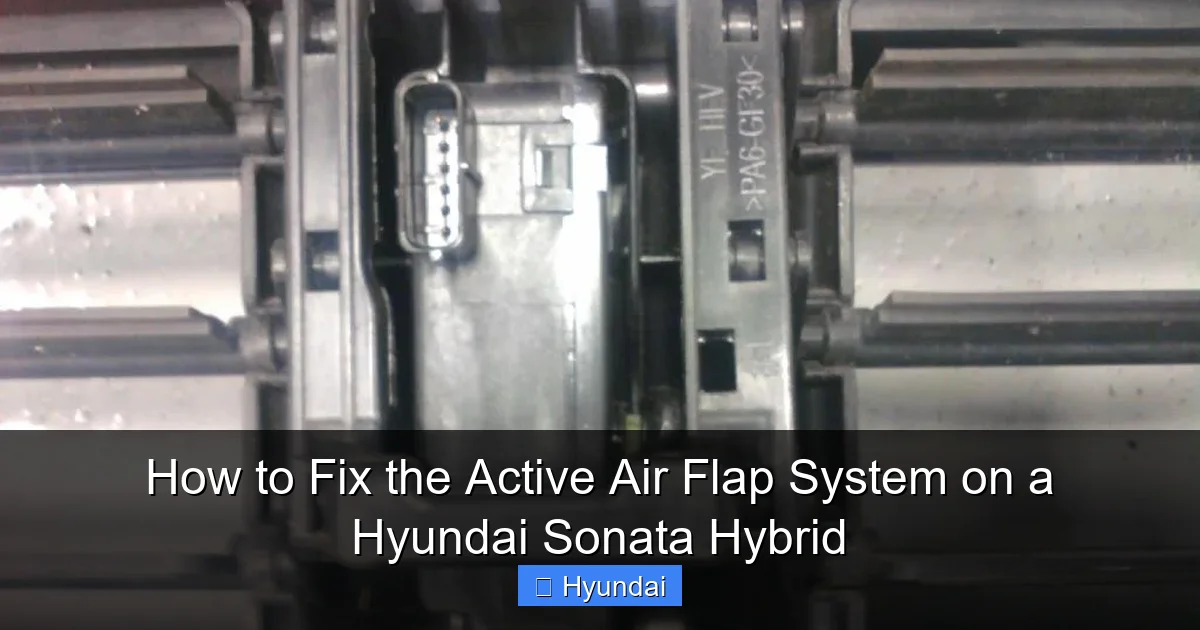
Visual guide about How to Fix the Active Air Flap System on a Hyundai Sonata Hybrid
Image source: cdn.carcomplaints.com
The Tell-Tale Warning Lights
The most direct sign is a warning on your dashboard. This is often a “Check Hybrid System” message. Sometimes, it might be a more specific icon. Using an OBD2 scanner that can read Hyundai-specific codes is crucial here. Generic scanners might just show “P0A80” or similar, which is a generic code for the system. A more advanced scan might show “Active Air Flap Motor Circuit” or “Position Sensor” codes. Pay attention to any other coinciding warnings, like battery temperature warnings or reduced engine power lights.
Performance and Efficiency Changes
Because the system’s primary job is battery thermal management, its failure directly impacts your hybrid’s performance. You might notice:
- Poorer fuel economy: The car might keep the flaps closed more often to be safe, starving the battery of cooling and forcing the engine to work harder.
- Reduced electric-only driving: The system may limit EV mode to prevent battery heat buildup.
- Strange engine or electric motor behavior: You could feel jerky transitions between electric and gas power as the system tries to manage thermal stress.
It’s not usually a safety-critical failure that leaves you stranded, but it degrades the very reason you bought a hybrid: efficiency and smoothness.
Overheating and AC Issues (Less Common)
In severe cases, if the flaps are stuck fully closed, it can create a bottleneck in the overall cooling system. This might lead to the engine running slightly hotter than normal, or your air conditioning feeling less effective, as the condenser relies on the same airflow path. If you’re seeing consistent coolant temperature rises alongside the hybrid warning, the stuck flaps could be a contributing factor.
Diagnostic Steps: Don’t Guess, Verify
This is the most important phase. Throwing parts at a problem is expensive. A methodical diagnosis saves time, money, and frustration. Here is your step-by-step diagnostic pathway.
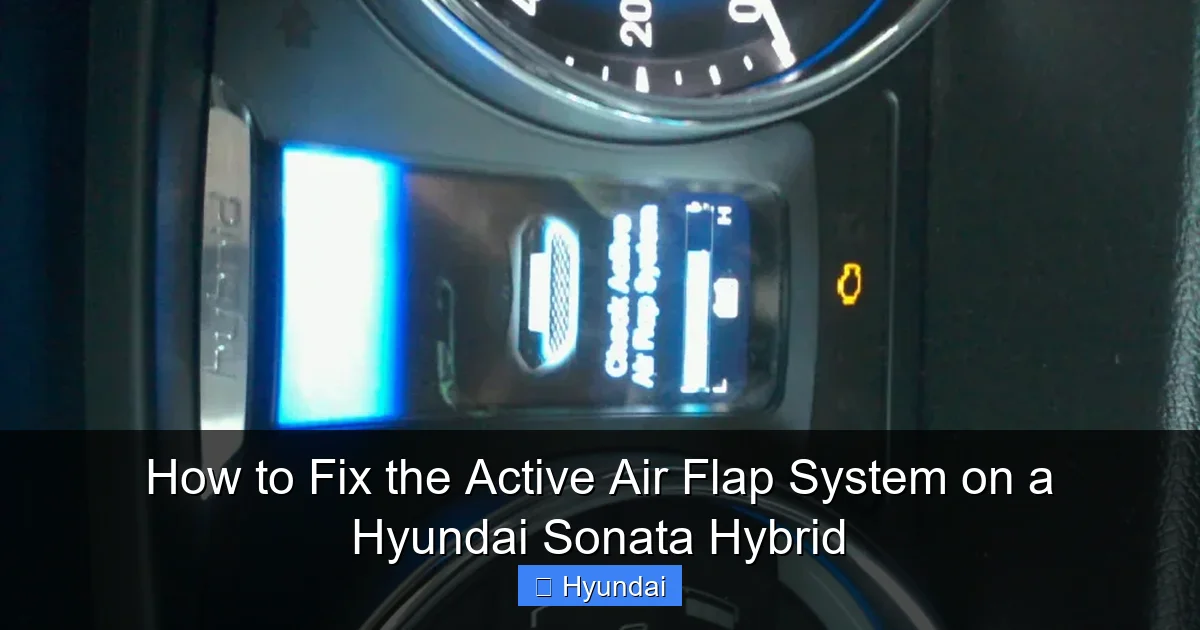
Visual guide about How to Fix the Active Air Flap System on a Hyundai Sonata Hybrid
Image source: thecarhow.com
Step 1: The Visual & Physical Inspection
Open the hood and locate the air intake passages behind the front grille. On the Sonata Hybrid, you’ll typically find a plastic shroud covering the radiator and air intake area. Carefully inspect this area. You are looking for:
- Debris: Leaves, plastic bags, bugs, and dirt can jam the flap blades physically. This is a very common cause! Clean out any obstructions with care.
- Damaged Flaps: Look for broken plastic pieces or misaligned flaps. Gently try to move them by hand (with the car OFF!). They should move freely from closed to open. If they are stuck, that’s your problem.
- Disconnected or damaged wiring: Follow the wiring harness from the flap motor. Check for frayed wires, corrosion, or connectors that are loose or unplugged.
- Motor condition: Locate the small motor itself (it’s usually attached to the flap assembly). Look for signs of burning, melting plastic, or water damage.
Pro Tip: While you’re here, a simple maintenance task that helps is checking and replacing your engine air filter if it’s dirty. A clogged air filter makes the entire cooling system work harder and can contribute to heat soak. You can find guides for similar procedures, like how to change an air filter on a Honda Civic, which illustrates the general principle of maintaining clean airflow, even if the exact location differs.
Step 2: The OBD2 Scan – Your Best Friend
You cannot skip this. Plug a compatible OBD2 scanner (like a Bluetooth dongle with an app like Torque, or a more advanced scanner like Autel or Launch) into the port under the dash. Turn the ignition to “ON” but don’t start the engine. Read the stored diagnostic trouble codes (DTCs).
For the Active Air Flap System, you’re hunting for codes in the P0Axx range, which are hybrid-specific. Key codes include:
- P0A80: Active Air Flap System
- P0A81: Active Air Flap Motor Circuit
- P0A82: Active Air Flap Position Sensor
Note the exact code and whether it’s “active” (currently failing) or “stored” (a past fault). This code tells you if the computer thinks the problem is with the motor circuit, the sensor circuit, or the overall system logic.
Step 3: Electrical Circuit Testing (For the Brave)
If you have the code and a clean physical inspection, you’ll need a multimeter to test the motor and its circuit. CAUTION: Work on a cool engine and with the 12V battery disconnected.
- Test for power and ground at the motor connector: Reconnect the battery, turn the ignition ON. Carefully back-probe the motor connector. You should see 12V+ on one pin and a ground on the other when the system is trying to move the flaps (you might need to trigger it by warming up the car). No power? The fault is upstream (fuse, relay, ECU). Power but no movement? The motor is dead.
- Test motor resistance: Disconnect the connector and measure resistance across the motor’s pins. A typical small DC motor will have a low resistance, usually between 2-10 ohms. An “open circuit” (infinite resistance) means the motor windings are fried.
- Test the position sensor: This is trickier. It’s usually a potentiometer. You can check for continuity and smooth resistance change as you manually move the flap. Abrupt jumps or open circuits indicate a bad sensor.
Common Fixes: From Simple to Complex
Once you’ve diagnosed, here are the most common repairs, in order of likelihood and simplicity.
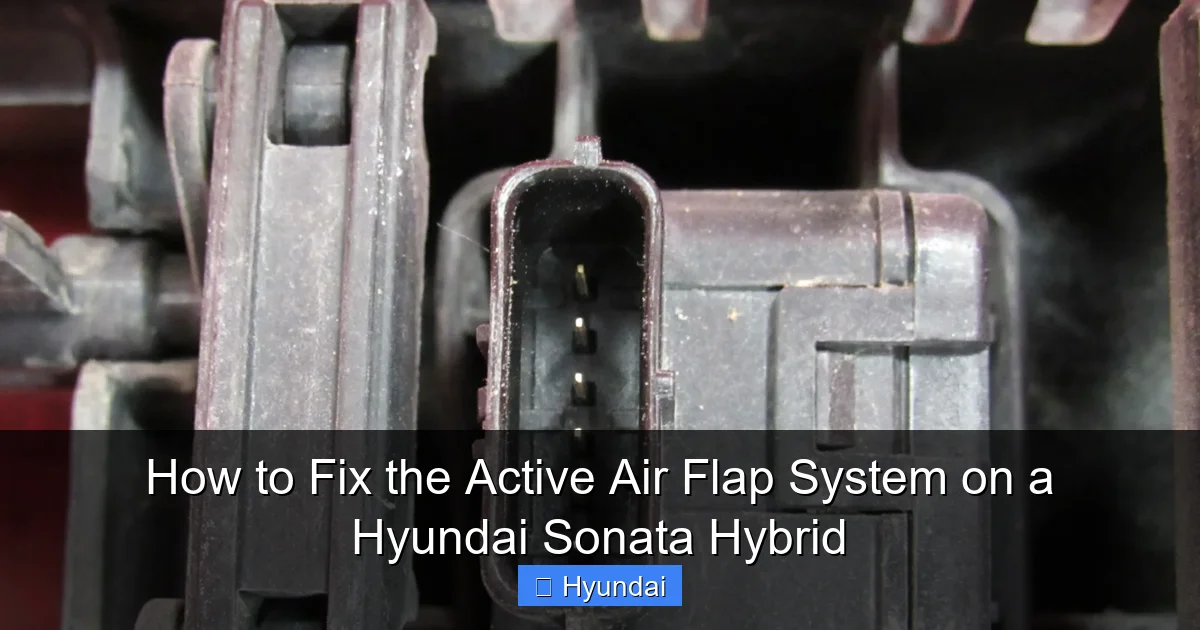
Visual guide about How to Fix the Active Air Flap System on a Hyundai Sonata Hybrid
Image source: importapart.com
Fix #1: The Clean-Up (Debris Jam)
This is the easiest and most common fix. If your visual inspection found leaves or a plastic bag jammed in the flap mechanism, carefully remove it. Use long-nose pliers or a flexible grabber tool. Once clear, manually move the flaps through their full range of motion several times. Reconnect the battery, clear the codes with your scanner, and take it for a drive. The system should recalibrate and the light should go off. Problem solved!
Fix #2: Replace the Air Flap Motor/Actuator
If the motor tests dead (no resistance) or you see physical damage, replacement is needed. This is a very common DIY repair.
- Location: The motor is typically bolted to the flap assembly behind the grille. You’ll need to remove the upper grille or radiator support covers to access it. Consult a service manual for your specific year (2011-2019 Sonata Hybrid) for exact steps.
- Procedure: Disconnect the battery. Disconnect the electrical connector. Unbolt the motor assembly. Install the new motor (ensure it’s the correct OEM or high-quality aftermarket part). Reassemble. Reconnect battery.
- Critical Step – Calibration/Reset: After replacement, the system must be reset. Simply clearing the code is often not enough. You usually need to perform a specific “Active Air Flap Reset” procedure via your OBD2 scanner (if it has that function) or by following a manual key-on/off sequence. The car needs to learn the new motor’s “home” position. Failure to do this will cause the light to return immediately.
Fix #3: Replace the Position Sensor
Less common than motor failure, but possible. The sensor is often integrated with the motor assembly. In many Sonata Hybrids, you must replace the entire motor/sensor unit. If you have a separate sensor, the replacement process is similar to the motor: access, disconnect, unbolt, replace, and reset.
Fix #4: Wiring or Connector Repair
If your multimeter tests show no power at the motor but fuses are good, you have a wiring issue. Look for broken wires inside the harness, especially at points where it bends or rubs against the body. Repair involves splicing in new wire and using heat-shrink tubing. Corroded connectors should be replaced.
When to Call a Professional: Knowing Your Limits
Some aspects of this system are best left to trained technicians. Seek professional help if:
- The diagnostic codes point to a “Control Module” or “ECU” fault. This suggests a problem with the car’s main computer or the dedicated flap control module, which requires advanced reprogramming.
- You have no power at the motor, but all fuses and relays are good. Tracing the circuit back to the source requires factory wiring diagrams and expertise.
- The flaps are mechanically broken. If the plastic flap blades themselves are cracked or the linkage is damaged, you may need to replace the entire duct assembly, which is a larger job.
- You are uncomfortable working with high-voltage hybrid systems. While the Active Air Flap is a 12V system, it’s located in an area near the hybrid battery and power cables. Always exercise extreme caution. If you’re unsure, it’s not worth the risk.
- The system resets but the code returns immediately. This indicates an intermittent fault that is hard to catch, often requiring a dealer-level scanner to monitor live data streams.
For complex electrical gremlins that might also affect other systems, professionals have tools that can simulate signals and monitor network communications. A problem that seems like an air flap issue could sometimes be linked to a broader network communication fault, similar to how a BSD system error on a Kia can stem from a single faulty module disrupting the car’s internal network.
Maintenance and Prevention: Keep It Breathing
An ounce of prevention is worth a pound of cure. Here’s how to keep your Active Air Flap System happy:
- Keep the front grille area clean: Regularly wash the front of your car, especially the grille and lower air intakes. Remove leaves and debris after parking under trees or in windy conditions.
- Address engine overheating issues promptly. A chronically overheating engine creates a hostile, hot environment for the flaps and their sensors. If your temperature gauge runs high, get that fixed first.
- Use your OBD2 scanner periodically. Even if no light is on, scanning for stored codes can reveal a developing sensor fault before it becomes a major problem.
- Don’t ignore the “Check Hybrid System” light. It’s your car’s cry for help. The longer you drive with it on, the more you risk thermal damage to the battery. The cost of a motor replacement is tiny compared to a hybrid battery replacement.
- Consider a professional inspection during major services. Ask your mechanic to take a quick look at the flap movement during a radiator or coolant service.
Good overall vehicle maintenance supports all systems. For instance, maintaining clean airflow is a universal principle—just as you’d change a cabin air filter on a Honda Civic to keep the interior air clean and the HVAC system efficient, keeping the engine bay’s air pathways clear is vital for the Sonata Hybrid’s thermal management.
Frequently Asked Questions
Can I still drive my Sonata Hybrid with an Active Air Flap error?
Yes, but only for short distances. The car will likely limit performance to protect the battery. Driving long distances or in hot weather with a failed cooling system risks severe, irreversible damage to the expensive hybrid battery pack. Get it diagnosed and repaired as soon as possible.
How much does it cost to fix the Active Air Flap System?
Cost varies wildly. If it’s just debris, the cost is $0. If it’s the motor, the part alone is typically $150-$300. With DIY labor, your total is just the part cost. At a dealership, with diagnosis and labor, you’re looking at $400-$700+. If the wiring or ECU is involved, costs can climb higher.
Do I need a special scanner to reset the Active Air Flap System?
For many repairs, a basic code-clearing scan tool is not enough. You need a scanner that has the specific “Active Air Flap Reset” or “Hybrid System Reset” function for Hyundai. This tells the car’s computer to re-learn the new motor’s position. Some advanced DIY scanners (like certain Autel or Launch models) have this function. Otherwise, a dealership or specialized independent shop is required for the reset procedure.
What’s the difference between this and a regular radiator flap?
>Good question! Many cars have engine coolant temperature-controlled flaps. The Active Air Flap System on your Sonata Hybrid is part of the *hybrid* system. It’s controlled by the hybrid control unit and prioritizes cooling for the high-voltage battery and power electronics, not just the engine. Its failure triggers a “Check Hybrid System” light, not just a standard check engine light.
Could a faulty Active Air Flap cause my hybrid battery to fail completely?
Yes, over time. The hybrid battery operates best within a narrow temperature range (usually around 40-50°C/104-122°F). If the cooling flaps are stuck closed, the battery can overheat during normal driving. Chronic overheating degrades the battery cells, drastically reducing their capacity and lifespan, eventually leading to complete failure and a very costly replacement.
Is this problem covered under warranty?
It may be if your Sonata Hybrid is still under the original 10-year/100,000-mile hybrid system warranty. However, warranties typically exclude “wear and tear” or damage from lack of maintenance (like debris damage from not keeping the grille clean). If the failure is due to a defective motor or sensor, it should be covered. Always check with your Hyundai dealer with your VIN to confirm coverage.
