How to Check Audi A6 Oil Level

Contents
- 1 Key Takeaways
- 2 📑 Table of Contents
- 3 Why Checking Your Audi A6’s Oil Level is Non-Negotiable
- 4 Understanding Your A6’s Oil System: Dipstick vs. Electronic
- 5 Preparation and Safety: Setting the Stage for an Accurate Read
- 6 Step-by-Step: Checking Oil on a Dipstick-Equipped A6
- 7 Step-by-Step: Checking Oil on an Electronic System A6
- 8 Interpreting Your Results and Taking Action
- 9 Maintenance Beyond the Level Check: A Holistic Approach
- 10 Frequently Asked Questions

Waterless Car Wash Spray

Car LED Headlight Bulb

Car MP3 Player

Tire Pressure Monitoring System (TPMS)
Regularly checking your Audi A6’s oil level is a non-negotiable maintenance task that protects your engine from catastrophic wear. The process differs significantly between older models with a traditional dipstick and newer Quattro-equipped versions that use an electronic sensor system accessed via the infotainment screen. Getting an accurate reading requires the car to be on level ground, the engine to be cool (or at operating temperature for electronic systems), and following precise steps to avoid false-low or false-high indicators. Mastering this simple procedure saves money, prevents breakdowns, and keeps your sophisticated Audi performing flawlessly.
Key Takeaways
- Your method depends on the model year: Pre-2012 A6 models typically use a physical dipstick, while most 2012+ models (especially with the 3.0T or 2.0T engines) use an electronic oil level sensor displayed in the MMI system. You must know which system your car has.
- Timing and temperature are critical: For dipstick models, check when the engine is cold and the car is parked on a level surface for at least 10 minutes. For electronic systems, the engine must be at operating temperature, and the car must be parked level for the sensor to give an accurate reading.
- The “safe zone” is key: Oil should always be between the MIN and MAX marks on the dipstick, or show “OK” in the infotainment display. Anything near or below MIN requires immediate attention and top-up.
- Use only Audi-approved oil: The correct viscosity (e.g., 5W-40, 0W-20) and specification (VW 502 00/504 00) are essential. Using the wrong oil can trigger warnings or damage the engine. Consult your owner’s manual.
- Checking is just step one: A low reading means you need to find the leak or consumption issue. Regularly checking also lets you monitor oil color and clarity, which can indicate contamination or the need for an earlier oil change.
- Never ignore the oil pressure warning: A red oil pressure light means immediate engine shutdown. The electronic oil level warning (often a yellow “oil level” symbol) means you must top up soon but has more time to react.
- When in doubt, consult a pro: If you’re consistently low on oil between changes, have an Audi specialist diagnose for leaks or excessive consumption in turbocharged engines.
📑 Table of Contents
- Why Checking Your Audi A6’s Oil Level is Non-Negotiable
- Understanding Your A6’s Oil System: Dipstick vs. Electronic
- Preparation and Safety: Setting the Stage for an Accurate Read
- Step-by-Step: Checking Oil on a Dipstick-Equipped A6
- Step-by-Step: Checking Oil on an Electronic System A6
- Interpreting Your Results and Taking Action
- Maintenance Beyond the Level Check: A Holistic Approach
Why Checking Your Audi A6’s Oil Level is Non-Negotiable
Your Audi A6 is a masterpiece of German engineering—a blend of performance, luxury, and advanced technology. Under that sleek hood lies a powerful, high-revving engine, often turbocharged, that demands respect and meticulous care. The lifeblood of this precision instrument is its engine oil. It lubricates, cools, cleans, and protects thousands of moving parts from grinding against each other. Skipping regular oil level checks is like ignoring the fuel gauge on a long road trip; it’s a gamble you will eventually lose, and the cost is a rebuilt or replaced engine.
Many Audi A6 owners, lulled by the car’s quiet sophistication and advanced maintenance reminders, become complacent. They trust the service interval light alone. While modern Audis have excellent service reminders, they are not infallible sensors for oil *level*. They track time and mileage for *change*, but not for unexpected consumption or slow leaks. A small leak or a turbocharger seal that’s beginning to wear can cause a quart of oil to disappear every 500 miles without tripping the “change oil” light. By the time the light comes on, the level may be dangerously low. This guide will walk you through the exact process for your specific Audi A6 generation, ensuring you always know the true state of your engine’s vital fluid.
Understanding Your A6’s Oil System: Dipstick vs. Electronic
The very first step is to identify which oil level monitoring system your Audi A6 uses. This is the single most important piece of information. The transition from dipstick to electronic happened around the 2012 model year, but it’s not absolute. Your best bet is always your owner’s manual, but here’s a general rule of thumb.

Visual guide about How to Check Audi A6 Oil Level
Image source: i.ytimg.com
The Traditional Dipstick System (Mostly Pre-2012)
If your A6 has a yellow or orange looped handle under the hood, often near the front of the engine bay on the driver’s side, you have a dipstick. This is the classic, mechanical method. You pull it, wipe it, reinsert it fully, pull it again, and read the oil film against the marked indicators. It’s simple, direct, and requires no electronics. Models with base 2.8L V6 or early 3.2L V6 engines often use this system.
The Electronic Oil Level Sensor System (Most 2012+)
For the vast majority of A6s from the C7 generation (2012-2018) and the current C8 generation (2019+), Audi eliminated the dipstick. Instead, a sensor in the oil pan measures the level and sends the data to the car’s computer. You view this information through the Multi-Media Interface (MMI) screen in the dashboard. This system is more convenient and sealed from the elements, but it has specific requirements to function correctly. The engine must be at operating temperature, and the car must be parked perfectly level. If you try to check it when cold or on a slope, it will give an erroneous reading, often falsely low. This is a common point of confusion. For owners of these models, the process is entirely menu-driven.
Pro Tip: If you’re unsure, a quick visual check under the hood is all it takes. No looped handle? You’re electronic. You can also search online for “**[Your Year] Audi A6 oil dipstick location**” to see photos from forums. Speaking of other maintenance procedures, if you’re also managing tire pressure on your Audi, our guide on how to check Audi Q5 tire pressure covers the precise steps for the A6’s sibling, as the MMI menu navigation is very similar.
Preparation and Safety: Setting the Stage for an Accurate Read
Rushing into an oil check is the fastest way to get a wrong reading. Proper preparation ensures accuracy and safety. Whether you have a dipstick or an electronic system, the foundation is the same: a level, stationary vehicle.
Visual guide about How to Check Audi A6 Oil Level
Image source: thecarhow.com
The Perfect Location and Engine State
Park your A6 on a flat, level surface. A slight incline can cause oil to pool to one side, giving a false reading on a dipstick or confusing the electronic sensor. Engage the parking brake firmly. For dipstick models, the engine must be cold or have been shut off for at least 10-15 minutes. This allows all the oil to drain back into the sump (oil pan) for a true “resting” level reading. Checking it when the engine is hot and recently shut off will show a lower level because oil is still distributed throughout the engine and hasn’t drained back.
For electronic models, the requirement is the opposite. The engine must be at full operating temperature. This means driving the car for at least 15-20 minutes until the coolant temperature gauge is in the normal range. Then, you park it on level ground, leave the engine running in Park (P), and follow the menu prompts. The system needs the oil to be warm and thin to get a consistent sensor reading. Starting from cold will often result in a “Level Check Not Possible” message or an inaccurate low reading.
Gathering Your Tools
You don’t need much. A clean, lint-free cloth or paper towel is essential for wiping the dipstick. For top-ups, you’ll need the correct Audi-approved oil. Have a funnel with a long, narrow spout ready to avoid spills. Gloves are a good idea to keep your hands clean. Keep a bottle of oil in your trunk—Audi recommends specific viscosities, typically 5W-40 or 0W-20 for newer models, meeting VW specification 502 00 (for fixed interval changes) or 504 00/507 00 (for long-life service). The exact specification is on your oil cap or in your manual. Using the wrong oil, as discussed in guides for other brands like Toyota Tacoma oil percentage, can lead to serious issues, so always verify.
Step-by-Step: Checking Oil on a Dipstick-Equipped A6
If your A6 has a dipstick, the process is straightforward but must be done correctly to avoid contamination and misreads.

Visual guide about How to Check Audi A6 Oil Level
Image source: thecarhow.com
1. Locate and Access the Dipstick
Open the hood and secure it with the prop rod. The dipstick is usually a yellow or orange looped handle. In the A6, it’s commonly located on the driver’s side of the engine, near the firewall (back of the engine compartment). It may have a yellow cap or a ring pull. Pull it out completely.
2. Clean, Reinsert, and Read
This is the most critical sequence. Wipe the entire dipstick clean with your cloth. This removes all old oil, giving you a clean baseline. Now, fully reinsert the dipstick all the way back into its tube. Do not just drop it in; push it until it seats properly. Immediately pull it back out again. Hold it vertically and read the oil film on the lower end. You will see two notches, lines, or a cross-hatched area labeled “MIN” and “MAX” or “L” and “F”.
3. Interpreting the Dipstick Markings
The oil film should leave a clear mark between these two points. Ideal is right in the middle or slightly towards the MAX (upper) mark. Do not overfill. If the oil is at or below the MIN mark, you must add oil immediately. If it’s above MAX, you have overfilled, which can cause aeration, foaming, and increased pressure, leading to leaks and damage. In this case, you’ll need to drain a small amount. The mark should be distinct. A smeared or spotty mark means you didn’t wipe it clean enough the first time—repeat the process. For a visual comparison of how different car systems work, our general guide on how to check oil level on any car illustrates the universal principles of dipstick use.
Step-by-Step: Checking Oil on an Electronic System A6
For A6s without a dipstick, the process lives in the MMI infotainment system. The exact menu names can vary slightly by model year and MMI version (MIB1, MIB2, etc.), but the logic is consistent.
1. Bring the Engine to Temperature
As stated, this is mandatory. Drive your A6 on the highway or city streets for at least 15-20 minutes. Ensure the coolant temperature needle is in the normal operating zone (usually centered on the gauge). Then, park on a perfectly level surface. Leave the engine running. Put the transmission in Park (P) and apply the parking brake.
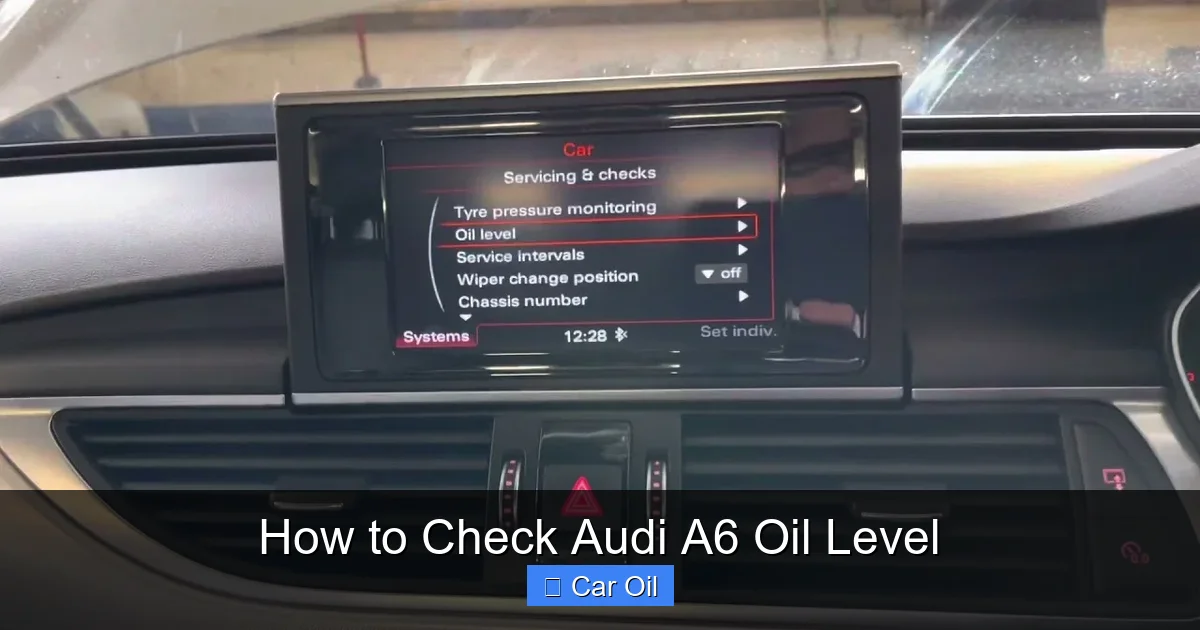
2. Navigating the MMI Menu
Press the “Car” or “Vehicle” button on your MMI controller. Use the knob or touchpad to navigate to “Service & Checks” or “Vehicle Status”. Look for an option called “Oil Level” or “Engine Oil Level”. Select it. The system will now communicate with the oil level sensor. You may see a message like “Check in Progress” or a spinning icon.
3. Reading the Display
After a few seconds, the system will display the result. This will not be a number; it will be a status. You will typically see one of the following:
- OK or Within Normal Range: The oil level is perfect. No action needed.
- Max or Upper Range: The level is too high. Do not add oil. You may need to have some drained.
- Min or Lower Range: The level is low. The display will often show a specific amount to add, like “Add approx. 1.0 quart”. You must add oil immediately.
- — or No Reading: This means conditions aren’t met (car not level, engine not hot, sensor fault). Re-park on level ground, ensure engine is at temperature, and try again.
4. After Adding Oil
If you add oil, the system needs to re-calibrate. After adding, turn the engine off, wait about 30 seconds, then restart it. Return to the same menu and let it re-check. The reading should update to “OK” if you added the correct amount. Do not overfill based on the electronic reading alone; if it says “Max” after adding, you’ve added too much.
Important Caveat: The electronic system can fail. If you get a persistent “Oil Level Sensor Fault” message, or if the reading seems erratic compared to what you expect (e.g., you just changed the oil and it reads low), you may have a faulty sensor or wiring issue. At this point, a manual check (if possible by accessing the sensor plug or via a diagnostic tool) or a visit to an Audi specialist is required. This is analogous to checking transmission fluid on models without a dipstick, as covered in our articles about Nissan Altima CVT fluid or Nissan CVT transmission fluid, where electronic systems also require specific conditions.
Interpreting Your Results and Taking Action
Getting the reading is only half the battle. Understanding what it means and what to do next is what protects your engine.
What “OK” Really Means
An “OK” or “Normal” reading is a green light, but it’s not a permanent one. It means your oil level is sufficient right now. It doesn’t tell you about the oil’s condition (its viscosity, contamination, or acidity). That’s determined by time and mileage, which is why the service interval light exists. Keep checking at least once a month or before long trips.
The “Add Oil” Signal: Immediate Action Required
If your dipstick is at or below MIN, or your MMI says “Min” or prompts you to add a specific amount, you must add the correct oil immediately. Do not postpone. Running an engine even slightly low on oil causes extreme friction, rapid wear, and can lead to seized components. Add oil slowly through a clean funnel. Add about half the suggested amount (e.g., 0.5 quart if it asks for 1 quart), wait a minute for the oil to settle, then re-check. This prevents overfilling. Repeat until the level is in the safe zone. After adding, note the mileage. If you find yourself adding more than a quart between regular oil changes, you have a problem—either a leak (check for drips under the car) or internal consumption (common in high-mileage turbocharged engines). This needs professional diagnosis.
The “Too High” or “Max” Signal
Overfilled oil is a less common but serious issue. Excess oil can foam as the crankshaft slaps through it, turning it from a lubricant into a aerated, ineffective liquid that can’t properly lubricate. It also increases pressure, stressing seals and causing leaks. If your reading shows “Max” or the dipstick is clearly above the upper mark, you need to remove oil. The best method is to use an oil extractor pump through the dipstick tube to suck out the excess. Alternatively, a mechanic can drain a small amount from the drain plug. Do not simply run the engine to “burn off” the oil; this is ineffective and dangerous.
Maintenance Beyond the Level Check: A Holistic Approach
Checking the level is a vital snapshot, but it’s part of a larger maintenance ecosystem for your A6.
Integrating Level Checks with Your Service Schedule
Audi’s flexible service intervals (FlexService) are based on driving conditions. Hard driving, extreme temperatures, and lots of short trips will shorten the interval. Regardless of what the reminder says, you should manually check your oil level at least once a month and before any long journey. This habit catches issues between services. Combine this with checking other critical fluids. For instance, knowing how to check coolant level in a Toyota Camry teaches the principles of checking overflow reservoirs that apply to your Audi’s coolant tank as well.
The Importance of the Correct Oil and Filter
When you do need a full oil change, the quality of the product matters immensely. Always use oil that meets the exact Audi/VW specification listed in your manual (502 00, 504 00/507 00, etc.). These are not just suggestions; they are formulated for the specific tolerances and technologies (like turbochargers and direct injection) in your engine. Pair it with a high-quality OEM or OEM-spec filter (like Mann, Mahle, or genuine Audi). A cheap filter can allow particles into the engine or have poor bypass valves, negating the benefit of good oil. This attention to detail is what keeps a high-performance car like the A6 running smoothly for hundreds of thousands of miles.
When to Seek Professional Help
If you are consistently adding oil (more than a quart every 1,000-2,000 miles), it’s time for a professional inspection. For turbocharged A6 engines (the 2.0T and 3.0T are very common), a small amount of consumption can be normal, but excessive consumption points to failing turbo seals, piston ring wear, or valve guide seals. A mechanic can perform a leak-down test, check for physical leaks, and use diagnostic tools to monitor oil pressure and consumption patterns. Catching these issues early can prevent a catastrophic turbo or engine failure.
Frequently Asked Questions
How often should I check the oil in my Audi A6?
You should check the oil level at least once a month and before any long trips. For electronic systems, ensure the engine is warm and the car is level. For dipstick models, check when the engine is cold and has sat for 10+ minutes. This frequent habit catches leaks or consumption issues early.
What should I do if the oil level is low?
Add the correct Audi-approved oil specification immediately, using a funnel. Add slowly, re-checking after each half-quart to avoid overfilling. If you need to add more than a quart between scheduled oil changes, have a mechanic inspect for leaks or internal engine consumption.
My A6 has an electronic system. Why does it sometimes say “Level Check Not Possible”?
This message means the system’s conditions aren’t met. Ensure the engine is at full operating temperature, the car is parked on a perfectly level surface, and the transmission is in Park with the engine running. Driving on a hill or checking when cold will trigger this error.
Can I check the oil when the engine is hot?
It depends on your system. For a traditional dipstick, no—the engine must be cold to get an accurate resting level. For an electronic system, yes—the engine must be hot and running for the sensor to provide a correct reading. Always consult your owner’s manual for your specific model.
What type of oil should I use to top up my Audi A6?
Use only oil that meets the exact specification listed in your owner’s manual or on your oil cap (e.g., VW 502 00, VW 504 00/507 00). The correct viscosity (like 5W-40 or 0W-20) is also critical. Using the wrong oil can cause damage and trigger service warnings. When in doubt, use genuine Audi oil or a high-quality brand with the correct VW approval.
What does the red oil pressure warning light mean versus the yellow oil level warning?
A red oil pressure light means immediate danger—low or no oil pressure. You must shut off the engine immediately to prevent severe damage. A yellow oil level symbol (often an oil can with a level line) indicates low oil *quantity*. You can safely drive a short distance to add oil but must address it promptly. Never ignore either warning.