
How Much Is a 2009 Toyota Camry Le Worth According to Kbb?

Wondering what a 2009 Toyota Camry LE is worth? Kelley Blue Book (KBB) is the industry standard for pricing. For a typical 2009 Camry LE in good condition with average mileage, KBB lists a private party value between $3,500 and $5,500, and a dealer trade-in range of $2,800 to $4,200. However, your car’s specific worth depends heavily on its exact condition, mileage, location, and service history. Always use KBB as a powerful starting point, not the final word.
Key Takeaways
- KBB is a Valuation Guide: Kelley Blue Book provides estimated market values based on vast sales data, but it’s a starting point, not a guaranteed sale price.
- Condition is King: The difference between “Excellent” and “Fair” condition for a 2009 Camry can mean over $2,000 in value.
- Mileage Matters Greatly: For a 15-year-old car, every 10,000 miles over the average (around 150,000) significantly lowers the KBB value.
- Two Main Prices: Know the difference between “Private Party” (what you’ll likely get) and “Trade-In” (what a dealer offers, which is lower).
- Location Influences Price: KBB adjusts for regional demand; a Camry in a snowy state with high salt exposure may be worth less than one in a dry climate.
- History Boosts Value: A complete, verifiable service record can push your Camry from “Good” to “Very Good” condition in KBB’s eyes.
- Market Fluctuates: Used car prices are dynamic. Check KBB regularly as values can change monthly based on supply and demand.
[FEATURED_IMAGE_PLACEHOLDER]
📑 Table of Contents
- Understanding the 2009 Toyota Camry LE’s Legacy
- What Exactly Is Kelley Blue Book (KBB) and How Does It Work?
- The Current KBB Value Breakdown for a 2009 Toyota Camry LE
- Critical Factors That Change Your 2009 Camry’s Value (Beyond the KBB Form)
- How Does the 2009 Camry LE Compare to Its Rivals? Putting KBB in Context
- Practical Tips: Using Your KBB Value to Sell or Buy Smartly
- The Bottom Line: Is a 2009 Camry LE Still a Smart Buy?
Understanding the 2009 Toyota Camry LE’s Legacy
Let’s talk about a true automotive legend. The 2009 Toyota Camry LE. If you’re reading this, you probably own one, are thinking of buying one, or are just curious about its worth. You’ve made a smart choice looking into the Kelley Blue Book (KBB) value. The Camry, especially from this era, isn’t just a car; it’s a benchmark. It’s the reason your neighbor’s 2009 model still runs flawlessly with 200,000 miles. It’s the car that defined “reliable midsize sedan” for a generation. But time marches on, and a 15-year-old vehicle enters a different market segment. Its value isn’t about depreciation from a new sticker price anymore; it’s about pure utility, remaining lifespan, and solid, no-nonsense transportation. KBB understands this. Their valuation for a 2009 Camry LE isn’t a guess; it’s a calculated estimate based on thousands of actual recent sales of identical or very similar vehicles. Before we dive into the specific numbers, we need to understand why this car holds the value it does. It’s a combination of Toyota’s reputation for durability, the Camry’s massive popularity (making parts cheap and plentiful), and a simple, effective design that avoids complicated, expensive gadgets that fail with age. This foundation is what KBB’s algorithm builds upon.
What Exactly Is Kelley Blue Book (KBB) and How Does It Work?
You can’t talk about a car’s worth without talking about KBB. It’s the name everyone knows. But what does it actually do? Think of KBB as a massive, constantly updated database and a complex set of formulas. They gather millions of data points from dealership auctions, retail sales, and private party transactions across the country. Their analysts then adjust this raw data for trends, seasonal changes, and economic factors. When you input your vehicle’s details—year, make, model, trim (LE), mileage, condition, and zip code—you’re not getting a single number. You’re getting a range. This is crucial. The range accounts for the fact that one 2009 Camry LE with 120,000 miles and a stack of service receipts is not the same as another with 180,000 miles and a cracked dashboard. KBB typically offers several value tiers: Private Party, Trade-In, and often Typical Listing Price or Certified Pre-Owned. For someone selling or buying from a neighbor, the Private Party value is your most relevant and realistic benchmark. The Trade-In value is what a dealership will offer you before any negotiation, and it’s always lower because the dealer must recondition the car and make a profit. Understanding these distinctions is the first step to not leaving money on the table.
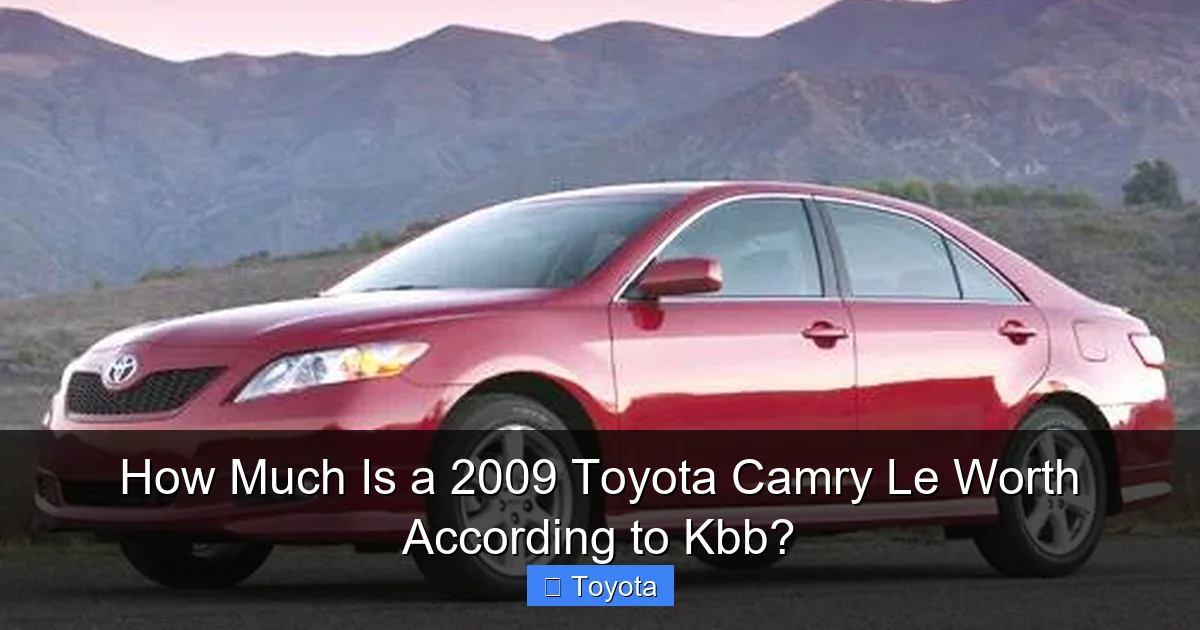
Visual guide about How Much Is a 2009 Toyota Camry Le Worth According to Kbb?
Image source: file.kelleybluebookimages.com
KBB’s Five Condition Categories Explained
This is where most people go wrong. You might think your car is in “Excellent” shape. But KBB has strict definitions. Be brutally honest with yourself:
- Excellent: Like new. No mechanical issues, flawless exterior and interior, full service history, no accidents. This is rare for a 15-year-old car.
- Very Good: Minor cosmetic blemishes (small door ding, wear on driver’s seat), all major services up to date, no accidents. Fully functional.
- Good: Normal wear and tear for the age. May have a few minor scratches, slight wear on controls, but all equipment works. This is the most common category.
- Fair: Significant wear,可能需要 minor repairs (e.g., a failing sensor, worn brakes), possible unrepaired accident damage, or high mileage.
- Poor: Major mechanical problems, significant rust, severe accident damage, or non-functional components. Often sold for parts or project cars.
For a 2009 Camry LE, most will realistically fall into Good or Very Good if well-cared for. Don’t automatically select “Excellent”—it will give you an unrealistic expectation.
The Current KBB Value Breakdown for a 2009 Toyota Camry LE
Alright, the numbers you’ve been waiting for. As of late 2023/early 2024, here is the typical KBB valuation range for a standard 2009 Toyota Camry LE. Remember, these are national averages. Your specific zip code will adjust these up or down. We’ll use a baseline of 150,000 miles, which is about average for this model year.
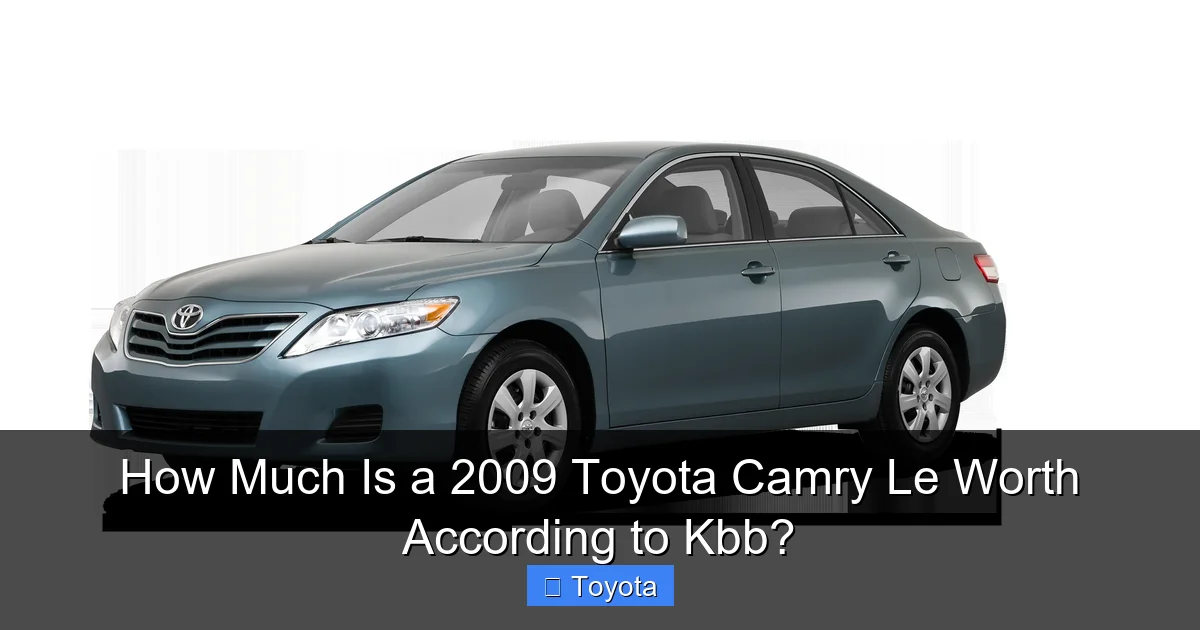
Visual guide about How Much Is a 2009 Toyota Camry Le Worth According to Kbb?
Image source: file.kelleybluebookimages.com
Private Party Value
This is what you can expect to sell the car for to an individual buyer. For a 2009 Camry LE in Good condition with 150,000 miles, the KBB private party value typically ranges from $3,500 to $4,500. If the car is in Very Good condition—meaning it has a clean title, full service records, and minimal wear—that range can climb to $4,200 to $5,500. The upper end is for cars in premium regions with high demand for affordable, reliable transportation. A car in just Fair condition might only fetch $2,500 to $3,200. These numbers represent a car that is mechanically sound, passes inspection, and has no major issues.
Dealer Trade-In Value
If you’re planning to roll your Camry into a newer car at a dealership, expect these figures. The trade-in value is systematically lower. For the same 150,000-mile, Good condition Camry LE, KBB’s trade-in range is usually $2,800 to $3,800. A Very Good example might see $3,400 to $4,200. The gap between private party and trade-in is the dealer’s reconditioning cost and profit margin. This is why selling privately almost always yields more money, but requires more effort.
What About the “Typical Listing Price”?
KBB also shows what dealers are asking for similar cars on their lots. For a 2009 Camry LE, this might be $4,900 to $6,500. This is an asking price, not a selling price. Dealers will often price above their actual trade-in value to leave room for negotiation. As a buyer, you can use this number to benchmark your offer if buying from a dealer, but as a seller, it’s less relevant than the private party figure.
Critical Factors That Change Your 2009 Camry’s Value (Beyond the KBB Form)
Plugging numbers into KBB is step one. Step two is understanding the real-world variables that can add or subtract thousands from that estimate. These are the things a savvy buyer will inspect and a smart seller will highlight.
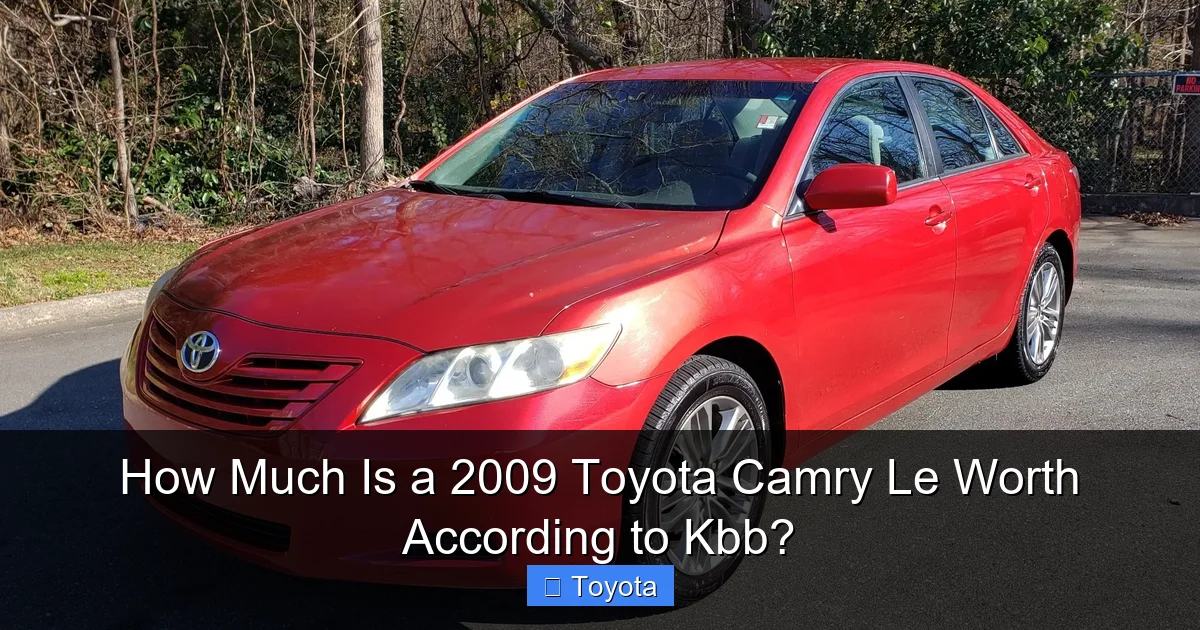
Visual guide about How Much Is a 2009 Toyota Camry Le Worth According to Kbb?
Image source: i2.wp.com
1. The Mileage Treadmill
For a car this old, mileage is the single biggest factor after condition. The national average for a 2009 vehicle is roughly 150,000 miles. KBB’s calculator is sensitive to this. If your Camry has a verifiable 120,000 miles (about 10,000 miles below average), you can add $500-$1,000 to the private party value. Conversely, a car with 200,000 miles (50,000 over) will see a significant drop, potentially $1,500-$2,500 less, even if the engine is strong. High mileage suggests more wear on everything from the transmission to the suspension bushings.
2. The Condition Conundrum: Be Honest
We touched on this, but let’s get specific. What moves a car from “Good” to “Very Good”?
- Service History: A thick folder of oil changes, tire rotations, and major services (timing belt/water pump at 100k, transmission fluid) is GOLD. It proves the car was maintained, not just fixed when it broke.
- Tires: Are they a matched set with plenty of tread? Worn, mismatched tires are a $600+ deduction in a buyer’s mind.
- Interior: Is the driver’s seat bolster completely worn away? Are the headliner sagging? Stains, burns, or missing pieces hurt. A clean, odor-free interior is a huge plus.
- Exterior: Major rust (especially on rocker panels, frame, or under the car) is a deal-killer for many. Small dents and scratches are acceptable. All lights must work.
- Mechanical: Any check engine lights? Does the transmission shift smoothly? Are there strange noises? A recent pre-purchase inspection from a trusted mechanic can verify “Very Good” mechanical condition.
3. The Geographic Price Shift
KBB automatically adjusts your value based on your zip code. A 2009 Camry LE in Phoenix, AZ, where salt and rust are non-issues, will have a slightly higher value than an identical car in Buffalo, NY, where road salt causes corrosion. Supply and demand locally also matter. In a city with high Uber/Lyft demand for cheap, reliable cars, prices might be firmer. In a rural area, it might be softer. Always check the KBB value for your specific zip code, not just a national average.
4. Trim Level and Options: The LE is a Sweet Spot
The LE is the base model, but for a car this old, that’s often a positive. It means fewer complex gadgets to break (like power rear sunshades or heated rear seats). Standard LE features for 2009 included air conditioning, keyless entry, cruise control, and a basic sound system. However, if your LE has the optional JBL premium audio system or a sunroof, those can add a small premium ($200-$400) if they work perfectly. Major missing features don’t hurt it much at this price point. The LE is valued for being a basic, durable people-mover.
How Does the 2009 Camry LE Compare to Its Rivals? Putting KBB in Context
Knowing your Camry’s KBB value is great, but context is everything. How does it stack up against its 2009 competition? This helps you position your car correctly in the market. The main rivals were the 2009 Honda Civic and the 2009 Hyundai Sonata. The Civic was the sportier, more fuel-efficient choice. The Sonata was the value-packed, feature-rich alternative with a longer warranty (if still under original). According to KBB, a comparable 2009 Honda Civic LX (also a base model) with similar mileage often trades in a very similar range to the Camry LE, sometimes a few hundred dollars higher due to Honda’s enthusiast cachet. The 2009 Hyundai Sonata GLS, however, might have a slightly lower KBB value at this age due to historically worse long-term depreciation and perception of reliability compared to Toyota and Honda. This gives the Camry a strong position in the “bulletproof used sedan” category. Its value is supported by a proven track record. You’re not just buying a car; you’re buying a known quantity with a massive owner community and cheap parts. This reliability premium is baked into KBB’s numbers.
Practical Tips: Using Your KBB Value to Sell or Buy Smartly
So you have your KBB number. Now what? Here’s how to turn that estimate into real dollars.
For Sellers: Maximizing Your Price
First, get your KBB value for your specific VIN, mileage, zip code, and honest condition. This is your floor and ceiling. Now, prepare the car. A thorough wash and vacuum costs nothing but makes a huge difference. Gather every piece of service paperwork. Take clear, well-lit photos from all angles, including the engine bay and odometer. When pricing, list it at the top of your KBB Private Party range if it’s in Very Good condition, or at the mid-point for Good. Be prepared to justify your price with the service history and photos. In your listing, say “Priced according to Kelley Blue Book” to build trust. When a buyer comes, be firm but flexible within your range. Never start at your lowest number.
For Buyers: Negotiating from a Position of Strength
As a buyer, KBB is your weapon. Before you ever call about a 2009 Camry LE, look up its exact KBB Private Party value for your area. Use the lowest reasonable condition if the ad is vague. When you find a car listed for $5,000, but KBB says $4,200 for Good condition, you have leverage. Point to KBB politely: “I see the car is priced a bit above the KBB private party value for a 2009 Camry LE with this mileage in our area. Are you flexible?” This shows you’re informed, not just lowballing. Always get a pre-purchase inspection from an independent mechanic. If the inspection finds $800 in needed repairs, you can use that fact to negotiate the price down by that amount, regardless of KBB. The KBB value is for a car in the stated condition; a car needing repairs is worth less.
The Bottom Line: Is a 2009 Camry LE Still a Smart Buy?
At a KBB value of $3,500-$5,500, the 2009 Toyota Camry LE represents one of the most rational automotive purchases you can make. It’s not flashy. It’s not a status symbol. But it is, in all likelihood, the most reliable, cheapest-to-run, and most practical vehicle in that price bracket. The engine (2.4L 4-cylinder) is famously robust. The automatic transmission is simple and strong. Repairs are well-documented and inexpensive. Fuel economy is respectable for its size (around 21-24 MPG combined). You are buying a known entity. The KBB value reflects this: it’s not high because the car is new and exciting; it’s fair because the car is proven and dependable. If you need a no-questions-asked, point-A-to-point-B vehicle that will likely outlast its next owner with minimal fuss, the 2009 Camry LE, purchased at or near its KBB private party value, is arguably the best $4,000 you can spend on a car. Just make sure you get one with a clean title and verify its maintenance history. That KBB number is your roadmap to a solid deal.
Frequently Asked Questions
Is the KBB value for a 2009 Camry LE the same as what I’ll actually sell it for?
No. KBB provides a realistic market estimate. The final sale price depends on your local demand, your negotiation skills, the car’s exact condition, and how you market it. Use KBB as a target, not a guarantee.
Should I use the “Excellent” condition value on KBB for my 2009 Camry?
Probably not. “Excellent” on KBB means a car that is essentially showroom new with full history. For a 15-year-old car, “Very Good” or “Good” is almost always more accurate. Overstating condition will give you an unrealistic price that buyers will reject.
How accurate is KBB compared to other sites like Edmunds or NADA?
KBB is widely considered the most consumer-focused and frequently updated. Edmunds is also excellent, often with similar ranges. NADA Guides is more dealer-oriented and can sometimes show higher values. For a private party sale, cross-check with KBB and Edmunds. They should be within a few hundred dollars of each other.
Do major modifications lower the KBB value of my 2009 Camry?
Yes, typically. Aftermarket wheels, loud exhausts, or stereo systems do not add value in KBB’s eyes and often subtract from it because they are personal preferences that most buyers don’t want. They can also indicate harder driving. Keep it stock for the highest KBB value.
What is the best time of year to sell my 2009 Camry LE according to KBB trends?
KBB values are relatively stable year-round for this model, but demand for used cars often peaks in spring and early summer (March-June). More buyers are shopping, which can help you achieve the top end of your KBB range. Values can dip slightly in deep winter due to weather and holiday lulls.
Can I get more than the KBB Private Party value for my 2009 Camry?
Yes, but it’s the exception, not the rule. You can command a premium if your car is in truly exceptional, well-documented condition for its age, has exceptionally low mileage (<100,000), or is in a very hot, specific local market (e.g., a college town with high student demand). For the vast majority, aiming for the top of the KBB range is the realistic goal.
