
How Much Does It Cost to Replace the Battery in a Toyota Sienna Hybrid?

Replacing the high-voltage hybrid battery in a Toyota Sienna Hybrid typically costs between $2,500 and $5,000, with the final price depending heavily on your model year, location, and whether you use a dealership or an independent shop. This major repair is often covered under Toyota’s generous hybrid battery warranty, which can last up to 10 years or 150,000 miles in many states. Understanding your options, from new vs. remanufactured batteries to potential core charges, is crucial for making a cost-effective and informed decision.
Key Takeaways
- Cost Range: Expect to pay between $2,500 and $5,000 for a complete Toyota Sienna hybrid battery replacement, with parts being the major expense.
- Warranty is Key: Check your warranty first; Toyota’s hybrid battery warranty often covers 8 years/100,000 miles or 10 years/150,000 miles in CARB states, potentially making the repair $0.
- New vs. Remanufactured: A brand-new OEM battery is the most expensive option, while a remanufactured (reman) unit with a good warranty offers significant savings, often $1,000-$2,000 less.
- Labor Adds Up: Replacement is complex, requiring 3-5 hours of skilled labor at $100-$150/hour, contributing $300-$750+ to the total bill.
- Core Charge Applies: Most shops charge a “core charge” (often $1,000-$1,500) for your old battery, which is refunded when the old battery is returned.
- Age & Mileage Matter: A failed battery in a 2015 Sienna is more likely to be out of warranty than one in a 2021 model, drastically changing your out-of-pocket cost.
- Professional Installation Only: This is not a DIY job. High-voltage systems are dangerous and require specialized training, tools, and safety protocols.
📑 Table of Contents
- Understanding Your Sienna’s Hybrid Battery System
- The Real Cost of Replacement: Breaking Down the Numbers
- What Factors Influence the Final Price Tag?
- The Replacement Process: What to Expect
- Prolonging Your Hybrid Battery’s Life: Maintenance Tips
- Making the Right Decision: Repair, Replace, or Replace Early?
Understanding Your Sienna’s Hybrid Battery System
So, you drive a Toyota Sienna Hybrid. You love the space, the comfort, and the amazing fuel economy. But now, that little dash warning light has come on—the one that looks like a battery with an exclamation point. Your heart sinks a little. You know this isn’t a simple fix like a dead 12-volt auxiliary battery. This is the big one: the high-voltage hybrid battery. The very thought of replacing it can be scary, and the first question is always, “How much is this going to cost me?”
Before we dive into dollars and cents, let’s get a quick, simple understanding of what this battery does. Your Sienna Hybrid doesn’t plug in, but it still has a large, high-voltage (nickel-metal hydride, or NiMH) battery pack tucked away, usually under the floor of the second-row seats or in the cargo area. This battery is the heart of the hybrid system. It stores energy recovered from braking (regenerative braking) and works with the gasoline engine to provide power, improve efficiency, and enable the vehicle to run on electric-only power at low speeds. It’s a complex, heavy, and expensive component designed to last the life of the car, but like all batteries, it can degrade over time.
The Difference Between Your Hybrid Battery and the 12-Volt Battery
It’s critical to distinguish this from the small, standard 12-volt battery under the hood that powers your lights and radio. A failing 12-volt battery is a cheap and easy fix, often costing less than $200. The high-voltage hybrid battery is an entirely different beast. It operates at over 200 volts, making it potentially lethal if mishandled. This is why its replacement is a professional job and why its cost is so much higher. If you’re having starting issues, it might just be your 12-volt battery, which you can check yourself or have tested for free at many auto parts stores.
The Real Cost of Replacement: Breaking Down the Numbers
Alright, the moment of truth. The total cost to replace a Toyota Sienna hybrid battery is not a single number you can just look up. It’s a sum of several parts. Think of it like building a complex Lego set where you need the specialized pieces (the battery itself), someone who knows exactly how to put it together (the labor), and you might even have to pay a deposit for the old pieces you’re giving back (the core charge).
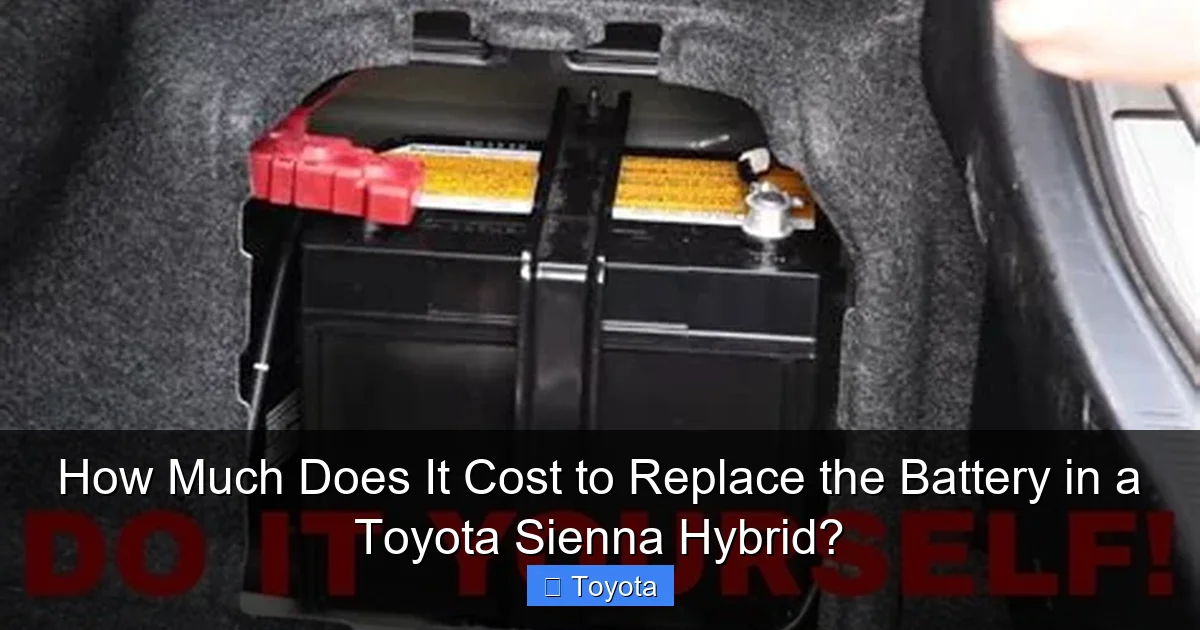
Visual guide about How Much Does It Cost to Replace the Battery in a Toyota Sienna Hybrid?
Image source: autozonic.com
On average, across most model years and regions, you should prepare a budget of $2,500 to $5,000. The vast majority of quotes will fall somewhere in the middle of that range, around $3,000 to $4,000. Let’s break down where that money goes.
Part 1: The Battery Itself (The Biggest Chunk)
The battery module or pack is the star of the show and the most expensive part. You generally have three choices:
- New OEM (Original Equipment Manufacturer): This is a brand-new battery direct from Toyota. It comes with a full Toyota warranty (often 12 months/unlimited miles). This is the gold standard but also the most expensive, typically ranging from $2,800 to $4,000+ for the part alone, depending on the year and market.
- Remanufactured (Reman): This is a very popular and cost-effective option. A reputable remanufacturer disassembles a used core, tests and replaces only the weak or bad individual NiMH cells or modules, and reassembles it to like-new specifications. These units usually come with a strong warranty (e.g., 12 months/12,000 miles or even 3 years/36,000 miles). The cost for a quality reman battery is typically $1,800 to $3,000. This is where you can save $1,000 or more without necessarily sacrificing reliability.
- Used/Salvage: You can find used batteries from salvage yards or eBay. The price can be as low as $800-$1,500. We strongly caution against this option. You have no idea about the history, state of health, or remaining life of the battery. It could fail again in six months, making it a false economy. The risk is high, and the warranty is usually nonexistent or very short.
Part 2: Labor (The Skilled Hands)
Replacing the Sienna hybrid battery is not a quick job. It’s heavy (100+ lbs), requires unbolting several components, disconnecting high-voltage cables (which must be done following strict safety procedures to avoid electrocution), and often involves removing seats or interior trim. A skilled technician at a dealership or independent hybrid specialist will need between 3 and 5 hours to complete the job.
Labor rates vary wildly. Dealerships in major metropolitan areas might charge $150-$180 per hour. A reputable independent shop might charge $100-$130 per hour. Doing the math:
- 3 hours @ $120/hr = $360
- 5 hours @ $160/hr = $800
So, labor will add at least $300 and can easily reach $800 or more. Always ask for an estimated labor time and hourly rate upfront.
Part 3: The Core Charge (A Temporary Fee)
This is a deposit most shops and parts suppliers charge for the old battery core. The old battery has value because its good cells can be used in remanufacturing. The core charge is typically between $1,000 and $1,500. When the shop returns your old battery to their supplier, that deposit is refunded to them, and it should be credited to your final bill. It’s not an extra cost; it’s a hold. Make sure your invoice clearly shows the core charge and its subsequent refund.
What Factors Influence the Final Price Tag?
Now you know the basic building blocks. But why does one person pay $2,800 and another pay $4,800 for the same job on the same model year? Several key factors swing the price pendulum.

Visual guide about How Much Does It Cost to Replace the Battery in a Toyota Sienna Hybrid?
Image source: i.ytimg.com
Model Year and Generation
The Toyota Sienna has been a hybrid since the 2021 model year (the fourth generation). All 2021-2024 Sienna Hybrids share a very similar, if not identical, hybrid battery system. However, supply and demand, and the maturity of the remanufacturing market, can affect prices. As these vehicles age and more batteries fail, the market for reman units will become more robust, potentially lowering prices. For a 2021 model, a reman battery might be slightly more expensive today than for a 2024 model simply because fewer cores are available for reman yet. Conversely, a brand-new OEM battery for a 2021 might be less available than for a 2024, affecting its price.
Geographic Location and Shop Type
As mentioned, labor rates are tied to local cost of living. Replacing your battery in New York City or San Francisco will cost significantly more in labor than in a midwestern town. Furthermore, the choice of shop is massive.
- Toyota Dealer: Highest confidence in OEM parts and factory-trained technicians. They will install a new battery with a full Toyota warranty. Price is usually at the top of the range. They also have direct access to any Technical Service Bulletins (TSBs) that might affect the procedure.
- Independent Hybrid Specialist: This is often the sweet spot. These shops specialize in hybrid and electric vehicles. They have the expertise, often use high-quality remanufactured batteries with excellent warranties, and their labor rates are lower than the dealer. You can save $1,000-$2,000 here without a proportional drop in confidence.
- General Repair Shop: Be cautious. Unless they have specific, documented experience with Toyota hybrids and the proper safety equipment (like insulated tools and high-voltage safety gloves), this is not the place to go. The risk of improper installation or safety procedures is not worth the potential savings.
Warranty Status (The Most Important Factor)
This cannot be stressed enough. Before you get a single quote, you must verify your hybrid battery warranty status. Toyota provides an excellent warranty on its hybrid components.
In most states, the warranty is 8 years or 100,000 miles, whichever comes first. In states that have adopted California Air Resources Board (CARB) regulations (like California, New York, Vermont, and several others), the warranty is extended to 10 years or 150,000 miles.
Call any Toyota dealer with your VIN, and they can tell you your remaining warranty coverage in 30 seconds. If your Sienna is under this warranty, the replacement should cost you $0 for both parts and labor. You may only be responsible for a small deductible if your state requires one for warranty work (some do not). This makes checking your warranty the absolute first step. For a 2021 Sienna Hybrid, you are likely still under the 10-year/150k-mile warranty if you have under 150,000 miles and are in a CARB state. For a 2023 model, you are almost certainly still under warranty.
The Replacement Process: What to Expect
So, you’ve gotten your quotes, verified your warranty (or lack thereof), and chosen a shop. What actually happens on the day of the repair? Knowing the steps can help you ask the right questions and feel more confident.
Visual guide about How Much Does It Cost to Replace the Battery in a Toyota Sienna Hybrid?
Image source: rparts-sites.s3.amazonaws.com
Step 1: Diagnosis and Verification
A legitimate shop won’t just replace the battery because the light is on. They will perform a full diagnostic scan of the hybrid system using specialized software (like Techstream). They will check the battery’s state of health, looking at individual cell/module voltages and resistance. They need to confirm that the battery itself is the fault and not, for example, a faulty DC-DC converter or an issue with the charging system. A good shop will show you the diagnostic data if you ask.
Step 2: Safety First – High-Voltage Disconnect
This is the most critical safety step. The technician will locate the high-voltage service disconnect plug (usually in a marked compartment under the hood or in the cargo area). They will use a special insulated tool to remove this plug, which physically severs the high-voltage circuit. The system must be verified as “dead” using a high-voltage probe before any physical work on the battery begins. Never, ever let someone work on the hybrid battery without describing this procedure to you.
Step 3: Removal
The heavy battery pack is unbolted from the vehicle’s chassis. This often involves removing interior trim pieces, second-row seat rails, or cargo floor panels to access the mounting bolts. The pack is then carefully lifted out using a hoist or a team of technicians, as it’s too heavy for one person.
Step 4: Installation
The new or remanufactured battery is lowered into position. All mounting hardware is torqued to specification. The high-voltage cables are reconnected, and the service disconnect plug is reinstalled. The technician will then perform a series of initialization procedures on the vehicle’s computer to “introduce” the new battery to the system.
Step 5: Final Testing
The car is started, and the hybrid system is monitored. The technician will clear any diagnostic trouble codes (DTCs) and perform a road test to ensure the vehicle operates correctly in both gasoline and electric modes. They will verify that the hybrid battery state of charge is building properly and that there are no warning lights.
Prolonging Your Hybrid Battery’s Life: Maintenance Tips
While hybrid batteries are incredibly robust, they are not indestructible. Their capacity slowly degrades over many years and cycles. You can’t stop this process, but you can avoid accelerating it. Following these tips can help you get the maximum life from your original battery and avoid a premature replacement.
1. Keep It Cool, But Not Too Cold
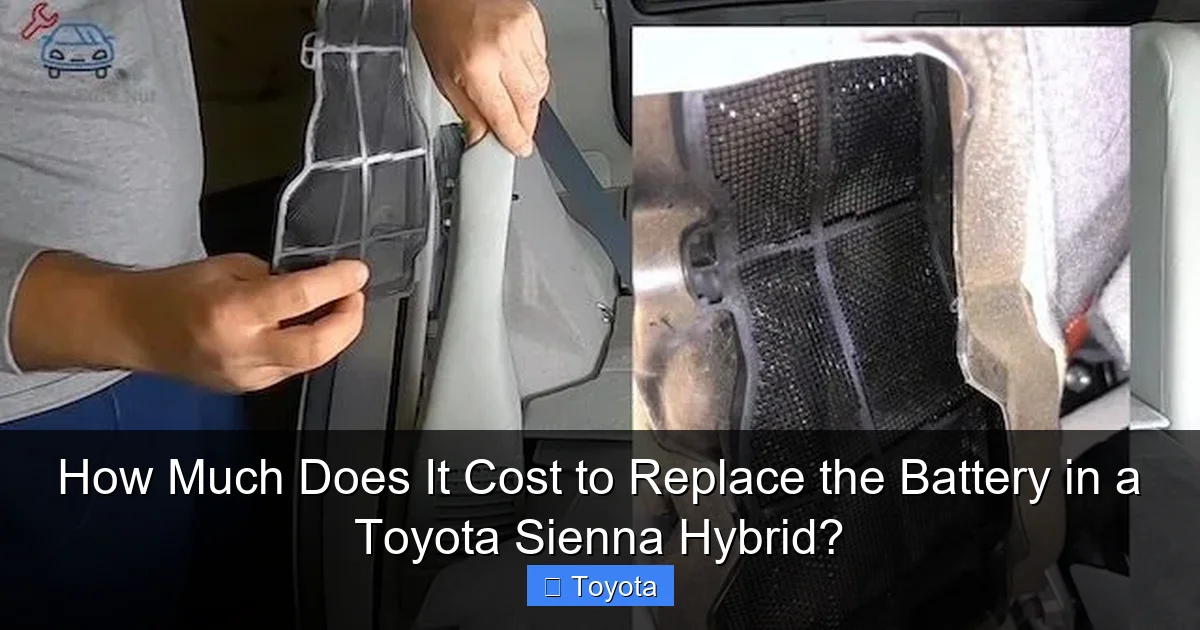
Heat is the number one enemy of the NiMH battery. The Sienna has a dedicated cooling system for the hybrid battery, usually with a blower motor and air ducts. Ensure the air intake for this system (often located behind a trim panel in the cargo area or wheel well) is kept clear of debris, leaves, and dirt. Don’t block it with cargo. A clogged cooling system can lead to overheating and accelerated cell degradation.
2. Drive Consistently, Avoid Short Trips
The hybrid system loves to be used. Very short trips, where the engine barely warms up and the battery never gets a chance to fully charge or discharge, can be hard on it. If possible, combine errands. Occasional longer highway drives are good for the overall health of the powertrain and battery.
3. Don’t Ignore Other Issues
A failing 12-volt battery can put extra strain on the hybrid system. If your 12-volt battery is weak, get it tested and replaced promptly. Similarly, keep your engine in good shape. An engine that runs poorly can cause the hybrid system to work harder, indirectly affecting the battery. Regular oil changes and maintenance are part of protecting your hybrid investment.
4. Storage Considerations
If you plan to store your Sienna for several months, the hybrid battery will self-discharge. Toyota recommends connecting a maintenance charger to the 12-volt battery and, for very long-term storage, possibly taking steps to maintain the hybrid battery’s state of charge. Consult your owner’s manual for specific storage guidelines.
Making the Right Decision: Repair, Replace, or Replace Early?
You have a diagnosis. The hybrid battery is failing. What now? Beyond just paying the bill, you have some strategic considerations.
Option 1: Wait and Save (If It’s Still Under Warranty). If your diagnostic shows the battery is weak but not completely failed, and you are still under the Toyota warranty, you might be able to wait. However, once the battery state of health drops below a certain threshold (often around 40-50% of original capacity), the system will trigger a warning. At that point, Toyota will likely replace it under warranty. There’s no benefit to replacing it early under warranty. If you are out of warranty and the battery is merely weak, you might drive it cautiously until it fully fails, but you risk being stranded with a dead hybrid system that may only propel you a short distance at low speed.
Option 2: Replace with a Quality Remanufactured Battery. For most out-of-warranty owners, this is the most sensible financial decision. A reputable remanufacturer will test the old battery, replace the failing modules, and give you a solid warranty. You get 90% of the performance of a new battery at 60-70% of the cost. Always ask about the warranty specifics—what it covers and for how long.
Option 3: Sell or Trade-In. In a strange twist, a car with a known, failed hybrid battery can sometimes be a burden for a private buyer but an opportunity for a savvy dealer. Some dealerships have programs to buy cars with failed hybrid batteries at a discount because they have in-house hybrid repair facilities. It’s worth getting a trade-in appraisal from a Toyota dealer, as they may offer more than you expect, factoring in their lower repair cost. This can sometimes be a cleaner financial exit than paying for the repair yourself.
Final Thought: The Toyota Sienna Hybrid is an outstanding vehicle. Its hybrid system is proven and reliable. A hybrid battery replacement is a significant, but not uncommon, expense for any high-mileage hybrid vehicle. By understanding your warranty, getting multiple quotes from qualified specialists, and considering remanufactured options, you can navigate this repair with confidence and without financial panic. Remember, this is a long-term investment in keeping your fantastic family hauler on the road for years to come.
For other common Toyota maintenance costs, like an oil change, you can check our detailed guide on how much it costs to change oil in a car. If you’re considering cosmetic upgrades, our articles on wrapping a Toyota Camry or painting a Toyota Tundra might be of interest. For those with other hybrid models, we also have a specific article on how much a Toyota Camry hybrid battery costs, which shares many similarities with the Sienna’s system.
Frequently Asked Questions
Is a Toyota Sienna hybrid battery replacement covered under warranty?
Yes, it is covered under Toyota’s hybrid system warranty, which is 8 years/100,000 miles in most states and 10 years/150,000 miles in CARB states (e.g., CA, NY). You must verify your specific VIN with a dealer to confirm remaining coverage. If under warranty, the repair should have no cost for parts or labor.
How long does a Toyota Sienna hybrid battery typically last?
With proper care, the original hybrid battery is designed to last the life of the vehicle, often exceeding 150,000 miles. However, real-world lifespan varies based on climate, driving habits, and maintenance of the cooling system. Many begin to show reduced capacity around 100,000 to 150,000 miles.
Can I replace the Toyota Sienna hybrid battery myself?
Absolutely not. The high-voltage battery system operates at over 200 volts and can cause severe injury or death if mishandled. Replacement requires specialized high-voltage safety training, insulated tools, and strict procedures. It is illegal in many jurisdictions for unlicensed individuals to work on these systems.
What are the signs of a failing Sienna hybrid battery?
Common signs include: a persistent “Check Hybrid System” warning light, a significant drop in fuel economy, the gasoline engine running more often than usual (especially at low speeds where it previously would have been off), reduced performance, and the vehicle entering a “limp mode” with limited power. The battery state of charge gauge may also behave erratically.
Should I buy a new or remanufactured hybrid battery?
For most out-of-warranty repairs, a high-quality remanufactured battery from a reputable specialist is the best value. It offers significant savings (often $1,000-$2,000 less) and comes with a solid warranty (usually 12 months/12,000 miles or better). A new OEM battery is the most expensive but comes with a full Toyota warranty and zero wear, making it preferable for those wanting absolute peace of mind.
What is a core charge and why do I have to pay it?
A core charge is a deposit (typically $1,000-$1,500) that the parts supplier charges for your old battery. This is because your old battery’s good cells have recycling value. The charge is refunded to the shop—and credited to your final bill—once your old battery is returned to the supplier. It’s not an extra cost; it’s a temporary hold to ensure the old core is returned.
