
How Much Does It Cost to Replace a Toyota Camry Alternator?

Replacing a Toyota Camry alternator typically costs between $400 and $1,200, with the average landing around $500-$800. The final price depends heavily on your Camry’s model year, engine type, and whether you choose an OEM or aftermarket part. Labor rates at a dealership or independent shop are the other major factor. While a skilled DIYer can save significant money on labor, professional installation is recommended for most owners to ensure reliability and proper charging system function.
Let’s be honest: car repairs are rarely fun. They’re often unexpected, and the bill can feel like a punch to the gut. If your trusty Toyota Camry is showing signs of electrical trouble—like a flickering dashboard light or headlights that seem dimmer at night—your alternator might be the culprit. It’s a critical part that you don’t think about until it fails. So, the big question on your mind is, “How much does it cost to replace a Toyota Camry alternator?” We’re going to break down every single factor that influences that final number, from the part itself to the mechanic’s wrench time. By the end, you’ll know exactly what to expect, how to get the best value, and whether you might even tackle this job yourself.
The alternator is essentially your car’s power plant when the engine is running. It converts mechanical energy into electrical energy, recharging the battery and powering all the electronics—your radio, power windows, engine management computer, and lights. When it quits, you’re running on battery power alone, which gives you maybe 30 minutes of driving before everything shuts down. Replacing it isn’t the most complex repair, but it’s not a simple spark plug swap either. The cost isn’t one-size-fits-all because Camrys have been built with different engines over the years, and your location and choice of repair shop play a huge role. We’ll explore all of that, so stick with us.
Key Takeaways
- Total Cost Range: Expect to pay $400 to $1,200+ for a complete alternator replacement on a Toyota Camry, with most repairs falling between $500 and $800.
- Parts are the Biggest Variable: An OEM alternator from a Toyota dealer is the most expensive option, while quality aftermarket or remanufactured units offer significant savings.
- Labor Adds 40-60% to the Bill: Shop labor rates and the specific engine in your Camry (like the 2.5L 4-cylinder vs. 3.5L V6) determine how many hours the job takes.
- Warning Signs are Clear: A dashboard battery light, dimming headlights, or electrical glitches are your car’s primary alerts that the alternator is failing.
- DIY vs. Professional: Replacing it yourself can save $200-$400 in labor but requires mechanical skill and the right tools; professional installation includes a warranty on parts and labor.
- Neglect Leads to Costlier Repairs: Driving with a bad alternator will drain the battery and can eventually leave you stranded with a dead battery and a car that won’t start.
- Get Multiple Quotes: Always compare estimates from at least two or three reputable shops, asking specifically about the brand and warranty of the alternator they will install.
📑 Table of Contents
- Understanding the Alternator and Its Role in Your Camry
- 5 Clear Signs Your Camry’s Alternator is Failing
- The Complete Cost Breakdown: Parts and Labor
- DIY vs. Professional Installation: Which Path Saves You Money?
- 7 Key Factors That Change Your Final Price
- Smart Maintenance Tips to Extend Your Alternator’s Life
- Conclusion: Knowledge is Your Best Tool
Understanding the Alternator and Its Role in Your Camry
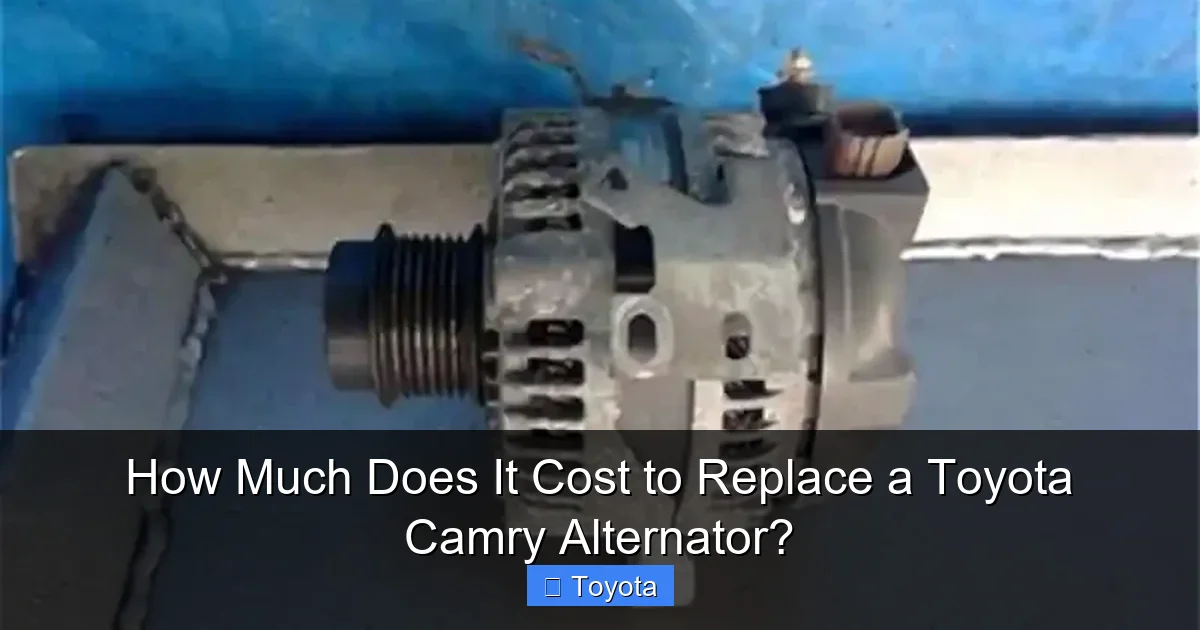
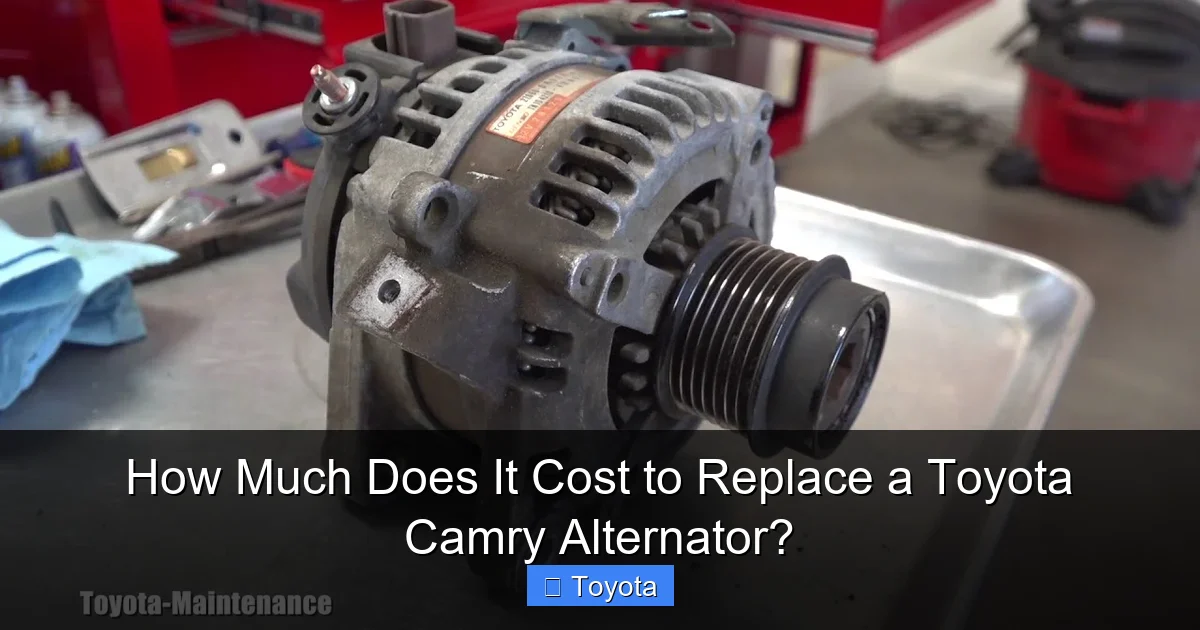
Before we dive into dollars and cents, it helps to understand what you’re paying for. The alternator is a belt-driven generator. As your Camry’s engine runs, a serpentine belt spins the alternator’s pulley, which spins a rotor inside a stator, creating an electrical current. That current is regulated and sent to the battery and the vehicle’s electrical system. It’s a workhorse part that spins at thousands of RPMs for years on end. Over time, the internal brushes, bearings, and diodes wear out, leading to the failure you’re now facing.
The Anatomy of an Alternator Cost
When you get a quote, it’s almost always split into two buckets: parts and labor. The parts cost is where you have the most control and the biggest price swings. There are generally three tiers of replacement alternators you’ll encounter:
- OEM (Original Equipment Manufacturer): This is the exact part that Toyota put in your Camry when it was new. It’s sourced from the same supplier (often Denso or Aisin) and meets all of Toyota’s original specifications. It’s the gold standard for reliability and warranty but comes at a premium price. An OEM alternator for a recent model-year Camry can easily run $700 to $1,000+ before any core charge is applied.
- Remanufactured: This is a used OEM core that has been completely disassembled, all worn parts replaced (brushes, bearings, diodes, voltage regulator), and then rigorously tested to meet or exceed original specs. It’s a fantastic middle-ground option. You get the quality of an OEM part without the full new-part price. A remanufactured unit typically costs $300 to $600.
- Aftermarket: These are new alternators built by third-party companies like Bosch, Remy, or Standard Motor Products. Quality varies widely. Top-tier aftermarket brands are excellent and often come with strong warranties. Budget options exist but may have shorter lifespans. Prices range from $200 to $500.
It’s critical to ask your mechanic or parts store exactly what brand and type of alternator they are quoting. Never assume “new” means OEM. A $250 “new” alternator is almost certainly a low-end aftermarket unit.
5 Clear Signs Your Camry’s Alternator is Failing
How do you know the alternator is the problem and not just a dead battery? A battery can die for many reasons, but a failing alternator has a distinct set of symptoms. Catching these early can save you from a complete breakdown and a potential tow bill.
Visual guide about How Much Does It Cost to Replace a Toyota Camry Alternator?
Image source: i1.wp.com
The Illuminated Battery/Charging Light
This is the most obvious and direct warning. The little battery-shaped light on your dash is connected to the charging system. When the alternator’s output drops below a certain threshold, the car’s computer turns on the warning light. If this light comes on while you’re driving, it means your car is running on battery power alone. Turn off all non-essential electronics (radio, A/C, heated seats) and get to a safe place or a shop immediately.
Dim or Flickering Headlights and Interior Lights
Since the alternator supplies power to all lights, a struggling unit can’t maintain consistent voltage. You might notice your headlights dim noticeably when you come to a stop (the engine RPM drops, alternator output dips) or when you turn on the wipers or defroster. Interior dome lights might flicker. This is a classic sign of an alternator on its last legs.
Electrical Component Glitches and Slow Cranking
Modern cars are full of sensitive electronics. A weak alternator can cause strange issues: your power windows might move slowly, the radio might cut in and out, or you might see error messages on the display. Additionally, if you go to start your car and the engine cranks slowly and labored, it could be because the battery wasn’t properly charged by the alternator. A weak battery can also cause this, so it’s a symptom that requires further diagnosis.
Unusual Noises
A failing alternator often makes noise. You might hear a grinding, whining, or squealing sound. A grinding noise usually points to worn-out internal bearings. A high-pitched whine or squeal can come from a loose or failing serpentine belt, or from the alternator’s internal diodes. If the noise changes pitch with engine speed, it’s a strong indicator the alternator is the source.
Dead Battery (Repeatedly)
If you jump-start your Camry and it runs fine, but the battery is dead again the next day or after a short drive, the alternator isn’t recharging the battery. A healthy alternator will replenish the battery’s charge in about 30 minutes of highway driving. If it can’t do that, it’s defective. Before blaming the alternator, a good mechanic will first test the battery itself, as a shorted cell in an old battery can also prevent proper charging.
The Complete Cost Breakdown: Parts and Labor
Now, the number you’ve been waiting for. Let’s build a realistic cost estimate for a 2018 Toyota Camry SE with the 2.5L 4-cylinder engine—one of the most common configurations. We’ll use national averages, but remember your local market will vary.
Visual guide about How Much Does It Cost to Replace a Toyota Camry Alternator?
Image source: i.ytimg.com
Parts Cost: The Heart of the Expense
For our example Camry, here’s what you might pay for the alternator itself from different sources:
- Dealership (OEM): $750 – $1,100. This includes the core charge. You’ll get your old (core) alternator back if you return it, but you pay the full price upfront.
- National Auto Parts Chain (Remanufactured): $450 – $650. Stores like AutoZone, Advance Auto Parts, and O’Reilly offer remanufactured units with decent warranties (often 3-5 years/unlimited miles). This is a very popular and reliable choice.
- Independent Mechanic (Aftermarket/Reman): $350 – $550. Shops often have preferred suppliers and may get a better price, passing some savings to you. They’ll typically install a reputable brand.
- DIY from Online/Wholesale: $250 – $450. If you’re buying the part yourself from RockAuto, eBay, or a wholesale distributor, this is your ballpark for a good quality unit.
Labor Cost: The Skill Tax
This is where the total cost really diverges. Labor is billed by the hour, with rates varying dramatically by region and shop type. The “book time” (the time the manufacturer estimates the job should take) for a Camry alternator replacement is typically between 1.5 and 2.5 hours.
- Dealership Labor Rate: $120 – $180 per hour. At 2 hours, that’s $240 – $360 in labor alone. Dealerships charge a premium for certified technicians and factory training.
- Independent Shop Labor Rate: $80 – $130 per hour. This is the most common range. For our 2-hour job, that’s $160 – $260.
- Mobile Mechanic: $90 – $150 per hour, plus sometimes a service call fee. Convenience comes at a slight premium.
Total Estimated Repair Bill (Parts + Labor)
Let’s combine these numbers for our common 2018 Camry 2.5L:
- Dealership (OEM Part): ($900 parts avg) + ($300 labor avg) = $1,200+
- Independent Shop (Reman Part): ($500 parts avg) + ($210 labor avg) = $710
- DIY (Aftermarket Part): ($350 parts) + ($0 labor) = $350
Important Note: Your total could be lower if your Camry has the easier-to-access 4-cylinder engine (most are), or higher if you have the 3.5L V6, which often has more components in the way, increasing labor time. Some V6 models can take 3+ hours, adding $100-$200 to the labor cost.
DIY vs. Professional Installation: Which Path Saves You Money?
This is the million-dollar question. If you have basic mechanical aptitude and a set of sockets, you can save the entire labor cost. But is it worth the risk and hassle?
Visual guide about How Much Does It Cost to Replace a Toyota Camry Alternator?
Image source: i.ytimg.com
The DIY Route: Tools, Time, and Troubleshooting
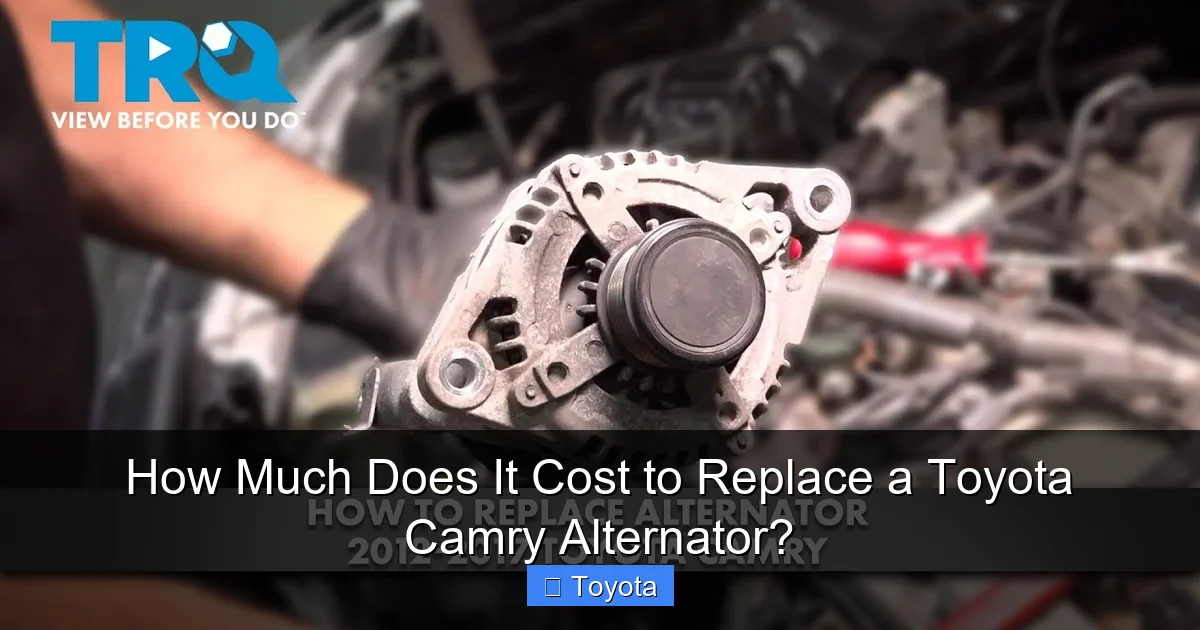
What you’ll need: A good socket set and ratchet, a torque wrench (crucial for proper serpentine belt tension), possibly a breaker bar for tensioner pulley, a multimeter to test the old and new alternator, and safety glasses/gloves. You’ll also need to figure out the exact belt routing, which can be tricky on some models. A repair manual (like Haynes or Chilton) or a detailed YouTube video for your specific year Camry is invaluable.
The process in a nutshell: Disconnect the battery, remove the serpentine belt, unbolt the alternator (usually 2-3 bolts), disconnect the electrical wiring harness, remove the old unit, install the new one, re-connect wiring, re-install and tension the serpentine belt correctly, reconnect the battery, and start the engine to check voltage output (should be ~13.8-14.4 volts).
Potential Pitfalls: Over-tightening or under-tightening the belt can cause premature bearing failure or belt slippage. Forgetting to disconnect the battery first can cause a short circuit. Incorrectly routing the belt means your water pump and power steering could fail. If you make a mistake, you could cause hundreds more in damage. For the DIYer, the real savings is in labor, but the risk is in a botched installation that damages other components.
The Professional Route: Warranty, Peace of Mind, and Speed
Taking your Camry to a trusted mechanic or the dealership comes with significant intangible benefits:
- Diagnostic Confidence: A good tech won’t just replace the alternator; they’ll test the charging system output, check the battery health, and inspect the belt and tensioner. They might find a worn belt that should be replaced now ($50-$100 part) to protect your new alternator.
- Warranty Coverage: You get a warranty on both the part (often 12 months/unlimited miles for reman, 3-5 years for some aftermarket) AND the labor. If the new alternator fails or was installed incorrectly, the shop fixes it at no extra cost. DIY has no safety net.
- Proper Disposal: Shops handle the old alternator and its core charge for you. If you DIY, you must return the core to the parts store to get your deposit back, which is an extra trip.
- Time and Convenience: A professional can usually do this job in 1-2 hours. For a DIYer, it might take 3-4 hours of fumbling, especially the first time. Your time has value.
Our Recommendation: If you are comfortable with intermediate automotive repairs and have the tools, the DIY path is viable and can save you $200-$400. However, if you are unsure about any step, the belt routing, or don’t have a multimeter to verify the repair, paying for professional installation is a wise investment that protects your vehicle and your sanity. It’s a repair where the labor cost is a fair price for expertise and a warranty.
7 Key Factors That Change Your Final Price
Even within the same model year, your specific Camry’s repair cost can differ. Here are the variables that shops consider when giving you a quote.
1. Model Year and Engine Type
This is the primary factor. A 2012 Camry with the 2.5L 4-cylinder has a very straightforward alternator location. A 2024 Camry Hybrid has a different, more complex system with a dedicated hybrid battery and a different alternator (often called a “converter” or “DC-DC converter”) that is much more expensive and difficult to replace—costs can easily exceed $2,000. The 3.5L V6 models from 2012-2017 have tighter engine bays, increasing labor time. Always specify your exact engine when asking for a quote.
2. Your Geographic Location
Labor rates are not uniform. A shop in Manhattan or San Francisco might charge $180/hour, while a shop in a small town in the Midwest might charge $85/hour. This alone can create a $200+ swing in your total bill. Dealerships in major metropolitan areas are almost always at the top of the rate spectrum.
3. Shop Type: Dealership vs. Independent vs. Chain
We touched on this, but it bears repeating. Dealerships are the most expensive but use OEM parts and factory-trained technicians. Independent shops offer the best balance of price and quality if you find a reputable one. National chain stores (like Midas, Meineke, or Valvoline Instant Oil Change) often have standardized pricing and promotions, but quality can vary by location.
4. The Condition of Related Components
A smart mechanic will inspect the serpentine belt, belt tensioner, and idler pulleys while the alternator is off. If the belt is cracked, glazed, or has 100,000 miles on it, replacing it now is a smart preventative move. A failing tensioner will kill a new alternator quickly. Adding a belt ($40-$80 part) and tensioner ($100-$200 part + labor) can add $150-$300 to your bill but saves you from a comeback repair in 6 months.
5. The Part You Choose: New, Reman, or Used
We covered this in the breakdown, but it’s a major cost driver. A used alternator from a junkyard might be $100, but it’s a gamble—you have no idea of its history or remaining life. It’s rarely recommended unless it’s an absolute emergency and you plan to replace it properly soon. The savings aren’t worth the risk of being stranded again.
6. Additional Electrical System Issues
Sometimes the alternator is fine, but the problem is a bad connection, a blown fuse, or a faulty voltage regulator in the engine control unit. A thorough diagnostic should rule these out. If the issue is a simple corroded ground strap, the fix could be $50. Make sure you’re paying for the correct repair.
7. Warranty and Service Contracts
If your Camry is still under the original Toyota powertrain warranty (typically 5 years/60,000 miles), the alternator might be covered as a powertrain component (it’s not always, so check your warranty booklet). Also, if you purchased an extended service contract (vehicle service agreement), it may cover the repair. Always check these first before paying out of pocket.
Smart Maintenance Tips to Extend Your Alternator’s Life
Your alternator is a robust part, but it works hard. You can help it last longer with a few simple practices.
Keep Your Electrical System Clean and Tight
Corrosion on the battery terminals and the alternator’s electrical connections increases resistance, forcing the alternator to work harder and run hotter. Periodically (once a year) disconnect the negative battery terminal, clean the posts and clamps with a baking soda/water solution and a wire brush, and re-tighten. Check the main power cable from the alternator to the battery for any signs of fraying or corrosion.
Replace the Serpentine Belt Proactively
This belt is the alternator’s lifeline. A worn, glazed, or loose belt can slip, causing the alternator to spin at the wrong speed and not generate proper voltage. It also puts uneven stress on the alternator bearings. Inspect the belt for cracks, glazing (shiny appearance), or chunks missing. Toyota’s recommended interval is often around 60,000 miles, but inspect it at every oil change. Replacing it preemptively is cheap insurance.
Address Engine Mount Issues
Worn engine mounts allow the engine to shift excessively under acceleration. This can put abnormal stress and misalignment on the serpentine belt and its pulleys, including the alternator pulley, leading to premature bearing wear. If you feel excessive engine vibration or thumping during acceleration, have your mounts checked.
Limit Aftermarket Electrical Accessories
Adding high-draw accessories like powerful aftermarket stereo amplifiers, off-road lights, or high-output USB chargers without upgrading the charging system puts a constant, heavy load on the alternator. If you’re adding significant electrical demand, consider upgrading to a higher-amperage alternator (if available for your model) to avoid premature failure.
Listen and Look Early
That faint whine or the slightly dim headlights at idle? Don’t ignore them. Catching a failing alternator in its early stages usually means you only need to replace the alternator. Waiting until it completely fails often means you also need a new battery, as a deeply discharged lead-acid battery can be permanently damaged. Early action saves you the cost of a new battery ($150-$250).
Conclusion: Knowledge is Your Best Tool
So, how much does it cost to replace a Toyota Camry alternator? The honest answer is: it depends. But now you have the framework to understand any quote you receive. You know that a bill around $500-$800 for a well-running 4-cylinder Camry with a quality remanufactured part is very fair. You understand why a dealership quote of $1,200+ isn’t necessarily a rip-off—it’s for an OEM part and certified labor. You can now confidently ask a shop, “Is that an OEM or aftermarket alternator? What’s the labor rate? Is the belt being replaced? What’s the warranty on parts and labor?”
This repair is a classic automotive trade-off: cost versus convenience and security. The DIY route offers maximum savings but requires skill and carries risk. The professional route offers a warranty and peace of mind at a higher price. For most Camry owners, using a reputable independent mechanic with a good remanufactured alternator and a new serpentine belt is the sweet spot. It protects your investment in your reliable Camry without breaking the bank.
Finally, remember that your Camry is a remarkably dependable vehicle. Addressing this alternator issue promptly gets you back to that worry-free driving experience Toyota is known for. And while you’re investing in keeping your Camry running perfectly, you might also be thinking about its appearance. If you’ve ever wondered about the cost to give your Camry a fresh, new look, our guide on how much does it cost to wrap a Toyota Camry provides a fantastic breakdown of that popular cosmetic upgrade. A well-maintained, great-looking Camry is a joy to own for years to come. Don’t let a failing alternator sideline yours.
Frequently Asked Questions
Can I drive my Toyota Camry with a bad alternator?
You can drive it for a short distance, but it’s not advisable. Once the alternator fails, you’re running solely on the battery’s remaining charge, which typically lasts 20-40 minutes of driving. Driving further will drain the battery completely, leaving you stranded. It’s best to address the issue immediately.
How long does a Toyota Camry alternator replacement take?
A professional mechanic can usually complete the job in 1.5 to 2.5 hours, depending on the engine type (4-cylinder is faster than V6). For a skilled DIYer with the right tools and instructions, expect to spend 3-4 hours. The time is mostly spent on accessing the alternator and properly re-tensioning the serpentine belt.
Should I replace the battery when I replace the alternator?
Not necessarily, but you should have the battery tested. A severely discharged battery from a failed alternator can be permanently damaged and may not hold a charge. If the battery test shows it’s weak or old (over 4-5 years), replacing it at the same time is a wise investment to avoid future trouble.
Is a remanufactured alternator a good choice for my Camry?
Yes, absolutely. A quality remanufactured alternator from a reputable brand or parts store is an excellent value. It’s rebuilt to meet or exceed original specifications and typically comes with a solid warranty (often 3-5 years/unlimited miles). It’s the preferred choice for most independent shops and DIYers.
What’s a core charge and why do I have to pay it?
A core charge is a deposit you pay when you buy a remanufactured or rebuilt part. It’s essentially a fee for the old, worn-out part (the “core”) that the rebuilder needs to rebuild your new unit. When you return your old alternator (in most cases, within a set time frame), you get the core charge refunded. It incentivizes you to return the old part for recycling.
Can a bad alternator cause my check engine light to come on?
Yes. The alternator’s voltage output is monitored by the car’s computer (PCM/ECU). If the voltage is too high or too low, it will log a diagnostic trouble code (like P0562 for system voltage low) and illuminate the check engine light. This is a common secondary symptom of alternator failure.