
How Many Miles Can I Go Over My Oil Change on My Toyota Corolla

Sticking to your Toyota Corolla’s recommended oil change interval is crucial for engine longevity. While modern synthetic oils and engine technology offer some flexibility, consistently exceeding the recommended mileage—typically 5,000 to 10,000 miles—increases wear and risks costly damage. Factors like severe driving conditions (extreme temps, stop-and-go traffic, dusty roads) often require more frequent changes. The safest approach is to follow Toyota’s guidelines in your owner’s manual and use the maintenance minder system if equipped, rather than pushing your luck on miles.
Ah, the oil change. It’s the most common and arguably most important routine maintenance for your Toyota Corolla. You see the sticker on your windshield, you hear the reminder chime, and the thought inevitably creeps in: “How many miles can I *really* go over my oil change?” It’s a tempting question, especially when life gets busy or you’re trying to save a few bucks. But when it comes to your engine’s lifeblood, the answer isn’t simple, and pushing the limit can be a gamble with very high stakes.
The Toyota Corolla is famous for its reliability and longevity. A big part of that reputation is due to proper maintenance, with regular oil changes at the top of the list. Oil is the unsung hero of your engine. It lubricates moving parts, reduces friction, helps cool the engine, seals piston rings, and suspends harmful contaminants. Over time and with use, oil breaks down. Its chemical additives deplete, it gets contaminated with fuel, water, and metal particles, and its viscosity (thickness) changes. An oil change replaces this degraded fluid and the filter that traps solids, giving your engine a fresh start.
So, what’s the real answer? How many miles can you safely go over? The short, responsible answer is: as few as possible, and ideally, zero. But let’s dig into the details, the manufacturer’s logic, the real-world variables, and the very real consequences of waiting too long. We’ll talk about your specific Corolla, from a 2010 model to a 2024, and help you make an informed decision that protects your investment.
Key Takeaways
- Toyota’s official recommendation is your primary guide: Newer Corollas with synthetic oil often use a 10,000-mile interval, but older models or those using conventional oil may require changes every 5,000 miles. Always check your owner’s manual.
- “Severe” driving conditions shorten the interval: Frequent short trips, extreme temperatures, heavy traffic, towing, or dusty environments mean you should change oil more often than the standard recommendation.
- Going significantly over increases engine wear: Oil degrades over time and mileage, losing its ability to lubricate, cool, and clean. This leads to sludge, increased friction, and premature wear on vital parts like bearings and camshafts.
- The oil type matters immensely: Full synthetic oil lasts longer and protects better than conventional oil. Using the correct oil grade (e.g., 0W-16 for many modern Corollas) is non-negotiable for achieving the recommended interval.
- Your driving habits are a major factor: Highway driving is gentle on oil; constant city stop-and-go is severe. Be honest about your driving style when deciding if you can extend an interval.
- Never ignore the maintenance minder: If your Corolla has Toyota’s Maintenance Required light, it calculates service needs based on engine operations. Resetting it without changing the oil is a false economy.
- Adding oil is not a substitute for changing it: Topping up between changes keeps the level full but does not replace the exhausted additives or remove contaminants. The oil filter also needs regular replacement.
📑 Table of Contents
Toyota’s Official Stance: What the Manual Actually Says
The absolute best starting point for any question about your Corolla is the official owner’s manual. Toyota engineers the engine and specifies the lubricants for a reason. They provide a recommended oil change interval based on extensive testing. This is not a random number; it’s a calculated balance between optimal engine protection, oil technology, and convenience.
The Modern Standard: 10,000-Mile Intervals with Synthetic
For most newer Toyota Corollas (typically model years 2011 and newer, but confirm for your specific year and engine), Toyota recommends using full synthetic oil and changing it every 10,000 miles or 12 months, whichever comes first. This is a significant jump from the old 3,000-mile rule of thumb from the era of conventional oil. This longer interval is made possible by the superior stability and longevity of modern synthetic base stocks and advanced additive packages. They resist thermal breakdown (from engine heat) and oxidative degradation (from exposure to air) much better.
If your Corolla is equipped with the Maintenance Required light/reminder system (most are), this 10,000-mile interval is often what it’s programmed to track. The system monitors engine runtime, vehicle speed, and other parameters to calculate when service is due. When the light illuminates, it’s signaling that the system’s calculated interval has been reached, which typically aligns with the 10,000-mile/12-month schedule for normal driving.
The Conventional Oil & Older Model Reality
If you own an older Corolla (pre-2011, roughly) or if you are using conventional mineral oil instead of synthetic (which is generally not recommended for modern Corollas), the interval drops dramatically. Toyota’s recommendation for conventional oil in older models was often every 5,000 miles or 6 months. Some older manuals even suggested 3,000 miles for severe conditions. The difference in longevity between conventional and synthetic oil is stark.
It’s critical to use the oil viscosity and specification that Toyota calls for. For example, many recent Corollas require 0W-16 oil, a very thin synthetic designed for maximum fuel efficiency. Using a thicker oil like 5W-30 can harm the engine and may not allow you to safely extend to the 10,000-mile interval. You can find the exact specification on the oil cap or in your manual. For precise capacity and type, always refer to a guide like how much oil a Toyota Corolla takes for your specific model year.
The “Severe Service” Schedule: The One You’re Probably On
Buried in every owner’s manual is a table with two columns: “Normal” driving conditions and “Severe” driving conditions. Here’s the secret: very few drivers actually qualify for the “Normal” schedule. Toyota defines severe conditions as:
- Driving mostly on short trips (less than 5 miles in normal temperatures, or less than 10 miles in freezing temps).
- Extensive idling or stop-and-go traffic in hot weather.
- Driving in extremely cold (below 10°F) or extremely hot (above 100°F) temperatures.
- Driving on dusty, muddy, or salty (winter road treatment) roads.
- Towing a trailer or carrying heavy cargo.
If any of these sound like you—and for most people, several do—then your Corolla is operating under the severe service schedule. For many models, this means an oil change every 5,000 miles or 6 months, even if you’re using synthetic oil. The Maintenance Minder system in your car is designed to account for these conditions and may call for service sooner than the 10,000-mile benchmark. Ignoring this “severe” classification is one of the most common ways drivers exceed safe intervals without even realizing it.
The Real-World Factors That Change the Equation
So you have the manual recommendation. But the real world is messy. Your specific driving habits, environment, and even the oil filter you choose can add or subtract miles from your safe change window. Let’s break down the key variables.
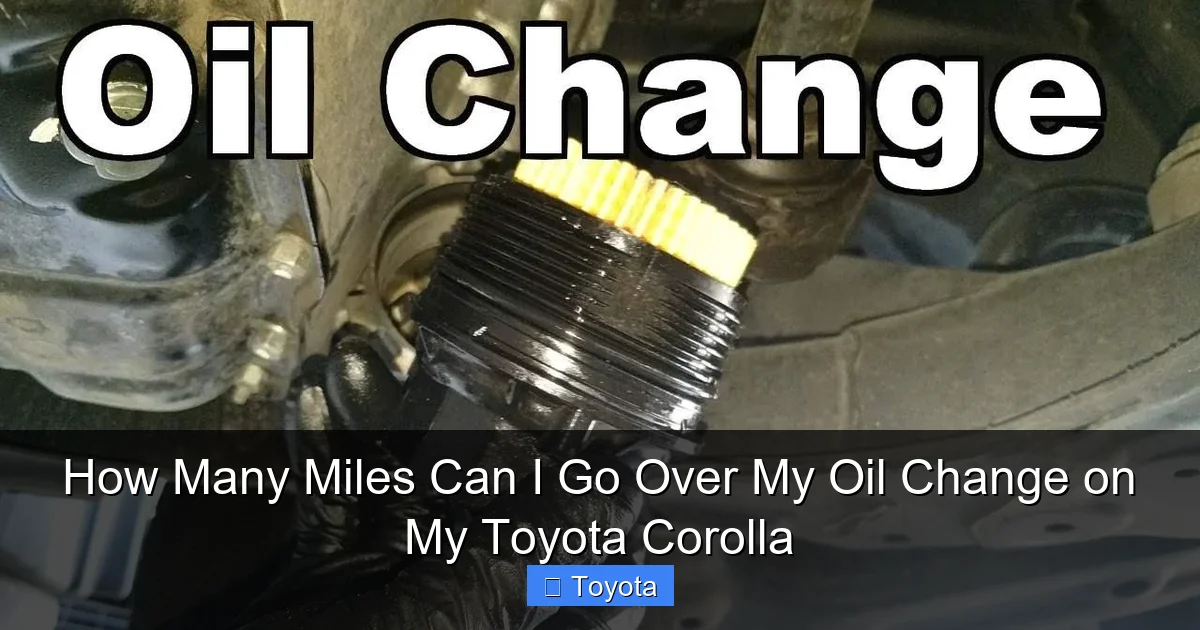
Visual guide about How Many Miles Can I Go Over My Oil Change on My Toyota Corolla
Image source: i.ytimg.com
Your Driving Style: Highway vs. City
This is the single biggest factor after oil type. Highway driving is easy on your engine and your oil. The engine operates at a steady, optimal temperature, there’s less frequent start-stop wear, and contaminants are burned off. A Corolla driving 500 miles a week on the interstate can likely hit the upper end of its interval.
City driving is the opposite. Constant acceleration and braking, long periods of idling at lights, and repeated cold starts mean the engine runs at lower average temperatures. This prevents fuel and water vapors from fully evaporating and being vented, leading to fuel dilution and sludge formation in the oil. If your Corolla is a dedicated city commuter with short trips, you should be changing oil at the severe service interval or even sooner.
Climate and Environment: Heat, Cold, and Dust
Extreme Heat: High ambient temperatures thin the oil and accelerate oxidation. If you live in Arizona or Texas, your oil is working harder to protect your engine.
Extreme Cold: In Minnesota or Canada, cold starts are brutal. The oil must flow quickly to lubricate on startup, and short trips don’t allow the engine to fully warm up, causing fuel and moisture to contaminate the oil.
Dust and Dirt: If you drive on rural, gravel, or untreated winter roads, more airborne contaminants can work their way past the air filter and into the combustion chamber, eventually ending up in your oil. The oil filter catches them, but a clogged filter reduces flow. In dusty conditions, you might consider more frequent changes and always use a high-quality filter.
For those in harsh climates, it’s wise to check out other Toyota-specific guides, like how many miles a Toyota Avalon can last, to see how different models and driving conditions interplay for longevity.
Oil Quality and Filter Choice: You Get What You Pay For
Not all synthetic oils are created equal. A high-quality oil that meets Toyota’s specifications (look for API SP and ILSAC GF-6 ratings, and Toyota’s own TSNM 0W-16 specification) will have superior additive packages for wear protection, sludge prevention, and fuel economy. A budget synthetic might meet the minimum spec but degrade faster. Stick to reputable brands.
Similarly, the oil filter is your engine’s second line of defense. A cheap, low-efficiency filter allows more abrasive particles to circulate. A high-quality filter with better media and a robust construction (like those from OEM Toyota, Mobil 1, Wix XP, or K&N) will trap more contaminants and maintain better flow over its lifespan. Pairing a long drain interval with a cheap filter is a recipe for accelerated wear.
Vehicle Age and Condition
A newer Corolla with tight engine tolerances and fresh seals runs more efficiently and burns less fuel, which means less fuel dilution in the oil. As your engine ages (say, past 100,000 miles), seals can become slightly less effective, and general wear might allow for a tiny bit more blow-by (combustion gases entering the crankcase). This can contaminate the oil faster. While the interval doesn’t change dramatically, an older, high-mileage Corolla might benefit from sticking to the lower end of the range or using a high-mileage synthetic oil formulated with seal conditioners.
The Risks of “Going the Extra Mile”: What Happens When You Overextend
This is the most important section. Understanding the consequences of skipping or delaying an oil change makes the decision crystal clear. You’re not just risking a “check engine” light; you’re actively degrading your engine from the inside out.

Visual guide about How Many Miles Can I Go Over My Oil Change on My Toyota Corolla
Image source: i.ytimg.com
Oil Breakdown and Loss of Protection
Oil’s viscosity is carefully engineered. As it ages, its molecules shear and break down from heat and pressure. It becomes thinner (loses its high-temperature viscosity) or thicker (from sludge formation). Both are bad. Thin oil can’t maintain the protective film between metal parts, leading to metal-on-metal contact. Thick, sludgy oil clogs oil passages, starving critical components like the camshaft and crankshaft bearings of lubrication. The result is increased friction, excessive heat, and accelerated wear.
Acid Buildup and Corrosion
One of oil’s key additives is a detergent that neutralizes acids formed by the combustion process. As these additives deplete, the acids remain in the oil. These acids are corrosive and can slowly eat away at bearing surfaces, cylinder walls, and other precision-machined metal parts. This type of damage is silent and irreversible.
Sludge and Deposits: The Engine Killer
This is the most visible and common problem with neglected oil changes. When oil degrades, it can no longer keep contaminants in suspension. They clump together with oxidized oil molecules to form a thick, tar-like sludge. Sludge can block oil galleries (the tiny passages that deliver oil to the top of the engine), coat the lifters and cam lobes causing ticking and wear, and plug the oil pump pickup screen, leading to oil starvation and catastrophic failure. Cleaning sludge out requires a costly engine teardown or, in worst cases, engine replacement. For a practical look at how long a car can go without an oil change before these issues become critical, see how long a car can go without an oil change.
The Oil Filter Becomes a Liability
Oil filters have a finite capacity. They can only hold so many grams of dirt before they become clogged. A clogged filter causes a major pressure drop, forcing the engine to use a bypass valve that sends unfiltered oil directly to the engine. All the gunk your filter caught over the last 5,000 miles is now circulating freely. Additionally, a severely overdue change means the oil itself is so thick with sludge that it can’t even flow properly through a new filter.
Warranty Implications
This is a critical point for newer Corollas still under warranty. Toyota’s warranty requires that you follow the maintenance schedule outlined in the owner’s manual. If you have a catastrophic engine failure and can show a history of significantly extended oil change intervals (e.g., 15,000 miles on a 10,000-mile recommendation), Toyota could deny your warranty claim. They would argue the failure was due to improper maintenance. Keep your receipts as proof of service.
Practical Tips: How to Decide and What to Do
Okay, theory is one thing. You’re sitting there looking at your Corolla’s odometer, and the sticker says “5,500 miles” but you’re at 6,200. What do you do? Here’s a practical framework.
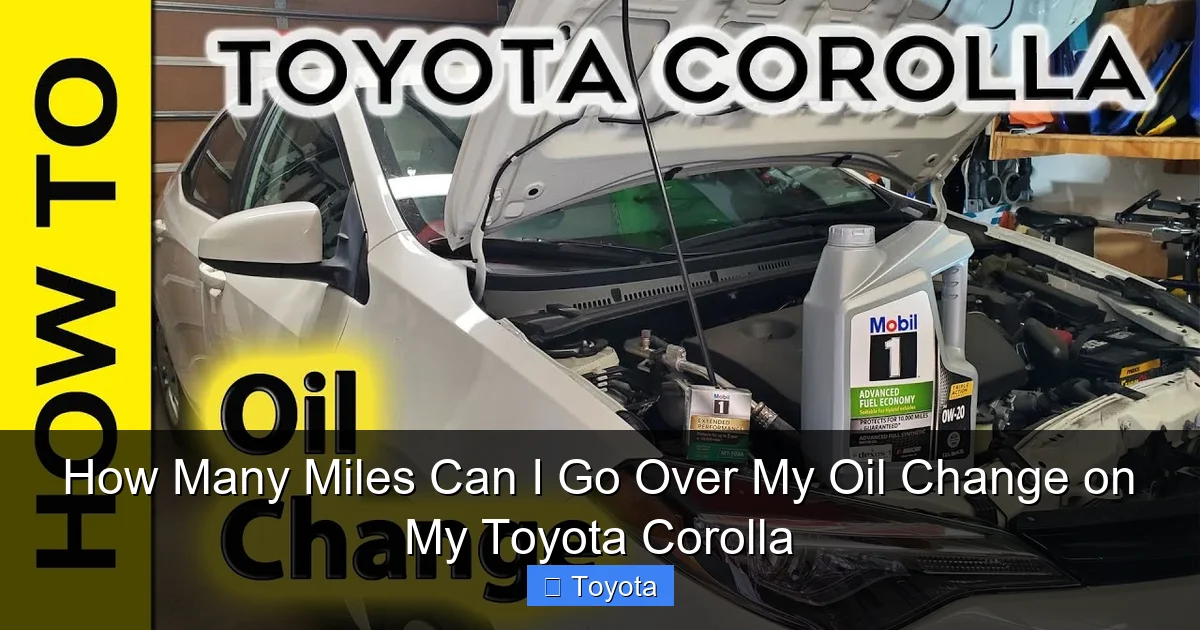
Visual guide about How Many Miles Can I Go Over My Oil Change on My Toyota Corolla
Image source: i.ytimg.com
Step 1: Consult Your Manual and Minder System
First, find the exact recommendation for your model year and engine. Look for the “Normal” and “Severe” schedules. Be brutally honest about which one applies. Second, if your car has a Maintenance Required light, understand what it means. It’s not a “low oil” light; it’s a mileage-based service timer. When it comes on, plan your oil change within the next 1,000 miles or one month. Don’t reset it until the work is done. If you’re unsure how to reset it after a change, a guide like how to reset the oil light on Toyota can walk you through the steps for your specific model.
Step 2: Assess Your Recent Driving
Think about the last 3,000-5,000 miles. Was it mostly highway cruising, or a grind through city traffic? Did you tow a small utility trailer or drive on dusty backroads? Did you experience a heatwave or a polar vortex? If it was a “severe” cycle, don’t push the interval. Change it now, even if you’re a few hundred miles under the sticker.
Step 3: Check the Oil Itself (The Dipstick Test)
Once a month, or before a long trip, pull the dipstick. This is free and takes 30 seconds. Here’s what to look for:
- Level: Is it between the add and full marks? Never let it drop below the add mark. Low oil is an immediate red flag. You can add oil temporarily, but understand that adding oil is not a substitute for changing it.
- Color: New synthetic oil is amber and clear. Used oil darkens to a brown or almost black color. This is normal. However, if it’s milky or foamy, that’s a sign of coolant contamination (a serious problem). If it’s gritty when rubbed between your fingers, the oil is full of solid contaminants and is way overdue.
- Smell: A strong, acrid, burnt smell indicates overheating and severe degradation.
Step 4: When in Doubt, Change It
If you’re questioning whether you’ve gone too far, the answer is almost certainly yes. The cost of an oil change ($50-$80 for a Corolla with synthetic) is trivial compared to the $4,000-$8,000+ cost of rebuilding or replacing an engine. It’s the ultimate “pay me now or pay me later” scenario. When you do get it changed, use a high-quality filter and the exact oil specified. For DIYers, knowing how many quarts of oil a Toyota Corolla takes is essential to avoid over or under-filling.
Conclusion: A Simple Rule for a Reliable Corolla
Your Toyota Corolla is a marvel of efficient, reliable engineering. It will likely outlast many other cars on the road with proper care. The simplest, most effective thing you can do to ensure it reaches 200,000, 300,000, or even more miles is to be religious about your oil changes.
Forget the old 3,000-mile myth. For a modern Corolla using the correct full synthetic oil, a 7,500 to 10,000-mile interval is reasonable under predominantly highway, non-severe conditions. But if your driving is anything less than ideal—and for most of us, it is—lean toward the 5,000 to 7,500-mile range. Heed the Maintenance Minder light. Check your dipstick. And when that sticker date or mileage comes due, get it done. Don’t play chicken with your engine’s lifespan. The peace of mind and long-term savings are worth far more than the few dollars and minor inconvenience of an extra oil change. Keep your Corolla’s heart clean and well-lubricated, and it will reward you with years of dependable, low-cost transportation.
Frequently Asked Questions
Can I just add oil instead of changing it?
No. Adding oil only tops up the level but does not remove the degraded oil, contaminants, or replace the exhausted additives. The oil filter also remains full of debris. This is a temporary fix for a low level, not a maintenance strategy.
What happens if I go 15,000 miles without an oil change in my Corolla?
At that point, your oil has almost certainly turned into a thick, abrasive sludge. It has lost all lubricating and protective properties. You are causing accelerated wear to bearings, camshafts, and piston rings, and risk complete engine failure due to oil starvation or sludge blockage.
Is it okay to change my oil more often than recommended?
Absolutely. Changing your oil more frequently (e.g., every 5,000 miles on a 10,000-mile interval) is not harmful. It’s a low-cost insurance policy that can further reduce wear, especially in severe conditions. The only downside is a slightly higher cost and more frequent shop visits.
Does the “Maintenance Required” light mean my oil is low?
No. This light is a mileage-based service reminder. It tells you it’s time for scheduled maintenance (usually an oil change and tire rotation), not that the oil level is low. A low oil level triggers a separate, red “oil pressure” warning light, which is an emergency.
My Corolla uses 0W-16 oil. Can I use 5W-30 to extend the interval?
Never use a different viscosity oil than specified. 0W-16 is specifically engineered for your engine’s tight tolerances and fuel efficiency goals. Using thicker 5W-30 can cause increased wear, poor fuel economy, and potential damage to variable valve timing systems.
How can I reset the oil change light after I’ve had the service done?
The procedure varies by model year. Typically, you turn the ignition on (not start), turn the odometer/trip meter display to “Trip A,” turn the key off, then turn it back on while holding the trip meter reset button until the light blinks and goes off. For exact steps for your year, consult your owner’s manual or a specific online guide.
