
How Much Does It Cost to Replace a Battery in a Toyota Camry

Replacing a Toyota Camry battery typically costs between $150 and $400 for a conventional 12V battery, while a hybrid Camry’s high-voltage battery replacement can range from $1,000 to $5,000+. The final price depends on your Camry’s model year, battery type (AGM vs. standard), where you buy it, and whether you install it yourself. Always get a professional diagnosis first, as a “dead battery” might indicate a deeper electrical issue.
So you turn the key, and your Toyota Camry just clicks. Or maybe the dash lights are dim. That sinking feeling is universal: your battery is dead. But before you panic about the cost, take a breath. Replacing a battery in a Camry is one of the more common—and often more affordable—auto repairs you’ll face. The price, however, can swing wildly from a couple hundred dollars to several thousand. Let’s pop the hood and break down exactly what you can expect to pay, why prices vary, and how to make the smartest choice for your specific Camry.
First, a critical distinction: we’re talking about two completely different batteries here. Your standard gasoline-powered Camry has a single 12-volt lead-acid or AGM (Absorbent Glass Mat) battery that starts the engine and powers accessories. A Camry Hybrid has that same 12V battery plus a large, high-voltage (usually ~200-300V) lithium-ion or nickel-metal hydride traction battery that works with the electric motor. The cost to replace the 12V battery is a routine maintenance item. Replacing the hybrid battery is a major component repair, akin to replacing a transmission. This guide covers both, but the vast majority of Camry owners will be dealing with the 12V battery.
Key Takeaways
- Conventional 12V battery cost: Expect to pay $150-$400 for parts, with installation adding $50-$120 at a shop.
- Hybrid battery is a major expense: Replacing the high-voltage traction battery in a Camry Hybrid costs $1,000-$5,000+, often with a core charge.
- Your Camry’s specifics matter: Model year, trim level (LE vs. XSE), and whether it has a start-stop system affect battery type and price.
- DIY can save labor costs: Swapping a 12V battery is often a 30-minute DIY job, but hybrids require specialist handling and safety protocols.
- Quality matters more than price: A cheap battery may fail prematurely; stick with reputable brands like Toyota OEM, Interstate, or DieHard.
- Warranty is key: New batteries come with warranties (often 3-5 years). Check if your old battery is under warranty before buying.
- Battery failure often signals other issues: A failing alternator or parasitic draw can kill a new battery quickly. Always have the charging system tested.
📑 Table of Contents
- Understanding Your Camry’s Battery: The 12V vs. The Hybrid Battery
- Cost Breakdown: Replacing the 12V Battery in a Gas-Powered Camry
- Cost Breakdown: Replacing the Hybrid Battery in a Camry Hybrid
- 5 Critical Factors That Change the Final Price
- Should You Replace the Battery Yourself? A Practical Guide
- Pro Tips to Save Money and Extend Battery Life
- Conclusion: A Predictable Cost with a Plan
Understanding Your Camry’s Battery: The 12V vs. The Hybrid Battery
Before we dive into dollars and cents, you must know which battery you’re replacing. Confusing the two will lead to a very unpleasant surprise at the register.
The Standard 12-Volt Battery
This is the battery under your hood. Its job is to power the starter motor, ignition system, lights, radio, and all computer modules when the engine is off. Once the engine is running, the alternator takes over and recharges it. All Camrys, including hybrids, have this 12V battery. In modern Camrys (roughly 2012 and newer), it’s almost always an AGM battery because these vehicles have start-stop systems and more electrical loads. AGM batteries are more expensive but last longer and perform better. If you have a pre-2012 base model Camry, you might have a standard flooded lead-acid battery, which is cheaper.
The High-Voltage Hybrid Battery
Only in the Camry Hybrid. This is the large, often silver, box located behind the rear seat or in the trunk. It’s the heart of the hybrid system, storing energy for the electric motor. It’s not something that wears out like a 12V battery; its failure is less common but catastrophic when it happens. Replacing it is a complex, high-voltage job that should only be done by trained technicians with proper safety equipment. The cost is in a different universe entirely.
Cost Breakdown: Replacing the 12V Battery in a Gas-Powered Camry
Let’s get to the numbers for the most common scenario. A 12V battery replacement is a straightforward part and labor job.
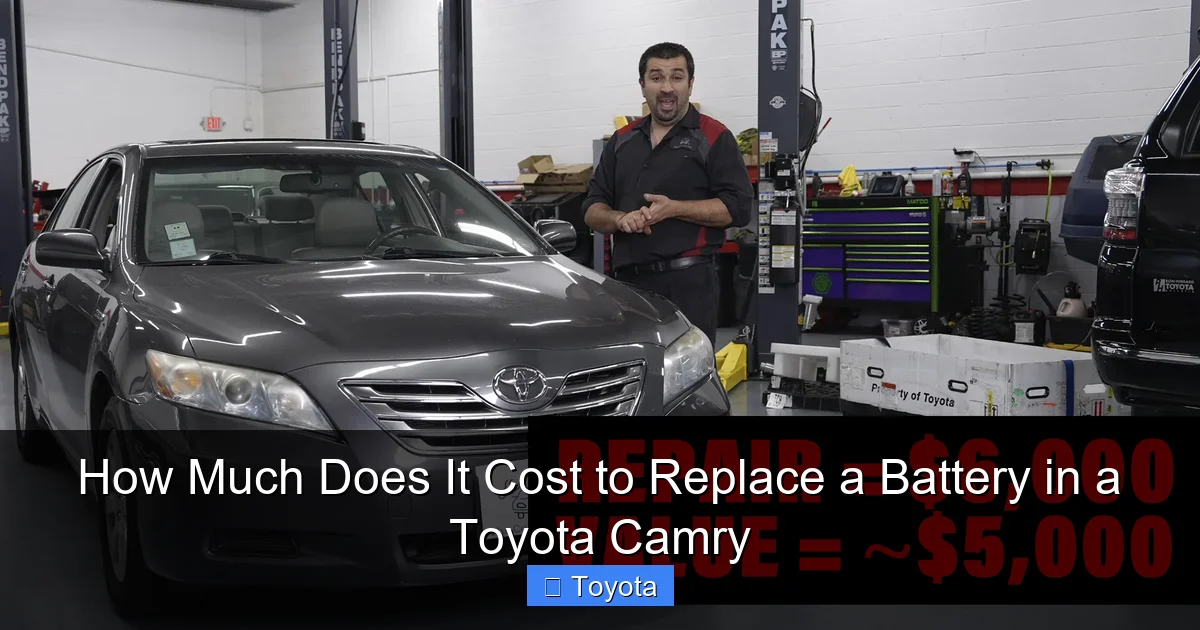
Visual guide about How Much Does It Cost to Replace a Battery in a Toyota Camry
Image source: carscoops.com
Parts Cost: The Battery Itself
The price of the battery depends on its type, brand, and where you buy it. Here’s a realistic 2024 price range for a Group 24F or 35 battery, which fits most modern Camrys:
- Economy/Standard Flooded Lead-Acid: $100 – $160 (Rare for post-2012 models, but may fit older ones)
- AGM (Absorbent Glass Mat): $180 – $300+ (The standard for 2012+ Camrys with Start/Stop)
- Premium/OEM Brand: $220 – $400 (Toyota genuine part, Interstate, Odyssey, Optima RedTop)
You’ll also pay a core charge (typically $15-$30) if you don’t return your old battery. This is refundable.
Labor Cost: Who Installs It?
- DIY Installation: $0. If your Camry’s battery is easily accessible in the engine bay (most are), this is a 20-45 minute job requiring basic tools (wrenches, maybe a socket set). You must connect the positive terminal first, then the negative to avoid electrical issues. Always consult your owner’s manual. Some newer models have the battery in the trunk or under a cover, slightly increasing difficulty.
- Quick Lube/Chain Auto Store (e.g., AutoZone, Advance, O’Reilly): Often free installation with battery purchase. This is the easiest and cheapest route. They have the tools and experience.
- Independent Mechanic or Dealership: $50 – $120 in labor. A dealership will likely charge on the higher end ($90-$120) but will use OEM parts and perform a full system check. An independent shop might be $50-$90.
Total 12V Battery Replacement Cost Scenarios
Let’s put it all together for a typical 2020 Toyota Camry LE with an AGM battery:
- Budget DIY: Buy a quality AGM from a parts store ($200) + install yourself = $200 + core
- Convenience Route: Buy battery with free install from a major retailer ($220-$260) = $220-$260 total
- Dealership Service: OEM battery ($350) + 1 hour labor ($110) = $460 total
Key Takeaway: For a standard 12V battery, you should budget $200-$350 for a complete, professional replacement with a good quality AGM battery. Going to the dealer pushes it toward $400-$500.
Cost Breakdown: Replacing the Hybrid Battery in a Camry Hybrid
This is a different beast. The high-voltage battery pack is a major, expensive component. Failure is relatively rare but will trigger multiple warning lights (check engine, hybrid system warning, triangle with exclamation point).
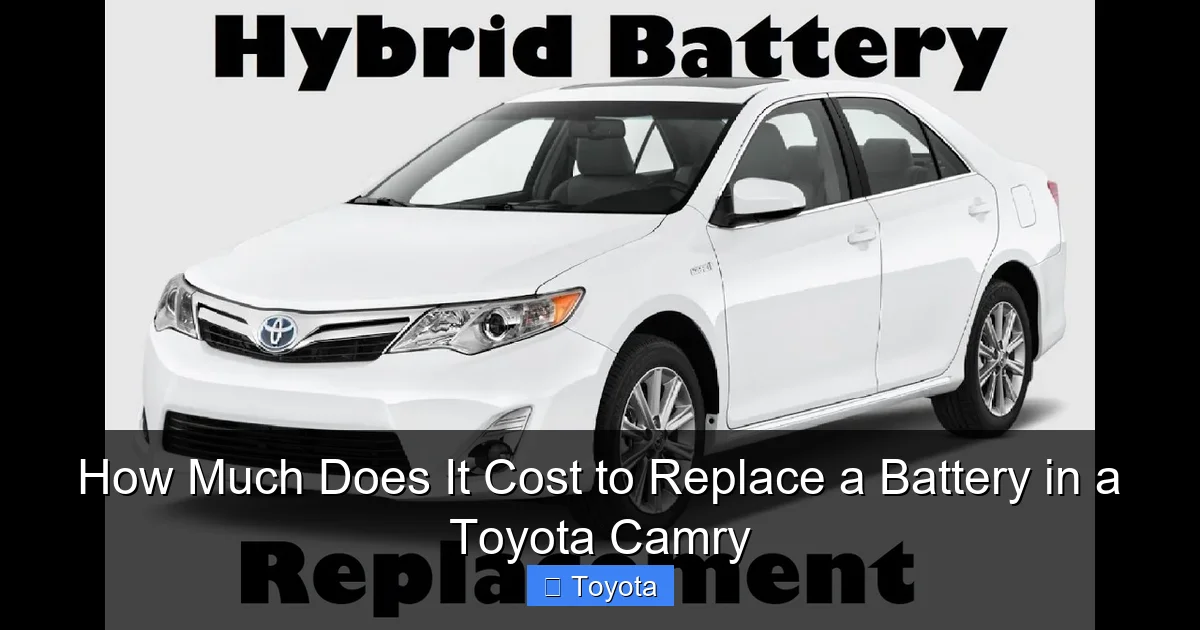
Visual guide about How Much Does It Cost to Replace a Battery in a Toyota Camry
Image source: i.ytimg.com
Parts Cost: The Traction Battery Pack
The cost here is dominated by the battery modules and labor.
- Aftermarket/Remanufactured Pack: $1,200 – $2,500. These are refurbished packs with new cells. Reputable brands offer warranties (often 1-3 years). This is the most common “replacement” route.
- OEM Toyota Hybrid Battery: $2,800 – $4,500+ from a dealer. You are buying a brand-new, factory-packaged unit. This is the most expensive but comes with a full Toyota warranty (typically 8 years/100,000 miles for the original, but replacement warranty may be shorter).
- Used/Salvage Yard: $800 – $1,500. High risk. You don’t know the state of health or remaining lifespan. Only consider this for a temporary fix or if the car is near the end of its life.
Labor Cost: A Specialized Job
This is not a backyard job. It involves:
- Disconnecting the high-voltage system (requires a scan tool to “power down” the system).
- Removing heavy battery modules (each can weigh 30-50 lbs).
- Handling high-voltage cables with extreme caution.
- Installing the new pack and reactivating the system.
Labor time is typically 3-6 hours. At a dealership or hybrid specialist, labor rates are $120-$180/hour.
- Labor Estimate: $400 – $900+
Total Hybrid Battery Replacement Cost Scenarios
For a 2016 Toyota Camry Hybrid with a failed traction battery:
- Aftermarket Reman with Independent Hybrid Shop: $1,800 (parts) + $600 (labor) = ~$2,400 total
- OEM Pack at Dealership: $3,800 (parts) + $700 (labor) = ~$4,500 total
Key Takeaway: Budget a minimum of $2,000 and up to $5,000+ for a Camry Hybrid battery replacement. Always get a detailed quote that separates parts and labor. Ask about the warranty on the battery pack itself.
5 Critical Factors That Change the Final Price
Why is one Camry owner quoted $220 and another $450 for a 12V battery? Here are the variables:
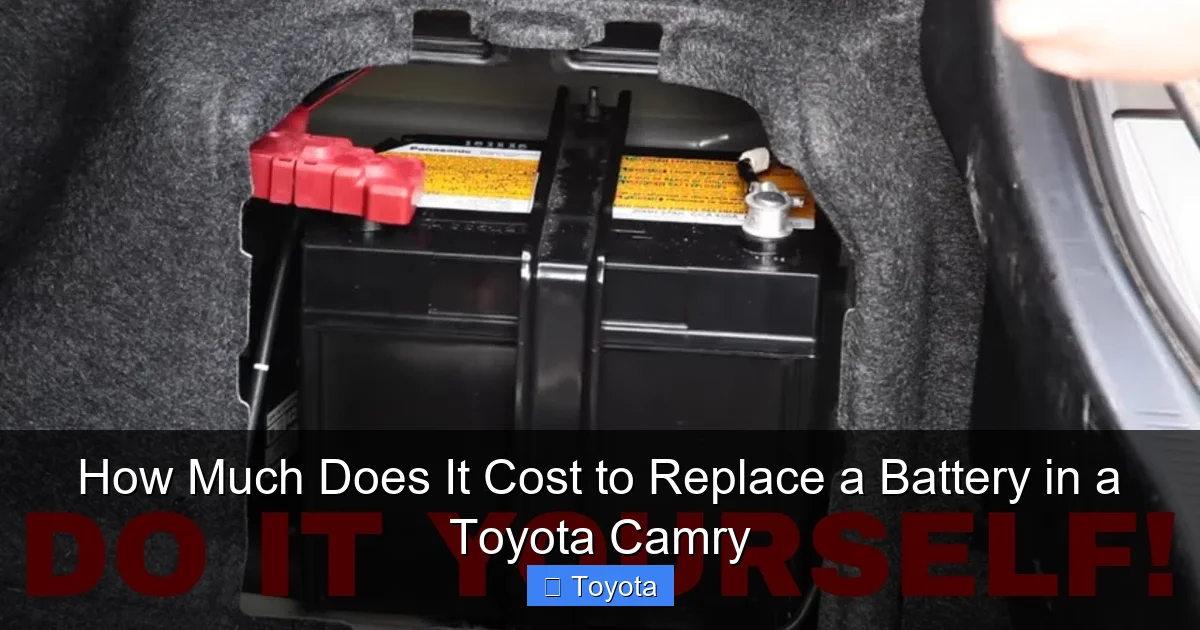
Visual guide about How Much Does It Cost to Replace a Battery in a Toyota Camry
Image source: i.ytimg.com
1. Model Year and Trim Level
A 2024 Camry XSE with a premium audio system and start-stop has more electrical demand than a 2012 base model. This often means a higher-capacity AGM battery, which costs more. Always check your owner’s manual or the old battery’s label for the exact recommended replacement group size (e.g., Group 24F, 35, 48).
2. Battery Type: AGM vs. Standard
If your Camry has a start-stop system (which shuts off the engine at red lights), it requires an AGM battery. Using a standard battery will cause it to fail quickly and may damage the vehicle’s electrical system. AGM batteries are 50-100% more expensive than old-style flooded batteries. This is the single biggest factor for 12V battery cost.
3. Where You Buy & Who Installs
As shown above, dealerships charge a premium for OEM parts and brand trust. Big-box auto parts stores offer competitive pricing and free install. Independent mechanics offer a middle ground. For hybrids, a dedicated hybrid or electrical vehicle specialist is often more affordable than a dealer but more expensive than a general mechanic.
4. Geographic Location
Labor rates vary wildly. A battery replacement in New York City or San Francisco will cost 30-50% more in labor than in a small Midwest town. Parts prices are more consistent online, but local store pricing can vary.
5. Additional Services & Diagnostics
A reputable shop won’t just sell you a battery. They’ll test your charging system (alternator output) and check for parasitic draw (something draining the battery when the car is off). This diagnostic might be free or cost $50-$100. If they find a bad alternator, you’re looking at another $500-$900 for that repair. Always insist on a full system check before accepting a battery replacement as the sole solution. If you’re considering other maintenance, services like a regular oil change are much less expensive but equally important for overall health.
Should You Replace the Battery Yourself? A Practical Guide
For the 12V battery, DIY is a viable and money-saving option for many. Here’s how to decide.
When DIY Makes Sense
- Your Camry’s battery is easily accessible in the engine bay (no trunk or wheel well removal).
- You have basic tools (wrenches, socket set, terminal puller, wire brush, dielectric grease).
- You follow safety procedures: Wear gloves and eye protection. Always disconnect the NEGATIVE (black) terminal first and connect it last. Never let the positive and negative terminals touch. Ensure the car is off and keys are away from the vehicle.
- You properly dispose of the old battery. Most auto parts stores (AutoZone, Advance, etc.) will give you a core refund and recycle it for free.
When to Call a Professional
- The battery is in the trunk or under a panel. This is more complex and may require trim removal.
- You’re uncomfortable with car electronics. Modern cars are sensitive. A reversed connection can blow fuses or damage modules.
- The battery terminals are corroded or seized. This can require special tools and force to break free, risking damage.
- You suspect an underlying issue. If the battery dies again within a few months, you have a “parasitic drain” or bad alternator. A pro can diagnose this.
The Hybrid Battery: Never DIY
Let’s be absolutely clear: Do not attempt to replace a Camry Hybrid’s high-voltage battery yourself. The voltage (200-300V) is lethal. It requires:
- Specialized high-voltage insulated tools.
- A scan tool to de-energize the system.
- Insulated gloves rated for 1000V (class 00 or 0).
- Proper training and certification.
Improper handling can cause severe injury, death, or catastrophic damage to the vehicle’s hybrid system. This is a job for a dealer or a certified hybrid specialist only.
Pro Tips to Save Money and Extend Battery Life
You can avoid premature battery failure and get the best value with these strategies.
1. Buy the Right Battery, Not the Cheapest
A $99 battery from a discount warehouse is likely a low-capacity, short-life unit. For a Camry, invest in a mid-range AGM from a reputable brand (Interstate, Exide, DieHard, Deka). Check the Cold Cranking Amps (CCA) rating—get one that meets or exceeds Toyota’s spec. More CCA is better for cold starts. For hybrids, a remanufactured battery from a company with a solid 3-year warranty is usually the best value.
2. Shop Around and Use Price Matching
Check prices at dealerships, online (Amazon, Tire Rack), and local parts stores. Many national parts stores will price match competitors. Also, sign up for retailer newsletters for coupons (e.g., 10-15% off).
3. Consider the Core Charge
When you buy a battery, you pay a $15-$30 core charge. If you return your old battery, you get this back. If you DIY, bring the old battery to a parts store for a refund. If you have a shop install it, they handle the core return and usually deduct it from your bill.
4. Maintain Your 12V Battery
- Keep terminals clean. Corrosion adds resistance. Clean with a baking soda/water solution and a wire brush. Apply dielectric grease to terminals after reconnecting.
- If you have an AGM battery, avoid deep discharges. Don’t leave lights on. If the car sits for long periods (weeks), consider a smart trickle charger/maintainer.
- Have the charging system checked every 2-3 years during other maintenance.
5. Know Your Hybrid Battery Warranty
Federal law mandates that hybrid batteries are warrantied for 8 years/100,000 miles. If your Camry Hybrid is within that period and the battery fails, it should be covered if the failure is deemed a manufacturer defect. However, warranties often have conditions (e.g., you must have followed maintenance schedules, no aftermarket modifications). Contact your dealer with your VIN to check warranty status before paying out of pocket. If it’s covered, you might only pay a diagnostic fee or a small deductible. You can also look into cosmetic upgrades while your car is at the shop for the battery work!
Conclusion: A Predictable Cost with a Plan
Replacing the battery in your Toyota Camry is a manageable expense when you go in with the right information. For the vast majority of gas-powered Camry owners, budgeting $200-$350 for a quality AGM battery and professional installation is a safe bet. By shopping around, choosing the correct battery type, and ensuring a full charging system diagnostic, you’ll get the most value and avoid a repeat visit.
For Camry Hybrid owners, the conversation shifts from “maintenance” to “major component repair.” A $2,000-$5,000 price tag is the reality for a failed traction battery. Here, warranty status is your first call to action. If out of warranty, seek quotes from reputable hybrid specialists and compare remanufactured vs. OEM options with their respective warranties.
Remember, a dead battery is often a symptom, not the disease. A good mechanic will use this replacement as an opportunity to check the alternator output and look for electrical gremlins. Treat it as part of your car’s long-term care, and your Camry will keep rewarding you with its legendary reliability for years to come. And if you’re already looking at other upkeep, understanding costs like windshield replacement can help you budget for all your vehicle’s needs.
Frequently Asked Questions
What are the signs my Toyota Camry battery needs replacing?
Common signs include slow engine cranking, dim headlights (especially when idling), a clicking sound when turning the key, the battery warning light illuminating on the dash, and electrical glitches (like power windows working slowly). If your car is over 3-4 years old and you experience any of these, get the battery tested.
How long does a Toyota Camry battery typically last?
A standard AGM battery in a modern Camry usually lasts 4-6 years, depending on climate, driving habits, and electrical load. Extreme heat in the engine bay shortens life. Hybrid 12V batteries have a similar lifespan. The high-voltage hybrid battery is designed to last the life of the car (often 10+ years) but can fail earlier.
Can I jump-start my Camry if the battery is dead?
Yes, a dead 12V battery can usually be jump-started. However, if the battery is old or damaged, it may not hold a charge and will die again quickly. A jump-start is a temporary fix, not a repair. For a completely dead hybrid battery, you cannot jump-start the high-voltage system; you may need a tow to a specialist.
Do I need to reprogram or reset anything after replacing the 12V battery?
Sometimes. On many post-2013 Camrys, after disconnecting the battery, you may need to reset the power window memory (by rolling each window up/down fully) and potentially re-initialize the steering angle sensor (by turning the wheel lock-to-lock). Your radio may also require a code. Check your owner’s manual for specific procedures. Dealerships and shops handle this automatically.
Should I buy an OEM Toyota battery or an aftermarket one?
OEM batteries are guaranteed to fit and meet Toyota’s specs, but they are often the most expensive. High-quality aftermarket AGM batteries from brands like Interstate, Interstate, or Odyssey meet or exceed OEM specs and are a great value. The key is ensuring the battery has the correct Group size, CCA rating, and is an AGM type if your Camry requires it.
What happens to my old battery? Is there a recycling fee?
Old lead-acid batteries are nearly 100% recyclable. When you buy a new one, you pay a core charge (usually $15-$30). You get this refund when you return the old battery to the store or shop where you purchased the new one. They handle the recycling. Never dispose of a car battery in the trash.
