
Why Does Toyota Not Recommend Changing Transmission Fluid

Toyota’s “lifetime” transmission fluid recommendation is tied to its sealed transmission systems and a specific warranty period. It does not mean the fluid lasts the vehicle’s entire life. While unnecessary changes can harm modern transmissions, many mechanics and owners recommend proactive fluid changes after 60,000-100,000 miles for long-term reliability, especially for severe driving conditions.
You pop the hood of your trusty Toyota Camry or RAV4, ready to tackle the routine maintenance checklist. Oil? Check. Coolant? Check. But then you hit a wall: the transmission. There’s no dipstick. The owner’s manual says the transmission fluid is “lifetime.” What does that even mean? Is it a marketing gimmick? A secret cost-saving trick? Or brilliant engineering? The statement “Toyota does not recommend changing transmission fluid” is one of the most polarizing topics in the automotive world, splitting owners, mechanics, and dealerships down the middle. Let’s pull back the curtain and understand exactly what Toyota means, why they say it, and what it means for you and your wallet.
Key Takeaways
- “Lifetime” means warranty period, not vehicle life: Toyota’s lifetime fluid claim is based on the transmission’s designed lifespan under warranty, typically 60,000-100,000 miles, not 200,000+ miles.
- Sealed systems prevent easy checks/changes: Many modern Toyotas have sealed transmissions without dipsticks, making DIY fluid checks impossible and professional changes complex and expensive.
- Unnecessary changes can be harmful: Flushing or changing fluid in a high-mileage, never-serviced transmission can dislodge varnish and cause failure, which is a key reason for Toyota’s caution.
- Severe service voids “lifetime” claim: Frequent towing, extreme temperatures, or stop-and-go traffic qualifies as severe service, shortening fluid life and justifying earlier changes.
- Proactive maintenance is a common debate: Many independent mechanics and long-term owners advocate for fluid changes at 60k-80k miles as cheap insurance against costly transmission repairs.
- Genuine Toyota fluid is critical: If a change is done, using the exact Toyota-specified fluid (like WS or LV) is non-negotiable to avoid shift quality issues.
- Check your owner’s manual: The definitive source is your vehicle’s manual. Some older models or specific trims may have explicit mileage intervals listed.
The Origin of the “Lifetime Fluid” Myth
To understand this, we must first decode the phrase itself. “Lifetime” is a legal and engineering term, not a consumer-friendly promise. For Toyota, “lifetime” is defined as the lifespan of the transmission under the vehicle’s original warranty. In practical terms, this is typically 60,000 miles or 5 years, whichever comes first, for most modern models. It does not mean “until the car is scrapped.” This terminology stems from a shift in transmission design and company policy that began in the late 1990s and accelerated in the 2000s.
A Shift to Sealed Systems
The primary enabler of the “no service” claim is the move to sealed, fully-automatic transmission systems. Unlike older transmissions with a simple dipstick tube, these units are welded or bolted shut. There is no official way for a consumer to check the fluid level or condition. The only way to service it is to remove the transmission pan or, more commonly, perform a pressurized flush through the cooler lines—a procedure that requires specialized equipment. Toyota designed these systems to be virtually maintenance-free within the warranty period. The logic is that if the fluid and internal components are designed to last 100,000 miles without degradation, why add a maintenance item that costs the owner and dealer time and money?
The Warranty Shield
This policy also creates a powerful warranty shield. If a transmission fails within the warranty period and the owner can prove they had a third-party shop perform a fluid flush or change (which involves breaking the seal), Toyota can—and often does—deny warranty coverage. They argue the unauthorized service introduced contaminants or improper fluid. This has made many dealers and owners extremely hesitant to perform the service, even after the warranty expires, for fear of being blamed for a future failure.
丰田的工程哲学:为可靠性而设计
丰田并非凭空做出这一声明。其背后是深厚的工程理念,核心是“设计容差”和“系统完整性”。丰田的工程师们从零开始设计其现代自动变速箱(如A650E、UA80等)及其配套的专用流体(如WS、LV系列),目标是让它们作为一个完全密封的系统协同工作。
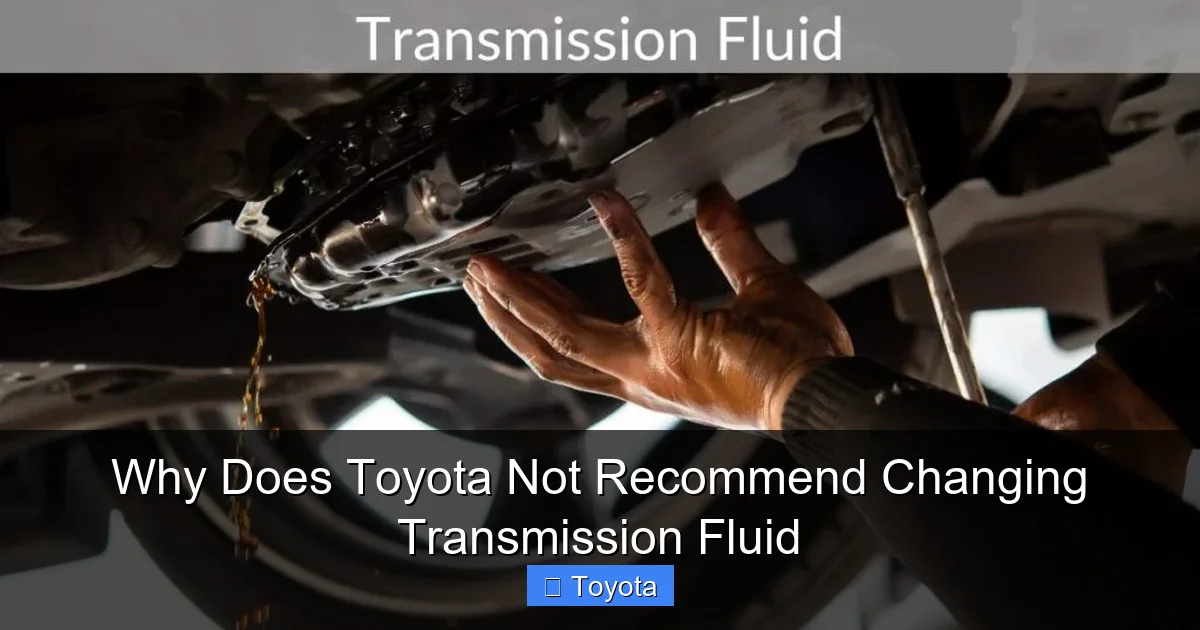
Visual guide about Why Does Toyota Not Recommend Changing Transmission Fluid
Image source: parksroyal.com
专用流体与精密公差
丰田的变速箱油不仅仅是润滑剂;它是一种液压工作流体,负责驱动离合器、制动器,并精确控制换挡时机和感觉。这些变速箱具有极其精密的公差,流体必须具有特定的粘度、摩擦系数和抗剪切稳定性。例如,Toyota WS(World Standard)流体专为无级变速器(CVT)和某些自动变速箱设计。使用错误的流体,甚至是一些“通用”的ATF,会立即导致换挡打滑、顿挫或离合器接合不良。丰田的“终身”声明是基于使用其原厂流体在受控环境下的寿命测试。
密封系统的优势
密封系统的主要优势在于防止污染和氧化。传统的开放式系统会因呼吸作用(热胀冷缩)让微量空气和水分进入,逐渐氧化流体,使其变质、变黑并产生酸性。密封系统最大限度地减少了这种暴露。此外,它消除了消费者因使用错误流体或不当加注而造成的“用户错误”风险。丰田的立场是:“我们建造了一个我们信任的系统。请不要破坏它。”
为什么改变流体可能弊大于利?
这是丰田官方建议最有力的论据,也是许多经验丰富的技师所赞同的。在一个运行了10万英里且从未更换过流体的密封变速箱中,内部的离合器和制动器材料会自然磨损,产生细小的颗粒和“油泥”。这些颗粒实际上与流体混合,帮助离合器平稳接合——它们已经成为了系统的一部分。
Visual guide about Why Does Toyota Not Recommend Changing Transmission Fluid
Image source: i.ytimg.com
冲洗的风险:扰动沉积物
当引入新鲜、清洁的流体(尤其是通过强力冲洗)时,这种微妙的平衡会被打破。清洁的流体具有更强的溶解能力,可能会溶解并搅动那些已经稳定存在的沉积物。这些松动的颗粒随后会循环到精密阀体中,造成卡滞,或者重新沉积在离合器表面上,导致打滑。结果?一个原本运行平稳的变速箱在“服务”后不久就出现故障。丰田认为,主动打破这个经过验证的系统是一个不必要的风险。
服务中的“引入污染”
任何维修过程都涉及风险。一个不洁净的工具、一个未正确消毒的接头、或一台冲洗机中残留的旧流体,都可能将污染物引入这个高度敏感的液压系统。在一个设计为终身密封的系统中,这种风险被认为是不值得承担的。丰田的论点是,如果流体在100,000英里内不会降解,那么引入污染物的风险远大于流体本身老化的风险。
现实世界:何时及为何考虑更换
尽管有丰田的警告,但现实世界的证据和许多独立机械师的建议指向一个不同的实践。原因在于“终身”的定义与车辆的实际使用寿命之间的差距,以及驾驶条件的巨大差异。
Visual guide about Why Does Toyota Not Recommend Changing Transmission Fluid
Image source: thecarhow.com
里程与时间因素
即使是最坚固的流体,在100,000英里或8-10年后,也会因热循环和氧化而开始降解。对于计划将车辆保留到200,000英里以上的车主来说,在60,000至80,000英里时进行一次流体更换被视为一种“廉价保险”。这笔花费(通常为200-400美元)与3000-5000美元的变速箱大修相比,是微不足道的。对于许多丰田车型,如凯美瑞、RAV4、汉兰达,论坛和维修店中充满了车主在12万英里后因未换流体而遭遇故障的案例,同样也有在8万英里时主动换油后运行到25万英里无问题的案例。
严重驾驶条件
丰田的“终身”保修是基于“正常”驾驶条件。如果你经常处于以下情况,你几乎肯定处于“严重服务”类别,这大大缩短了流体寿命:
- 频繁短途行驶(变速箱未充分预热)
- 在极热(>100°F)或极冷(<0°F)环境下驾驶
- 经常拖拽拖车或运输重物
- 主要在拥堵的城市交通中行驶(频繁启停)
- 在山地或丘陵地区行驶
在这些条件下,热负荷和流体剪切力急剧增加,流体性能会更快衰减。如果你符合这些条件,主动维护是明智的。你可以参考更具体的指南,例如丰田汉兰达的变速箱油更换周期,这些文章通常会讨论严重服务条件。
特定车型与年份的例外
并非所有丰田变速箱都是一样的。一些较旧的4速和5速自动变速箱(在2000年代初期及更早)实际上有推荐的更换间隔(通常是60,000-100,000英里)。此外,某些特定型号的变速箱已知存在与流体相关的问题。例如,一些早期的A750E系列变速箱在高温下对流体质量特别敏感。对于这些车型,社区共识强烈建议定期更换。即使是较新的8速和10速自动变速箱,虽然声称是“终身”的,但许多制造商(包括宝马、奔驰)在保修期后也建议进行服务。
如果你决定更换:如何正确操作
如果你在权衡风险后,决定在60,000英里以上进行流体更换,方法至关重要。目标不是“清洁如新”,而是“用新鲜流体稀释旧流体”,并避免完全排空和冲洗。
never a “Power Flush”
避免使用高压冲洗机。这些设备在短时间内用大量新鲜流体强行冲刷系统,最有可能扰动沉积物。推荐的程序是“重力加注和循环”或“拆卸油底壳和更换滤网”。拆卸油底壳可以让你:1) 检查底部是否有金属碎屑(灾难的征兆),2) 更换内置于油底壳的滤网(如果配备),以及3) 仅排空约40-50%的流体。然后,重新加注,让变速箱在发动机怠速和换挡过程中自然循环,将新旧流体混合。重复此过程2-3次,每次更换约40%的流体,可以逐步将旧流体比例降至10%以下,而不会造成剧烈扰动。
使用正确的流体
这是绝对必须的。使用错误的流体是变速箱快速死亡的最快途径。你必须使用丰田指定的确切规格。对于大多数现代丰田自动变速箱,这是Toyota Genuine ATF WS(或符合Toyota WS规格的等效品)。对于许多CVT,它是Toyota Genuine CVTF FE或类似规格。对于较旧的车型,它可能是Type T-IV。永远不要假设“所有红色ATF都一样”。检查你的用户手册或了解丰田变速箱油的制造商和规格。使用劣质或不兼容的流体会导致换挡质量差、离合器打滑和过热。
寻求专业帮助
鉴于密封系统的复杂性,这通常不是DIY项目。你需要一个知道如何正确执行“拆卸油底壳和循环”程序的商店,而不仅仅是连接冲洗机。寻找专门研究亚洲车型或变速箱的商店。他们了解丰田系统的细微差别,并会使用正确的流体。询问他们将执行的具体程序,并确保他们打算检查油底壳和滤网。
给丰田车主的实用建议
那么,你该怎么办?以下是基于证据和社区经验的清晰、可行的步骤。
第一步:查阅你的用户手册
这是你的首要资源。虽然许多手册只说“终身”,但有些(特别是较旧的或特定市场)可能会列出里程间隔。确认你的变速箱类型(例如,6速自动、8速自动、CVT)和推荐的流体规格。
第二步:评估你的驾驶情况和车辆计划
诚实地问自己:
- 我打算开这辆车超过15万英里吗?
- 我经常拖车、在山地驾驶或在极端温度下行驶吗?
- 我的变速箱换挡是否仍然顺滑、及时?
如果答案是“是”以上任何一个,那么计划在60,000-80,000英里时进行服务是
Frequently Asked Questions
What is Why Does Toyota Not Recommend Changing Transmission Fluid?
Why Does Toyota Not Recommend Changing Transmission Fluid is an important topic with many practical applications.
