
How Much Does a Car Tire Weigh

Car tire weight varies widely based on size, type, and construction, typically ranging from 15 to 80 pounds. Understanding tire weight helps improve fuel economy, handling, and overall vehicle performance.
Key Takeaways
- Standard passenger car tires weigh between 15 and 25 pounds each. These are common on sedans, hatchbacks, and compact SUVs.
- Light truck and SUV tires can weigh 30 to 50 pounds or more. Larger treads and reinforced sidewalls add significant mass.
- Tire construction materials impact weight significantly. Steel belts, rubber compounds, and internal layers all contribute.
- Performance and racing tires are often lighter for speed. They use advanced materials to reduce rotational mass.
- Heavier tires can reduce fuel efficiency and affect handling. Extra weight increases rolling resistance and strain on suspension.
- Always check your vehicle’s recommended tire specifications. Using tires outside the recommended weight range can impact safety and performance.
- Proper tire maintenance helps offset weight-related issues. Regular rotation, alignment, and inflation improve longevity and efficiency.
📑 Table of Contents
How Much Does a Car Tire Weigh? A Complete Guide
If you’ve ever lifted a car tire—or watched a mechanic change one—you might have wondered: just how much does a car tire weigh? It’s not a question most drivers think about until they’re faced with replacing a flat or upgrading their wheels. But tire weight plays a bigger role in your driving experience than you might realize. From fuel economy to handling and even braking performance, the weight of your tires affects nearly every aspect of how your car feels on the road.
Tire weight isn’t a one-size-fits-all number. It depends on several factors, including the size of the tire, the type of vehicle it’s designed for, and the materials used in its construction. A tire on a small city car will be much lighter than one on a full-size pickup truck. Even within the same vehicle class, differences in tread design, load rating, and performance features can lead to noticeable variations in weight. Understanding these differences helps you make smarter choices when buying, maintaining, or upgrading your tires.
Factors That Influence Car Tire Weight
Visual guide about How Much Does a Car Tire Weigh
Image source: compressorlab.com
So, what makes one tire heavier than another? It’s not just about size—though that’s a big part of it. Several key factors contribute to how much a car tire weighs, and each plays a role in performance, durability, and efficiency.
Tire Size and Dimensions
The most obvious factor is tire size. Tires are measured using a standardized system that includes width, aspect ratio, and rim diameter. For example, a common size like 225/60R16 means the tire is 225 millimeters wide, has an aspect ratio of 60% (sidewall height is 60% of the width), and fits a 16-inch rim. Larger tires—those with bigger widths, taller sidewalls, or larger diameters—naturally weigh more because they contain more rubber and internal materials.
For instance, a compact car tire like a 195/65R15 might weigh around 18 pounds, while a larger SUV tire such as a 265/70R17 could tip the scales at 45 pounds or more. The difference comes down to volume: more rubber, more steel belts, and more structural components are needed to support the larger footprint and heavier vehicle.
Tire Type and Vehicle Application
Not all tires are created equal—and neither are their weights. Tires are engineered for specific purposes, and those design goals influence how heavy they are.
Passenger car tires, like those on sedans and coupes, are built for comfort, fuel efficiency, and everyday driving. They’re typically the lightest, ranging from 15 to 25 pounds. These tires use lighter materials and fewer reinforcement layers to keep weight down and rolling resistance low.
On the other hand, light truck and SUV tires are built to handle heavier loads and rougher terrain. They often feature thicker sidewalls, deeper treads, and additional steel belts for durability. As a result, they can weigh anywhere from 30 to 50 pounds. For example, a tire like the Goodyear Wrangler DuraTrac in size 275/65R18 might weigh around 48 pounds due to its aggressive tread and reinforced construction.
Performance and racing tires take a different approach. While they may be wide and large, they’re often designed to be as light as possible to improve acceleration and handling. High-performance tires use lightweight compounds and advanced materials like Kevlar or carbon fiber to reduce rotational mass. A high-end performance tire like the Michelin Pilot Sport 4S might weigh only 22 pounds despite its wide profile, thanks to these innovations.
Construction Materials and Internal Structure
Beneath the tread and sidewall, a tire is a complex sandwich of materials. Each layer adds to the overall weight. The main components include:
– **Tread rubber**: The outer layer that contacts the road. Softer, grippier compounds may be heavier.
– **Steel belts**: Woven into the tread area to provide strength and stability. More belts mean more weight.
– **Casing plies**: Fabric layers (often polyester or nylon) that form the tire’s body. Additional plies increase durability but also weight.
– **Sidewall rubber**: Protects the tire from impacts and flexing. Thicker sidewalls add weight.
– **Bead wires**: Steel wires that anchor the tire to the rim. Heavier-duty tires have stronger, heavier beads.
For example, a tire designed for off-road use will have extra plies and reinforced sidewalls to resist punctures and damage. That added protection comes at the cost of increased weight. In contrast, a low-rolling-resistance tire for a hybrid car might use thinner materials and fewer plies to reduce weight and improve fuel economy.
Load Index and Speed Rating
Tires are rated for how much weight they can safely carry (load index) and how fast they can go (speed rating). Higher ratings usually mean heavier tires because they need more structural support.
A tire with a high load index—say, 110 or above—is built to carry heavy loads, like those found on SUVs, vans, or trucks. These tires often have extra reinforcement and thicker materials, adding several pounds compared to a standard passenger tire.
Similarly, high-speed-rated tires (like those with a “V” or “Z” rating) are engineered to handle high speeds without overheating or failing. They often use stronger, denser materials and more precise construction techniques, which can increase weight. A tire rated for 149 mph (V rating) will generally be heavier than one rated for 118 mph (H rating), even if they’re the same size.
Average Weights by Tire Category
Visual guide about How Much Does a Car Tire Weigh
Image source: tiresglobe.com
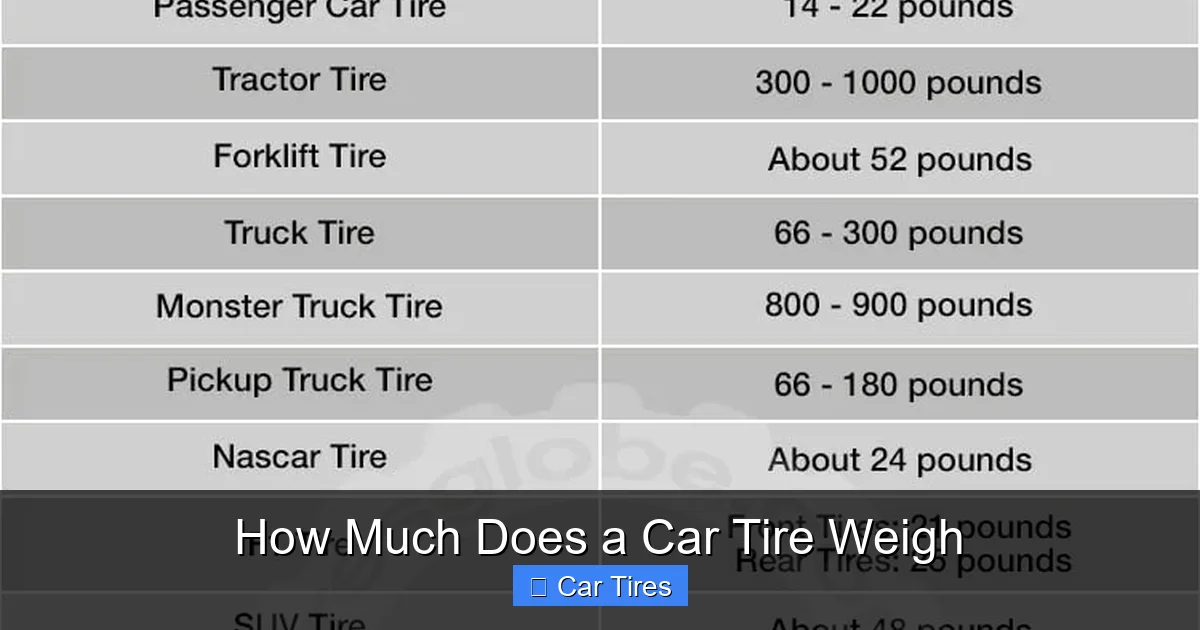
Now that we’ve covered the factors that influence tire weight, let’s look at some real-world examples. Here’s a breakdown of average tire weights across different vehicle types and tire categories.
Compact and Economy Car Tires
These are the lightest tires on the market, designed for small vehicles like the Honda Civic, Toyota Corolla, or Hyundai Elantra. Common sizes include 185/65R15 or 195/60R16.
– **Average weight**: 15 to 20 pounds
– **Example**: A 195/65R15 tire from a brand like Michelin or Goodyear typically weighs around 18 pounds.
– **Why so light?** These tires prioritize fuel efficiency and low rolling resistance. They use fewer plies and lighter rubber compounds.
These tires are easy to handle during installation and contribute to better gas mileage. However, their lighter construction may mean less durability under heavy loads or rough conditions.
Sedan and Midsize Car Tires
Found on vehicles like the Toyota Camry, Honda Accord, or Ford Fusion, these tires offer a balance of comfort, performance, and durability.
– **Average weight**: 20 to 25 pounds
– **Example**: A 225/60R16 tire might weigh around 23 pounds.
– **Why this range?** These tires are slightly larger and often have higher load ratings than compact car tires. They may also include additional features like noise-reducing foam or improved tread patterns.
Drivers of midsize sedans benefit from a good mix of efficiency and performance. The moderate weight helps maintain responsive handling without sacrificing too much fuel economy.
SUV and Crossover Tires
SUVs and crossovers like the Toyota RAV4, Honda CR-V, or Ford Explorer use larger, more robust tires to support their weight and provide better traction.
– **Average weight**: 30 to 40 pounds
– **Example**: A 235/65R17 tire can weigh around 35 pounds.
– **Why heavier?** These tires need to support more vehicle weight and often have all-terrain or all-season capabilities. They feature thicker sidewalls and deeper treads.
The added weight can slightly reduce fuel efficiency, but it improves stability and load-carrying capacity. Many SUV tires also include run-flat technology or reinforced shoulders, which add a few extra pounds.
Light Truck and Pickup Tires
Pickup trucks like the Ford F-150, Chevrolet Silverado, or Ram 1500 require heavy-duty tires capable of handling payloads and towing.
– **Average weight**: 40 to 60 pounds
– **Example**: A 275/65R18 all-terrain tire might weigh 50 pounds.
– **Why so heavy?** These tires are built for durability, with extra plies, reinforced sidewalls, and aggressive tread patterns. They’re designed to withstand rough roads, heavy loads, and off-road conditions.
Some heavy-duty or commercial-grade tires can even exceed 70 pounds, especially in larger sizes like 285/70R17 or 33-inch off-road tires. While the weight improves toughness, it can also increase strain on suspension components and reduce fuel economy.
Performance and Racing Tires
Designed for sports cars and high-performance vehicles, these tires prioritize speed, grip, and responsiveness.
– **Average weight**: 18 to 30 pounds (despite larger sizes)
– **Example**: A 255/35R19 performance tire might weigh only 24 pounds.
– **Why lighter?** Advanced materials like silica-enhanced rubber, Kevlar belts, and lightweight casing designs reduce rotational mass. Less weight means faster acceleration and better handling.
Performance tires are a great example of how engineering can offset size-related weight. Even though they’re wide and large, they’re often lighter than expected due to material innovations.
Why Tire Weight Matters

Visual guide about How Much Does a Car Tire Weigh
Image source: mrtirerack.com
You might be thinking, “So what if my tires are a few pounds heavier?” But even small differences in tire weight can have noticeable effects on your vehicle’s performance and efficiency.
Impact on Fuel Economy
Heavier tires increase rolling resistance—the force needed to keep the tire moving. More resistance means your engine has to work harder, which burns more fuel. Studies show that reducing tire weight by just 10% can improve fuel economy by 1 to 2%.
For example, swapping from 40-pound SUV tires to lighter 30-pound all-season tires could save you several gallons of gas per year, depending on driving habits. Over time, that adds up—both in savings and reduced emissions.
Effect on Handling and Acceleration
Tire weight affects how quickly your car can accelerate, brake, and turn. This is because rotating mass—like wheels and tires—has a greater impact on performance than static weight.
Imagine spinning a light bicycle wheel versus a heavy one. The lighter wheel spins up faster and stops quicker. The same principle applies to your car. Lighter tires improve throttle response, reduce braking distance, and enhance cornering ability.
Performance drivers and track enthusiasts often invest in lightweight wheels and tires to gain a competitive edge. Even everyday drivers can benefit from better responsiveness and a more engaging driving experience.
Wear and Tear on Vehicle Components
Heavier tires place more stress on your vehicle’s suspension, brakes, and drivetrain. Over time, this can lead to premature wear on shocks, struts, ball joints, and CV axles.
For example, a lifted truck with oversized, heavy tires may experience faster suspension wear due to the added load. Mechanics often recommend upgrading suspension components when installing heavier tires to maintain safety and performance.
Additionally, heavier tires can increase brake temperatures, especially during repeated hard stops. This may lead to brake fade or reduced stopping power over time.
Noise and Ride Comfort
While not directly related to weight, heavier tires often come with stiffer sidewalls and more aggressive tread patterns, which can increase road noise and reduce ride comfort. Lighter tires with softer compounds tend to absorb bumps better and provide a quieter ride.
However, this isn’t always the case. Some modern heavy-duty tires use noise-canceling technology and advanced tread designs to maintain comfort despite their weight.
How to Choose the Right Tire Weight for Your Vehicle
With so many options available, how do you pick the right tire—and the right weight—for your needs? Here are some practical tips to help you decide.
Check Your Owner’s Manual
Your vehicle’s manufacturer specifies the correct tire size, load index, and speed rating. Sticking to these recommendations ensures optimal performance, safety, and warranty compliance.
For example, if your car calls for 215/55R17 tires with a load index of 95 and speed rating of H, don’t install heavier tires designed for trucks. Doing so could overload your suspension or alter your speedometer accuracy.
Consider Your Driving Habits
Think about how and where you drive. If you mostly commute on highways, lightweight, low-rolling-resistance tires can improve fuel economy. If you frequently drive on gravel, snow, or rough roads, heavier all-terrain or winter tires may be worth the extra weight for added durability and traction.
Off-road enthusiasts might prefer heavier tires for their puncture resistance and load capacity, even if it means sacrificing a bit of fuel efficiency.
Balance Performance and Efficiency
You don’t have to choose between performance and economy. Many modern tires offer a great balance. For example, all-season tires with lightweight construction and silica-enhanced tread compounds provide good grip, long tread life, and decent fuel efficiency.
Look for tires with a high UTQG (Uniform Tire Quality Grade) rating for treadwear, traction, and temperature resistance. These indicators help you compare performance across brands and models.
Don’t Forget the Wheel
Tire weight is only part of the equation. The wheel (or rim) also contributes to total rotating mass. Lightweight alloy wheels can offset the weight of heavier tires, improving overall performance.
For example, replacing steel wheels with aluminum ones can save 10 to 15 pounds per corner—equivalent to removing 40 to 60 pounds from your vehicle’s unsprung weight. This can make a noticeable difference in handling and ride quality.
Maintaining Tires for Optimal Performance
No matter how much your tires weigh, proper maintenance is key to getting the most out of them.
Regular Inflation Checks
Underinflated tires increase rolling resistance, reduce fuel economy, and wear out faster. Overinflated tires can lead to a harsh ride and uneven tread wear. Check your tire pressure at least once a month and before long trips.
Use the recommended pressure listed on the driver’s side door jamb—not the maximum pressure printed on the tire sidewall.
Tire Rotation and Alignment
Rotating your tires every 5,000 to 7,000 miles ensures even wear, especially if your vehicle is front-wheel or rear-wheel drive. Misaligned wheels can cause uneven wear and increase rolling resistance, making your tires feel heavier than they are.
Balancing and Mounting
Properly balanced tires reduce vibrations and improve ride comfort. When installing new tires, have them balanced and mounted by a professional to avoid issues like wobbling or uneven wear.
Monitor Tread Depth
Worn tires not only reduce grip but can also become unbalanced or develop flat spots. Use a tread depth gauge or the penny test (insert a penny into the tread with Lincoln’s head upside down—if you can see the top of his head, it’s time to replace the tire).
Conclusion
So, how much does a car tire weigh? The answer isn’t simple—it depends on size, type, construction, and intended use. But one thing is clear: tire weight matters. From fuel economy and handling to safety and comfort, the pounds on your wheels affect your entire driving experience.
Whether you’re driving a compact car with 18-pound tires or a heavy-duty truck with 60-pound behemoths, understanding tire weight helps you make informed decisions. Choose the right tires for your vehicle and driving style, maintain them properly, and you’ll enjoy better performance, longer tire life, and improved efficiency on every mile.
Next time you’re at the tire shop or changing a flat, take a moment to appreciate the engineering behind those rubber donuts. They’re not just round and black—they’re a crucial part of how your car moves, stops, and feels on the road.
Frequently Asked Questions
How much does a standard car tire weigh?
A standard passenger car tire typically weighs between 15 and 25 pounds. This includes common sizes used on sedans and compact cars, such as 195/65R15 or 225/60R16.
Why do truck tires weigh more than car tires?
Truck tires are heavier because they’re built to carry heavier loads and withstand rough conditions. They have thicker sidewalls, deeper treads, and more reinforcement layers, all of which add weight.
Can lighter tires improve fuel efficiency?
Yes, lighter tires reduce rolling resistance, which means your engine uses less fuel. Even a small reduction in tire weight can improve gas mileage by 1 to 2%.
Do performance tires weigh less than regular tires?
Often, yes. Performance tires use advanced materials like Kevlar and lightweight rubber compounds to reduce weight while maintaining grip and speed capabilities.
Is it safe to use heavier tires than recommended?
Not necessarily. Using tires outside the manufacturer’s specifications can affect handling, braking, and suspension performance. Always follow your vehicle’s recommended tire size and load rating.
How often should I check my tire pressure?
Check your tire pressure at least once a month and before long trips. Proper inflation ensures even wear, better fuel economy, and safer driving.