
How Many Miles Will a Dodge V10 Last?

The Dodge V10 engine, most famously used in the Ram 2500/3500 trucks and the Viper sports car, is known for its durability and raw power. With proper care, many owners report these engines lasting well beyond 200,000 miles—some even reaching 300,000+ miles.
If you’re considering buying a used Dodge Ram with a V10—or already own one—you’ve probably asked the million-dollar question: *How many miles will a Dodge V10 last?* It’s a fair concern. These big, burly engines aren’t cheap to replace, and whether you’re hauling trailers across states or just cruising down backroads, you want to know your rig will go the distance.
The good news? The Dodge V10 has earned a reputation for toughness. Unlike some engines that start wheezing at 150,000 miles, the V10—especially the 8.0L Magnum version found in Ram trucks from the late ’90s to mid-2000s—is built like a tank. It’s an iron-block, pushrod design with a simple valvetrain, which means fewer complex parts that can fail. That simplicity translates into reliability, especially when treated right.
But let’s be real—no engine lasts forever without care. Even the most robust powerplants need attention. So while it’s possible to see a Dodge V10 hit 300,000 miles or more, it’s not guaranteed. Your driving habits, maintenance routine, climate, and even the type of fuel you use all play a role. In this guide, we’ll break down everything you need to know about maximizing the life of your Dodge V10, from oil change schedules to red flags that signal trouble ahead.
Key Takeaways
- Typical Lifespan: Most Dodge V10 engines last between 200,000 and 300,000 miles with regular maintenance.
- Heavy-Duty Use: In commercial or towing applications, longevity depends heavily on service intervals and driving conditions.
- Oil Changes Are Critical: Frequent oil changes every 3,000–5,000 miles significantly extend engine life.
- Cooling System Maintenance: Overheating is a major threat—keep radiators, hoses, and thermostats in top shape.
- Viper vs. Ram Differences: The Viper’s high-revving V10 is performance-tuned and may wear faster than the truck version under hard use.
- Signs of Wear: Listen for ticking lifters, oil leaks, or loss of compression—these signal it’s time for inspection.
- Rebuild Potential: Even high-mileage V10s can be rebuilt or refreshed for another 100,000+ miles with quality parts.
📑 Table of Contents
Understanding the Dodge V10 Engine
Before we dive into mileage expectations, it helps to understand what makes the Dodge V10 tick. This engine comes in two main flavors: the 8.0L Magnum V10 used in heavy-duty Ram trucks (1994–2003), and the 8.4L V10 found in the Dodge Viper (1996–2017). While they share a similar architecture—both are 90-degree V10s with cast-iron blocks and aluminum heads—they’re tuned for very different purposes.
The Ram’s 8.0L V10 was designed for torque, not speed. It produces around 305–315 horsepower and a whopping 450–460 lb-ft of torque, making it ideal for towing boats, campers, or heavy equipment. Its low-end grunt and rugged construction made it a favorite among contractors and off-roaders. Meanwhile, the Viper’s 8.4L variant is a high-strung performance engine, revving to 6,500+ RPM and delivering over 600 horsepower in later models. That kind of stress takes a toll over time.
Despite their differences, both engines benefit from a common trait: simplicity. There’s no timing belt to replace (they use a robust chain), no direct injection to clog, and no turbochargers to overheat. The pushrod design means fewer moving parts than overhead-cam engines, reducing points of failure. That said, the Viper’s higher operating temperatures and RPMs mean it generally won’t last as long as its truck sibling under similar conditions—unless it’s meticulously maintained.
Design Strengths That Boost Longevity
One reason the Dodge V10 endures is its overbuilt nature. Chrysler engineers didn’t cut corners. The crankshaft is forged steel, the connecting rods are beefy, and the block is thick-walled iron—perfect for handling high loads without flexing. Even the oiling system is generous, with a high-volume pump and deep sump that keeps lubrication steady under heavy acceleration or steep grades.
Another advantage? The V10’s firing order and balance shaft (in later models) reduce vibration, which minimizes stress on bearings and seals. Less vibration means less wear over time. Plus, because it’s a naturally aspirated engine, there’s no boost pressure straining gaskets or internals—unlike modern turbocharged mills that can grenade if oil changes are skipped.
Common Misconceptions About the V10
Some folks assume the V10 is outdated or unreliable because it’s not a modern DOHC engine. But that’s a myth. While it lacks fancy tech like variable valve timing, its mechanical simplicity is a strength—not a weakness. Others worry about fuel economy, and yes, the V10 guzzles gas (expect 10–14 mpg in a Ram), but that’s the trade-off for massive towing capacity and longevity.
Also, don’t confuse age with obsolescence. Just because your Ram V10 was built in 2002 doesn’t mean it’s ready for the scrapyard. Many of these trucks are still on the road today, proving that age alone isn’t a death sentence—it’s how you treat the engine that matters.
Real-World Mileage: What Owners Are Reporting
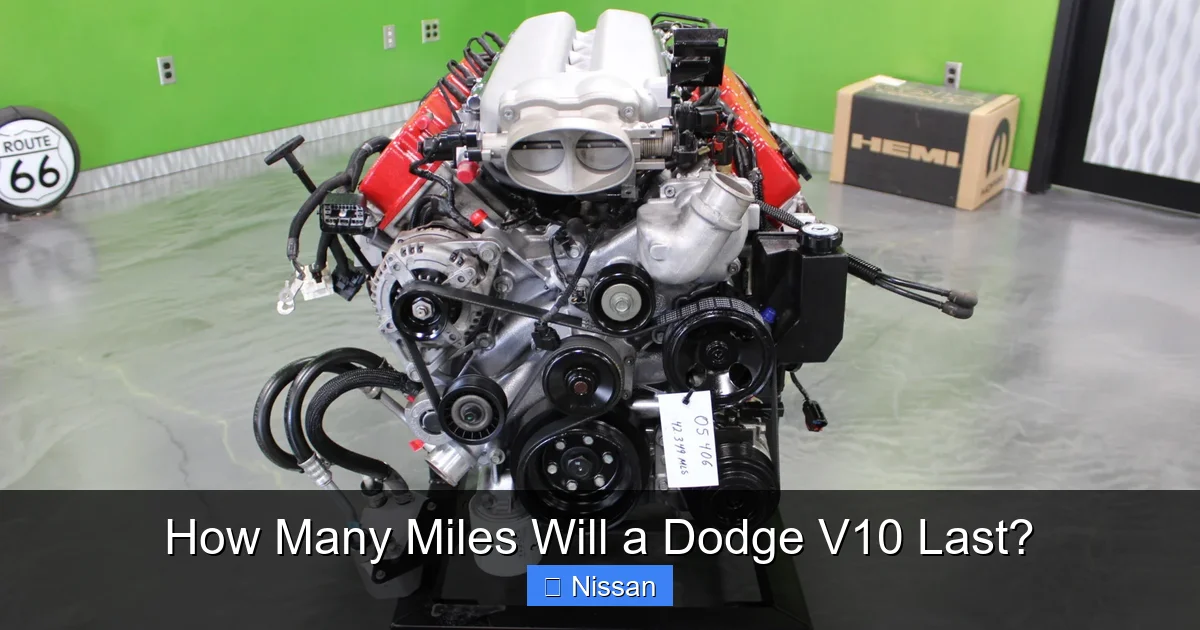
Visual guide about How Many Miles Will a Dodge V10 Last?
Image source: silodrome.com
So, what’s the actual mileage you can expect? Let’s look at real-world data from forums, owner surveys, and mechanic reports. Across thousands of Dodge Ram V10 owners, the consensus is clear: these engines are built to last.
Many report hitting 200,000 miles with only routine maintenance. Some push past 250,000. And yes, there are documented cases of V10s crossing 300,000 miles—especially in lightly driven, well-maintained trucks used for light towing or highway commuting.
For example, a 2001 Ram 2500 with the 8.0L V10 owned by a retired farmer in Iowa recently hit 312,000 miles. He changed the oil every 3,000 miles, used synthetic blend, and never towed beyond the truck’s capacity. His only major repair was a water pump replacement at 240,000 miles. Another owner in Texas used his V10 Ram for hauling construction materials and still reached 285,000 miles before selling it—with the original engine intact.
Of course, not every V10 makes it that far. Neglect, overheating, or chronic low oil levels can cut life short. But the trend is unmistakable: when cared for, the Dodge V10 is a marathon runner, not a sprinter.
Factors That Influence Longevity
Several variables determine how long your V10 will last:
– **Maintenance frequency:** Oil changes every 3,000–5,000 miles are non-negotiable.
– **Driving style:** Frequent short trips, extreme heat, or constant heavy towing accelerate wear.
– **Climate:** Cold weather increases cold-start wear; hot climates strain the cooling system.
– **Fuel quality:** Using low-octane fuel in a high-compression engine can cause detonation.
– **Modifications:** Adding performance chips or lifting the truck without supporting mods can stress the engine.
Viper V10: A Different Story
While Ram V10s often cruise past 200k miles, Viper owners face different realities. The Viper’s engine is tuned for high RPMs and track use, which generates more heat and stress. Many Viper V10s see 100,000–150,000 miles before needing rebuilds—especially if driven hard. However, with meticulous care (including frequent oil changes with high-quality synthetic and upgraded cooling), some have exceeded 200,000 miles. It’s rare, but possible.
Maintenance Tips to Maximize Engine Life
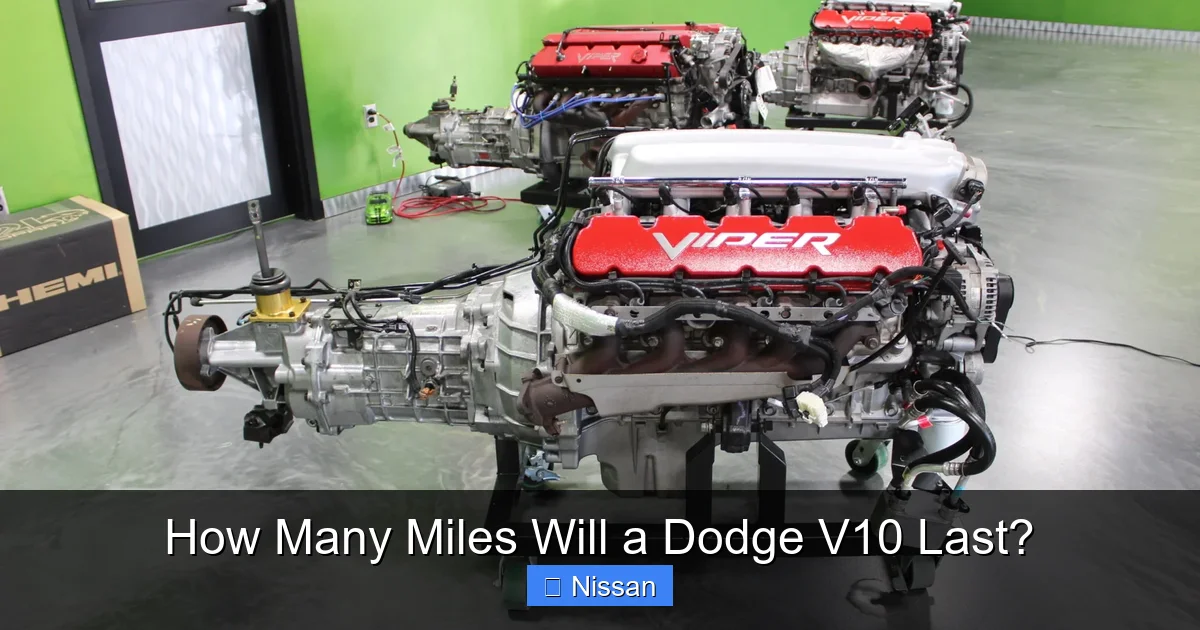
Visual guide about How Many Miles Will a Dodge V10 Last?
Image source: silodrome.com
You don’t need a PhD in mechanical engineering to keep your V10 healthy—just consistency and attention to detail. Here’s your maintenance checklist for long-term success.
Oil Changes: The #1 Priority
Oil is the lifeblood of any engine, but especially a V10. These engines run hot and work hard, so sludge and breakdown are real risks. Stick to a strict schedule:
– **Every 3,000 miles** if you tow, drive in dust, or make frequent short trips.
– **Every 5,000 miles** for highway driving in moderate climates.
– Use **10W-30 or 10W-40 high-quality synthetic or synthetic blend oil** (check your owner’s manual).
– Always replace the oil filter with a reputable brand (like Wix or Mobil 1).
Skipping oil changes is the fastest way to kill a V10. Sludge clogs oil passages, leading to bearing failure and catastrophic engine damage.
Cooling System Care
Overheating is the V10’s kryptonite. The engine generates a lot of heat, and if the cooling system fails, warped heads or blown head gaskets follow. Here’s how to prevent it:
– Flush the coolant every 30,000–50,000 miles (or per manufacturer specs).
– Inspect hoses and radiator for cracks or leaks annually.
– Replace the thermostat every 60,000–100,000 miles.
– Keep the radiator clean—bugs, dirt, and debris reduce airflow.
If you tow often, consider an auxiliary transmission cooler and a high-capacity radiator. Even a few degrees of extra cooling can add years to your engine’s life.
Belts, Hoses, and Accessories
Don’t ignore the small stuff. A failed serpentine belt can leave you stranded and damage the water pump. Inspect belts for cracks and glazing every oil change. Replace them every 60,000–100,000 miles.
Check vacuum hoses for brittleness—especially in older Rams. A cracked hose can cause rough idle or poor performance.
Fuel System and Air Intake
Use top-tier gasoline with detergents to keep injectors clean. Consider a fuel system cleaner every 10,000 miles if you notice hesitation or rough idle.
Replace the air filter every 15,000–30,000 miles. A clogged filter forces the engine to work harder, reducing efficiency and increasing wear.
Tuning and Diagnostics
Modern OBD-II scanners can catch issues early. If your check engine light comes on, don’t ignore it. A misfire or lean condition can damage the catalytic converter or overheat the engine.
Avoid cheap performance tuners that push the engine beyond safe limits. If you modify your V10, do it gradually and monitor exhaust gas temperatures (EGTs).
Common Problems and How to Spot Them Early

Visual guide about How Many Miles Will a Dodge V10 Last?
Image source: silodrome.com
Even the best-maintained V10s can develop issues. Catching them early saves thousands in repairs.
Lifter Tick or Valve Train Noise
A light ticking from the valve cover is normal on cold starts. But if it persists when warm, or gets louder, it could mean worn lifters or low oil pressure. Check oil level and condition first. If noise continues, have a mechanic inspect the valvetrain.
Oil Leaks
The V10 is prone to rear main seal and valve cover leaks as it ages. Small leaks are common, but large drips under the truck mean it’s time for repair. Ignored leaks lead to low oil levels and engine damage.
Coolant Loss or Overheating
If your temperature gauge climbs or you see coolant puddles, act fast. Check for leaks, test the radiator cap, and inspect the water pump weep hole. A failing water pump often leaks before it seizes.
Loss of Power or Misfires
Could indicate worn spark plugs, bad coils, or carbon buildup. Replace plugs every 30,000–50,000 miles. Use premium plugs designed for V10s.
Excessive Oil Consumption
Burning a quart every 1,000 miles isn’t normal. It may signal worn piston rings or valve guides. A compression test or leak-down test can confirm.
Can You Rebuild a High-Mileage V10?
Absolutely. One of the V10’s greatest strengths is its rebuildability. Unlike some modern engines with integrated components, the V10’s design allows for relatively straightforward overhauls.
Many shops offer “refresh” kits that include new pistons, rings, bearings, gaskets, and seals for under $2,000 in parts. With labor, a full rebuild might cost $4,000–$7,000—far less than a new engine.
Rebuilt V10s often run like new and can easily add another 100,000–150,000 miles. Some owners even upgrade during the rebuild—adding forged internals, ported heads, or improved oiling systems for extra durability.
When to Consider a Rebuild
– Compression is low in multiple cylinders.
– Oil consumption exceeds 1 quart per 1,000 miles.
– Knocking or rumbling noises persist after oil change.
– You plan to keep the truck for many more years.
A rebuild isn’t just a repair—it’s an investment in longevity.
Conclusion: The Dodge V10 Is Built to Last
So, how many miles will a Dodge V10 last? The honest answer is: it depends—but with proper care, you can expect 200,000 to 300,000 miles, and sometimes more. These engines aren’t fragile; they’re overbuilt workhorses designed for heavy-duty use.
The key is consistency. Stick to a strict maintenance schedule, listen to your engine, and address small issues before they become big ones. Whether you’re driving a Ram 2500 through farm fields or a Viper down a mountain road, the V10 rewards diligence with decades of reliable service.
Don’t let age or mileage scare you away from a used V10-powered Dodge. With the right care, these engines keep on going—long after others have called it quits.
Frequently Asked Questions
How many miles can a Dodge Ram V10 last?
Most Dodge Ram V10 engines last between 200,000 and 300,000 miles with proper maintenance. Some well-cared-for examples have exceeded 300,000 miles.
Is the Dodge V10 reliable?
Yes, the Dodge V10 is known for its reliability, especially in Ram trucks. Its simple, robust design and iron block contribute to long-term durability when maintained correctly.
What oil should I use in a Dodge V10?
Use 10W-30 or 10W-40 high-quality synthetic or synthetic blend oil. Always follow the manufacturer’s recommendations and change it every 3,000–5,000 miles.
Can a Viper V10 last as long as a Ram V10?
Not typically. The Viper’s high-revving nature and performance tuning mean it usually lasts 100,000–150,000 miles unless meticulously maintained. Ram V10s are more durable under normal use.
What causes Dodge V10 engines to fail early?
Common causes include infrequent oil changes, overheating, low oil levels, and neglecting the cooling system. Towing beyond capacity also accelerates wear.
Is it worth rebuilding a high-mileage Dodge V10?
Yes, especially if the engine is otherwise sound. A rebuild can cost $4,000–$7,000 and add 100,000+ miles of reliable service, making it a cost-effective option.