
How Many Miles Can a 2015 Toyota Camry Go on a Full Tank?

A 2015 Toyota Camry with a full 15.8-gallon tank can typically travel between 350 and 470 miles, depending on the engine and driving conditions. The most common 2.5L 4-cylinder model averages around 28-29 MPG combined, while the more powerful 3.5L V6 gets about 22-23 MPG combined. Your actual mileage will vary based on your driving habits, terrain, vehicle maintenance, and whether you’re navigating city streets or cruising on the highway. Understanding these factors helps you plan trips and avoid the stress of running low on fuel.
Key Takeaways
- Tank Capacity: All 2015 Camry models have a fuel tank capacity of 15.8 gallons (59.9 liters).
- Combined MPG Estimates: The EPA rated the 2.5L 4-cylinder at 27-28 MPG combined and the 3.5L V6 at 21-22 MPG combined.
- Highway vs. City: Highway driving significantly boosts range; the 4-cylinder can achieve up to 35 MPG on the highway, while the V6 can reach 31 MPG.
- Real-World Variables: Aggressive driving, heavy loads, extreme temperatures, and poor maintenance can reduce your actual miles per gallon by 15-25%.
- Gas Light Reserve: The low fuel warning typically illuminates with about 1-2 gallons remaining, giving you an additional 25-50 miles of range before empty.
- Do Not Drive on Empty: Consistently running the tank dry can damage the fuel pump and introduce sediment into the engine, leading to costly repairs.
- Maximizing Range: Maintain proper tire pressure, use recommended motor oil, drive gently, and remove unnecessary roof racks or cargo to improve fuel efficiency and extend your range per tank.
📑 Table of Contents
- Introduction: The Quest for Maximum Range
- The Foundation: Fuel Tank Size and EPA Ratings
- Real-World Mileage: Why Your Numbers Will Differ
- The Gas Light: Your Critical Warning System
- Maximizing Your Miles Per Tank: Practical Strategies
- Comparing Trims: Does the V6 Really Cost That Much Range?
- Conclusion: Knowledge is Power (and Miles)
Introduction: The Quest for Maximum Range
One of the most practical questions a car owner can ask is, “How far can I go before I need to fill up again?” For a vehicle as popular and reliable as the 2015 Toyota Camry, this question is especially relevant. Whether you’re planning a cross-country road trip, budgeting for your weekly commute, or simply trying to avoid the anxiety of the low fuel light, understanding your car’s true range is key. The answer isn’t a single number; it’s a range that depends on your specific Camry’s engine, your driving style, and the conditions you face on the road. This guide will break down everything you need to know about the 2015 Camry’s fuel capacity and efficiency, giving you a clear picture of how many miles you can realistically expect from a full tank of gas.
We’ll start with the hard numbers from the Environmental Protection Agency (EPA) and Toyota’s official specs. Then, we’ll dive into the real-world factors that can make your mileage differ from the sticker. You’ll learn about the critical “reserve” fuel after the gas light comes on and why you should never test that limit. Finally, we’ll share actionable tips to help you squeeze every last mile out of each fill-up. By the end, you’ll be a master of your Camry’s fuel economy, equipped to plan your journeys with confidence and save money at the pump.
The Foundation: Fuel Tank Size and EPA Ratings
To calculate potential range, we need two core pieces of data: how much fuel the car can hold, and how efficiently it uses that fuel. Let’s establish the baseline for the 2015 Toyota Camry.
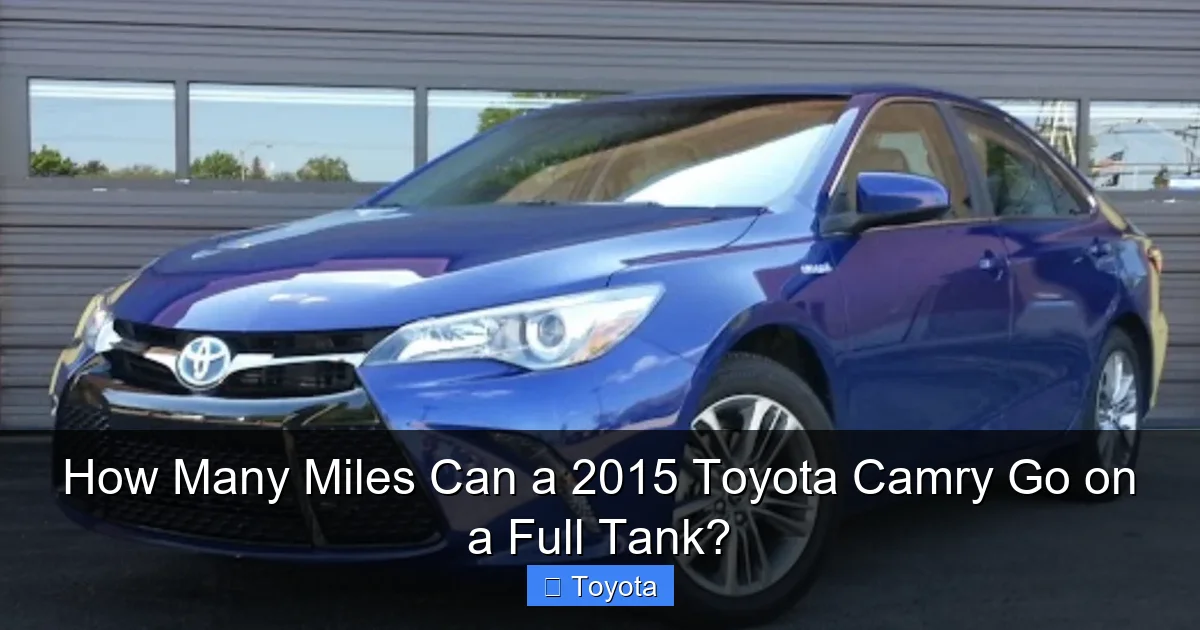
Visual guide about How Many Miles Can a 2015 Toyota Camry Go on a Full Tank?
Image source: blog.consumerguide.com
Universal Fuel Tank Capacity
Across all trims and engine options for the 2015 model year, the Toyota Camry is equipped with a single fuel tank size. Every single 2015 Camry has a fuel tank capacity of 15.8 gallons (59.9 liters). This consistency simplifies our calculations. Whether you drive a base-model LE with a 4-cylinder or a top-tier XSE V6, you’re starting every journey with the same maximum volume of gasoline in the tank. This is a key piece of data you can always rely on. For comparison, you might wonder how this compares to other vehicles; for instance, the larger Toyota Camry gas tank size is typical for a midsize sedan, while a minivan like the Sienna holds more but is less efficient.
EPA-Estimated Fuel Economy by Engine
The 2015 Camry was offered with two distinct engine choices, each with its own EPA fuel economy ratings. These are the official “sticker” numbers you see on the window of a new car and serve as our best standardized comparison point.
- 2.5L 4-Cylinder Engine (Most Common): This engine was standard on the L, LE, SE, and XLE trims. The EPA ratings for this powertrain are:
- City: 25 MPG
- Highway: 35 MPG
- Combined: 28 MPG
Using the combined figure, the theoretical maximum range on a full tank is 15.8 gallons x 28 MPG = 442.4 miles.
- 3.5L V6 Engine: This was the upgrade option, available on the SE, XLE, and XSE trims. The EPA ratings for this more powerful engine are:
- City: 21 MPG
- Highway: 31 MPG
- Combined: 22 MPG
Using the combined figure, the theoretical maximum range on a full tank is 15.8 gallons x 22 MPG = 347.6 miles.
It’s crucial to note the dramatic difference between city and highway MPG for both engines. The V6’s penalty in the city is particularly steep due to its larger displacement and higher output. This immediately tells you that your driving environment is the single biggest factor in determining your actual range. A driver who spends 90% of their time on interstate highways could potentially see ranges even exceeding the EPA combined estimate, while a driver in constant stop-and-go urban traffic will fall well below it.
Real-World Mileage: Why Your Numbers Will Differ
EPA tests are conducted in controlled laboratory conditions on a dynamometer. The real world is messier. Your actual miles per gallon—and thus your total range on a full tank—are influenced by a complex web of variables. Understanding these helps you diagnose poor fuel economy and set realistic expectations.
Visual guide about How Many Miles Can a 2015 Toyota Camry Go on a Full Tank?
Image source: i.ytimg.com
Driving Style and Environment
Your right foot is your most powerful fuel economy tool. Aggressive acceleration and hard braking can reduce fuel efficiency by up to 33% in city driving. Smooth, gradual inputs that mimic a “keep-away” game with the traffic around you are far more efficient. Your typical route matters immensely. A commute dominated by highway cruising will yield numbers closer to the 35 MPG (4-cyl) or 31 MPG (V6) highway ratings. A commute filled with traffic lights, congestion, and short trips where the engine never fully warms up will pull your average down toward the city ratings or worse.
Environmental factors play a huge role. Cold weather thickens engine oil and increases aerodynamic drag, reducing MPG. Using the heater and defroster also adds a small electrical load. Extreme heat forces the engine cooling system and air conditioning to work harder. Driving at high altitudes can affect engine tuning. Even tire pressure is critical; for every 1 PSI that your tires are under-inflated, your fuel economy drops by approximately 0.2%. That’s why maintaining the proper maintenance schedule, including tire rotations and pressure checks, is directly linked to fuel savings.
Vehicle Condition and Maintenance
A well-maintained Camry will perform as intended. A neglected one will not. Key maintenance items that directly impact fuel economy include:
- Engine Oil: Using the correct viscosity (often 0W-20 for the 2015 Camry) is essential. Thicker oil increases internal friction. Regular oil changes keep the engine clean and lubricated.
- Air Filter: A clogged air filter restricts airflow to the engine, forcing it to work harder and burn more fuel. It’s a cheap and easy fix.
- Spark Plugs: Worn spark plugs cause misfires and incomplete combustion, wasting fuel.
- Fuel System: Deposits on fuel injectors or in the combustion chambers can alter spray patterns and reduce efficiency.
- Wheel Alignment: Misaligned wheels create drag, forcing the engine to overcome more resistance.
Even something as simple as carrying an extra 100 pounds of cargo in the trunk can reduce MPG by about 1%. Roof racks and carriers create significant aerodynamic drag, even when empty, cutting highway fuel economy by several percent. It’s always best to remove them when not in use.
The Gas Light: Your Critical Warning System
Understanding the “reserve” fuel is just as important as knowing your tank’s total capacity. That moment when the low fuel warning light (often a yellow gas pump icon) illuminates on your dashboard is not a suggestion—it’s a serious warning. But how far can you *really* go after it comes on?
Visual guide about How Many Miles Can a 2015 Toyota Camry Go on a Full Tank?
Image source: autozonic.com
The Reserve Fuel Tank
Automakers intentionally design fuel systems with a “reserve” beyond what the gauge indicates. The fuel pump, located inside the tank, needs to be submerged in fuel for cooling and lubrication. Running the tank completely dry is a surefire way to destroy the pump. The low fuel light is triggered by a separate level sensor designed to give you enough warning to find a gas station without starving the pump.
For the 2015 Toyota Camry, the general consensus from owner forums, repair manuals, and Toyota’s own engineering is that when the gas light comes on, you have approximately 1 to 2 gallons of fuel remaining. This is not an exact science, as the precise trigger point can vary slightly by model year and individual vehicle calibration. However, it’s a safe and widely accepted estimate.
Calculating the Emergency Range
Using our 1-2 gallon reserve estimate, we can calculate your emergency “after light” range:
- For the 2.5L 4-Cylinder (28 MPG combined): 1 gallon x 28 MPG = ~28 miles. 2 gallons x 28 MPG = ~56 miles.
- For the 3.5L V6 (22 MPG combined): 1 gallon x 22 MPG = ~22 miles. 2 gallons x 22 MPG = ~44 miles.
Therefore, a safe, conservative estimate is that a 2015 Camry can travel between 25 and 50 miles after the gas light illuminates. This aligns closely with discussions on other models; for example, the range after the light comes on in a Toyota Camry is typically in this same ballpark.
Important Caveat: This is a worst-case, emergency-only figure. This remaining fuel is being used under conditions that are likely not optimal for efficiency (you may be stressed, searching for a station, in stop-and-go traffic). You should treat this as your absolute maximum buffer and plan to refuel immediately after the light comes on. Consistently driving until the tank is near empty increases the risk of running out, overheating the fuel pump, and drawing sediment from the bottom of the tank into your fuel system.
Maximizing Your Miles Per Tank: Practical Strategies
Now that we understand the variables, let’s focus on what you can actively do to push your Camry’s range toward the upper end of its potential. These are simple, actionable habits that can save you money and time at the gas station over the life of the vehicle.
Driving Techniques for Efficiency
Your driving technique has the most immediate and dramatic impact. Think of the accelerator pedal as a money burner. The harder you press it, the more fuel you inject.
- Accelerate Gradually: Pretend there’s an egg under your foot. Take 5-7 seconds to reach your cruising speed from a stop. This keeps engine RPMs lower and reduces fuel injection.
- Maintain Steady Speeds: Use cruise control on flat, open highways. Constant speed is far more efficient than constant acceleration and braking.
- Anticipate Traffic: Look far ahead. If you see a red light or slowing traffic, take your foot off the gas early and coast. Your Camry’s fuel injection system cuts off when you coast in gear, using zero fuel.
- Observe Speed Limits: Aerodynamic drag increases exponentially with speed. Driving 70 mph vs. 60 mph can increase fuel consumption by 10-15%. The sweet spot for most cars, including the Camry, is usually between 45-60 mph on flat terrain.
- Reduce Idling: If you’re stopped for more than 30-60 seconds (not in traffic), turn the engine off. Modern engines use very little fuel to start.
Vehicle Preparation and Upkeep
Combine smart driving with a well-tuned machine for the best results.
- Check Tire Pressure Monthly: Inflate tires to the pressure listed on the driver’s door jamb sticker (usually 32-35 PSI for the Camry), not the max on the tire sidewall.
- Use the Recommended Oil: Toyota specified 0W-20 synthetic oil for the 2015 Camry for a reason—it reduces internal friction. Stick with it.
- Remove Excess Weight: Clean out the trunk. Every 100 lbs. costs about 1% in fuel economy.
- Service the Air Filter: Check it during every oil change. Replace it if it’s dirty.
- Consider Tires: When it’s time for new tires, choose low-rolling-resistance models if maximizing MPG is a priority. They are often the OE (Original Equipment) tires on the Camry.
By adopting these habits, a driver who typically gets 25 MPG in mixed driving could realistically see a 2-3 MPG improvement, translating to an extra 30-45 miles on a single tank over the course of several fill-ups.
Comparing Trims: Does the V6 Really Cost That Much Range?
The choice between the efficient 4-cylinder and the powerful V6 is a classic trade-off. Let’s quantify the real-world range difference based on our EPA numbers.
On a single 15.8-gallon tank:
- 4-Cylinder (28 MPG combined): ~442 miles
- V6 (22 MPG combined): ~348 miles
That’s a difference of about 94 miles per tank. Over the course of a year, assuming 12,000 miles driven and an average gas price of $3.50/gallon, the V6 owner would make roughly 15-16 more fill-ups and spend about $300-$350 more on fuel, depending on actual driving conditions. This is the tangible cost of choosing performance over efficiency. However, it’s important to note that in pure highway driving, the gap narrows significantly (35 MPG vs. 31 MPG), meaning the long-distance road tripper will see a smaller penalty per tank than the city commuter.
For context on larger vehicles, a minivan like the Toyota Sienna has a larger tank but is heavier and less aerodynamic, resulting in a different range profile altogether. The Camry remains a leader in its class for combining decent size with excellent sedan efficiency.
Conclusion: Knowledge is Power (and Miles)
So, how many miles can a 2015 Toyota Camry go on a full tank? The definitive answer is: it depends. Your baseline is a 15.8-gallon tank paired with an EPA-rated combined fuel economy of 28 MPG for the 4-cylinder or 22 MPG for the V6. This gives you a theoretical range of roughly 350 to 470 miles. However, your real-world result is a direct reflection of your driving environment, your vehicle’s health, and your personal driving habits.
The most important takeaway is to respect the low fuel warning. With only about 1-2 gallons left—giving you a final 25-50 miles—it’s your cue to start planning a refuel immediately. Making a habit of filling up when you have a quarter tank remaining is the best way to protect your fuel system, avoid stress, and ensure you’re always ready for the next journey.
By implementing the efficient driving techniques and maintenance practices outlined here, you can consistently achieve mileage at or even above the EPA estimates. You’ll not only extend the distance between fill-ups but also contribute to the long-term health and longevity of your reliable 2015 Toyota Camry. Ultimately, understanding your car’s capabilities turns a simple question about range into a powerful tool for smarter, more economical driving.
Frequently Asked Questions
What is the exact fuel tank capacity of a 2015 Toyota Camry?
All 2015 Toyota Camry models, regardless of trim or engine, have a fuel tank capacity of 15.8 gallons (59.9 liters). This is a fixed specification for that model year.
How many miles can I drive after the gas light comes on in my 2015 Camry?
When the low fuel warning light illuminates, you typically have approximately 1 to 2 gallons of fuel remaining. For the 2.5L 4-cylinder, this provides a safe emergency range of about 25 to 50 miles. For the 3.5L V6, expect 20 to 40 miles. You should refuel as soon as possible after the light comes on.
Does the 4-cylinder or V6 Camry have a longer range on a full tank?
Yes, the 4-cylinder model has a significantly longer range. Based on EPA combined ratings, the 4-cylinder can travel about 440 miles on a full tank, while the V6 can travel about 350 miles. This is a difference of nearly 100 miles per fill-up due to the V6’s lower fuel economy.
What are the biggest factors that reduce my Camry’s actual MPG?
The biggest factors are aggressive driving (hard acceleration and braking), excessive highway speed, under-inflated tires, a dirty air filter, using the wrong oil viscosity, carrying unnecessary weight, and neglecting regular maintenance like tune-ups and oil changes. Cold weather and constant city traffic also reduce efficiency.
Can towing or using a roof rack affect my Camry’s range?
Absolutely. Both towing a trailer and carrying a roof rack or cargo box create significant aerodynamic drag. This can reduce highway fuel economy by 10% or more, dramatically decreasing your total range on a full tank. Always remove roof carriers when not in use.
Is it bad to frequently drive my Camry until it’s almost empty?
Yes, it is not recommended. Consistently running the fuel tank very low can overheat and prematurely fail the in-tank fuel pump, which relies on gasoline for cooling and lubrication. It also increases the chance of drawing sediment and debris from the bottom of the tank into your fuel system, potentially clogging filters and injectors.