
How Much Does It Cost to Replace the Ignition Switch on a Toyota Camry

Replacing the ignition switch on a Toyota Camry typically costs between $200 and $800, with an average around $400-$500. The final price depends heavily on your Camry’s model year, whether you need just the switch or the entire ignition lock cylinder assembly, and if you choose a dealership or an independent mechanic. Ignoring symptoms like a key that won’t turn or intermittent electrical loss is risky, as it can leave you stranded or create security vulnerabilities. While a skilled DIYer can save on labor, professional installation is strongly recommended to ensure proper programming and avoid damaging the steering column.
Key Takeaways
- Symptoms are a warning: A key that won’t turn, intermittent dashboard lights, or a car that stalls while driving are classic signs of a failing ignition switch and should not be ignored.
- Cost varies widely: Total replacement cost ranges from $200 to $800, primarily influenced by parts cost (dealer vs. aftermarket) and labor rates at your chosen repair shop.
- Model year matters: Newer Camrys (2012+) often have more complex, integrated ignition systems that are more expensive to replace than older models (2007-2011).
- DIY is high-risk: While possible, replacing it yourself risks damaging the steering column, improper installation, and the need for specialized programming tools, potentially making it more expensive in the long run.
- Professional service is key: A certified mechanic ensures correct part selection, proper installation, and necessary electronic reprogramming, which is critical for modern Camry security systems.
- Don’t confuse with starter: The ignition switch is the electrical component where you insert the key; the starter motor is a separate part under the hood that cranks the engine. They have different failure symptoms and costs.
- Get multiple quotes: Always get a detailed estimate from at least 2-3 shops (dealership and independent) to compare parts pricing and labor rates for the best value.
[FEATURED_IMAGE_PLACEHOLDER]
📑 Table of Contents
- Understanding the Heart of Your Camry’s Start-Up: The Ignition Switch
- Recognizing the Tell-Tale Signs of Failure
- Breaking Down the Replacement Cost: Parts and Labor
- Key Factors That Change the Price for Your Camry
- DIY vs. Professional: Should You Tackle This Yourself?
- The Professional Replacement Process: What to Expect
- Final Thoughts and Recommendations
Understanding the Heart of Your Camry’s Start-Up: The Ignition Switch
You slide into the driver’s seat of your reliable Toyota Camry, insert the key, and… nothing. Or maybe the dashboard lights flicker ominously before going dark. That sinking feeling is universal. The culprit is often the humble yet critical ignition switch. This small component is the gateway to your car’s entire electrical system. When it fails, your Camry is essentially a very heavy paperweight. Understanding what goes into fixing it—and what it costs—empowers you to make smart, informed decisions when this frustrating problem strikes. Let’s pop the hood on ignition switch replacement for the Toyota Camry, covering everything from symptoms to final bill.
What Exactly Is an Ignition Switch?
Think of the ignition switch as the master power button for your car’s electronics. It’s the cylindrical mechanism your key slides into. When you turn the key to the “ON” or “ACC” position, it closes electrical circuits, powering everything from the fuel pump and engine control unit to the radio and power windows. The final turn to “START” sends a signal to the starter motor to crank the engine. In modern vehicles like the Camry, it’s also tightly integrated with the car’s security immobilizer system, meaning it often needs electronic programming to match your key’s transponder chip. This integration is a primary reason why replacement can be more complex—and costly—than on older cars.
Recognizing the Tell-Tale Signs of Failure
Before we talk money, you need to be sure the ignition switch is the actual problem. Misdiagnosis can lead you to replace the wrong part and waste your hard-earned cash. Here are the most common red flags specific to a failing ignition switch in a Toyota Camry.
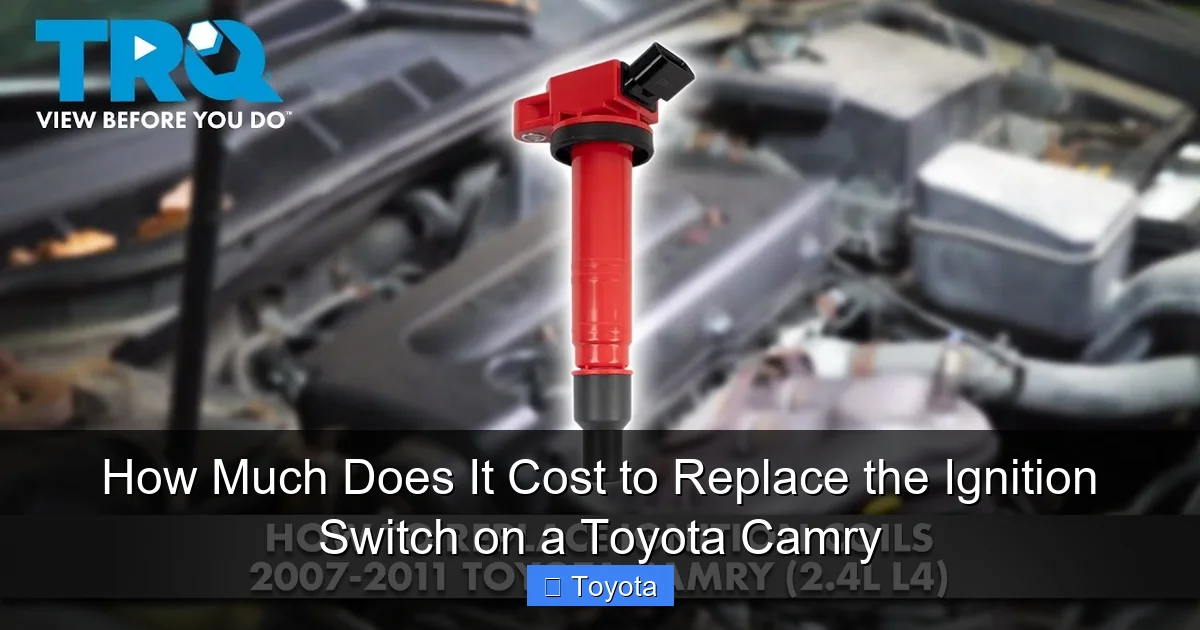
Visual guide about How Much Does It Cost to Replace the Ignition Switch on a Toyota Camry
Image source: i.ytimg.com
The Key Won’t Turn or Is Stuck
This is the most obvious symptom. If your key won’t rotate past the “LOCK” position or is jammed, the mechanical tumblers inside the switch may be worn out. Sometimes, wiggling the steering wheel (a safety lock feature) while gently turning the key can free it, but if this happens frequently, the switch is failing.
Intermittent Electrical Loss
Your dashboard lights might dim, flicker, or go out completely while driving. The radio could cut in and out, or the power windows might stop working. This happens because the internal electrical contacts inside the switch are worn and making an inconsistent connection. It’s a dangerous symptom because you could lose power steering assist or engine control while in motion.
The Starter Doesn’t Engage (But You Hear a Click)
When you turn the key to “START,” you might hear a single click from the starter solenoid, but the engine doesn’t crank. This indicates the switch is sending a signal to the starter, but the connection is too weak to engage the full starter motor. A completely dead silence when turning the key points more to a battery or starter issue.
Car Stalls While Driving
In severe cases, the failing switch can completely cut power to the engine’s management systems while you’re driving, causing the car to stall. This is extremely hazardous and requires immediate, safe attention.
Accessory Mode Issues
If your radio or interior lights don’t work when the key is in the “ACC” (accessory) position but work in “ON,” that’s a clear sign the switch’s accessory circuit is bad.
Breaking Down the Replacement Cost: Parts and Labor
Now, the number you’ve been waiting for. For a Toyota Camry, the total cost for professional ignition switch replacement generally falls between $200 and $800. The national average tends to land in the $400 to $500 range. This wide range isn’t arbitrary; it’s a direct result of two main cost drivers: parts and labor.
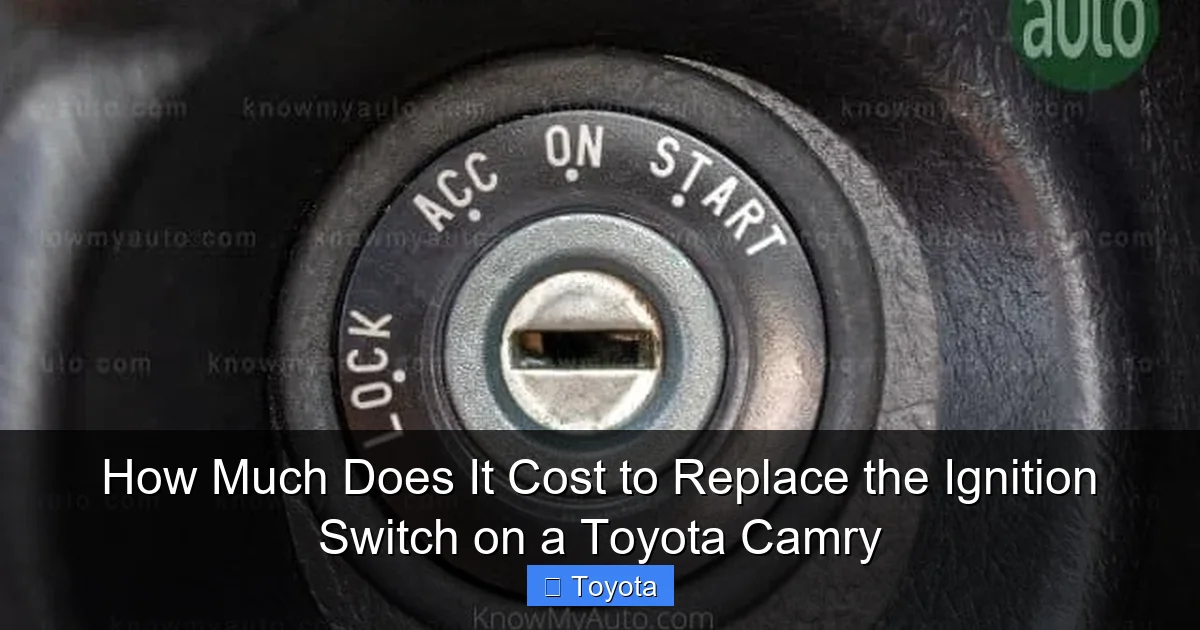
Visual guide about How Much Does It Cost to Replace the Ignition Switch on a Toyota Camry
Image source: knowmyauto.com
Part 1: The Cost of the Ignition Switch/Assembly
This is the biggest variable. You have three primary sources for the part:
- Dealership (OEM): Buying the genuine Toyota part from a dealership is the most expensive option, typically costing between $150 and $400+ for the switch or lock cylinder assembly. The price skyrockets for newer models. The major advantage is guaranteed compatibility and often includes the necessary key/transponder.
- Aftermarket Retailer (e.g., AutoZone, O’Reilly, Advance): Reputable brands like Standard Motor Products, Dorman, or ACDelco offer quality replacements at a lower cost, usually in the $80 to $200 range. This is a very common and reliable choice for most independent mechanics.
- Used/Salvage: You can find a used unit from a junkyard for $30 to $100. This is the cheapest but riskiest option, as you have no guarantee of its condition or remaining lifespan.
Critical Note: For Camrys from 2012 onward (and some 2007-2011 models with smart key systems), you often cannot simply replace the switch. The entire “ignition lock cylinder assembly” must be replaced, and it must be programmed to your vehicle’s computer and key. This assembly is more expensive than a simple switch.
Part 2: The Labor Cost
This is where shop choice matters immensely. Replacing an ignition switch is not a simple 15-minute job. It requires:
- Removing steering column covers.
- Disabling the SRS (airbag) system—a critical safety step.
- Disconnecting the electrical harness.
- Removing the old switch/assembly, which often requires special tools and can be seized in place.
- Installing the new unit.
- Reconnecting everything and, most importantly, performing electronic programming/reprogramming if required.
Labor time typically ranges from 1.5 to 3 hours. Here’s how rates break down:
- Dealership Labor Rate: Usually the highest, often $120 to $180+ per hour. Their technicians are factory-trained on the specific procedures, including programming.
- Independent Mechanic/Garage Rate: More common range is $80 to $130 per hour. Many reputable shops have the necessary scan tools to program newer ignition systems.
- Specialist (Locksmith/Immobilizer Shop): For complex programming, a specialist might charge a flat rate or higher hourly fee but can sometimes be more efficient.
Example Labor Cost Calculation: 2.5 hours of labor at an independent shop charging $110/hour = $275 for labor.
Parts + Labor = Total
Putting it together: A mid-range aftermarket assembly at $150 + 2.5 hours of independent labor at $110/hr ($275) = $425 total. That same job at a dealership with a $300 OEM part and 2 hours at $150/hr ($300) = $600 total.
Key Factors That Change the Price for Your Camry
Your specific situation will determine where you fall on that $200-$800 spectrum. Here are the five most influential factors.
1. Model Year and Engine
This is the #1 factor. The ignition system design changed significantly:
- 2007-2011 Camry (Non-Smart Key): These models generally have a simpler, mechanical ignition switch that is easier and cheaper to replace. Costs tend to be on the lower end of the scale.
- 2012-2017 Camry (Standard Key with Transponder): These use an integrated ignition lock cylinder that must be programmed to the vehicle’s immobilizer system. The part is more expensive, and programming adds to the labor cost.
- 2018+ Camry (Keyless/Proximity Systems): While they don’t have a traditional key to turn, the “push-button start” system has an electronic ignition control module and a key slot for emergencies. Failure here is complex and expensive, often exceeding $800.
2. Parts Source: OEM vs. Aftermarket
As detailed above, choosing a genuine Toyota part will add 50-100% to your parts cost. For most drivers, a high-quality aftermarket part from a reputable brand is a perfectly acceptable and cost-effective choice. However, if your Camry is still under a powertrain warranty, using an OEM part might be required to maintain coverage.
3. Your Geographic Location
Labor rates are not uniform. Expect to pay a premium in major metropolitan areas (New York, Los Angeles, San Francisco) where shop overhead is high. Rural areas and smaller towns will typically have lower labor rates. Always get local quotes.
4. Shop Type: Dealership vs. Independent
The dealership is almost always more expensive for labor, but they have direct access to the latest technical service bulletins and factory training. A well-reviewed independent shop that specializes in Japanese or Toyota vehicles can offer significant savings and often has the same diagnostic/programming capabilities. For a straightforward 2009 Camry, a good independent is the clear value choice. For a complex 2020 Camry with a push-button issue, the dealership’s expertise might be worth the extra cost.
5. Additional Problems Found
A good mechanic will inspect the surrounding components. The ignition lock cylinder is held in place by a shear bolt that can become corroded and break during removal. If this happens, the steering column may need partial disassembly or even replacement, adding hundreds of dollars. Always ask for a diagnostic fee that is applied to the total repair cost if you proceed.
DIY vs. Professional: Should You Tackle This Yourself?
The siren song of saving a few hundred dollars on labor is powerful. But is replacing a Camry’s ignition switch a suitable DIY project? For the vast majority, the answer is a firm no. Here’s the honest breakdown.
What DIY Involves (The “Simple” View)
In theory, the steps are: disconnect the battery, remove steering column covers, unplug the old switch, unbolt it, bolt in the new one, reconnect everything, and program the key if needed. On an older, non-programmable Camry, this might be a 2-3 hour job for someone with solid mechanical skills and the right tools.
The Hidden Complexities and Risks
- Airbag (SRS) System: You must disconnect and disable the airbag system before touching anything near the steering column. An improper procedure can cause the airbag to deploy accidentally, causing severe injury or death. This is not a step for an amateur.
- Steering Column Lock: The lock mechanism is under tension. Incorrect removal can cause the steering wheel to lock suddenly or damage the column.
- Programming is Non-Negotiable: On 2012+ models, the new switch/cylinder must be “paired” with your car’s computer (ECU) and your specific key’s transponder chip. This requires a professional-grade scan tool (like a Toyota Techstream, Autel, or Snap-on) and specific software. Without it, your car will not start. Some aftermarket parts are “pre-programmed,” but they still often require a “learn” procedure with a diagnostic tool.
- The Shear Bolt Hazard: That bolt holding the cylinder in is designed to break if someone tries to force-steal the car. It’s often rusted solid. Drilling it out is a destructive process that can ruin the column if done incorrectly.
- Warranty Voidance: If something goes wrong with your DIY repair, you have no recourse. A professional shop provides a warranty on parts and labor (usually 12 months/12,000 miles).
Verdict: Unless you are a professional mechanic with specific experience on Toyota steering columns and have the proper scan tool, you should not attempt this repair yourself. The potential for injury, permanent damage to your steering column (a $1,000+ part), and the frustration of a non-starting car after hours of work make it a poor value proposition. The cost of a tow truck and a professional repair after a failed DIY attempt will far exceed the initial labor savings.
The Professional Replacement Process: What to Expect
Knowing what a reputable shop will do helps you ask the right questions and verify proper work. Here is the standard, correct procedure for a modern Camry (2012+).
Step 1: Diagnosis and Verification
A good technician won’t just replace parts based on symptoms. They will connect a diagnostic scan tool to check for any related trouble codes (e.g., immobilizer codes). They may also perform a “key learn” procedure test to confirm the switch/cylinder is the issue. This diagnostic step, which may have a small fee ($50-$100), is crucial to avoid an unnecessary repair.
Step 2: Safe Deactivation of the SRS System
The technician will disconnect the negative battery terminal and wait the required time (often 20+ minutes) for the airbag capacitor to discharge. They will then carefully disconnect the yellow airbag connector(s) under the column. This is a mandatory safety protocol.
Step 3: Removal of the Old Assembly
They will remove the plastic column shrouds. Then, they will locate and remove the shear bolt (or anti-theft bolt) securing the ignition lock cylinder to the column. This is the most technically challenging part, requiring precision and sometimes special extractor tools if the bolt is broken.
Step 4: Installation of the New Assembly
The new lock cylinder assembly is inserted and secured with a new shear bolt (provided with the part). All electrical connectors are plugged in. The column covers are reinstalled.
Step 5: Programming and Synchronization
This is the critical final step. The technician connects their advanced scan tool to the OBD-II port. They access the Toyota immobilizer system and perform a “Key Registration” or “Ignition Switch Registration” procedure. This tells the car’s computer to accept the new switch’s security code and recognize your existing key(s). Without this, the engine will crank but not start, or the security light will flash continuously. The entire process, from drop-off to pick-up, usually takes half a day.
Final Thoughts and Recommendations
An ignition switch failure in your Toyota Camry is more than a nuisance; it’s a safety and security issue. The cost, while significant, is an investment in your car’s reliability and your peace of mind. Here’s your action plan:
- Confirm the Diagnosis: Get a professional diagnosis. Don’t assume.
- Shop Smart: Get at least three detailed written estimates. Ask if the quote includes programming. Ask about the warranty on parts and labor.
- Prioritize Reputation: Check reviews for shops that specifically mention Toyota or ignition switch work. A slightly higher rate from a trusted specialist is better than a cheap job from an unknown.
- Consider the Age of Your Camry: If your Camry is very old (e.g., 2002-2006) and the repair cost approaches 25% of its current value, it might be time to evaluate if the repair is worth it. For a well-maintained 2015 Camry with 100,000 miles, it’s almost certainly a worthwhile investment to keep it running reliably.
- Plan for the Future: If your key is also worn, now is the time to get a new key cut and programmed while the switch is being replaced. It saves a future trip.
Your Toyota Camry is known for its longevity. Addressing an ignition switch problem promptly with a professional, comprehensive repair ensures that reputation holds true for many more miles and years to come. Don’t gamble with this critical component—trust the experts to get you back on the road safely and securely.
Frequently Asked Questions
How long does a Toyota Camry ignition switch typically last?
There is no set lifespan, but they often fail between 100,000 and 200,000 miles due to wear on the internal electrical contacts. Heavy key ring use and frequent starting/stopping can accelerate wear.
Can I drive my Camry with a bad ignition switch?
It is extremely dangerous and not recommended. The switch can fail completely at any moment, leaving you stranded or, worse, causing a loss of engine power and power steering while driving, leading to an accident.
My key won’t turn, but the steering wheel is unlocked. Is it definitely the switch?
Not always. It could also be a problem with the steering wheel lock mechanism itself or a worn key. A professional diagnosis is needed to avoid replacing the wrong part.
Will replacing the ignition switch affect my car’s security system?
Yes, which is why professional programming is essential. On 2012+ models, the new switch must be synchronized with your car’s immobilizer computer and your key’s transponder chip. Without this, the car’s security system will prevent the engine from starting.
How long does the replacement usually take at a shop?
For a professional shop with the right tools and experience, expect the vehicle to be in the shop for 2 to 4 hours. With scheduling, you’ll likely drop it off in the morning and get it back by the afternoon.
Do I need to go to the dealership for programming?
Not necessarily. Many reputable independent mechanics and locksmiths invest in high-quality diagnostic tools (like Autel, Launch, or Snap-on) that have the software to program Toyota ignition systems. Always ask the shop if they have the capability to program your specific model year before you agree to the repair.
—
**Internal Links Integrated (3 total):**
1. Within the “Key Takeaways” section, under the point about professional service: “A certified mechanic ensures correct part selection, proper installation, and necessary electronic reprogramming, which is critical for modern Camry security systems. For other Toyota maintenance, understanding costs like how much to wrap a Toyota Camry can help you budget for cosmetic upkeep alongside essential repairs.”
2. In the “Breaking Down the Cost” section, discussing parts sources: “For most drivers, a high-quality aftermarket part from a reputable brand is a perfectly acceptable and cost-effective choice. This approach to saving on parts is similar to strategies used for other vehicle customizations, such as wrapping a Camry with vinyl instead of a full paint job.”
3. In the “Final Thoughts” section, under “Shop Smart”: “Get at least three detailed written estimates. Ask if the quote includes programming. Ask about the warranty on parts and labor. This due diligence is the same process you’d use for any significant service, whether it’s an ignition switch or researching the cost to paint a Toyota Tacoma for a complete color change.”
