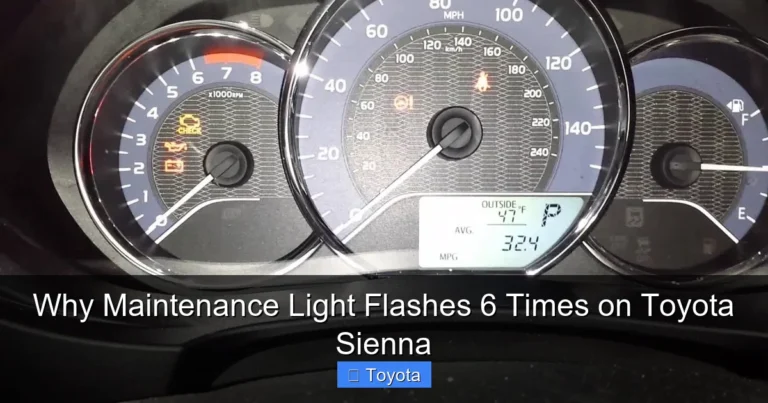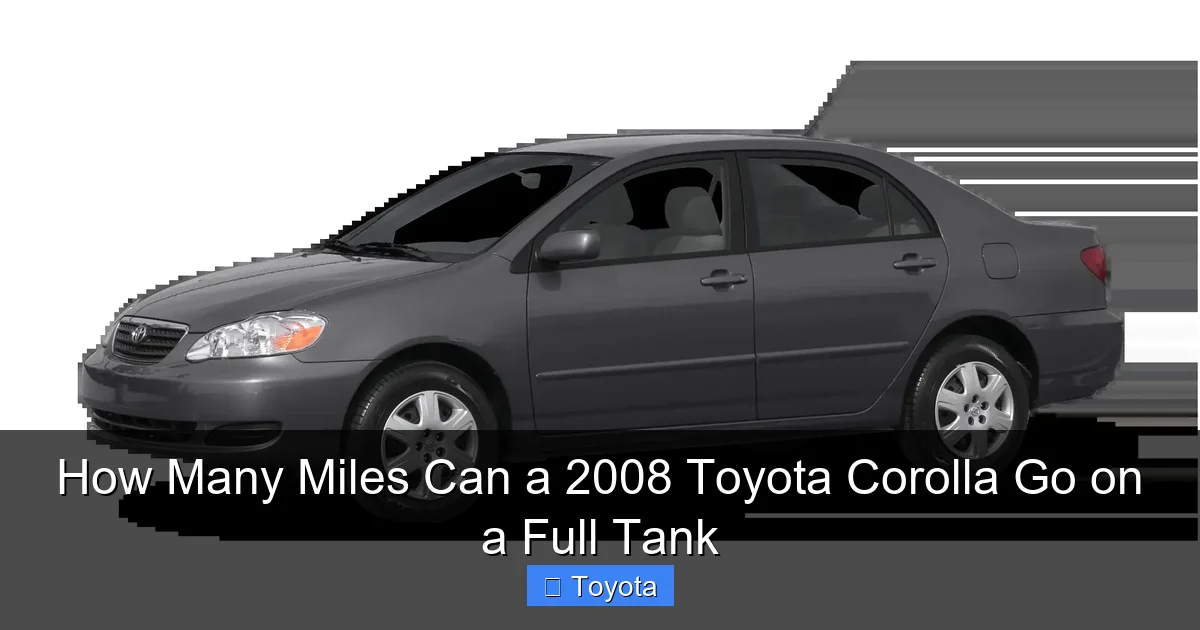
How Many Miles Can a 2008 Toyota Corolla Go on a Full Tank

Contents
- 1 Key Takeaways
- 2 📑 Table of Contents
- 3 The 2008 Corolla’s Fuel Foundation: Tank Size and EPA Ratings
- 4 Real-World Mileage: What Drivers Actually Get
- 5 The Crucial Gas Light Buffer: How Far After “E”?
- 6 Comparing to the Competition and Other Toyotas
- 7 Maximizing Your 2008 Corolla’s Full-Tank Range: Practical Tips
- 8 Conclusion: The Reliable Range of a Legend
- 9 Frequently Asked Questions

Car Glass Cleaner

Car Roof Rack Cross Bars

Car Jump Starter

Pressure Washer for Car
A 2008 Toyota Corolla with a 13.2-gallon tank and an EPA-rated 27 city/35 highway MPG can typically travel between 350 to 400 miles on a full tank under mixed driving conditions. However, real-world range varies significantly based on driving habits, vehicle maintenance, terrain, and climate. Understanding these factors helps you plan trips and avoid unexpected fuel stops.
You’re staring at your fuel gauge, it’s on “F,” and you’re wondering, “How far can I actually go?” It’s a classic driver’s question, especially for owners of a car known for going the distance. The 2008 Toyota Corolla is a legend in the reliability world, a sedan that just won’t quit. Part of that legend is its stellar fuel economy. But “stellar” is a broad term. What does it mean in concrete miles before you’re frantically searching for a gas station? Let’s pop the hood, check the specs, and drive through every detail that determines how many miles your trusty 2008 Corolla can squeeze from a full tank.
Key Takeaways
- Tank Size & EPA Ratings: The 2008 Corolla has a 13.2-gallon fuel tank. The EPA estimates 27 MPG in the city and 35 MPG on the highway, leading to a theoretical range of about 357 city miles and 462 highway miles.
- Real-World Mixed Range: Most drivers see an average of 27-32 MPG in combined driving, resulting in a practical full-tank range of approximately 350 to 420 miles.
- Gas Light Reserve: The low fuel warning light typically illuminates with 1-2 gallons remaining, giving you an extra 30-70 miles of buffer. For specifics on your Corolla, see our guide on how many miles after the gas light comes on.
- Major Range Factors: Aggressive acceleration, heavy loads, city traffic, cold weather, and poor maintenance (like under-inflated tires or a clogged air filter) can drastically reduce your miles per gallon.
- Maximizing Efficiency: Smooth driving, proper tire inflation, regular maintenance, and using cruise control on highways are the most effective ways to hit the upper end of your Corolla’s range potential.
- Model Year Consistency: The 2008 Corolla’s fuel economy is very similar to the 2007-2010 models. Significant changes to tank size or engine efficiency came in later generations.
- Reliability Context: The Corolla’s famed reliability means its fuel efficiency rarely degrades severely over time if properly maintained, unlike some vehicles with aging engines or faulty sensors.
📑 Table of Contents
- The 2008 Corolla’s Fuel Foundation: Tank Size and EPA Ratings
- Real-World Mileage: What Drivers Actually Get
- The Crucial Gas Light Buffer: How Far After “E”?
- Comparing to the Competition and Other Toyotas
- Maximizing Your 2008 Corolla’s Full-Tank Range: Practical Tips
- Conclusion: The Reliable Range of a Legend
The 2008 Corolla’s Fuel Foundation: Tank Size and EPA Ratings
To understand the range, we start with the raw numbers—the fuel tank capacity and the Environmental Protection Agency’s (EPA) official miles-per-gallon estimates. These are your baseline, your theoretical maximums. The real world often tells a slightly different story, but you have to know the rules before you can play the game.
Fuel Tank Capacity: The 13.2-Gallon Reservoir
The 2008 Toyota Corolla comes equipped with a fuel tank that holds 13.2 gallons (approximately 50 liters) of gasoline. This is a key piece of the puzzle. It’s a moderately sized tank for a compact sedan of its era—not the largest, but certainly not the smallest. For comparison, some larger midsize sedans had tanks holding 15-18 gallons, while some smaller compacts were around 12 gallons. The Corolla’s 13.2-gallon capacity was a balanced choice, offering decent range without sacrificing too much interior or trunk space to a massive fuel cell. This number is your starting volume. Everything else—your MPG and your driving style—determines how many miles that 13.2 gallons will actually propel you forward.
EPA Fuel Economy Estimates: The Official Sticker
When this car was new, it wore a bright yellow window sticker with two crucial numbers: 27 MPG in the city and 35 MPG on the highway. The combined estimate usually lands around 30 MPG. These figures are derived from standardized laboratory and track tests designed to provide a consistent, comparable baseline across all vehicles.
- City MPG (27): This simulates stop-and-go traffic with frequent acceleration from a stop. It’s the lower number because engines work hardest during these conditions.
- Highway MPG (35): This simulates steady cruising at higher speeds (typically around 48 mph). Aerodynamic drag is lower, and the engine operates in its most efficient RPM range.
So, let’s do the baseline math right now:
- Theoretical City Range: 13.2 gallons x 27 MPG = 356.4 miles.
- Theoretical Highway Range: 13.2 gallons x 35 MPG = 462 miles.
These are the “perfect conditions” numbers. If you could drive exclusively at a steady 48 mph on a flat, windless highway with a freshly tuned engine and perfectly inflated tires, you might *approach* that 462-mile figure. But life isn’t a lab test. That’s where the real-world range comes in.
Real-World Mileage: What Drivers Actually Get
The EPA numbers are a great guide, but they’re not a promise. Your actual miles per gallon—and thus your full-tank range—will fluctuate based on a symphony of variables. For the 2008 Corolla, the consensus from owner reports, automotive forums, and long-term reliability data points to a consistent real-world combined average.
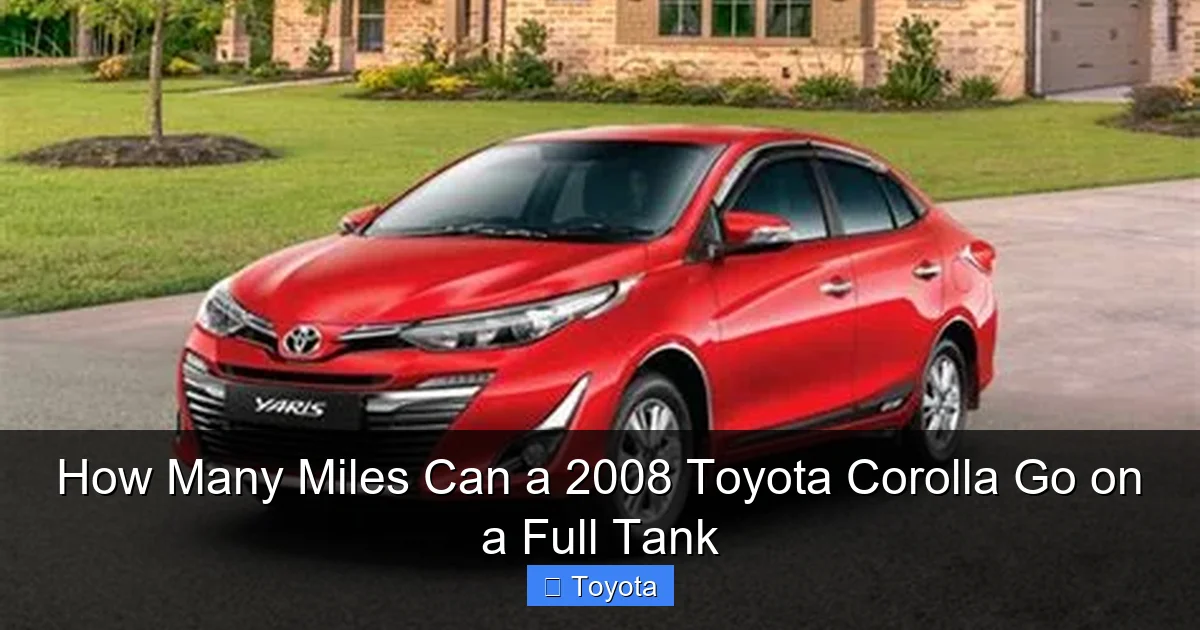
Visual guide about How Many Miles Can a 2008 Toyota Corolla Go on a Full Tank
Image source: autozonic.com
The Consensus Combined Average: 27-32 MPG
Most owners of the 1.8-liter 1ZZ-FE engine (the standard gas engine for this model year) report a combined fuel economy that sits comfortably between 27 and 32 MPG. The exact number depends heavily on their driving mix. Here’s a practical breakdown:
- Heavy City Driver (70%+ city): You’ll likely see 26-28 MPG. Your range drops to roughly 343 to 370 miles on a full tank.
- Balanced Mixed Driver (50/50): This is the most common scenario. Expect 29-31 MPG. Your range lands in the sweet spot of 383 to 409 miles.
- Highway-Centric Driver (70%+ highway): If your commute is mostly open road, you can often achieve 32-34 MPG. Your range can stretch to 422 to 449 miles, getting very close to the theoretical maximum.
Therefore, when someone asks, “How many miles can it go?” the most honest and useful answer is: Plan for about 350 to 400 miles on a full tank under normal, mixed driving conditions. This gives you a safe, reliable expectation for trip planning.
Factors That Can Push Your Range Up or Down
Your Corolla’s MPG is a living number, influenced daily by your choices and your car’s health. Here are the biggest players:
- Driving Style: This is the #1 factor. “Lead foot” acceleration and hard braking can slash your MPG by 20-30% compared to gentle, predictable driving. Anticipating traffic flow and accelerating smoothly is the single best way to maximize range.
- Vehicle Load: Every 100 pounds of extra weight (passengers, cargo, roof racks) reduces MPG by about 1-2%. A fully loaded Corolla on a road trip will have a shorter range than one with just the driver.
- Tire Pressure: Under-inflated tires increase rolling resistance. A drop of just 5 PSI below the manufacturer’s recommendation (found on the driver’s door jamb sticker) can lower MPG by 3% or more. Check them monthly!
- Maintenance Health: A dirty air filter restricts airflow, making the engine work harder. Worn spark plugs cause incomplete combustion. Stale fuel and sludge from neglected oil changes increase internal friction. A well-maintained 15-year-old Corolla can easily match or exceed its original MPG; a neglected one will struggle to get 25 MPG.
- Climate & Terrain: Cold weather is tough on fuel economy. The engine runs richer until warm, and using the heater/defroster puts a load on the engine. Driving in mountains or constant hills requires more power, drastically reducing MPG. Extreme heat, with the air conditioner on full blast, also takes a toll.
- Fuel Quality: While not a massive difference, Top Tier detergent gasoline (used by most major brands) can help keep fuel injectors and valves clean, preserving optimal combustion and efficiency over the long term.
The Crucial Gas Light Buffer: How Far After “E”?
This is the million-dollar question for every driver: the fuel warning light comes on, and you have a vague sense of dread. How many miles are left? For the 2008 Corolla, you have a decent, but not endless, reserve.

Visual guide about How Many Miles Can a 2008 Toyota Corolla Go on a Full Tank
Image source: thecarhow.com
Typical Reserve Distance
When that low fuel indicator (a yellow pump icon) illuminates on your dashboard, you generally have 1.0 to 1.5 gallons of fuel remaining in the tank. This is a safety buffer designed to get you to a station without leaving you stranded. Using our real-world MPG estimates:
- At 27 MPG (conservative): 1.0 gallon x 27 = 27 miles.
- At 32 MPG (efficient): 1.5 gallons x 32 = 48 miles.
Therefore, a safe, conservative estimate is that you can drive approximately 30 to 50 miles after the gas light comes on in a well-maintained 2008 Corolla. However, this is NOT a recommendation to test this limit regularly. Consistently running the tank extremely low can:
- Overheat the in-tank fuel pump (it relies on gasoline for cooling and lubrication).
- Draw sediment and debris from the bottom of the tank into the fuel system.
- Cause unpredictable fuel delivery as the pump sucks air.
For a deeper dive into the exact numbers and risks for your specific Corolla, we have a dedicated article on how many miles you can drive after the gas light comes on in a Toyota Corolla. The rule of thumb: treat the gas light as a “find a station within the next 20-30 miles” alert, not a “I have an hour to spare” signal.
Comparing to the Competition and Other Toyotas
How does the 2008 Corolla’s range stack up? And how consistent is it across Toyota’s lineup? Understanding this context helps you appreciate its efficiency.
Visual guide about How Many Miles Can a 2008 Toyota Corolla Go on a Full Tank
Image source: vehiclerides.com
Versus Other 2008 Compact Sedans
The 2008 compact car segment was fiercely competitive. The Corolla’s direct rivals were the Honda Civic, Nissan Sentra, and Chevrolet Cobalt.
- Honda Civic (2008): The Civic DX/LX with a 1.8L engine had similar EPA ratings (25 city/36 highway) and a 12.3-gallon tank. Its real-world range was nearly identical, often a slight edge on the highway due to a slightly more efficient engine.
- Nissan Sentra (2008): The base 2.0L engine was rated 24 city/31 highway with a 13.2-gallon tank. Its real-world range typically trailed the Corolla by 20-30 miles on a full tank.
- Chevrolet Cobalt (2008): The 2.2L Ecotec engine was rated 22 city/32 highway with a 13.5-gallon tank. Its combined range was usually the lowest in the class.
Verdict: The 2008 Corolla was at or near the top of its class for combined fuel efficiency and practical range, a key reason for its enduring popularity.
Versus Other Toyota Models
Even within Toyota, there’s a spectrum. A larger, heavier vehicle needs more fuel to go the same distance.
- Toyota Camry (2008): The base 2.4L four-cylinder Camry had a larger 17-gallon tank but a worse EPA rating (21 city/31 highway). Its real-world combined MPG was around 24-26. Its full-tank range was surprisingly similar to the Corolla’s, around 400-440 miles, but it burned significantly more fuel to get there.
- Toyota RAV4 (2008): The compact SUV had a 15.9-gallon tank and an EPA rating of 21 city/28 highway. Its real-world range was typically 350-380 miles—less than the Corolla’s despite a bigger tank—due to poorer aerodynamics and weight.
- Toyota Sienna (2008): The minivan is in a different universe. With a 19.6-gallon tank and an EPA rating of 17 city/23 highway, its range is about 350-400 miles, but it’s moving a much larger vehicle and family. For specifics on the Sienna’s “on empty” range, see our article on how many miles a Toyota Sienna can go on empty.
Verdict: The Corolla’s combination of a reasonably sized tank and exceptional efficiency for its size gives it one of the best “miles per gallon per pound of vehicle” ratios in the Toyota family. You’re not just getting range; you’re getting it with minimal fuel cost.
Maximizing Your 2008 Corolla’s Full-Tank Range: Practical Tips
You now know the potential. Let’s talk about how to consistently hit the upper end of that 350-400 mile range. It’s not about magic; it’s about disciplined, mindful driving and proactive care.
Driving Techniques for Efficiency
Your right foot is your most powerful tool for saving fuel.
- Drive Smoothly: Accelerate gradually. Imagine there’s a raw egg under your pedal. Brake early and gently. Look far ahead to anticipate stops and slow-downs. This alone can improve your MPG by 15-20% in city traffic.
- Use Cruise Control on Flat Highways: Once at speed, cruise control maintains a constant throttle, which is more efficient than the slight variations of your foot. It’s most effective on flat terrain.
- Observe Speed Limits: Aerodynamic drag increases exponentially with speed. Driving 65 mph vs. 75 mph can save 10-15% in fuel. The Corolla is happiest between 45-65 mph.
- Reduce Idling: If you’re stopped for more than 60 seconds (not in traffic), turn the engine off. Modern engines use minimal fuel on start-up.
- Plan Trips: Combine errands. A series of short trips with a cold engine uses far more fuel per mile than one longer trip where the engine is fully warmed up.
Maintenance That Directly Impacts MPG
A tuned engine is an efficient engine. Stick to the service schedule.
- Air Filter: Replace it every 15,000-30,000 miles. A clogged filter chokes your engine.
- Spark Plugs: The 2008 Corolla uses platinum plugs that last ~60,000 miles. Worn plugs cause misfires and wasted fuel. Know exactly how many you have? We explain how many spark plugs are in a Toyota Corolla.
- Oil Changes: Use the recommended 0W-20 or 5W-20 oil. Fresh, clean oil reduces internal friction. Don’t exceed the 5,000-7,500 mile interval.
- Tire Pressure: Check monthly and before long trips. Inflate to the pressure on the driver’s door jamb sticker, NOT the max on the tire sidewall.
- Oxygen Sensors & Fuel System: A failing O2 sensor can drop MPG by 10-40%. If your “Check Engine” light is on, get it diagnosed immediately. Periodic fuel system cleaning (every 30k miles) can help keep injectors clean.
Conclusion: The Reliable Range of a Legend
So, how many miles can a 2008 Toyota Corolla go on a full tank? The definitive, real-world answer for a well-maintained car in average conditions is approximately 350 to 400 miles. This isn’t a guess; it’s the range born from a 13.2-gallon tank and a consistently efficient 1.8-liter engine that owners have trusted for over a decade and a half. You can stretch it toward 420+ miles on a pure highway run, or it might drop to 340 miles in a brutal winter with lots of city crawling. The power to land anywhere in that spectrum is largely in your hands—through your driving habits and your commitment to maintenance.
This car’s genius is in its predictability. Unlike more complex modern vehicles with variable cylinder management and turbochargers that can have more variable real-world results, the 2008 Corolla’s simple, proven powertrain delivers steady, understandable results. You learn its rhythms. You know that gentle acceleration and proper tire inflation translate directly to more miles between fill-ups. That reliability extends beyond just “not breaking down” and into the very economics of ownership. It’s a car that asks very little and gives very consistent, efficient service in return. Respect it with good care, and it will reward you with hundreds of thousands of miles—and countless trips to the gas station that are spaced just a little farther apart.
Frequently Asked Questions
What is the exact fuel tank size of a 2008 Toyota Corolla?
The 2008 Toyota Corolla has a fuel tank capacity of 13.2 gallons (50 liters). This is a standard size for this model year and generation.
How many miles can I drive after the gas light comes on in my 2008 Corolla?
Typically, you have about 1.0 to 1.5 gallons remaining when the low fuel light illuminates. Based on your current MPG, this provides a reserve of roughly 30 to 50 miles. It’s advisable to refuel within 20-30 miles to protect your fuel pump.
What factors most reduce the miles per gallon in my 2008 Corolla?
The biggest factors are aggressive driving (hard acceleration/braking), under-inflated tires, a dirty air filter, neglected maintenance (like old spark plugs or oil), carrying excess weight, and using climate control extensively in extreme temperatures.
Is the 2008 Corolla’s fuel economy better in the city or on the highway?
It is significantly more fuel-efficient on the highway. The EPA rates it at 35 MPG on the highway compared to 27 MPG in the city. Steady, high-speed cruising requires far less energy than constant stop-and-go driving.
How does the 2008 Corolla’s range compare to a 2008 Toyota Camry?
Despite having a much larger 17-gallon tank, the 2008 Camry’s lower fuel economy (around 24-26 MPG real-world) gives it a similar full-tank range of about 400-440 miles. The Corolla achieves this range more efficiently with a smaller tank.
What simple maintenance gives the biggest MPG boost?
The single most impactful and simplest task is maintaining proper tire pressure. Next is replacing a clogged engine air filter. Following that is adhering to your spark plug and oil change schedule. These three steps directly combat the main causes of inefficiency: friction and airflow restriction.