
How Much Does It Cost to Replace the Ignition Switch on a Toyota Camry?

Replacing the ignition switch on a Toyota Camry typically costs between $300 and $900, with parts ranging from $150 to $400 and labor from $150 to $500. The final price depends heavily on your Camry’s model year, trim level, and whether you use a dealership or independent mechanic. Ignoring symptoms like a key that won’t turn or intermittent electrical issues can lead to a complete no-start situation, making prompt professional diagnosis and repair essential for safety and reliability.
Key Takeaways
- Total cost averages $300-$900: This range covers most model years (2012-2024), with parts being the larger variable.
- Symptoms are your warning sign: A key that won’t turn, intermittent dash lights, or the car starting then dying immediately point to a failing switch.
- DIY is not recommended for most: Modern ignition switches are part of a complex security system (immobilizer) and often require professional programming.
- Model year matters: Newer Camrys (2018+) with push-button start have a different, often more expensive, “ignition button assembly” versus traditional key cylinders.
- Dealership vs. Independent shop: Dealerships charge 30-50% more but use OEM parts and have direct access to programming tools; independents are often more affordable.
- It’s a safety-critical repair: A failed switch can strand you or cause stalling while driving; treat it as urgent, not optional.
- Get a diagnostic first: Always have a mechanic confirm the switch is the problem before buying parts, as other issues (starter, wiring) can mimic the same symptoms.
📑 Table of Contents
- Understanding the Heart of Your Camry’s Starting System
- Symptoms That Your Ignition Switch is Nearing Death
- The Complete Cost Breakdown: Parts and Labor
- Key Factors That Change the Final Price Tag
- DIY vs. Professional Replacement: Should You Tackle This Yourself?
- Protecting Your New Ignition Switch and Your Wallet
- Conclusion: A Critical Repair Worth the Investment
Understanding the Heart of Your Camry’s Starting System
Let’s talk about a part you never think about until it stops working: the ignition switch. In your Toyota Camry, this little component is the gateway between you and your engine. It’s the physical or electronic command center that tells your car, “Hey, it’s time to go.” When it fails, you’re not going anywhere. This guide will walk you through everything you need to know about the Toyota Camry ignition switch replacement cost, from what the part does to how you can save money on the fix. We’ll break down the numbers so clearly, you’ll feel like an expert before you even call a mechanic.
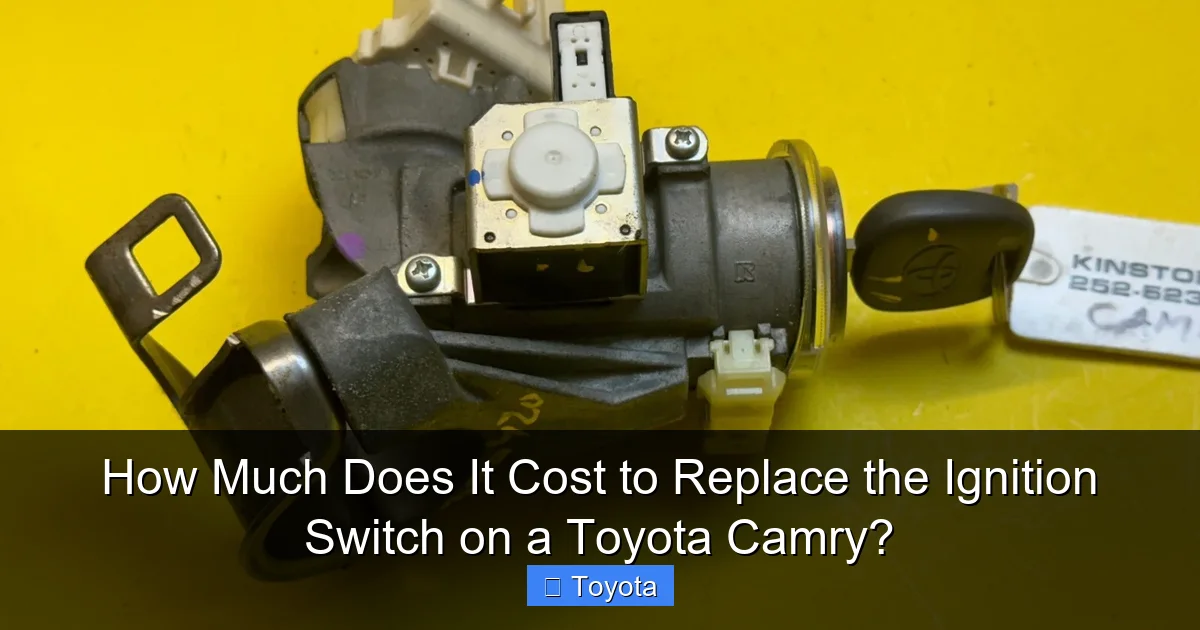
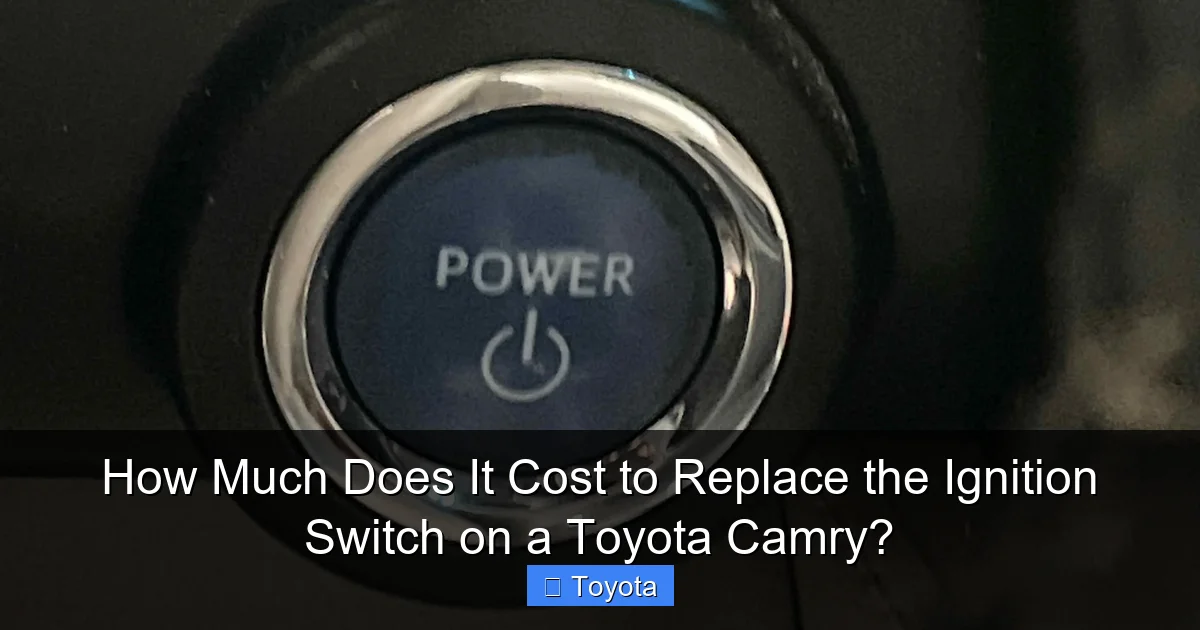
First, a quick primer. The ignition switch isn’t just a simple on/off button. In traditional key-based Camrys (pre-2018 for most trims), it’s the lock cylinder you insert your key into. Turn it to “ON,” and it powers up your dashboard and fuel pump. Turn it to “START,” and it sends a signal to the starter motor. In newer Camrys with the “Push Button Start” system, the physical switch is gone, replaced by an electronic button and a key fob with a built-in transponder chip. The “ignition switch” in these models is actually a complex assembly that reads the fob’s signal and communicates with the car’s computer (ECU). This fundamental difference is the #1 factor affecting your replacement cost.
The Two Main Types in Modern Camrys
Knowing which type you have is step one in estimating cost.
- Traditional Key Cylinder (Most 2012-2017 Models): This is the mechanical part with the keyhole. Failure often means the key won’t turn, or the car loses power randomly. Replacement is generally less expensive because it’s a simpler mechanical part, though it still needs the immobilizer system programmed to recognize your key’s chip.
- Push Button Start Assembly (2018+ Models): This is an electronic module. Common symptoms include the “Start” button flashing red, the key fob battery warning coming on even with a new battery, or the car refusing to start even with the fob inside. This assembly is more expensive and always requires professional programming with dealer-level software.
Symptoms That Your Ignition Switch is Nearing Death
Before we dive into dollars and cents, you need to be 100% sure the ignition switch is the culprit. Misdiagnosis is a common way to waste money. Here are the classic red flags that scream “ignition switch problem” in a Camry.
Visual guide about How Much Does It Cost to Replace the Ignition Switch on a Toyota Camry?
Image source: i.ebayimg.com
Electrical Gremlins and Starting Woes
The most common sign is a complete no-start condition. You turn the key (or press the button), and you hear a single “click” from the starter solenoid, or nothing at all. The dash lights might dim or go out. But it’s rarely that simple. Often, the problem is intermittent. Your Camry might start fine 90% of the time, then fail to start at the worst possible moment. You might also notice that your radio, power windows, or interior lights stop working when you turn the key to “ON.” This points directly to the switch not making proper contact inside. Another tell-tale sign? Your key gets stuck in the ignition, or it’s incredibly difficult to turn. That’s mechanical wear in the cylinder.
With push-button systems, watch for the “key not detected” warning on the dash when the fob is clearly in the car. The ignition button itself might feel loose or not press down correctly. If your Camry starts, then immediately dies, that’s a classic sign the switch is cutting power to the engine’s fuel and ignition systems after the initial start command.
Don’t Confuse It With These Other Problems
These symptoms can also be caused by:
- A dead or weak battery: Always rule this out first with a simple voltage test. A bad battery can cause slow cranking and electrical issues.
- A faulty starter motor: If you hear a constant whirring or grinding noise, or the engine cranks very slowly, the starter might be the issue.
- Wiring harness problems: Corrosion or damage to the wires running to the ignition switch can mimic a failed switch. This is more common in older Camrys.
- A bad starter relay or fuse: These are cheap, easy checks. Your owner’s manual will show you their location.
Pro Tip: Before spending a dime, have a trusted mechanic perform a live data scan of your Camry’s computer. This can often confirm if the ignition switch signal is being sent and received properly, saving you from replacing the wrong part.
The Complete Cost Breakdown: Parts and Labor
Now, the number you’ve been waiting for. The total cost to replace ignition switch on Toyota Camry is not one-size-fits-all. It’s a sum of two main components: the part itself and the labor to install it. Let’s separate them.
Visual guide about How Much Does It Cost to Replace the Ignition Switch on a Toyota Camry?
Image source: tomsforeign.com
Part Cost: The Price of the Switch Itself
This is where the biggest variance lies.
- Traditional Key Cylinder Assembly: You can expect to pay $120 – $300 for the part. An OEM (Original Equipment Manufacturer) Toyota part from a dealership will be at the high end. Aftermarket brands like Standard Motor Products or Dorman offer quality replacements for $80 – $200. For a 2014 Camry SE, an OEM part might be $250, while a solid aftermarket unit is $130.
- Push Button Start Assembly: This is significantly more. The electronic module alone runs $250 – $450 for OEM. Aftermarket options are sometimes available but are less common for these newer systems. You must ensure any replacement is compatible with your Camry’s specific VIN and security system.
Important: For any Camry with an immobilizer system (virtually all from 2000 onward), the new switch must be programmed or “matched” to your car’s computer and your existing key(s). This is not optional. Some aftermarket switches come “blank” and require full programming. Others are “pre-programmed” for a specific VIN range but still often need a “learn procedure” done with a scan tool. This programming is a separate cost and requirement.
Labor Cost: The Technician’s Time and Expertise
Labor is where shop rates bite. The time required varies by model year and type.
- Traditional Key Cylinder (2012-2017): This is a relatively straightforward job. A skilled mechanic can usually do it in 1.0 to 1.5 hours. At an independent shop charging $100/hour, that’s $100 – $150 in labor. A dealership at $150/hour would be $150 – $225.
- Push Button Start Assembly (2018+): This is more involved. The steering column covers must be removed, and the unit is often integrated with the steering lock mechanism. It can take 1.5 to 2.5 hours. Labor cost: $150 – $375 at a typical independent shop, or $225 – $500+ at a dealership.
The programming itself also takes time (15-45 minutes) and is billed as labor. Dealerships often bundle the part, labor, and programming into a single “flat rate” quote, which can seem higher but is all-inclusive.
Total Estimated Cost Summary
Putting it all together, here are realistic total price ranges for a 2020 Toyota Camry (common model):
- Traditional Key Model (e.g., 2016 Camry LE): Aftermarket Part ($150) + Independent Labor ($125) + Programming ($50) = $325 Total. OEM Part ($280) + Independent Labor ($125) + Programming ($50) = $455. Dealership (OEM Part + Labor + Programming) = $650 – $800.
- Push Button Start Model (e.g., 2020 Camry XSE): OEM Assembly ($350) + Independent Labor ($200) + Programming ($75) = $625 Total. Dealership (OEM Assembly + Labor + Programming) = $850 – $1,100.
These are estimates. Always get 2-3 specific quotes for your exact VIN.
Key Factors That Change the Final Price Tag
Why does one Camry owner pay $350 and another pay $900 for the same repair? Several variables are at play.
Visual guide about How Much Does It Cost to Replace the Ignition Switch on a Toyota Camry?
Image source: i.ytimg.com
Model Year and Trim Level Are Everything
As we’ve established, the single biggest factor is whether your Camry has a traditional key or a push-button start. Within push-button models, higher trims (XLE, XSE, Limited) sometimes have more integrated steering column components, which can add 0.5 hours to labor time. A 2012 Camry L is a much simpler, cheaper repair than a 2021 Camry TRD with push-start.
Your Choice of Repair Shop: Dealership vs. Independent
This is the classic automotive debate.
- Toyota Dealership: Pros: They have the latest OEM parts in stock, factory-trained technicians, and direct access to Toyota’s Techstream diagnostic and programming software. This is crucial for push-button systems. You get a warranty on both parts and labor (often 12 months/12,000 miles). Cons: Price. Expect a 30-50% premium.
- Independent Mechanic / Specialist: Pros: Lower hourly rates, often more personal service. Many reputable independents invest in high-quality scan tools (like Autel or Launch) that can program many ignition switches. Cons: They may not have the latest software for a brand-new Camry, or might use aftermarket parts. Always ask: “Do you have the capability to program a 2021 Camry ignition switch, and do you use OEM or aftermarket parts?”
- Mobile Mechanic: A growing option. They come to you. Pricing is often competitive with independents. The major limitation is they may not have the space or equipment for a complex column disassembly, so ask first.
Geographic Location and Shop Rates
Where you live matters. Labor rates in major metropolitan areas (Los Angeles, New York, Seattle) can easily hit $130-$180 per hour at independent shops. In smaller towns or the Midwest, $80-$110 per hour is common. Dealership rates are high nationwide but follow the same geographic pattern. This alone can swing your labor cost by several hundred dollars.
The “While You’re In There” Factor
A good mechanic will inspect the entire steering column and wiring harness when the ignition switch is out. If they find cracked wiring insulation, a broken steering lock mechanism, or a worn-out key, they will recommend fixing it now. This is smart—you save on labor by doing it all at once. But it adds to the parts bill. For a high-mileage Camry (150k+ miles), budgeting an extra $100-$300 for related wear items is wise. This is a prime example of where a pre-repair inspection saves money long-term.
DIY vs. Professional Replacement: Should You Tackle This Yourself?
For the mechanically-inclined with a garage full of tools, replacing a traditional key cylinder on an older Camry is a borderline DIY job. For anyone else, and for all push-button models, this is a professional repair. Here’s the honest breakdown.
The DIY Route (For Traditional Key Cylinders Only)
What’s Involved: You’ll need to remove the steering column covers (usually 4-6 screws/bolts), disconnect the electrical connector from the old switch, and sometimes remove the lock plate with a special tool (a “Torx” or “star” bit is common). The new switch bolts in, you reconnect the harness, and reassemble. The critical final step is the key programming procedure. For many 2012-2017 Camrys, this can be a “keyless entry” or “immobilizer” learn procedure done with just the key and a series of door lock cycles (check your owner’s manual!).
- Tools Needed: Basic socket set, screwdrivers, possibly a steering wheel puller (rarely), and a quality scan tool for programming if the manual procedure fails.
- Estimated DIY Cost: $100 – $250 (part only). You save all labor.
- Risks: Airbag system is in the steering column. Disconnecting the wrong harness can trigger the airbag light. Improper reassembly can leave the steering lock engaged, making the car undriveable. If the programming fails, your car will not start. You can easily brick your car’s security system, requiring a expensive dealership tow and reprogram.
The Professional Route: Why It’s Almost Always the Right Call
For push-button starts, there is no DIY. The assembly is complex, and the programming requires proprietary software and a secure online connection to Toyota’s servers. Even for key cylinders, the risk vs. reward is poor for most.
- They have the software: Independent shops with tools like the Autel MaxiSys or Launch X431 can program most switches. Dealerships use Techstream.
- They guarantee the work: If the repair fails, they fix it. If you DIY and break something, you own the bill.
- It’s fast: A pro does this job repeatedly. 1.5 hours vs. your 4 hours of frustration.
- Safety: They know how to safely handle the steering column and airbag components.
Bottom Line: Unless you have a specific, high-quality scan tool and have successfully programmed an immobilizer before, pay the professional. The ignition switch replacement cost you pay includes peace of mind and a warranty.
Protecting Your New Ignition Switch and Your Wallet
You just spent hard-earned money on this repair. Let’s make sure it lasts the life of your Camry. Here’s how to avoid a repeat visit.
Key Habits for Longevity
The ignition switch, especially the mechanical key cylinder, is a wear item. Here’s how to treat it right:
- Don’t overload your keychain. This is the #1 cause of premature ignition switch failure. A heavy keychain (with dozens of fobs, garage openers, etc.) swings and pulls on the cylinder, grinding the tumblers. Keep it light—just your car key and maybe one fob.
- Use the correct key. Don’t use a worn-out copy. A poorly cut key will bind and wear the cylinder faster. If your key is old and shows wear, get a new one cut from the original at the dealership.
- Don’t force the key. If it doesn’t turn easily, don’t jiggle and wrestle it. Make sure the steering wheel isn’t locked (sometimes turning the wheel slightly while turning the key helps). Forcing it breaks internal parts.
- For push-button systems: Avoid pressing the start button repeatedly in rapid succession. Let the system cycle. Also, ensure your key fob battery is replaced promptly when the low battery warning appears. A weak fob signal can stress the ignition button’s receiver.
Related Maintenance That Saves Money
Your Camry’s electrical system is a network. A failing battery puts extra strain on the ignition switch and all its circuits. Keep your battery healthy:
- Test your battery’s health every fall. A weak battery causes voltage drops that can damage sensitive electronics.
- Clean battery terminals regularly to prevent corrosion, which can cause starting issues that mimic ignition switch failure.
- For high-mileage Camrys, consider having the starter circuit inspected during routine service. A failing starter can draw excessive amperage, which over time can burn out the contacts inside the ignition switch.
This holistic approach to maintenance is how you avoid costly, cascading repairs. While you’re thinking about your Camry’s upkeep, you might also wonder about other common service costs. For instance, understanding the cost to fix an oil leak on a car helps you budget for both critical and cosmetic maintenance. And if you’re considering any aesthetic upgrades, knowing the cost to wrap a Toyota Camry allows you to prioritize between essential repairs and personalization.
Conclusion: A Critical Repair Worth the Investment
Replacing the ignition switch on your Toyota Camry is not a “nice-to-have” fix—it’s a “must-have.” It’s the linchpin of your entire starting and security system. While the cost can range from a manageable $300 at a trusted independent shop to over $1,000 at a dealership for a fully loaded push-button model, viewing it as an investment in your car’s reliability and your daily peace of mind is key.
The most important steps are: 1) Confirm the diagnosis with a professional scan, 2) Get multiple quotes specific to your VIN and location, and 3) Choose a repairer who can prove they have the correct programming tools. Don’t be tempted by the cheapest quote if they can’t program the immobilizer—your car will be a very expensive paperweight. By understanding the factors that drive the Toyota Camry ignition switch replacement cost, you can navigate this repair with confidence, avoid scams, and get your reliable Camry back on the road safely and affordably.
Frequently Asked Questions
Can I drive with a bad ignition switch?
No. Driving with a failing ignition switch is extremely dangerous. It can cause your car to stall without warning while driving, or fail to start when you need it, potentially leaving you stranded in an unsafe location. Have it diagnosed and repaired immediately.
How long does it take to replace a Camry ignition switch?
For a traditional key cylinder (2012-2017), expect 1-2 hours at a shop. For a push-button start assembly (2018+), it typically takes 1.5-2.5 hours due to more complex disassembly and required programming time.
Does the new ignition switch need to be programmed?
Yes, almost always. For any Camry with an immobilizer system (virtually all from 2000 onward), the new switch must be electronically matched to your car’s computer and your existing key(s). This requires a professional scan tool and is not a simple “plug-and-play” installation.
Will my car warranty cover this repair?
If your Camry is still under the original factory warranty (typically 3 years/36,000 miles), it should be covered if the defect is proven to be a manufacturer’s fault. For older cars, check if you have an extended warranty (like a Toyota Platinum plan), as these often cover ignition switches. Otherwise, it’s an out-of-pocket repair.
What’s the difference in cost between a dealership and an independent shop?
Expect to pay 30-50% more at a Toyota dealership. They use OEM parts at list price and have higher labor rates. However, they have guaranteed access to the latest programming software and provide a warranty that is often more comprehensive. A reputable independent shop can save you significant money but you must verify their programming capability for your specific model year.
Can a locksmith replace my Camry’s ignition switch?
Some automotive locksmiths are fully equipped to handle this, especially for traditional key cylinders. They often have mobile services and competitive rates. However, you must call and ask explicitly: “Do you have the tool and software to program a 2020 Toyota Camry push-button start ignition switch?” Many locksmiths specialize in keys and locks but lack the complex ECU programming software needed for newer models.
