
How Do You Reset Dashboard Lights on a 2015 Toyota Corolla?

Resetting dashboard lights on your 2015 Toyota Corolla is often a simple DIY task, but it requires understanding what each light means first. Common resets for lights like the tire pressure (TPMS), maintenance required, and check engine can frequently be done from the driver’s seat using the odometer button or steering wheel controls. However, some warning lights indicate serious issues that must be repaired before the light will turn off, and attempting a reset without fixing the problem is unsafe and ineffective.
That little glowing icon on your dashboard isn’t just there to annoy you. It’s your car’s voice, trying to tell you something important. When that voice becomes a persistent, nagging reminder—like the “MAINT REQD” light on your 2015 Toyota Corolla—it’s time to listen and take action. But what does it mean, and more importantly, how do you make it go away after you’ve addressed the issue? Resetting dashboard lights is a common task for any car owner, but it’s not a one-size-fits-all process. The method depends entirely on which light is on and why. This guide will walk you through everything you need to know about identifying, understanding, and safely resetting the various dashboard lights on your 2015 Corolla, ensuring you stay informed and your vehicle stays healthy.
Key Takeaways
- Safety is the absolute priority: Never ignore a critical warning light (like oil pressure, engine temperature, or brake system). These indicate a potentially dangerous failure that requires immediate professional diagnosis and repair.
- Identify the specific light: The reset procedure depends entirely on which icon or message is illuminated. A “MAINT REQD” light has a completely different reset process than a “Check Engine” or “TPMS” light.
- Simple resets are often menu-based: Many 2015 Corolla lights (like maintenance or trip meter resets) are cleared through the multi-information display using the “trip/odometer” button on the instrument cluster or steering wheel controls.
- The “Check Engine” light (MIL) is special: It will only reset automatically after the vehicle’s computer (ECM) runs self-tests and confirms the fault is gone. Clearing it with a code reader is possible, but the underlying issue must be fixed first.
- TPMS resets require specific conditions: After adjusting tire pressure, you must initiate a reset sequence via the button inside the glovebox or through the vehicle settings menu. The system needs to learn the new sensor IDs.
- If a light returns immediately after reset, there is a problem: A persistent or recurring light means the fault has not been resolved. Continuing to drive and resetting is unsafe and can cause catastrophic damage.
- Consult your owner’s manual: It is the definitive source for your specific vehicle’s exact procedures, light meanings, and recommended actions. Procedures can vary slightly even within the same model year.
📑 Table of Contents
- Understanding Your Dashboard: A Language of Lights and Symbols
- Safety First: The Non-Negotiable Prelude to Any Reset
- Resetting the “MAINT REQD” Light (The Most Common Reset)
- Resetting the Tire Pressure Monitoring System (TPMS) Light
- The Elusive “Check Engine” Light (MIL): Why Resetting is Often the Wrong First Step
- Other Common Resettable Lights and Procedures
- When DIY Reset Fails: Knowing When to Call a Professional
- Conclusion: Empowerment Through Understanding
Understanding Your Dashboard: A Language of Lights and Symbols
Before you can reset a light, you must decode its message. Your 2015 Corolla’s dashboard is a sophisticated communication center. Lights generally fall into two categories: reminder/maintenance lights and warning lights. Knowing the difference is the first and most critical step.
Reminder & Maintenance Lights
These are your car’s polite nudges. The most common is the “MAINT REQD” (Maintenance Required) light. This is not an emergency. It’s a pre-programmed reminder that your scheduled maintenance—typically an oil change and tire rotation—is due based on mileage or time intervals. Other reminder lights might indicate it’s time for routine service. These lights are designed to be reset after the maintenance is performed.
Warning Lights: The Urgent Messages
These are your car’s panicked shouts. They illuminate (often in red or yellow) when a system is operating outside safe parameters or has failed. Examples include the oil pressure light, engine temperature light, brake system warning, ABS light, airbag (SRS) light, and the infamous “Check Engine” light (Malfunction Indicator Lamp or MIL). Here is the golden rule: You should NEVER, under any circumstances, simply reset a warning light without first diagnosing and repairing the underlying problem. The light is a symptom, not the disease. Resetting it while the fault exists is like turning off a fire alarm while a fire is still burning. It will simply come back on, and you’ve delayed addressing a potentially serious and expensive issue. For complex warning lights, a professional scan with a diagnostic tool is almost always required to find the root cause.
Safety First: The Non-Negotiable Prelude to Any Reset
Your safety and the safety of others on the road is paramount. This section isn’t just advice; it’s a mandatory checklist before you touch any button.
Visual guide about How Do You Reset Dashboard Lights on a 2015 Toyota Corolla?
Image source: i.pinimg.com
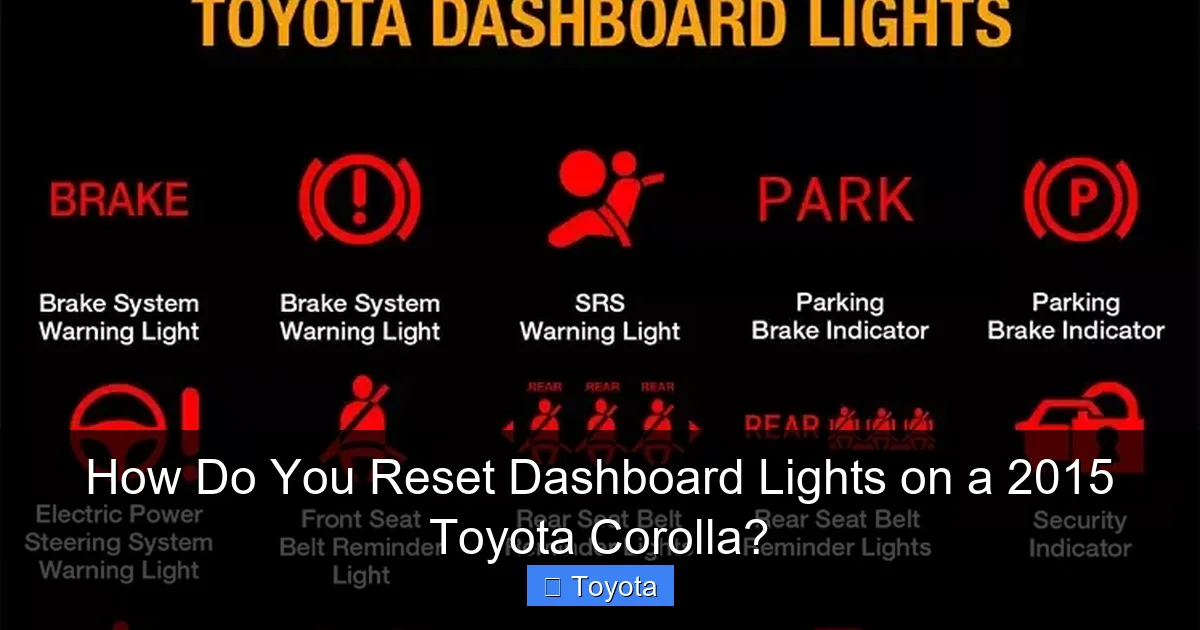
Critical Warning Lights That Demand Immediate Professional Help
If any of the following lights are illuminated—especially if they are red or flashing—do not attempt a reset. Stop the vehicle safely (if possible) and seek professional assistance immediately:
- Red Oil Pressure Light: Indicates no oil pressure. Engine damage can occur in seconds.
- Red Engine Temperature Light: Indicates severe overheating. Continued driving will destroy the engine.
- Brake System Warning Light (exclamation mark in circle): Could mean critically low brake fluid or a major brake system failure.
- Red Battery Light: Indicates the charging system has failed. The battery will drain, and the car will stall.
- Airbag (SRS) Light: A fault in the supplemental restraint system means airbags may not deploy in a crash.
- Steering Wheel with Exclamation Mark (EPS): Indicates a failure in the electric power steering system.
For these lights, “resetting” means diagnosing the fault with a professional scan tool, making the necessary repair (which could be anything from adding fluid to replacing a pump), and then the light will turn off on its own once the system passes its self-test. For more on related Toyota systems, you might read about how to reset the airbag light on a Toyota Camry, as the principles for diagnosing SRS faults are similar across models.
Resetting the “MAINT REQD” Light (The Most Common Reset)
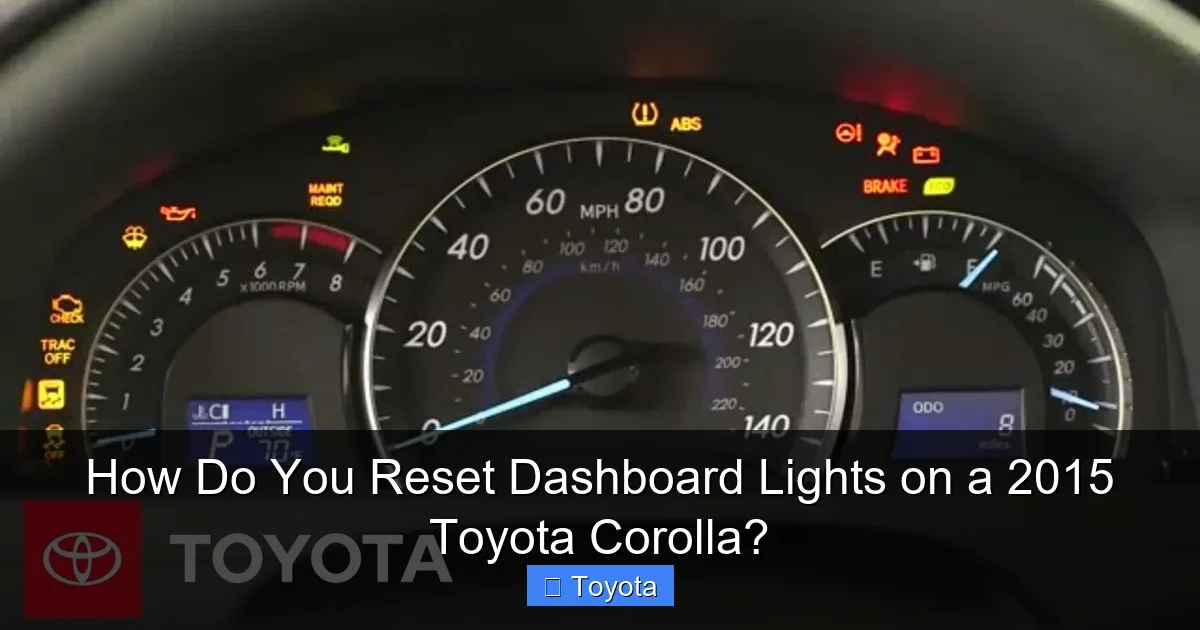
This is the reset most 2015 Corolla owners will ever need. It’s a simple, manual procedure you can do at home in under 30 seconds after your oil change and tire rotation are complete. The Corolla uses the odometer display to perform this reset.
Visual guide about How Do You Reset Dashboard Lights on a 2015 Toyota Corolla?
Image source: i.ytimg.com
Step-by-Step Manual Reset Procedure
There are two common methods. Method 1 is the standard for most 2015 Corolla trims.
- Turn the ignition ON. Do not start the engine. Press the “START/STOP” button twice without touching the brake pedal (for push-button start) or turn the key to the “ON” position (for key ignition). All dashboard lights will illuminate briefly.
- Ensure the odometer is displaying the total mileage (ODO). Use the “trip/odometer” button on the instrument cluster to toggle the display until you see the total vehicle mileage, not a trip A or trip B reading.
- Turn the ignition OFF. Press the “START/STOP” button once (without brake) or turn the key to “OFF.”
- Now, press and hold the “trip/odometer” button. While holding it, turn the ignition back to the “ON” position (as in step 1).
- Continue holding the button. You will see the odometer display change. It may show “000000” or flash for about 5-10 seconds.
- Release the button. The “MAINT REQD” light should blink a few times and then go out, confirming the reset was successful.
Important Note: If your Corolla has steering wheel-mounted controls, the reset might be accessed through the “Menu” or “Settings” on the multi-information display. Consult your owner’s manual for the exact path. The principle remains the same: you must access the maintenance reset mode with the ignition in the “ON” position but engine off. For a broader look at Toyota’s maintenance reminder systems, this guide on how to reset the maintenance required light on a Toyota covers the philosophy behind these systems.
Resetting the Tire Pressure Monitoring System (TPMS) Light
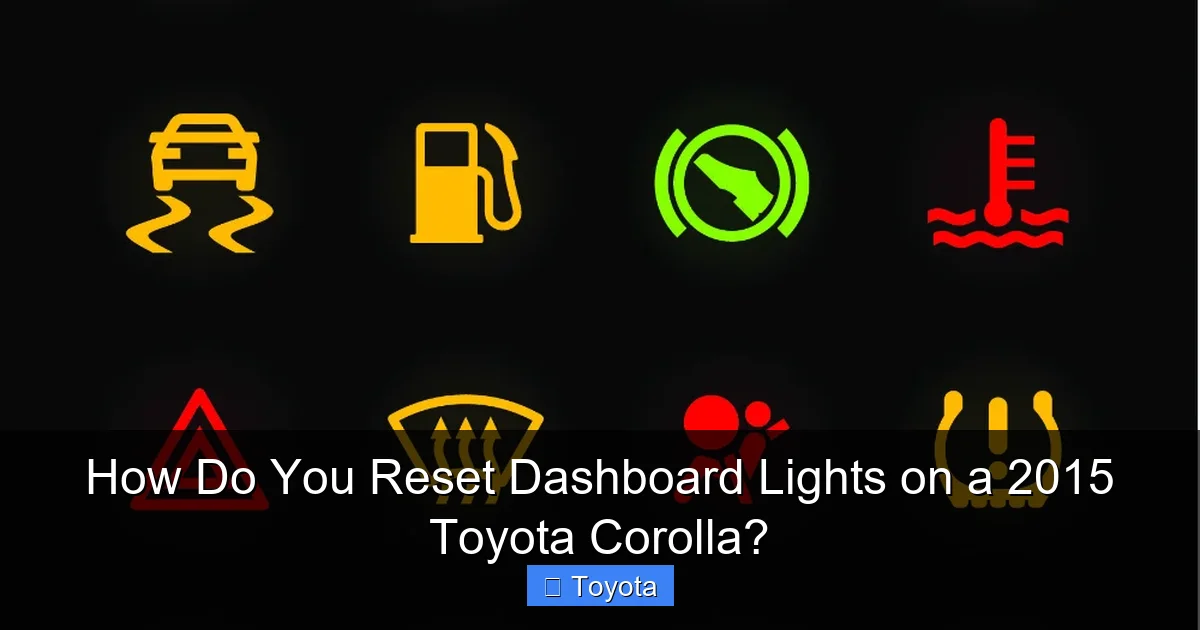
The TPMS light (a cross-section of a tire with an exclamation point) illuminates when one or more tires are significantly under-inflated. After you have checked and inflated all tires (including the spare, if equipped with a sensor) to the pressure listed on the driver’s door jamb sticker, you must perform a reset so the system learns the new sensor positions and pressures.
Visual guide about How Do You Reset Dashboard Lights on a 2015 Toyota Corolla?
Image source: i.pinimg.com
The 2015 Corolla TPMS Reset Procedure
The 2015 Corolla typically uses a direct TPMS with sensors in each wheel. The reset is initiated from inside the vehicle.
- Ensure all tires are properly inflated. This is crucial. If pressures are not correct, the reset will fail.
- Turn the ignition ON. (Engine off).
- Locate the TPMS reset button. It is almost always inside the glovebox. On the 2015 Corolla, open the glovebox and look for a small, usually black, button on the upper left or right side of the interior.
- Press and hold the reset button. You will hear a short beep after about 3 seconds. Continue holding for another 2-3 seconds until you hear a longer, more distinct beep (approximately 8 seconds total). The TPMS light on the dashboard should blink three times to confirm the reset process has started.
- Release the button. Drive the vehicle for at least 20-30 minutes at speeds above 40 mph. The system will re-learn the sensor IDs and pressures during this drive cycle. The light should go out after this drive if all sensors are functioning and pressures are correct.
If the light comes back on after a successful drive, one of the sensors may be faulty or a tire may have a slow leak. This requires professional diagnosis. For specific procedures on other models, resources on how to reset a tire pressure sensor can provide additional context on TPMS technology.
The Elusive “Check Engine” Light (MIL): Why Resetting is Often the Wrong First Step
This is the most misunderstood dashboard light. The “Check Engine” light (MIL) illuminates when the engine control module (ECM) detects a fault that could increase emissions. The ECM stores a diagnostic trouble code (DTC) corresponding to the fault.
Why You Should NOT Just Reset It
Resetting the MIL with a code reader or by disconnecting the battery will turn the light off, but it does not fix the problem. The ECM will run its self-tests (called “drive cycles”). If the fault is still present, the light will return—often within a few miles of driving. More importantly, you have now erased the very diagnostic information a mechanic needs to fix your car. You’ve made the problem harder and more expensive to diagnose. The correct procedure is:
- Retrieve the Codes: Use an OBD-II scanner (available at auto parts stores or as a cheap Bluetooth adapter for your phone) to read the stored DTCs. This tells you what system is faulty (e.g., P0171 = System Too Lean).
- Diagnose and Repair: Research the code. The issue could be simple (a loose gas cap) or complex (failing oxygen sensor, catalytic converter). Perform the necessary repairs.
- Clear the Codes: After the repair is complete, use the scanner to clear the DTCs from the ECM’s memory.
- Drive and Verify: Drive the car normally. The ECM will perform its tests. If the repair was successful and no new faults occur, the MIL will stay off. If it comes back, the repair was incomplete or a new fault has developed.
Disconnecting the battery to reset the ECM is an outdated and ineffective method for modern vehicles like the 2015 Corolla. It will also reset other learned data (like transmission shift points and idle settings), causing poor performance until the computer re-learns. For more on the ECM specifically, you can read about how to reset the ECM on a Dodge Ram, which explains the general principles of engine computer resets, though the method for a Corolla is different.
Other Common Resettable Lights and Procedures
Your Corolla has a few other lights that can be manually reset after a specific action.
Oil Change Reminder (If Separate from MAINT REQD)
Some Corolla models or models from different markets may have a separate “Oil” icon. The reset procedure is often identical to the “MAINT REQD” light described earlier, using the odometer button sequence. It is part of the same maintenance reminder system.
Low Fuel Light
This is not a resetable light; it’s a direct sensor reading. It will automatically turn off when you add sufficient fuel. There is no procedure to “reset” it other than refueling. If it illuminates prematurely, you may have a faulty fuel level sensor.
Headlight/Taillight Outage Indicators
These lights (often a bulb icon with an exclamation point) will go out automatically when you replace the burned-out bulb and the circuit is complete. No manual reset is needed. If the light stays on after replacing the bulb, there may be an electrical issue.
Trip Meter/Average Fuel Economy Reset
This isn’t a warning light, but a display function. To reset your trip A or trip B meter and associated average MPG, simply display the trip you want to reset on the multi-information display and then press and hold the “trip/odometer” button until it zeros out. This is a common point of confusion. For more on resetting trip meters on different Toyotas, see this article on how to reset the trip meter on a 2022 Toyota Camry.
When DIY Reset Fails: Knowing When to Call a Professional
You’ve followed the correct procedure for the specific light, but it comes right back on. Now what? This is your car’s final, clear message: “The problem is still here.” At this point, professional diagnosis is not optional; it’s essential.
Diagnosing the Un-Resettable
A persistent warning light requires a technician with:
- A Professional-Grade Scan Tool: This accesses all the vehicle’s control modules (ECM, ABS, SRS, etc.), not just the generic OBD-II engine codes. It can see “pending” codes and perform active tests on components.
- Wiring Diagrams and Service Information: To trace electrical issues.
- Specialized Knowledge: For systems like the SRS (airbags), which require extreme caution and specific repair procedures.
For example, a persistent TPMS light after a correct reset likely means one of the tire pressure sensors has failed. A persistent “Check Engine” light after clearing codes means the repair was ineffective or a new fault developed. A persistent battery light means the alternator is not charging. Attempting to “reset” these without repair is futile and dangerous. If you’re dealing with a battery-related warning, understanding how to reset the battery light on a Toyota Corolla clarifies that the reset is a final step after replacing the alternator or fixing the charging circuit.
Conclusion: Empowerment Through Understanding
Resetting dashboard lights on your 2015 Toyota Corolla is a straightforward task when you approach it with knowledge and caution. The process is a simple button sequence for routine maintenance reminders like the “MAINT REQD” light or the TPMS light after a tire service. However, the landscape changes dramatically for warning lights. Your car’s computer is a meticulous record-keeper. It will not allow a warning light to be extinguished until the fault is genuinely corrected and the system passes its self-diagnostic checks. Your takeaway should be this: Treat every dashboard light as a legitimate message. Look it up in your owner’s manual. For maintenance reminders, perform the reset after service. For warnings, diagnose and repair first—resetting is merely the final confirmation of a job well done. By respecting this sequence, you protect your investment, ensure your safety, and maintain the legendary reliability of your Toyota Corolla.
Frequently Asked Questions
Can I reset the check engine light by disconnecting the battery on my 2015 Corolla?
While disconnecting the battery will turn off the light temporarily, it is not a recommended reset method. It will clear all computer memory, potentially causing idle and driveability issues until the ECM re-learns. More importantly, it does not fix the underlying problem, so the light will return. The proper method is to repair the fault and then clear the codes with a scan tool.
My TPMS light is on, but my tires look fine and the pressure is correct. How do I reset it?
First, verify the pressure with a reliable gauge when the tires are cold, comparing to the spec on the driver’s door jamb. If all are correct, perform the glovebox reset button procedure. Then drive for 20-30 minutes above 40 mph. If the light returns, one or more tire pressure sensors may be faulty or have a dead battery, requiring replacement.
What does it mean if a light flashes before staying on solid?
>A flashing warning light (like the check engine light) indicates a severe, immediate problem that can cause catalytic converter damage or engine misfire. You should stop driving as soon as safely possible and have the vehicle towed for diagnosis. A solid light means a less urgent but still important fault that should be addressed soon.
I reset the maintenance light, but it came back on after 100 miles. Is that normal?
>No, that is not normal. The maintenance light is programmed for a specific interval (e.g., 5,000 miles). If it returns prematurely, it may indicate a fault in the maintenance reminder system itself, or possibly another unrelated warning light is illuminating and being mistaken for the maintenance light. Have the system scanned.
Is there a fuse I can pull to reset all dashboard lights?
>There is no single “dashboard lights” fuse. Pulling fuses randomly is dangerous and can disable critical safety systems like airbags or ABS. Some systems have backup power, so pulling fuses may not even reset them. Always use the manufacturer-specific reset procedures for each light or system.
My oil pressure light came on, I added oil, and the light went off. Do I still need to see a mechanic?
>Absolutely yes. The oil pressure light coming on means your engine was running with insufficient oil pressure, which can cause catastrophic internal damage. Adding oil may have been a temporary fix for a low level, but you must find out why the oil was low (leak, burning oil) and, more critically, whether the period of low pressure caused damage (like spun bearings). Have the vehicle inspected immediately.