
How Do I Get My Remote Start to Work Again on Toyota

Having trouble with your Toyota’s remote start? It’s usually a simple fix. The most common culprits are a dead key fob battery, a tripped system security lockout, or a recently replaced/weak car battery. Start by replacing the key fob battery and checking your vehicle’s owner’s manual for model-specific reset procedures. If those don’t work, issues with the aftermarket remote start module or the vehicle’s main computer may require professional diagnosis.
That sinking feeling when you press the remote start button on your Toyota key fob and… nothing happens. The engine doesn’t turn over, the lights don’t flash, and the silence is deafening. You’re not alone. Remote start failures are one of the most common convenience feature complaints we hear about. The good news? In the vast majority of cases, the problem is something you can diagnose and fix yourself without a trip to the dealer. This guide will walk you through every step, from the simplest battery swap to understanding when it’s time to call a pro.
Key Takeaways
- Dead Key Fob Battery: This is the #1 cause. Replace the CR2032 battery in your fob first—it’s cheap and solves most “no response” issues.
- Security System Lockout: Your Toyota’s anti-theft system can disable remote start after multiple failed attempts or a battery disconnect. A manual lock/unlock cycle with the key often resets it.
- Weak or Dead Car Battery: The remote start system needs a minimum voltage (typically ~9V) to engage. A battery on its last legs won’t send enough power to the starter.
- Aftermarket System Glitches: If your remote start was added after purchase, its wiring or programming can fail. Locating the module and checking for blown fuses is a critical DIY step.
- Check Engine Light (MIL):strong>: Many Toyotas will automatically disable remote start if the onboard computer detects an emissions-related fault. You must fix the underlying issue first.
- Key Fob Programming Lost: A dead car battery or system reset can cause the vehicle to “forget” the fob’s signal. Re-programming the fob to the car is often necessary, which may require a dealer or locksmith.
- Range Obstructions: While not a “fix,” always test from the driver’s seat with the hood up. Buildings, other vehicles, and even your own body can block the RF signal.
📑 Table of Contents
- Understanding Your Toyota’s Remote Start System
- Is Your Security System Locked You Out?
- The Car Battery Connection You Might Have Missed
- Aftermarket System-Specific Troubleshooting
- When the Check Engine Light is the Real Culprit
- Advanced Diagnostics and When to Call a Pro
- Preventative Maintenance for Long-Term Reliability
Understanding Your Toyota’s Remote Start System
Before we start pulling wires, it helps to know what you’re dealing with. Toyota remote start systems come in two main flavors: OEM (Original Equipment Manufacturer) and aftermarket. OEM systems are integrated into the vehicle’s factory security and computer networks from the day it’s built. They are seamless, reliable, but sometimes tricky to diagnose without a dealer-level scan tool. Aftermarket systems (like those from Compustar, Viper, or Avital) are added later and use their own control module and wiring. They are often more powerful in range and features but can have their own set of electronic gremlins.
Your first task is to identify which type you have. Look at your key fob. Does it have a dedicated remote start button (usually a circular icon with a curved arrow)? If yes, you likely have an OEM system. If your fob looks standard but you use a separate, larger remote or a smartphone app to start the car, that’s almost certainly aftermarket. This distinction is crucial because our troubleshooting steps will diverge slightly. For example, an aftermarket system’s control module is usually found under the dashboard, while an OEM issue often points back to the vehicle’s main Body Control Module (BCM).
The Critical Role of Your Key Fob Battery
Let’s start with the absolute easiest and most frequent fix. That little CR2032 coin cell battery inside your key fob powers the radio transmitter. As it weakens, the signal strength drops dramatically. You might still be able to lock/unlock the doors at close range (as those functions use less power), but the remote start command, which needs a strong, clear signal to the car’s receiver, simply won’t get through.
How to fix it: Open your key fob (usually by prying at the seam with a flathead screwdriver or fingernail). Replace the old battery with a fresh, high-quality CR2032. Reassemble the fob. Now, stand next to your car, point the fob directly at it, and press the start button. If it works, your problem is solved! Always keep a spare battery in your glove box. Pro tip: If your fob has a visible LED that blinks when you press buttons, and it no longer blinks, the battery is definitely dead.
Is Your Security System Locked You Out?
Your Toyota’s immobilizer system is designed to prevent theft, but it can sometimes be overzealous. If the system thinks there’s a security breach—like too many failed remote start attempts, a sudden battery voltage drop, or a recent key fob battery change—it can place the remote start function into a “lockout” mode as a precaution.
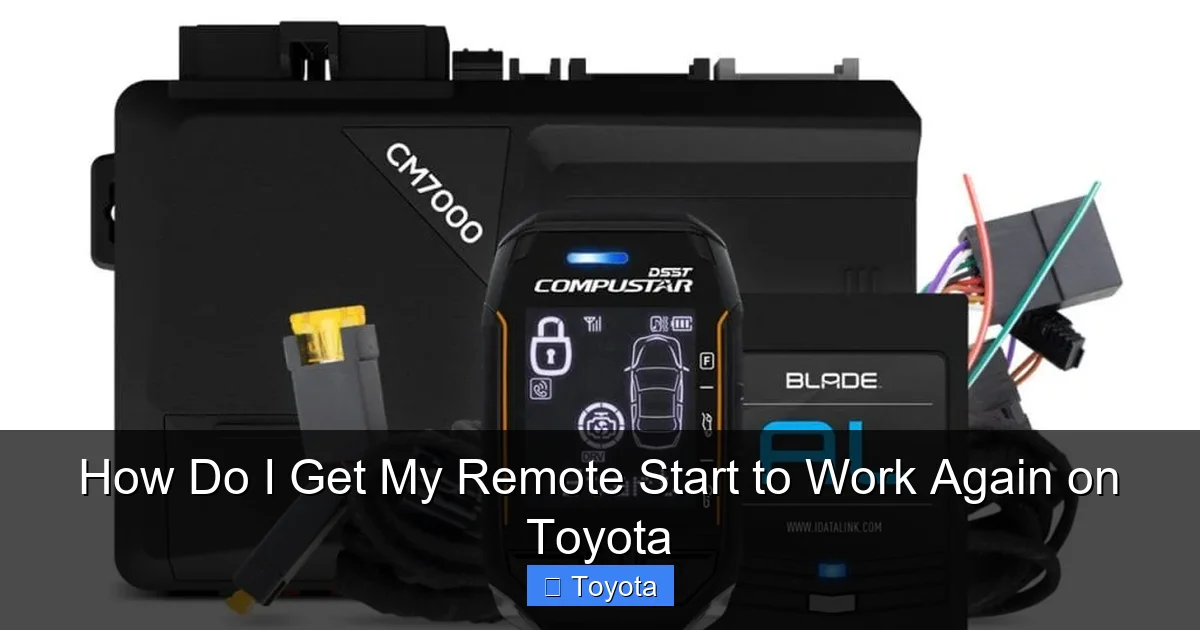
Visual guide about How Do I Get My Remote Start to Work Again on Toyota
Image source: compustar.com
This often manifests as the parking lights flashing rapidly once or twice when you press the button, but the engine doesn’t crank. It’s the car saying, “I see the signal, but I’m not starting because my security is active.”
The Manual Reset Procedure
The universal fix for this is to manually lock and unlock the driver’s door using the physical key blade hidden inside your fob. Here’s the process:
- Insert the key into the driver’s door lock.
- Turn it to the LOCK position and hold for 2-3 seconds.
- Turn it to the UNLOCK position and hold for 2-3 seconds.
- Repeat this lock/unlock cycle 2-3 times total.
This manual action often resets the security flag. After completing the cycle, try the remote start again from outside the vehicle. If you have a smart key system (push-button start), you may need to place the fob in the ignition or designated slot and follow a specific sequence of pressing the brake and start button, which is detailed in your owner’s manual. For specific model procedures, guides like the one for the 2023 Toyota Camry can provide exact steps, as the sequence can vary slightly between years and models.
The Car Battery Connection You Might Have Missed
It’s a cruel irony: the feature that lets you start your car without a driver also depends entirely on the car’s own battery being in good shape. The remote start system needs a healthy 12V battery to send power to the starter relay/solenoid. If your battery is old, weak, or has a bad cell, the voltage might sag too low when the remote start command is sent, preventing the starter motor from engaging. You might hear a single click or nothing at all.
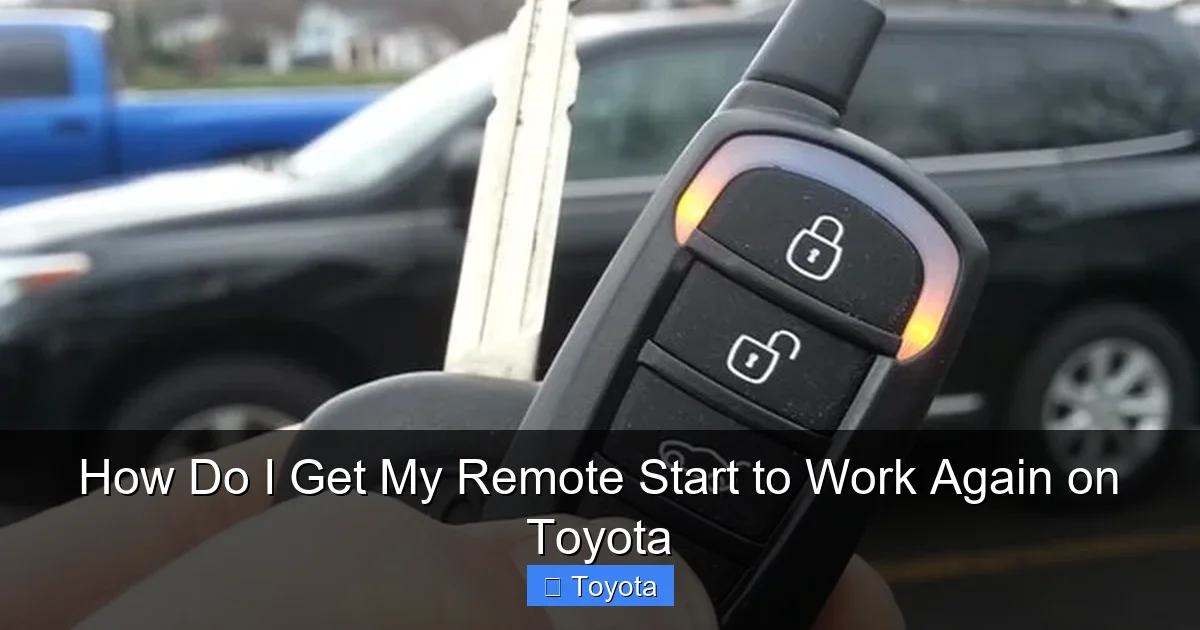
Visual guide about How Do I Get My Remote Start to Work Again on Toyota
Image source: img.philkotse.com
Diagnosing this: Get your battery tested. Any auto parts store will do this for free. A healthy battery should show over 12.6V at rest and not drop below 9-10V during cranking. If your battery is 4+ years old, test it. Also, check the battery terminals. Corrosion or a loose connection can create enough resistance to kill the remote start signal before it even reaches the starter. Clean the terminals with a baking soda/water mix and a wire brush, and ensure the clamps are tight.
Jump-Starting vs. Remote Starting
Here’s a key distinction: if your car is completely dead and won’t even turn the key or respond to the fob, you cannot use remote start to jump it. Remote start requires a baseline level of battery power to activate its control circuits. A totally dead battery (below ~8V) will not allow the remote start system to function. You must jump-start or charge the battery first. Once the car has been running and the alternator has topped off the battery, remote start should work again—unless the weak battery has triggered a security lockout, in which case you’ll need the manual reset from the previous section.
Aftermarket System-Specific Troubleshooting
If you know you have an aftermarket remote start, your troubleshooting path changes. These systems have their own brain (the control module) and wiring that interfaces with your car’s ignition switch, starter wire, and sometimes the brake pedal or neutral safety switch.
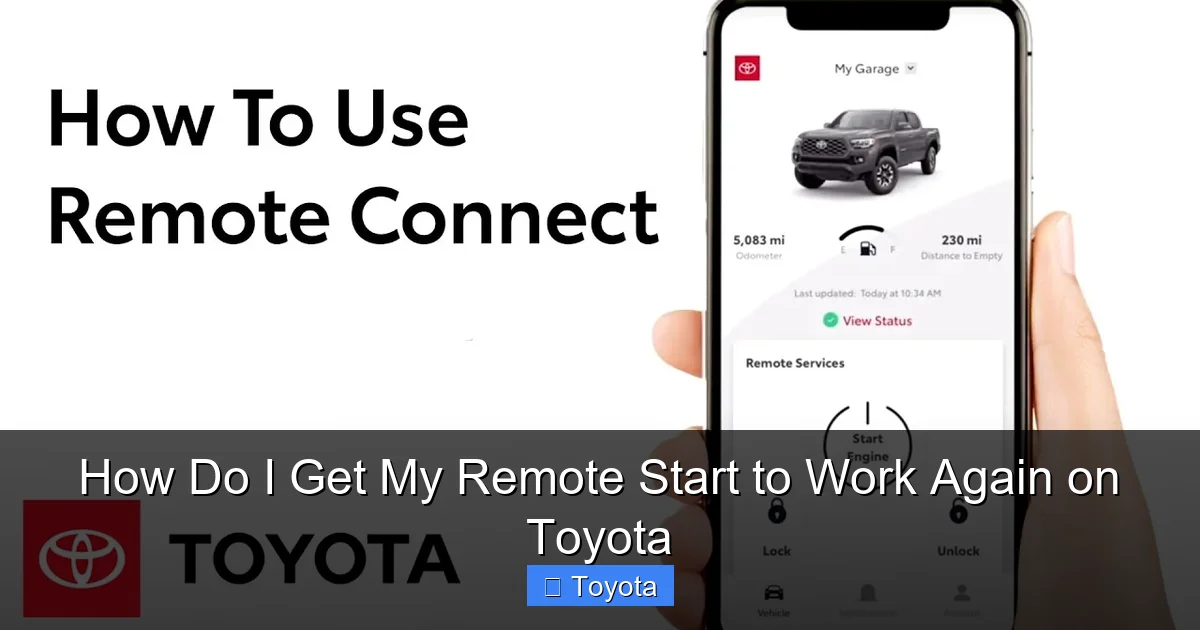
Visual guide about How Do I Get My Remote Start to Work Again on Toyota
Image source: i.ytimg.com
Step 1: Find the “Brain” and Check Fuses
Locate the aftermarket control module. It’s usually a small black box (about the size of a deck of cards) tucked under the driver’s side dash, behind the glovebox, or near the steering column. Once you find it, look for two things: status LEDs and fuses. Many modules have an LED that will blink a diagnostic code if there’s a problem. Consult your installation manual (if you have it) for the code meanings. More importantly, find the inline fuse that powers the module. This fuse is often located in the fuse box under the dash, but sometimes a separate fuse is installed on the module’s power wire itself. Pull this fuse and check if the metal strip is intact. A blown fuse here is a classic failure point.
Step 2: The Harness Connection
Vibration and heat can cause the wiring harness plugs to loosen from the module or from the car’s wiring. Locate the main plug going into the back of the control module. With the car battery disconnected for safety, unplug it and replug it firmly. Do the same for any other large connectors you see. A slightly loose pin can break the circuit for the starter signal.
Step 3: Neutral Safety Switch & Brake Pedal
For safety, almost all remote start systems require the vehicle to be in Park (and sometimes with the brake pedal depressed) to start. If the transmission range sensor (neutral safety switch) is misaligned or faulty, the car’s computer won’t see “Park,” and the remote start will be inhibited. This is a more complex electrical diagnosis that might require a multimeter to test the switch’s continuity in different gear positions. Similarly, a faulty brake pedal switch can confuse the system. These are less common but possible culprits.
When the Check Engine Light is the Real Culprit
This is a critical and often overlooked point. If your Toyota’s Check Engine Light (MIL) is on, the remote start will almost certainly NOT work. This is a deliberate safety and emissions compliance feature. The vehicle’s Powertrain Control Module (PCM) will disable the remote start function if it detects any diagnostic trouble code (DTC) that could affect engine performance or emissions. The logic is: if the engine has a problem, we don’t want you starting it remotely and potentially causing damage or creating excess pollution.
What to do: You must first address the check engine light. Use an OBD2 scanner (a cheap Bluetooth one works) to read the codes. Common culprits that disable remote start include faulty oxygen sensors, a loose or damaged gas cap, or a failing catalytic converter sensor. Fix the underlying issue, clear the codes, and the remote start should automatically re-enable itself after a drive cycle or two. You can learn how to read and reset these codes yourself; guides on resetting maintenance lights often cover basic OBD2 use, though the process for check engine lights is more involved.
Advanced Diagnostics and When to Call a Pro
If you’ve worked through the key fob battery, security reset, car battery health, and aftermarket module checks with no luck, the problem likely lies deeper within the vehicle’s network. This is the realm of professional technicians.
The Need for a Dealer-Level Scan Tool
For OEM systems, a basic OBD2 scanner won’t cut it. You need access to Toyota’s proprietary Techstream software to communicate with the Body Control Module (BCM) and immobilizer system. A technician can use it to:
- Check for stored fault codes in the BCM related to the remote start antenna or receiver.
- Verify the “key status” and see if the system recognizes your fob as valid and programmed.
- Test the output signals from the BCM to the starter relay.
- Re-program or re-match your key fob to the vehicle’s immobilizer if the pairing has been lost.
This is not something you can DIY at home without expensive, licensed software. If your vehicle is still under warranty, this is a clear-cut dealer visit. If out of warranty, a reputable independent shop with Toyota-specific scan tools (like those from Autel or Launch that have Toyota software packages) is your best bet. They can also diagnose if the problem is a faulty antenna ring around the ignition or a failed BCM itself, which requires replacement and re-programming.
Preventative Maintenance for Long-Term Reliability
Once you get your remote start working again, a little maintenance goes a long way to preventing future headaches.
- Replace Key Fob Batteries Proactively: Don’t wait for them to die. Change them every 2-3 years as a preventative measure.
- Keep Your Car Battery Healthy: If you don’t drive your Toyota often (less than once a week), invest in a battery tender/minder to keep it topped off and prevent sulfation.
- Address Check Engine Lights Immediately: As soon as that light comes on, get the codes read. Ignoring it will kill your remote start and could lead to more expensive repairs.
- For Aftermarket Owners: Know where your control module is. If you ever have electrical work done on the car (like a stereo upgrade), warn the technician not to unplug any mysterious black boxes under the dash.
By understanding these systems and following a logical diagnostic path—from the simple (battery) to the complex (BCM codes)—you can solve the vast majority of “why won’t my Toyota remote start?” problems yourself, saving time and money.
Frequently Asked Questions
Why does my Toyota remote start sometimes work and sometimes not?
Intermittent operation is often due to a weak key fob battery or a weak car battery. As the batteries age, their output voltage drops. The remote start command requires a strong, clean signal and sufficient power to engage the starter. On a very cold morning, a weak battery might fail completely, while on a warm afternoon it might barely work. Replacing both batteries is the first step.
Can a remote start installation damage my Toyota’s electrical system?
A professionally installed, high-quality aftermarket system should not damage your car’s electrical system. However, a poor installation—where wires are spliced incorrectly, causing shorts or drawing too much power from the wrong source—can blow fuses, cause weird electrical gremlins, or even damage control modules. Always choose an installer with Toyota-specific experience and a good reputation.
Will disconnecting my car battery erase my remote start programming?
Yes, it can. Disconnecting the battery or if the battery dies completely can cause the vehicle’s Body Control Module (BCM) to lose its “learned” data, including the pairing between your key fob’s transponder chip and the immobilizer system. This is why a security lockout often occurs after a battery replacement. You will typically need to perform a re-programming sequence, which may require a dealer or locksmith with the proper key-cutting and programming equipment.
My remote start works, but the engine shuts off after a few seconds. Why?
This is a classic symptom of the system’s safety checks failing. The most common reason is that the brake pedal is being slightly depressed (perhaps by a floor mat or your own foot if you’re reaching in), or the transmission is not fully registered in “Park.” The system sees a potential unsafe condition and kills the engine. Ensure the parking brake is set and nothing is touching the brake pedal. Also, a failing brake light switch can send a false signal.
How much does it cost to fix a broken Toyota remote start at the dealer?
Costs vary wildly. If it’s just a key fob battery or a simple security reset, it might be $0 if you do it yourself or a minimal diagnostic fee ($50-$100) at the dealer. If the issue is a faulty BCM, the part alone can cost $300-$800+, plus 1-2 hours of labor at $150+/hour. For an aftermarket system, a shop might charge $100-$200 for diagnosis and repair of wiring or module issues. Always get a clear diagnostic quote before authorizing repairs.
Can I program a new Toyota key fob for remote start myself?
For most modern Toyotas (2018+), the answer is no. The key fob contains a transponder chip that must be “matched” to your vehicle’s immobilizer system using proprietary, dealer-only software (Techstream). Even if you buy a blank fob online, you cannot program it to start the engine or use remote start without this system. You will need to visit a Toyota dealer or a certified automotive locksmith who has the Toyota authorization and tools. They will also cut the physical key blade to match your ignition. For older models (pre-2018), some simple on-board programming sequences exist, but these are increasingly rare.