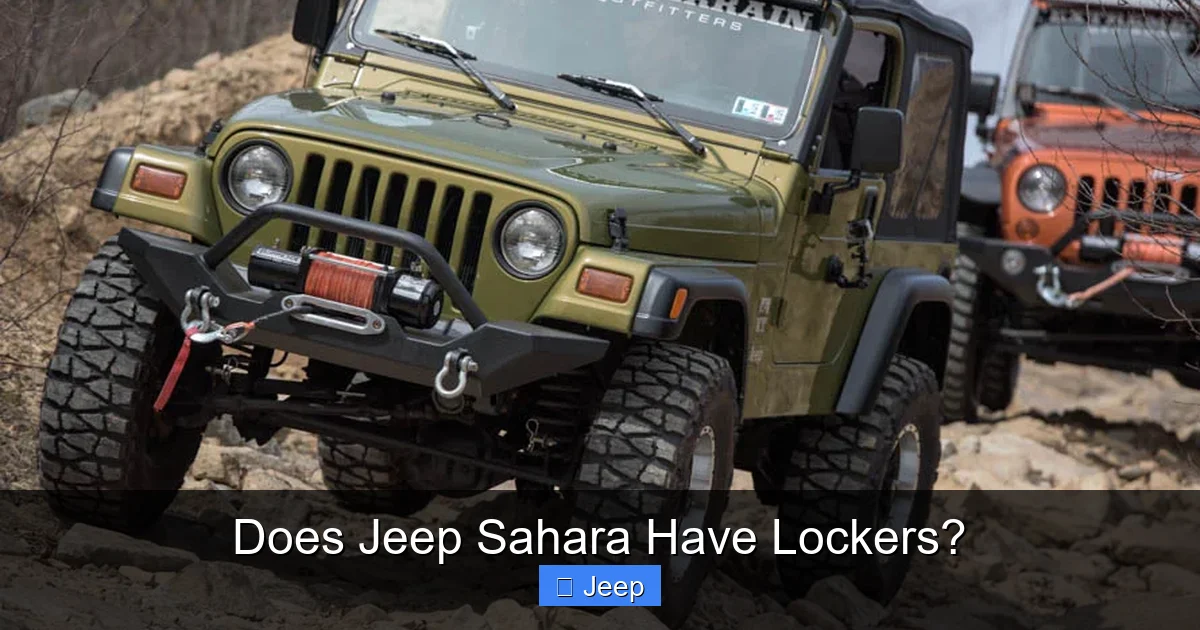
Does Jeep Sahara Have Lockers?

Contents
- 1 Key Takeaways
- 2 📑 Table of Contents
- 3 Understanding Locking Differentials: The “Why” Behind the Question
- 4 The Jeep Wrangler Sahara: A Trim Level Breakdown
- 5 Do Any Jeep Saharas Have Factory Lockers? The Model Year Verdict
- 6 The Electronic Locking Differential: A Rubicon Exclusive
- 7 Aftermarket Locker Solutions for Your Sahara
- 8 Sahara vs. Rubicon: The Real-World Off-Road Comparison
- 9 Practical Advice: Should You Buy a Sahara or Seek a Rubicon?
- 10 Conclusion: Embracing the Sahara’s Capable Identity
- 11 Frequently Asked Questions

Car Cup Holder Expander
Foam Cannon

Engine Oil Additive

OBD2 Scanner Tool
The Jeep Sahara does not come with factory-installed locking differentials. It relies on Jeep’s Selec-Terrain system and a limited-slip rear differential for traction. However, robust aftermarket locker options exist for serious off-road enthusiasts seeking maximum traction.
So, you’re eyeing a Jeep Wrangler Sahara. You’ve got your heart set on that classic, rugged look, the comfortable interior, and the promise of adventure. But then a critical question bubbles up from the back of your mind, whispered among off-road circles: Does the Jeep Sahara have lockers? It’s a simple question with a not-so-simple answer, and it gets to the very heart of what makes a Jeep truly capable when the pavement ends and the rocks, mud, or sand begin.
Let’s clear the air right away. The short, direct answer is no. The Jeep Wrangler Sahara trim does not come with factory-installed front or rear locking differentials. That coveted feature, often considered the holy grail of extreme off-road traction, is reserved for the top-tier Rubicon model. But before you feel disappointment, understand this: the absence of lockers doesn’t make the Sahara a mall crawler. Far from it. It’s a incredibly competent off-roader out of the box, and the world of aftermarket upgrades is vast and ready to transform it. This article will dive deep into exactly what the Sahara has, what it lacks, and what your options are if you need that ultimate mechanical grip.
Key Takeaways
- No Factory Lockers: Jeep Saharas are not equipped with front or rear electronic locking differentials from the factory.
- Traction Alternatives: Sahara models use a limited-slip rear differential and the Selec-Terrain traction control system for off-road grip.
- Aftermarket Path: Air, electronic, and manual aftermarket lockers can be installed for dedicated off-road use.
- Trim Differentiation: Lockers are a signature feature reserved for the higher-trim Rubicon model.
- Capability Context: The Sahara remains highly capable off-road with its standard features and aftermarket potential.
- Model Year Consistency: This lack of factory lockers has been consistent across recent Sahara model years.
- Consider Your Needs: For casual trail riding, the Sahara’s stock setup is sufficient; for rock crawling, lockers become critical.
📑 Table of Contents
- Understanding Locking Differentials: The “Why” Behind the Question
- The Jeep Wrangler Sahara: A Trim Level Breakdown
- Do Any Jeep Saharas Have Factory Lockers? The Model Year Verdict
- The Electronic Locking Differential: A Rubicon Exclusive
- Aftermarket Locker Solutions for Your Sahara
- Sahara vs. Rubicon: The Real-World Off-Road Comparison
- Practical Advice: Should You Buy a Sahara or Seek a Rubicon?
- Conclusion: Embracing the Sahara’s Capable Identity
Understanding Locking Differentials: The “Why” Behind the Question
Before we dissect the Sahara’s specs, we need to understand what a locker is and why off-roaders covet it so fiercely. A differential is a set of gears that allows your wheels to rotate at different speeds, which is essential for turning corners on pavement. But off-road, when one wheel loses traction and starts spinning freely, a standard open differential sends all the power to that spinning wheel—the path of least resistance. You’re stuck.
How a Locker Works
A locking differential mechanically connects both wheels on an axle, forcing them to turn at the same speed. If one wheel is in the air or on ice, the other wheel, with traction, will also receive power and pull you through. It’s a mechanical guarantee of torque to both wheels. There are two main types used in Jeeps:
- Electronic Locking Differential (E-locker): Activated by a button inside the cab. It uses an electric motor to engage a clutch pack, locking the differential. This is what the Rubicon has front and rear.
- Air Locking Differential (Air Locker): Activated by a button, but uses compressed air from an onboard air compressor to engage a pinion and ring gear lock. This is another factory option on some Rubicons and a popular aftermarket choice.
What the Sahara Uses Instead: Limited-Slip & Traction Control
Since it doesn’t have a mechanical locker, the Sahara relies on two key systems:
- Limited-Slip Differential (LSD): The Sahara comes standard with a limited-slip rear differential (often a clutch-pack type like the Trac-Lok). It uses spring-loaded clutch plates to bias torque to the wheel with more traction. It’s not a true 100% lock, but it’s vastly superior to an open diff and provides predictable, automatic traction aid without driver input.
- Selec-Terrain System: This is Jeep’s sophisticated traction control. With modes for Auto, Snow, Sand, Mud, and Rock, it manipulates engine power, transmission shift points, and—most importantly—applies brake pressure to a spinning wheel. By braking the spinning wheel, it effectively transfers torque to the wheel with grip, simulating a locker’s effect, though through electronic intervention rather than mechanical lockup.
The Jeep Wrangler Sahara: A Trim Level Breakdown
To understand why the Sahara doesn’t have lockers, you need to see where it fits in the Wrangler hierarchy. The Wrangler lineup is strategically segmented to meet different buyer desires and budgets.
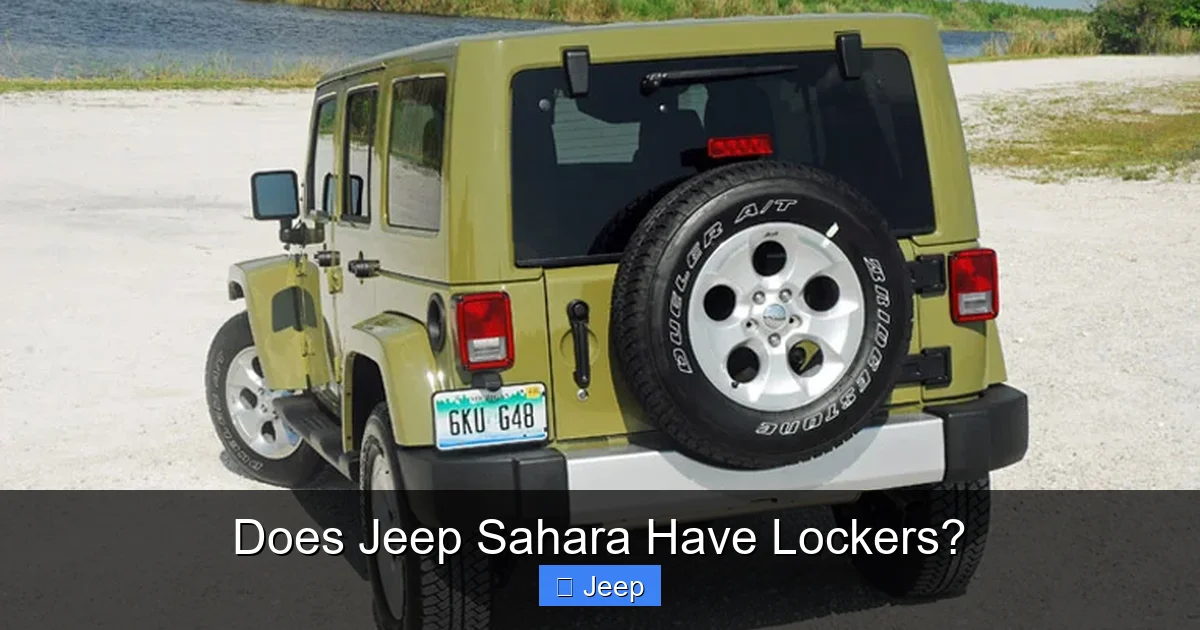
Visual guide about Does Jeep Sahara Have Lockers?
Image source: automotiveaddicts.com
Sahara: The Refined Adventurer
The Sahara is positioned as the “luxury” or “premium” Wrangler. It focuses on on-road comfort, style, and premium features. Think leather-trimmed seats, a premium sound system, aluminum-alloy wheels, and body-color fender flares. It’s for the buyer who wants the Wrangler’s iconic look and weekend adventure capability but with a more car-like ride and upscale interior. Its off-road hardware is excellent but not the absolute maximum available.
Rubicon: The Hardcore Off-Road King
The Rubicon is the dedicated off-road machine. It adds the front and rear electronic locking differentials, heavier-duty axles (Dana 44 front and rear), a heavier-duty transfer case (with a 4:1 low-range crawl ratio vs. the Sahara’s 2.72:1), upgraded suspension, and 33-inch (or larger) all-terrain tires. It also has reinforced rock rails and skid plates. The lockers are its flagship feature, making it the choice for serious rock crawling and extreme terrain.
Sport & Sport S: The Value & Base Models
These are the entry-level trims. They share the same off-road mechanicals as the Sahara (same axles, transfer case, and LSD) but lack the premium interior and some comfort features. They are the blank canvas for budget-conscious builders.
This tiered strategy is clear: lockers are a performance feature reserved for the Rubicon. The Sahara gets the next-best thing (a limited-slip diff) and excellent software (Selec-Terrain) to bridge the gap for most drivers.
Do Any Jeep Saharas Have Factory Lockers? The Model Year Verdict
We’ve established the general rule, but is it absolute? Have there been any exceptions across the Wrangler’s long history? For the modern Jeep Wrangler (JL generation, 2018-present) and the immediately preceding JK generation (2007-2018), the answer is a firm no. The Sahara trim has never been offered with front or rear electronic or air lockers from the factory. The lockers have been a steadfast, defining component of the Rubicon package.

Visual guide about Does Jeep Sahara Have Lockers?
Image source: selectjeeps.com
The Rare and Confusing Exceptions
Where things get murky is in the used market and with special editions. Occasionally, a Sahara might be found with an aftermarket locker installed by a previous owner. Furthermore, Jeep has released special edition models (like certain Freedom editions or anniversary editions) that may have Sahara-like features but are actually based on the Rubicon platform. These will have the VIN code for a Rubicon and the Rubicon’s hardware, including lockers. Always check the vehicle’s build sheet or VIN to confirm its true mechanical specifications. A “Sahara” badge does not 100% guarantee the lack of lockers if the vehicle’s underlying platform is Rubicon.
How to Check Your Specific Vehicle
If you’re looking at a used Sahara and want to be absolutely sure:
- Look for the Rubicon-specific badges (front and rear “RUBICON” badges, “RUBICON” on the spare tire cover).
- Check for the electronic locker switches on the dashboard. Saharas only have the Selec-Terrain dial. Rubicons have two additional switches for front and rear lockers.
- Inspect the axle. Rubicons have distinctive Dana 44 axles with electric locker actuators (or air line fittings for air lockers) on the differential housing.
- Review the original window sticker (Monroney label) or build sheet online using the VIN.
For the vast majority of Saharas rolling off the line, you can confidently plan on no factory lockers.
The Electronic Locking Differential: A Rubicon Exclusive
Let’s talk more about the locker itself, because it’s the star of the Rubicon show. The current JL Wrangler Rubicon comes standard with front and rear electronic locking differentials. They are incredibly robust, driver-activated systems.

Visual guide about Does Jeep Sahara Have Lockers?
Image source: i.ibb.co
Engagement and Use
You press the “Rear Locker” button on the dash, and after a brief moment (and at low speeds, typically below 10-15 mph), you’ll feel and hear it engage. A solid “clunk” means it’s locked. You then do the same for the front locker. With both locked, you have a true four-wheel-drive system where both front wheels are forced to turn together and both rear wheels are forced to turn together. This is maximum mechanical traction for rock crawling, deep mud, or sand. You must remember to disengage them before turning on pavement, as it will cause “wheel scrub” and potential damage to the drivetrain on high-traction surfaces.
Why Sahara Doesn’t Get Them
It’s a business and engineering decision. Adding the heavy-duty Dana 44 axles, locking differentials, and the associated wiring and switches adds significant cost and weight. Jeep reserves this package for the Rubicon to create a clear, performance-oriented flagship. The Sahara’s target audience—those wanting a comfortable, stylish, and capable Wrangler for mostly on-road use with occasional dirt roads or light trails—doesn’t typically need or want to pay for the added complexity and cost of lockers. The limited-slip diff and Selec-Terrain system serve their needs perfectly.
Aftermarket Locker Solutions for Your Sahara
This is where hope blossoms! If you’ve bought a Sahara and now find yourself tackling more challenging trails, you are not doomed to poor traction. The aftermarket industry for Jeep Wranglers is enormous, and locking differentials are a cornerstone of that world. You can absolutely add true mechanical lockers to your Sahara’s axles.
Choosing the Right Aftermarket Locker
You have three primary paths, each with pros and cons:
- Air Lockers (e.g., ARB Air Locker): The gold standard for many. They are incredibly strong, durable, and can be engaged at any speed (though still recommended at low speeds). They require an onboard air compressor or CO2 tank, adding complexity and cost, but offer unmatched reliability and strength.
- Electronic Lockers (e.g., Ox Locker, Yukon G2): These are direct replacements for your factory differential internals. They use an electric motor to engage the lock. They are simpler to install than air lockers (no air lines/compressor) but may have speed limitations for engagement and can be susceptible to water/mud ingress if not properly sealed.
- Manual/Switchable Lockers (e.g., OX or ARB manual): These require you to get out and manually turn a knob on the axle to engage/disengage. They are the most affordable and bulletproof (no electronics or air lines to fail) but are wildly impractical for frequent use on the trail.
The Installation Process and Considerations
Installing a locker is not a simple bolt-on. It requires:
- Axle Disassembly: You must remove the axle shafts, differential cover, and ring gear to install the new locker internals. This is intensive work.
- Ring Gear Pressing: The ring gear must be pressed off the old differential carrier and onto the new locker’s carrier. This requires a hydraulic press and proper tools.
- Re-gearing (Often Needed): If you change tire size significantly, you should re-gear your axles to restore proper acceleration and braking. This is the perfect time to install lockers, as you’re already in the axles.
- Wiring or Air Line Routing: For electronic or air lockers, you must run wiring or air lines from the differential to a switch inside the cab and to a power source or air compressor.
Professional installation is highly recommended unless you are a seasoned mechanic with a well-equipped shop. The cost of parts and labor will easily match or exceed the price difference between a used Sahara and a used Rubicon. This is a crucial financial calculation to make.
Sahara vs. Rubicon: The Real-World Off-Road Comparison
So, with lockers off the table for the Sahara, how does it really stack up against the Rubicon on the trail? The answer might surprise you.
The Power of the Limited-Slip and Selec-Terrain
For 95% of off-road situations—dirt roads, moderate rocky trails, mud holes, sand—the Sahara’s combination of a limited-slip rear diff and Selec-Terrain is remarkably effective. The system is smart. In “Rock” mode, it is very aggressive at braking a spinning wheel. On moderate terrain, you’ll often find the Sahara scrambling up obstacles just fine. The limited-slip diff provides constant, automatic bias to the wheel with grip, which is seamless and requires no driver thought.
Where the Rubicon’s Lockers Dominate
The advantage becomes stark in specific, extreme scenarios:
- Rock Crawling: On large, multi-point rock gardens where wheels are constantly lifting off the ground, a mechanical locker guarantees both wheels push. The Sahara’s LSD/brake-based system can be slower to react, allowing a wheel to spin excessively before the brake intervenes, potentially losing momentum.
- Deep, Low-Traction Sand or Mud: In situations where both rear wheels might have minimal, uneven traction, a locked rear axle ensures both are pushing equally. The LSD can still allow some slip.
- Articulation: When a vehicle is twisted (one front wheel and one rear wheel off the ground), a front locker will power the grounded front wheel. The Sahara has no front locker at all, so in this situation, it has zero front axle traction.
Bottom line: The Sahara is a phenomenal, trail-worthy machine. The Rubicon is an extreme, rock-crawling specialist. If your adventures involve technical rock crawling or deep, sustained low-traction situations where momentum is key, you will feel the lack of lockers on the Sahara. For forest service roads, moderate trails, and beach driving, you likely won’t.
Practical Advice: Should You Buy a Sahara or Seek a Rubicon?
This is the ultimate question, and the answer is deeply personal.
Choose the Sahara If:
- Your off-roading is mostly adventure touring, light to moderate trails, or beach driving.
- You prioritize on-road comfort, a premium interior, and lower initial cost.
- You are a DIY enthusiast who may add lockers later as a project (and understand the cost/effort).
- You want a versatile daily driver that can handle occasional dirt without a harsh ride.
Choose the Rubicon If:
- You regularly tackle technical rock crawls, deep mud, or severe sand where maximum traction is non-negotiable.
- You want the absolute most capable Jeep straight from the factory with no modifications needed for extreme terrain.
- You value the heavier-duty axles, lower crawl ratio, and reinforced underbody protection as much as the lockers.
- You don’t mind the slightly stiffer ride and higher price tag for that ultimate capability.
The Middle Ground: Sport/Sport S + Aftermarket
Many savvy buyers opt for a base Sport model, saving significant money, and then use that savings to build their perfect off-roader: installing lockers, a lift, bigger tires, and armor exactly to their spec. This path requires patience and mechanical interest but can yield a more capable and personalized vehicle than a stock Rubicon for the same money.
When considering modifications, remember that lifting your Jeep or installing larger tires can affect drivetrain geometry and component stress. It’s wise to consult with a reputable shop about the best locker choice for your intended tire size and use case. You might also want to research how much a Jeep lift cost as you plan your build. Additionally, if you plan to remove the top frequently, understanding how much a Jeep top weighs is useful for safe handling.
Conclusion: Embracing the Sahara’s Capable Identity
So, does the Jeep Sahara have lockers? The definitive, factory-issued answer is no. It is engineered without the mechanical front and rear locking differentials that define the Rubicon. But to label the Sahara as “incapable” because of this would be a profound mistake. It arrives with a superb limited-slip rear differential and one of the best traction control systems in the industry, making it a formidable machine for the overwhelming majority of off-road adventures.
The true beauty of the Jeep Wrangler, and the Sahara specifically, is its potential. It is a platform, not a final product. The absence of a locker is not a dead end; it’s an open invitation. For the driver who discovers a need for more extreme traction, the path is clear: the vibrant, well-supported aftermarket offers solutions to install true mechanical lockers. The decision then becomes a financial and practical one: is it more sensible to buy a Rubicon upfront, or to build a Sahara into the machine you need?
Your choice should mirror your adventure style. If your dreams involve sunny forest roads and scenic overlooks, the Sahara in its stock form is a perfect, comfortable companion. If your dreams involve conquering the Rubicon Trail’s infamous rocks, you should either start with a Rubicon or seriously budget for an aftermarket locker installation on your Sahara. Understand what you’re buying, know the limitations, and enjoy the unparalleled freedom that any Wrangler provides.
Frequently Asked Questions
Does the Jeep Wrangler Sahara have a locking rear differential?
No, the Sahara does not have a factory-installed mechanical locking rear differential. It comes with a limited-slip rear differential (Trac-Lok) and relies on the Selec-Terrain system for enhanced traction.
What is the difference between a Sahara and a Rubicon locker?
The Rubicon has both front and rear electronic locking differentials (or available air lockers) from the factory. The Sahara has no factory lockers at all, using only a limited-slip rear diff and brake-based traction control.
Can I install an aftermarket locker on my Jeep Sahara?
Yes, absolutely. Air lockers (like ARB), electronic lockers (like Ox), and even manual lockers can be installed in the Sahara’s Dana 30 front and Dana 35 rear axles. It is a major axle job requiring professional installation.
Are aftermarket lockers on a Sahara as good as factory Rubicon lockers?
High-quality aftermarket lockers like ARB Air Lockers are often considered stronger and more durable than the factory electronic lockers. However, they require separate installation and wiring/air systems, whereas the Rubicon’s are integrated and covered by warranty.
Does the Sahara have any other off-road features besides the lack of lockers?
Yes, the Sahara is very capable. It includes part-time 4WD, a 2.72:1 transfer case low range, skid plates, rock rails, and the excellent Selec-Terrain system with a “Rock” mode. It also has a higher ground clearance than many SUVs.
For casual off-roading, do I really need lockers on a Sahara?
For most dirt roads, moderate trails, sand, and mud, the Sahara’s stock limited-slip diff and Selec-Terrain system are more than sufficient. Lockers become a significant advantage only in extreme, low-traction rock crawling or deep sand where wheel spin is constant and severe.