Does a 2018 Toyota Camry Have a Timing Belt or Chain?

Contents
- 1 Key Takeaways
- 2 📑 Table of Contents
- 3 Introduction: The Million-Mile Question
- 4 Timing Belts vs. Timing Chains: What’s the Difference?
- 5 The 2018 Toyota Camry: A Full Lineup of Chains
- 6 Why Did Toyota Switch to Chains? The Bigger Picture
- 7 Maintenance Implications for Your 2018 Camry
- 8 Debunking Myths and Addressing Common Concerns
- 9 Conclusion: Peace of Mind in Your Driveway
- 10 Frequently Asked Questions

Car Jump Starter

Car Window Tint Film

Carburetor Cleaner

Windshield Cleaning Tool
The 2018 Toyota Camry uses a timing chain in all its engine configurations, including the hybrid. This means you don’t have the scheduled replacement cost and hassle associated with timing belts. Timing chains are designed to last the life of the engine with proper maintenance, making the 2018 Camry more reliable and cheaper to maintain long-term compared to models with timing belts.
Key Takeaways
- The 2018 Camry has a timing chain: All engine options for the 2018 model year, including the 2.5L 4-cylinder and 3.5L V6 gas engines and the Hybrid system, utilize a durable timing chain.
- No scheduled replacement needed: Unlike timing belts, which typically require replacement every 60,000-100,000 miles, timing chains are intended to last the lifetime of the engine with regular oil changes.
- Lower long-term ownership cost: The absence of a major scheduled timing belt service is a significant cost-saving and convenience advantage for Camry owners.
- Maintenance is still critical: While they last longer, timing chains can be stressed by neglected oil changes, low oil levels, or poor-quality oil, leading to premature wear or failure.
- Failure is rare but catastrophic: A timing chain failure in an interference engine like the Camry’s causes severe internal engine damage, making proactive maintenance essential.
- Listen for warning signs: Common symptoms of a worn timing chain include a rattling noise from the front of the engine (especially on cold starts), check engine lights, and poor engine performance.
- Hybrid models also use a chain: The 2018 Camry Hybrid’s gasoline engine component uses a timing chain, not a belt, following the same design philosophy as the gas models.
📑 Table of Contents
- Introduction: The Million-Mile Question
- Timing Belts vs. Timing Chains: What’s the Difference?
- The 2018 Toyota Camry: A Full Lineup of Chains
- Why Did Toyota Switch to Chains? The Bigger Picture
- Maintenance Implications for Your 2018 Camry
- Debunking Myths and Addressing Common Concerns
- Conclusion: Peace of Mind in Your Driveway
Introduction: The Million-Mile Question
If you own a 2018 Toyota Camry or are thinking about buying one, one of the most important—and often confusing—questions about its long-term care is about its timing system. Is it a timing belt or a timing chain? This isn’t just automotive trivia. The answer directly impacts your maintenance schedule, your wallet, and your peace of mind. A timing component failure can mean a destroyed engine and a bill that runs into the thousands. The good news for Camry owners is that for the 2018 model year, Toyota made a choice that favors reliability and lower cost of ownership. This article will give you a complete, easy-to-understand breakdown, so you know exactly what’s under the hood of your car and how to care for it.
Timing Belts vs. Timing Chains: What’s the Difference?
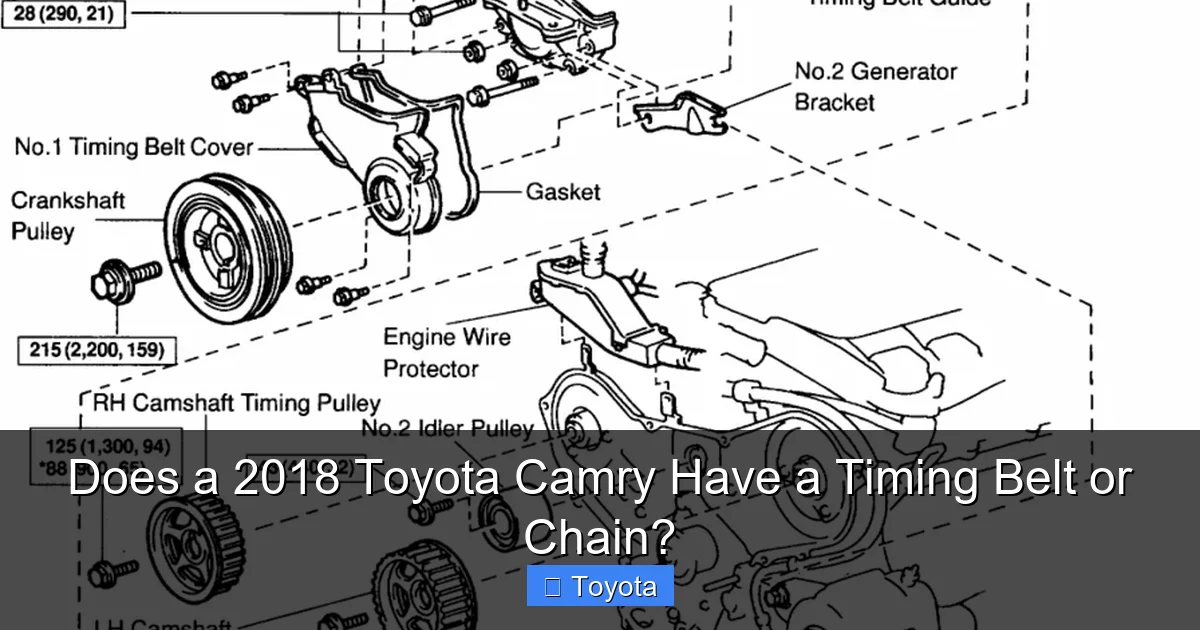
Before we dive into the 2018 Camry specifically, let’s quickly clarify the two types of timing systems. Both perform the same critical job: synchronizing the rotation of the crankshaft (which controls the pistons) and the camshaft(s) (which controls the valves). This precise timing allows the engine to breathe and fire correctly.

Visual guide about Does a 2018 Toyota Camry Have a Timing Belt or Chain?
Image source: i.ytimg.com
Timing Belts: The Quiet, Scheduled Worker
A timing belt is made of reinforced rubber with teeth that grip the gears. It’s quieter, lighter, and less expensive to manufacture. However, rubber degrades over time due to heat, moisture, and stress. Because of this, manufacturers mandate a strict replacement interval, usually between 60,000 and 100,000 miles. Missing this service is playing with fire. If a belt breaks, the pistons and valves can collide in an “interference engine” design (which most modern engines are), causing bent valves, damaged pistons, and a completely ruined engine. The replacement itself is labor-intensive, as the belt is often buried deep in the engine, making it a costly service.
Timing Chains: The Heavy-Duty, “Lifetime” Part
A timing chain is exactly what it sounds like: a metal chain, similar to a bicycle or motorcycle chain, but much stronger. It rides on sprockets and is lubricated by engine oil. Chains are inherently more durable and are designed to last the entire life of the engine without scheduled replacement. They are virtually immune to the age-related degradation that belts suffer. The trade-off is that they can be noisier (though modern engineering has minimized this) and slightly more expensive to produce upfront. However, for the owner, this means one less major, expensive service to worry about. This is a key reason many manufacturers, Toyota included, have shifted to chains for most of their modern engines.
The 2018 Toyota Camry: A Full Lineup of Chains
Now for the direct answer: the 2018 Toyota Camry uses a timing chain in every single engine variant. This was part of Toyota’s broader strategy to enhance reliability and reduce long-term ownership costs. Let’s break it down by engine.
Visual guide about Does a 2018 Toyota Camry Have a Timing Belt or Chain?
Image source: static.cargurus.com
The Gasoline Engines: 2.5L 4-Cylinder and 3.5L V6
The base engine for the 2018 Camry was the all-new (for that generation) 2.5-liter Dynamic Force 4-cylinder. This efficient, powerful engine uses a timing chain. The optional 3.5-liter V6, a carryover from the previous generation but still highly regarded, also uses a robust timing chain system. For both engines, Toyota’s official stance is that the timing chain is a “lifetime” component, meaning it is not part of a regular maintenance schedule. Its longevity is dependent on one thing: consistent, proper engine oil maintenance.
The Hybrid Powertrain: Same Chain Philosophy
The 2018 Camry Hybrid combines a 2.5-liter 4-cylinder gasoline engine with an electric motor. The gasoline engine in this hybrid system is a variant of the standard 2.5L engine. Crucially, it also uses a timing chain. The hybrid system adds complexity with its electric motors and battery pack, but the fundamental timing of the internal combustion engine is still handled by a durable chain, not a belt. This consistency across the entire Camry lineup simplifies maintenance advice for all owners.
A Note on “Lifetime”
It’s important to define what Toyota means by “lifetime.” In automotive engineering terms, this typically means the designed useful life of the engine itself under normal operating conditions. It does not mean “infinite.” Extreme neglect, such as consistently driving with low oil, using poor-quality oil, or ignoring severe service conditions (like constant towing in extreme heat), can absolutely lead to premature chain and guide wear. For the vast majority of drivers who follow the recommended oil change intervals, the chain should indeed last the life of the car.
Why Did Toyota Switch to Chains? The Bigger Picture
Toyota wasn’t alone in this transition. The entire industry has been moving from belts to chains for over a decade in many engine families. The decision is driven by a clear customer benefit: reduced cost of ownership and increased perceived reliability. A timing belt service is a major, unexpected expense for many car owners. By eliminating it, Toyota makes the Camry’s “Total Cost of Ownership” argument even stronger. For a brand whose reputation is built on reliability, removing a high-failure, high-cost scheduled item is a smart move. This philosophy extends to other models; you’ll find chains in most modern Toyotas, including the current RAV4, Corolla, and Tacoma. To see this trend in a different model line, you can explore what year Toyota Tundra has a timing chain, which shows a similar evolution in their truck platform.

Visual guide about Does a 2018 Toyota Camry Have a Timing Belt or Chain?
Image source: i.ytimg.com
Maintenance Implications for Your 2018 Camry
So, you have a timing chain. Does that mean you can forget about it and never worry? Not exactly. The chain system still requires proper care, just of a different kind.
The #1 Rule: Change Your Oil on Time
This cannot be stressed enough. A timing chain is lubricated by the engine oil. Dirty, sludge-filled oil or critically low oil levels are the primary causes of premature chain wear. The chain tensioners and guides, which keep the chain taut and on track, also rely on clean oil pressure. Following the severe or normal service schedule in your owner’s manual for oil changes is the single most important thing you can do for your timing chain’s health. Use the oil viscosity specified by Toyota (typically 0W-16 or 0W-20 for these engines).
Listen and Observe
While rare, chain issues can develop. Be aware of symptoms:
- A Rattling Noise: A distinct metallic rattle or slapping sound from the front top of the engine, especially noticeable on cold starts when oil is at the bottom of the pan. This is the classic sign of a worn chain, tensioner, or guide.
- Check Engine Light: A worn chain can trigger codes related to camshaft/crankshaft position correlation (P0010-P0017 series).
- Poor Performance/Misfires: If the chain has stretched enough to affect timing, you may experience rough running, loss of power, or misfires.
If you hear a persistent new rattle, get it diagnosed immediately. Catching a failing tensioner or guide early is far cheaper than replacing a stretched chain.
What About the Serpentine Belt?
Do not confuse the timing chain (internal, synchronizes engine parts) with the serpentine belt (external, drives the alternator, power steering, AC compressor). The 2018 Camry absolutely has a serpentine belt, and that belt does have a replacement interval (typically around 60,000-90,000 miles). It will show cracks and wear over time. This is a normal, relatively inexpensive wear item. You can learn more about general serpentine belt lifespan in articles like how long does a Toyota serpentine belt last. Keeping this belt in good shape is important for your accessories but has no bearing on your engine’s internal timing.
Debunking Myths and Addressing Common Concerns
Let’s clear up some frequent points of confusion that arise in forums and conversations about the Camry’s timing system.
“My 2007 Camry had a belt, so why does my 2018 have a chain?”
This is an excellent observation. The previous generation Camry (2007-2011) with the 2.4L 4-cylinder engine did indeed use a timing belt. Toyota made a significant engineering shift with the all-new 2018 generation’s engine (the A25A-FKS 2.5L). They adopted a new architecture that prioritized efficiency and durability, and the switch to a chain was a core part of that. It’s a clear example of engineering progress between generations.
“Is a timing chain really ‘lifetime’? I’ve heard they fail.”
Yes, chains can fail, but it is exceptionally rare in a well-maintained Toyota engine when compared to the statistical failure rate of a neglected timing belt. “Lifetime” is an engineering term, not a guarantee. The vast majority of timing chain failures are linked to poor maintenance—specifically, ignoring oil changes or using the wrong oil. In a Toyota engine that is serviced according to the manual, a timing chain failure is an extreme outlier. The risk is dramatically lower than the guaranteed, scheduled failure point of a rubber belt.
“What about the cost if it DOES fail?”
This is the sobering part. The 2018 Camry’s 2.5L engine is an interference design. If the chain breaks while the engine is running, the pistons will collide with the open valves. This results in bent valves, damaged pistons, and potentially a ruined cylinder head and block. The repair is a complete engine rebuild or replacement, costing several thousand dollars. This catastrophic scenario is precisely why proactive oil changes are non-negotiable. The cost of a hundred oil changes is a fraction of one engine replacement. For context on potential repair costs for other major components, you might research how much a Toyota Camry hybrid battery costs, another major (but less common) expense.
Conclusion: Peace of Mind in Your Driveway
For the owner of a 2018 Toyota Camry, the timing system question has a simple, reassuring answer: you have a timing chain. This is a major win for long-term reliability and your maintenance budget. You can drive with the confidence that you are not on a countdown to a $1,000+ scheduled service that, if missed, could destroy your engine. Your primary responsibility is to be a diligent owner: change your oil on schedule with the correct oil, address any unusual noises promptly, and keep up with all other routine services. By doing so, you are directly supporting the “lifetime” claim of your timing chain and ensuring your Camry’s legendary reliability lives up to its reputation for hundreds of thousands of miles. It’s one less major worry on your list, allowing you to focus on enjoying a car that’s renowned for its comfort, efficiency, and now, its worry-free timing system.
Frequently Asked Questions
Does the 2018 Toyota Camry have a timing belt or chain?
The 2018 Toyota Camry has a timing chain in all its engines, including the 2.5L 4-cylinder, 3.5L V6, and the Hybrid system. There is no timing belt in the 2018 model year.
When does the timing chain need to be replaced on a 2018 Camry?
According to Toyota, the timing chain is designed to last the lifetime of the engine and has no scheduled replacement interval. Its longevity depends entirely on regular oil changes with the correct oil viscosity.
What are the signs of a bad timing chain on a 2018 Camry?
Signs include a persistent metallic rattling noise from the front of the engine (especially on cold starts), a check engine light with camshaft/crankshaft codes, and poor engine performance or misfires.
Is a timing chain failure in a 2018 Camry common?
No, timing chain failure is very rare in a well-maintained 2018 Camry. The vast majority of failures are directly linked to neglected oil changes or using incorrect/low-quality oil, which causes excessive wear.
Does the 2018 Camry Hybrid have a timing belt?
No. The gasoline engine in the 2018 Camry Hybrid uses a timing chain, just like the non-hybrid models. The hybrid system does not change the internal timing design of the combustion engine.
What happens if the timing chain breaks on a 2018 Camry?
The 2018 Camry’s engine is an interference design. If the chain breaks, the pistons will collide with the valves, causing severe internal damage like bent valves and damaged pistons. This requires a complete engine rebuild or replacement, which is very expensive.