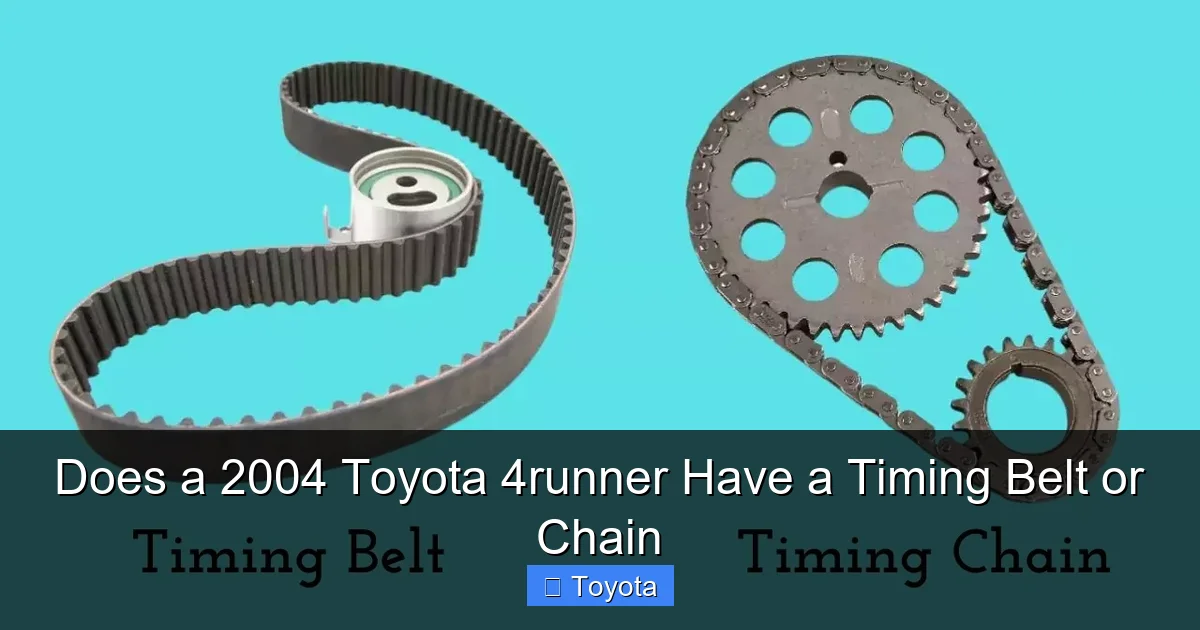
Does a 2004 Toyota 4runner Have a Timing Belt or Chain

Contents
- 1 Key Takeaways
- 2 📑 Table of Contents
- 3 The Core Difference: Belt vs. Chain
- 4 2004 Toyota 4Runner Engine Options Decoded
- 5 How to Identify Which Engine is in Your 2004 4Runner
- 6 Maintenance and Service Intervals: A Drastic Contrast
- 7 Signs of Impending Failure: What to Listen and Look For
- 8 The Bottom Line: Cost, Risk, and Your 4Runner
- 9 Conclusion: Knowledge is Power (and Saves Money)
- 10 Frequently Asked Questions

LED Indicator Light

Magnetic Car Phone Mount

Car MP3 Player

OBD2 Scanner Tool
The answer depends entirely on your 2004 Toyota 4Runner’s engine. The 4-cylinder 2.7L engine uses a timing belt that requires replacement every 90,000 miles. The V6 4.0L engine uses a timing chain, which is designed to last the engine’s lifetime but still requires regular inspection. Knowing which component your vehicle has is critical for proper maintenance and avoiding catastrophic engine failure.
If you own a 2004 Toyota 4Runner, or you’re thinking about buying one, one of the most important maintenance questions you can ask is about its timing system. It’s a classic point of confusion and a critical piece of information for any vehicle owner. Getting this wrong can mean the difference between a simple, affordable service and a completely destroyed engine that requires a full replacement. So, let’s clear the air right away: a 2004 Toyota 4Runner can have either a timing belt or a timing chain, and which one you have depends solely on which engine is under the hood.
Toyota offered two engine options for the 2004 model year 4Runner: the reliable 2.7-liter 4-cylinder (2TR-FE) and the powerful 4.0-liter V6 (1GR-FE). These two engines use fundamentally different methods to synchronize the rotation of the crankshaft and camshaft(s). Understanding this difference isn’t just automotive trivia; it’s essential knowledge that directly impacts your maintenance budget, long-term reliability, and what to listen for when you pop the hood. In this complete guide, we’ll break down exactly which engine has what, why it matters, how to identify your engine, and what maintenance tasks each system requires. We’ll also talk about the scary “what if” scenarios and give you practical advice to keep your 4Runner’s heart beating strong for years to come.
Key Takeaways
- Engine Determines the Part: The 2004 4Runner’s 2.7L 4-cylinder has a timing belt; the 4.0L V6 has a timing chain. You must check your engine size to know for sure.
- Maintenance Schedules Vary Wildly: The timing belt is a wear item with a strict replacement interval (every 90k miles). The timing chain is a “lifetime” part but needs regular oil changes and inspections for wear.
- Failure Has Different Consequences: A broken timing belt in an interference engine like the 2.7L causes severe, expensive damage. A timing chain failure is rare but also catastrophic. Prevention is key for both.
- Costs Are Not Comparable: Replacing a timing belt is a routine, moderate-cost service. Replacing a timing chain is a major, expensive engine job due to the labor involved.
- Listen and Look for Warning Signs: Belts can crack and wear visibly. Chains often give audible warnings like rattling or slapping noises before failing, especially on startup.
- Never Ignore Maintenance: Proactively replacing the belt on schedule is vastly cheaper than repairing the engine after it breaks. For chains, sticking to oil change intervals is the best prevention.
- Check Your Owner’s Manual or VIN: The definitive source is your vehicle’s owner’s manual. You can also decode your VIN or look under the hood to identify the engine.
📑 Table of Contents
- The Core Difference: Belt vs. Chain
- 2004 Toyota 4Runner Engine Options Decoded
- How to Identify Which Engine is in Your 2004 4Runner
- Maintenance and Service Intervals: A Drastic Contrast
- Signs of Impending Failure: What to Listen and Look For
- The Bottom Line: Cost, Risk, and Your 4Runner
- Conclusion: Knowledge is Power (and Saves Money)
The Core Difference: Belt vs. Chain
Before we dive into the specific engines, let’s quickly establish the fundamental differences between a timing belt and a timing chain. Think of them as two different solutions to the same problem: making sure the engine’s valves open and close at the exact right moment relative to the pistons moving up and down.
What is a Timing Belt?
A timing belt is a toothed rubber belt, reinforced with fiberglass or Kevlar cords for strength. It’s relatively quiet, inexpensive to manufacture, and does its job well. However, rubber degrades over time. It can dry out, crack, stretch, and eventually fail. Because of this, it is considered a wear item, similar to your brake pads or spark plugs. It has a manufacturer-recommended replacement interval, typically between 60,000 and 100,000 miles. If it breaks while the engine is running, the consequences depend on whether the engine is an “interference” or “non-interference” design. In an interference engine, which the 2.7L 4Runner engine is, the pistons and valves occupy the same space in the cylinder at different times. A broken belt means they collide, bending valves and smashing pistons—a very expensive repair.
What is a Timing Chain?
A timing chain is, as you’d guess, a metal chain. It’s housed inside the engine, lubricated by engine oil, and designed to last the entire lifespan of the engine—hence the often-used term “lifetime timing chain.” It’s quieter than it used to be, thanks to modern engineering, and is far more durable than rubber. Chains can stretch over hundreds of thousands of miles and their tensioners (which keep the chain tight) can wear out. While a chain failure is extremely rare on a well-maintained Toyota, it is still possible, and like a belt failure in an interference engine, it usually results in catastrophic damage. The key with a chain is not a mileage-based replacement, but preventative maintenance: religious oil changes with the correct oil viscosity to ensure proper lubrication and prevent premature wear.
So, in a nutshell: a belt is a scheduled replacement part. A chain is a “lifetime” part that lives or dies by your engine oil maintenance habits.
2004 Toyota 4Runner Engine Options Decoded
Now for the specific answer to your question. For the 2004 model year, Toyota 4Runners rolled off the assembly line with one of these two engines. You can find your engine size on a sticker under the hood, in your owner’s manual, or by decoding your Vehicle Identification Number (VIN).

Visual guide about Does a 2004 Toyota 4runner Have a Timing Belt or Chain
Image source: fourwheeltrends.com
The 2.7L 4-Cylinder (2TR-FE) – The Timing Belt Engine
The base engine for the 2004 4Runner was the 2.7-liter inline 4-cylinder, code-named 2TR-FE. This engine is known for its exceptional fuel economy and legendary durability, though it has less power than the V6. This engine uses a timing belt. It is an interference engine, meaning a belt failure will cause the pistons to collide with the open valves, leading to bent valves, damaged pistons, and potentially a ruined cylinder head. The recommended replacement interval for this belt is every 90,000 miles. This is not a service to skip or delay. The belt also drives the water pump on many models, so it’s highly recommended to replace the water pump at the same time since the labor to access it is already being done. This is a classic example of why knowing your engine type is so important—the maintenance plan for a 2.7L 4Runner is fundamentally different from a V6 model.
The 4.0L V6 (1GR-FE) – The Timing Chain Engine
The upgrade engine was the 4.0-liter V6, the 1GR-FE. This is the engine most 4Runner enthusiasts seek out for its superior power and towing capacity. This engine uses a timing chain. It is also an interference engine. The chain is located at the front of the engine, behind a cover, and is bathed in engine oil. Toyota did not assign a mileage replacement interval for this chain, marketing it as a “lifetime” component. In practice, this means it should last well beyond 200,000 miles with proper maintenance. The primary threat to this chain is neglect—specifically, running low on oil or using the wrong oil, which can cause excessive wear on the chain guides and tensioner. While failures are uncommon, they do happen on high-mileage engines where oil changes were infrequent. This is the engine you’d want if you prefer a “set it and forget it” timing system, but you cannot forget about oil changes.
How to Identify Which Engine is in Your 2004 4Runner
You might be reading this and thinking, “Great, but which one do I have?” Don’t guess. Here are three foolproof ways to find out.

Visual guide about Does a 2004 Toyota 4runner Have a Timing Belt or Chain
Image source: fourwheeltrends.com
1. Check the Engine Bay Label or Sticker
Open the hood and look for a white sticker, usually on the radiator support, the underside of the hood, or the firewall. This is your vehicle’s emission control label. It will explicitly list the engine displacement, such as “2.7L” or “4.0L.” This is the quickest visual confirmation.
2. Consult Your Owner’s Manual
The original owner’s manual will have a specifications section that lists the engine size. It will also contain the critical maintenance schedule, which will tell you exactly when the timing belt (if you have one) needs to be changed. If you don’t have the manual, you can often find a digital PDF online by searching for “2004 Toyota 4Runner owner’s manual.”
3. Decode Your VIN
Your Vehicle Identification Number (VIN) is a 17-character code that holds all your vehicle’s secrets. The 4th through 8th characters are the “Vehicle Descriptor Section.” For a 2004 4Runner, you can use a free online VIN decoder. The engine code is typically found in the 7th and 8th positions. For example, a code like “2TR-FE” indicates the 2.7L, while “1GR-FE” indicates the 4.0L. The National Highway Traffic Safety Administration (NHTSA) website offers a free VIN decoder that is very reliable.
Maintenance and Service Intervals: A Drastic Contrast
This is where the rubber meets the road—literally and figuratively. The maintenance philosophy for these two systems is night and day.
Visual guide about Does a 2004 Toyota 4runner Have a Timing Belt or Chain
Image source: partsofacarengine.com
For the 2.7L (Timing Belt) – A Non-Negotiable Mileage Service
If your 2004 4Runner has the 2.7L engine, you must adhere to the 90,000-mile timing belt replacement interval. This is not a suggestion. This is a hard deadline. The belt can degrade due to age and heat cycles even if you don’t drive 90,000 miles per year, so if the vehicle is over 10-12 years old, replacing it based on age (e.g., every 10 years) is also a wise precaution. As mentioned, the water pump is driven by the same belt. Because the labor to access them is nearly identical, you should replace the water pump, all the belt’s idler pulleys and tensioner, and the thermostat (which is also in the timing cover area) at the same time. This is a classic “while you’re in there” job that saves you from a future costly repair. The total cost for this service can range from $500 to $1,000+ depending on your location and whether you use OEM or aftermarket parts. It’s a significant expense, but it’s predictable and planned. It is incomparably cheaper than the $4,000-$6,000+ you’ll spend rebuilding or replacing the engine if the belt breaks. For more on the severe consequences of a timing belt failure, you can read our detailed article on what happens if a Toyota timing belt breaks.
For the 4.0L (Timing Chain) – Lifetime Maintenance Through Oil Changes
Owners of the 4.0L V6 get to skip the major scheduled timing service. However, this does not mean “no maintenance.” The health of your timing chain is 100% dependent on your engine oil. The chain rides on lubricated guides and is tensioned by hydraulic tensioners that use oil pressure. Using the correct oil (0W-20 or 5W-30 as specified for your model year) and changing it every 5,000-7,500 miles (or as indicated by your maintenance reminder) is the single most important thing you can do for your chain’s longevity. Sludge formation from neglected oil changes can clog oil passages to the tensioner, causing the chain to slap, wear, and eventually fail. Listen for a rattling or slapping noise from the front of the engine on cold starts that goes away after a few seconds—this can be a sign of a worn chain or tensioner. While there’s no scheduled “chain replacement,” a high-mileage V6 (250k+ miles) might have its chain and guides inspected during a major engine service. You can also look at the broader picture of Toyota’s engineering choices; for instance, the Toyota Tundra switched to timing chains around the same era for its V8 engines, reflecting a industry-wide trend toward chains for larger, heavier-duty engines.
Signs of Impending Failure: What to Listen and Look For
Both systems will usually give you some warning before a catastrophic failure, though the signs are different. Catching these early can save your engine.
Timing Belt Warning Signs (2.7L Engine)
Since the belt is outside the engine and made of rubber, you can often inspect it visually if you remove the timing cover (a job in itself). A mechanic will check for cracks in the rubber, fraying, glazing (a shiny appearance), or worn teeth. However, you don’t need to see it to know it’s old. The biggest sign is simply the mileage and age on the vehicle. If you don’t know the belt’s history and you’re over 90,000 miles, assume it’s original and replace it immediately. There are rarely any audible warnings before a belt snaps; it just fails. Your only defense is proactive replacement based on the schedule.
Timing Chain Warning Signs (4.0L Engine)
Chain issues often announce themselves with sound. The most common symptom is a distinct rattling or slapping noise from the front top of the engine that lasts for 1-3 seconds on cold startup, then disappears as oil pressure builds and the hydraulic tensioner takes up slack. This is often called a “cold start rattle.” As the chain stretches or the tensioner fails, the noise may become longer or constant. You might also experience poor performance, a check engine light (often for camshaft/crankshaft position sensor correlation codes), or even metal shavings in your oil during a change, which is a dire sign. If you hear this rattle, have a mechanic diagnose it immediately. It often means the chain, guides, and tensioner need replacement—a major job, but still cheaper than an engine replacement after a break.
The Bottom Line: Cost, Risk, and Your 4Runner
Let’s frame this in practical terms for a 4Runner owner or buyer.
If you have the 2.7L 4-cylinder: Budget for a $700-$1,200 timing belt service (including water pump, tensioner, etc.) every 90,000 miles. It’s a known, planned expense. The risk of not doing it is total engine destruction. There is no middle ground. The good news is that when done on schedule, this engine is incredibly reliable. You are trading a predictable service cost for immense peace of mind and engine longevity.
If you have the 4.0L V6: Your primary “timing system” cost is your oil change budget. Spend $50-$70 every 5,000-7,500 miles on a quality oil and filter change. This is your insurance policy against a $3,000-$5,000 chain/tensioner/guide replacement job or worse. The chain itself should not be a worry on a well-maintained truck. The trade-off here is lower routine costs for a tiny, long-term risk if oil changes are neglected. This engine is also extremely reliable when cared for properly.
For potential buyers, always ask the seller: “What engine is in it, and is the timing belt service history documented?” For a 2.7L, a missing belt history should be a red flag that demands a price reduction to cover the imminent service. For a V6, ask for oil change records. A well-maintained 2004 4Runner of either engine type can easily surpass 300,000 miles.
Conclusion: Knowledge is Power (and Saves Money)
So, does a 2004 Toyota 4Runner have a timing belt or chain? The answer is a definitive “it depends.” It hinges on the engine under the hood. The 2.7L 4-cylinder uses a timing belt with a strict 90,000-mile replacement rule. The 4.0L V6 uses a timing chain that, with impeccable oil change discipline, should last the life of the truck. This single piece of knowledge shapes your entire ownership experience. It dictates your maintenance schedule, your long-term costs, and what noises should make your ears perk up. Take the time now to identify your engine. Check the hood sticker, pop the VIN into a decoder, or consult your manual. Once you know, you can create a real plan. For the belt engine, that plan includes finding a trusted mechanic and budgeting for the service. For the chain engine, that plan means never, ever skipping an oil change. Your 4Runner’s legendary reliability is built on this kind of informed, proactive care. Don’t leave your engine’s fate to chance—find out your timing system and treat it right.
Frequently Asked Questions
What happens if the timing belt breaks on a 2004 4Runner with the 2.7L engine?
The 2.7L engine is an interference design. A broken timing belt will cause the pistons to collide with the open valves, resulting in bent valves, damaged pistons, and likely a ruined cylinder head. This requires a complete engine rebuild or replacement, costing thousands of dollars. This is why the 90,000-mile replacement interval is critical.
How much does it cost to replace the timing belt on a 2004 4Runner?
Expect to pay between $700 and $1,200 for a complete timing belt service on the 2.7L engine. This should include the belt, water pump, tensioner, and idler pulleys. The labor is intensive, which drives the cost. Always get multiple quotes and insist on replacing all related components.
Do I need to replace the timing chain on my 2004 4Runner’s 4.0L V6?
No, there is no scheduled replacement interval for the timing chain. It is designed to last the lifetime of the engine. The key to its longevity is strict adherence to oil change intervals using the correct oil weight. The only “replacement” would be if it fails or shows excessive wear, which is rare on a well-maintained engine.
What does a bad timing chain sound like in a 4.0L 4Runner?
The most common symptom is a distinct rattling or slapping noise coming from the front top of the engine. It occurs on cold starts and usually lasts for 1-3 seconds until oil pressure builds and the hydraulic tensioner engages. As the problem worsens, the noise may last longer or become constant. This requires immediate diagnosis.
Can I visually inspect the timing belt or chain myself?
The timing belt on the 2.7L is behind a plastic cover at the front of the engine. You could remove the cover to inspect it for cracks or wear, but this is part of the replacement process. The timing chain on the 4.0L is inside the engine behind a metal cover and is not meant for DIY inspection. Your best visual check is to look for oil leaks around the timing cover on either engine.
If I buy a used 2004 4Runner, how do I verify the timing belt was changed?
Ask for service records. A reputable seller or dealer will have receipts showing the belt replacement. Check the engine bay for a sticker from the shop that performed the work. You can also ask a mechanic to inspect the belt during a pre-purchase inspection; a new belt will have a different appearance and part number than an old, original one. If there’s no proof, assume it’s original and factor the replacement cost into your offer.