
What Is the Orange Exclamation Light on a Toyota Corolla?

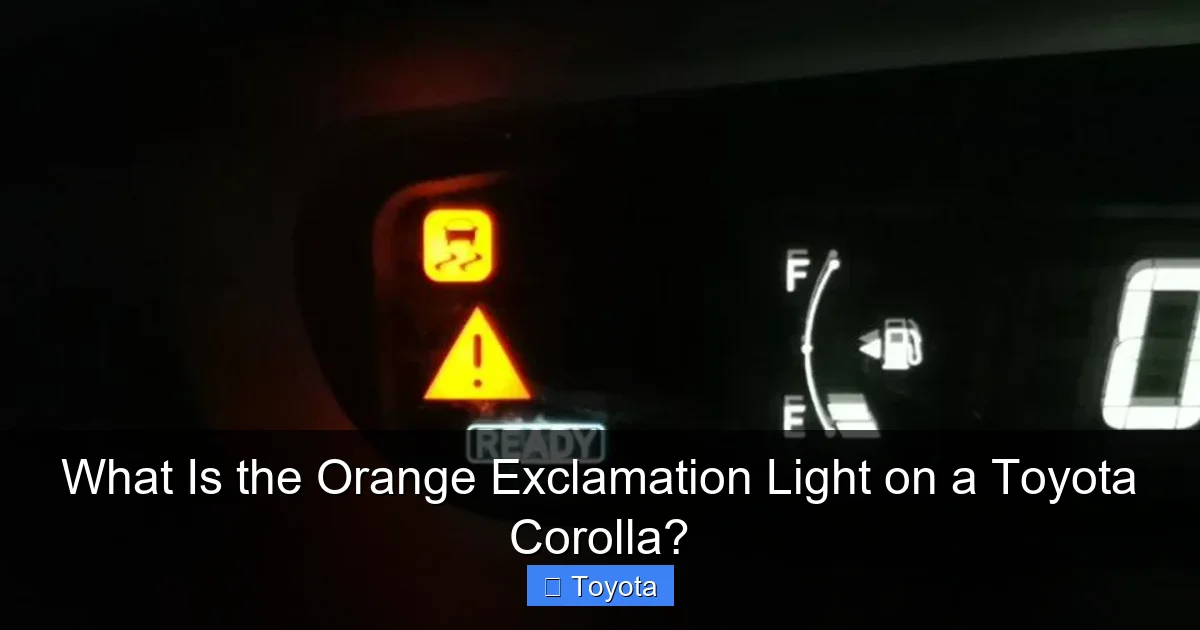
The orange exclamation light on a Toyota Corolla is a master warning indicator. It illuminates for various non-critical issues, most commonly low fuel, maintenance reminders, or minor system alerts. While often safe to drive briefly, you should diagnose the specific cause promptly using your multi-information display. Ignoring it can lead to bigger problems. Always consult your owner’s manual first, as the light’s meaning can vary by model year and trim level.
You’re cruising down the road in your reliable Toyota Corolla, everything seems fine, and then it catches your eye: a bright orange triangle with an exclamation point glowing on your dashboard. Your heart might skip a beat. What does it mean? Is it serious? Should you pull over right now? Take a deep breath. In the vast majority of cases, this light is your car’s way of giving you a friendly, urgent nudge about something that needs your attention—but it’s rarely an immediate crisis. Think of it as your Corolla’s “Hey, can we talk for a second?” light. This comprehensive guide will decode everything about the orange exclamation light on a Toyota Corolla, turning that moment of panic into a moment of informed action.
Key Takeaways
- It’s a Master Warning Light: The orange triangle with an exclamation point is Toyota’s generic “master warning” indicator, not tied to one specific fault.
- Common Triggers Are Usually Minor: It frequently comes on for low fuel, overdue maintenance (like oil changes), low tire pressure, or burnt-out bulbs.
- Your Display Holds the Code: The specific reason is shown on the multi-information display screen between your gauges. Check there immediately.
- Safety First: If the light is flashing or accompanied by other red warnings (like the oil pressure light), stop driving safely and seek help immediately.
- You Can Often Reset It: Once the underlying issue is fixed (e.g., adding fuel, inflating tires), the light will usually reset automatically after a few drive cycles or can be manually reset via the menu.
- Don’t Ignore It: While not an emergency like a red light, neglecting the warning can lead to neglected maintenance, poor fuel economy, or component damage.
- Consult Your Manual: The exact definitions and reset procedures can differ between Corolla model years. Your owner’s manual is the final authority.
📑 Table of Contents
- Decoding the Symbol: More Than Just an Exclamation Point
- Most Common Reasons Your Corolla’s Exclamation Light Comes On
- What to Do When the Light Comes On: A Driver’s Action Plan
- Resetting the Light: Can and Should You Do It Yourself?
- Related Dashboard Lights: Your Corolla’s Complete Vocabulary
- Prevention and Proactive Maintenance: Keeping the Light Off
- Conclusion: Your Co-Pilot, Not Your Enemy
Decoding the Symbol: More Than Just an Exclamation Point
Before we dive into causes and fixes, let’s get one thing perfectly clear. The symbol you’re seeing is not a random design. It’s a standardized icon used across the entire Toyota lineup and much of the automotive industry. It’s officially called the Master Warning Light. Its purpose is simple: to grab your attention and direct it to another message or warning displayed on your vehicle’s multi-information display (MID)—that small screen nestled between your speedometer and tachometer.
The Master Warning System Explained
Your Toyota Corolla’s computer (ECU) is constantly monitoring dozens of sensors and systems. When it detects a parameter outside the normal range—but not severe enough to trigger a dedicated, more urgent light like the red oil pressure or battery warnings—it activates this master alert. The exclamation point inside a triangle is the universal “pay attention” symbol. The real story is told in the text or icon that appears on the MID at the same time. It might say “LOW FUEL,” “MAINTENANCE REQUIRED,” “TPMS” (for tire pressure), or show a picture of a burnt-out headlight bulb. The orange exclamation light is the spotlight; the MID message is the play being performed on stage.
How It Differs from Other Dashboard Lights
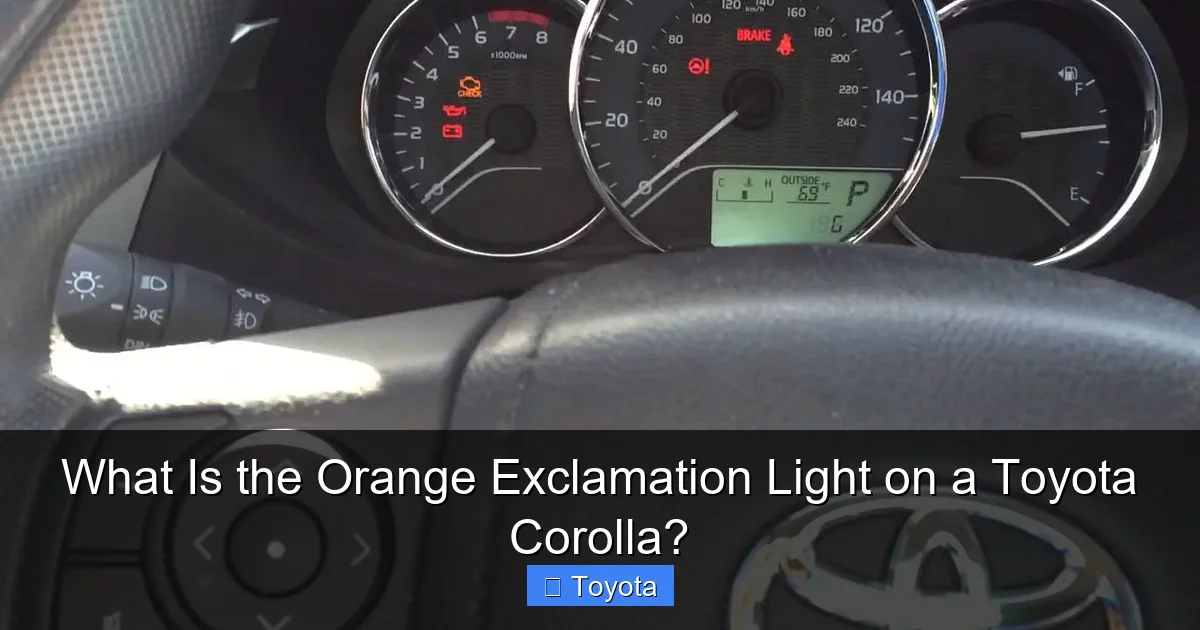
It’s crucial to distinguish this light from others. A red exclamation point (often in a circle) is usually the parking brake indicator. A yellow or amber engine-shaped light is the Check Engine Light, which indicates an emissions-related fault. The orange triangle is broader and less specific. It’s also different from the “BRAKE” system warning light, which is red and serious. Understanding this hierarchy—red for stop/danger, yellow/amber for caution/service soon, green/blue for system activation—is key to interpreting your dashboard correctly. If you’re ever unsure about any other light, especially red ones, safe driving dictates you pull over and investigate.
Most Common Reasons Your Corolla’s Exclamation Light Comes On
Now for the meat of the matter. Why is this light glowing in your specific Corolla? While the possibilities range from trivial to important, several causes are overwhelmingly common. Remember, the first step is always to glance at your MID for the specific message.
Visual guide about What Is the Orange Exclamation Light on a Toyota Corolla?
Image source: attachments.priuschat.com
Low Fuel or Fuel System Issues
This is the number one culprit, especially for older Corollas. The light will illuminate, and your MID will likely display “FUEL LEVEL LOW” or simply a gas pump icon. Some model years will even give you an estimate of remaining miles. This is your car’s polite way of saying, “I’m hungry.” It’s not an emergency, but you should refuel soon to avoid running out of gas, which can damage the fuel pump. A related, less common issue is a faulty fuel cap. A loose or damaged cap can trigger an evaporative emission (EVAP) system leak code, which might illuminate the master warning instead of the check engine light on some models. Ensuring your fuel cap is clicked tightly after refueling is a simple fix.
Scheduled Maintenance Reminders
Modern Corollas have sophisticated maintenance reminder systems. When your scheduled service is due—be it an oil change, tire rotation, or other factory-recommended service—the car will trigger the master warning. The MID will typically display “MAINTENANCE REQUIRED SOON” or “OIL CHANGE.” This is your Corolla’s digital service sticker. It’s based on mileage and time intervals, not just a calendar reminder. Ignoring this means you’re driving past the manufacturer’s recommended service interval, which can void aspects of your warranty and lead to accelerated wear. Resetting this light after the service is completed is a standard procedure, often done with a button combination on your steering wheel or via the trip meter menu. You can find detailed steps for your specific model year in your owner’s manual.
Tire Pressure Monitoring System (TPMS) Alerts
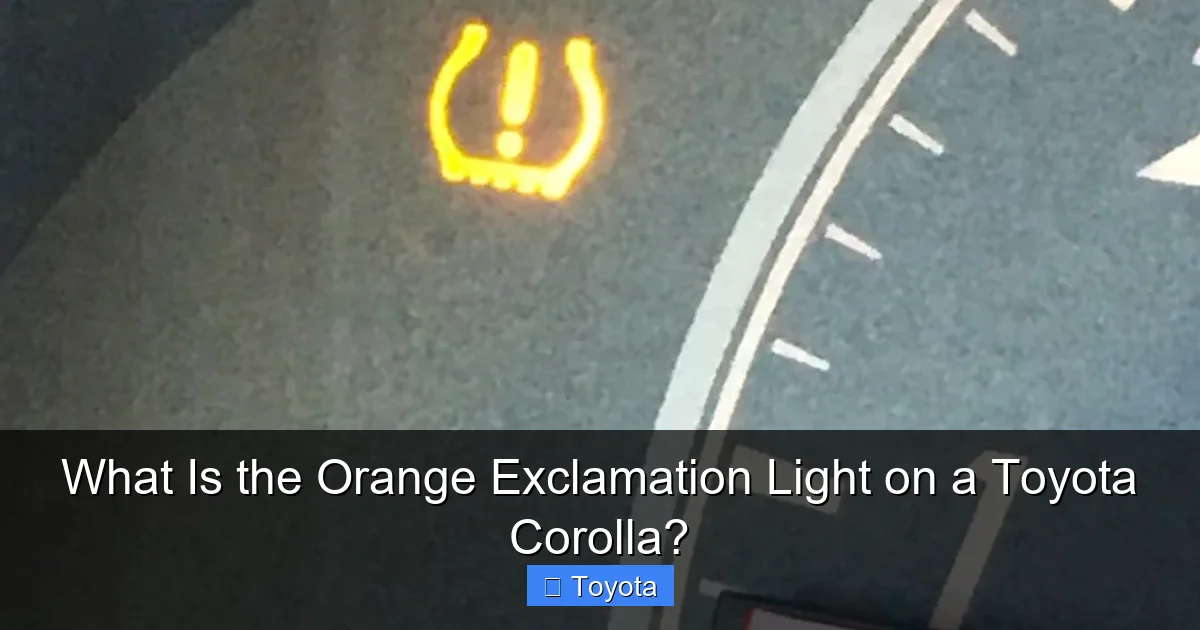
Since 2007, all U.S. vehicles, including the Corolla, have had a TPMS. If one or more tires drop significantly below the recommended pressure (usually 25% or more), the system triggers a warning. On many Corollas, this activates the master warning light along with a “TPMS” or a tire icon on the MID. Under-inflated tires are dangerous—they reduce handling, increase wear, and lower fuel economy. The fix is simple: check your tire pressure with a gauge and inflate to the PSI listed on the driver’s door jamb sticker. After driving a few minutes, the light should reset automatically if pressure is restored. If it persists, you may have a faulty sensor or a slow leak that needs a professional.
Electrical System and Bulb Outages
Your Corolla’s computer monitors many electrical circuits. A burned-out exterior light bulb—headlight, taillight, brake light, or turn signal—can trigger this warning. The MID might say “HEADLIGHT OUT” or show a picture of the affected light. This is a safety and legal issue (driving with a burned-out brake light is a ticketable offense). Similarly, an issue with the alternator or charging system might first manifest here before the dedicated battery light comes on. If the light comes on and you notice dimming headlights or other electrical oddities, have the charging system checked.
Brake System Warnings (Less Common)
While major brake failures trigger the red “BRAKE” light, some minor or sensor-related brake issues can sometimes illuminate the master warning. This could be related to worn brake pads (if your Corolla has pad wear sensors), low brake fluid level, or an issue with the Anti-lock Braking System (ABS). If the exclamation light comes on alongside the ABS light (which looks like “ABS” inside a circle), it points specifically to the ABS system. Your conventional brakes will still work, but you should get the ABS system diagnosed promptly. If the master warning appears with the red brake warning light, stop driving immediately.
What to Do When the Light Comes On: A Driver’s Action Plan
Seeing that orange triangle can be unsettling, but your response should be methodical, not panicked. Here is a step-by-step guide to handling the situation safely and effectively.
Visual guide about What Is the Orange Exclamation Light on a Toyota Corolla?
Image source: i.ytimg.com
Step 1: Immediate Safety Assessment (While Driving)
Your first priority is safe control of the vehicle. Take a quick, calm glance at your MID. What does it say? Is the car behaving strangely? Are there any other lights on, especially red ones? If you see a red oil pressure symbol, a red battery, or the main brake warning, you must find a safe place to pull over and shut off the engine immediately. These indicate serious, potentially engine-damaging conditions. If the only new light is the orange exclamation point and the car runs normally, you can usually continue to your destination or a safe location for inspection, but you should plan to diagnose it very soon.
Step 2: The Initial Visual Check (When Parked)
Once parked, perform a quick visual inspection. This solves a huge percentage of cases.
- Check Fuel Level: Is the gas needle low? If so, refuel.
- Check Tire Pressure: Visually inspect all four tires. Do any look significantly flat? Use a tire pressure gauge if you have one.
- Check for Burned-Out Bulbs: Turn on your headlights, taillights, and brake lights (have a friend help or use a reflective wall). Walk around the car.
- Check Engine Oil: Pull the dipstick. Is the level low? Is the oil dirty? Low oil can trigger warnings on some models.
- Check Coolant: Look at the coolant reservoir (the translucent plastic tank). Is the level between the MIN and MAX lines?
Step 3: Consult the Source and Retrieve the Code
Your owner’s manual has a dedicated section for warning lights. Find it. It will have a picture of the symbol and a list of potential MID messages associated with it. This is your first diagnostic tool. For a more precise diagnosis, you’ll need to read the specific diagnostic trouble code (DTC) stored in the car’s computer. This is easy with an affordable OBD2 scanner (any basic model works). Plug it into the port under your dashboard (usually near the steering column). Turn the ignition to “ON” (don’t start the car), and the scanner will read the code. This code (e.g., P0455 for a large EVAP leak) tells you exactly what system triggered the warning. You can then look up the code online or in a repair manual for a specific fix.
Step 4: When to Call a Professional
You can handle simple fixes like adding fuel, air in tires, or resetting a maintenance reminder yourself. But call a mechanic if:
- The OBD2 code points to a complex system (catalytic converter, transmission, multiple sensor failures).
- The light comes on and the car runs poorly (stalling, misfiring, loss of power).
- The light flashes while driving. A flashing master warning (or check engine light) usually indicates a severe misfire that can damage the catalytic converter. Stop driving.
- You’ve fixed the obvious issue (filled gas, inflated tires) but the light won’t reset after a few drive cycles.
- The issue is related to brakes, steering, or major electrical systems.
Resetting the Light: Can and Should You Do It Yourself?
Once you’ve identified and fixed the underlying problem, the light should go away on its own after a few start-up cycles (this is called a “drive cycle”). However, sometimes you need to manually reset it, especially for maintenance reminders. Here’s how and why.
Visual guide about What Is the Orange Exclamation Light on a Toyota Corolla?
Image source: static.cargurus.com
The Proper Reset Procedure for Maintenance Reminders
For oil change or general service reminders, the reset is usually done through the steering wheel controls or the odometer/trip meter button. A common method for many Corolla models (2014-2018) is: Turn ignition to “ON.” Use the trip/odometer button to cycle to the “Settings” menu on the MID. Navigate to “Maintenance” or “Service Reset,” select “Oil,” and confirm reset. Important: Only perform this reset after you have actually performed the maintenance (e.g., changed the oil). Resetting without doing the work is dishonest to the car’s system and to future buyers, and it defeats the purpose of the reminder. Your owner’s manual has the exact, model-year-specific steps. If you’ve recently had service and the light stayed on, the shop may have forgotten to reset it—you can do it yourself or ask them to.
Why Resetting Might Not Be the Solution
Here is a critical point: You cannot and should not simply reset a warning light without addressing the cause. If you clear the code or reset the light while the problem still exists, the car’s computer will simply detect the fault again and turn the light back on, often within a few minutes or miles. This is particularly true for TPMS and fuel cap warnings. If the tire is still low or the cap is loose, the system will re-trigger. Attempting to “turn off the light” by disconnecting the battery or using a scanner to clear codes without repair is ineffective and potentially dangerous. The light is a symptom; you must treat the disease. For issues like low fuel or a burnt bulb, fixing the problem is the reset. For complex codes, a repair is required before the light will stay off. If you’re unsure about the cause, a professional diagnosis is worth the cost before attempting any reset.
Resetting Other Related Lights
Sometimes, the master warning can be connected to other systems. If you’ve recently disconnected the battery or had work done, you might need to reset other systems. For example, if you’ve replaced the battery in your Corolla, you might encounter a different light or need to perform a specific battery registration procedure on newer models. Understanding how to reset specific lights can be helpful. For instance, learning how to reset the battery light on a Toyota Corolla is a useful skill, as charging system issues can sometimes first appear through the master warning. Similarly, knowing how to reset the check engine light on a Toyota Corolla after a repair is standard practice. However, remember the golden rule: fix the problem first, reset second.
Related Dashboard Lights: Your Corolla’s Complete Vocabulary
The orange exclamation point is just one word in your Corolla’s dashboard language. Understanding its neighbors helps you interpret messages more accurately and react appropriately.
The Check Engine Light (MIL)
This is the engine-shaped yellow light. It indicates a problem with the emissions control system, which can range from a loose gas cap (very common) to a failing catalytic converter (very expensive). While sometimes confused with the master warning, they are separate systems. However, a serious emissions fault could potentially also trigger the master warning. The key difference: the Check Engine Light is almost always directly tied to a stored OBD2 trouble code. If both lights are on, diagnose the check engine code first, as it’s more specific.
The Battery Light
This is a battery-shaped icon, usually red or yellow. It indicates a problem with the charging system—the alternator isn’t charging the battery properly. If this comes on while driving, you have limited electrical power. Turn off all non-essential accessories (radio, AC, heater) and get to a mechanic immediately, as the engine will stall once the battery is depleted. A failing alternator can sometimes cause voltage fluctuations that trigger other electronic warnings, including the master warning.
The Oil Pressure Light
A red oil can symbol. This is a stop-driving light. It means engine oil pressure has dropped to a dangerously low level. Continuing to drive will cause catastrophic engine damage within minutes. If this light comes on, pull over safely, shut off the engine, and check the oil level. If it’s low, add oil (but only if you have the correct type and it’s not a massive leak). If the level is fine, the oil pump or sending unit may have failed. Do not restart the engine; have the car towed.
Other Common Indicators
Familiarize yourself with the ABS light (circle with “ABS”), the SRS airbag light (a person with a circle/belt), and the temperature warning (a thermometer in liquid). The master warning often acts as a catch-all for systems that don’t have their own dedicated icon. For instance, a problem with the Eco Heat & Cool system (Toyota’s efficient HVAC mode) might trigger a message on the MID alongside the master warning. If you see such a message and are unfamiliar, researching what Eco Heat Cool on a Toyota Corolla means can clarify if it’s a simple setting issue or a fault.
Prevention and Proactive Maintenance: Keeping the Light Off
The best way to deal with the orange exclamation light is to prevent it from coming on unnecessarily. This is all about adhering to your Corolla’s legendary maintenance schedule.
Stick to the Factory Service Schedule
Your owner’s manual provides a detailed maintenance schedule based on mileage and time. This isn’t a suggestion; it’s the engineering requirement to keep your car reliable. It includes oil/fluid changes, filter replacements, spark plug changes, transmission fluid inspections, and more. Following this schedule prevents 90% of the “maintenance required” triggers. Use the reminder system as a helpful tool, not a nag. When it comes on, book your service appointment.
Regular DIY Checks
Every month or before long trips, perform a quick 5-minute check:
- Tires: Check pressure and tread depth. Look for nails or uneven wear.
- Fluids: Check engine oil, coolant, windshield washer fluid, and brake fluid levels.
- Lights: Test all exterior lights. Replace any burned-out bulbs immediately.
- Wipers: Inspect wiper blades for wear.
- Listen and Feel: Note any new noises, vibrations, or changes in performance.
Catching a low fluid or a slow tire leak early prevents the warning light from ever appearing.
Address Small Problems Immediately
That occasional odd noise? The slight change in shift quality? The “check engine” light that came on but went away? Don’t let it linger. These are often early warnings of a larger, costlier failure. Have them diagnosed. A $50 sensor fix today prevents a $1000 catalytic converter replacement tomorrow. The master warning is your last-chance alert before a minor issue becomes a major one.
Conclusion: Your Co-Pilot, Not Your Enemy
The orange exclamation light on your Toyota Corolla is not a design flaw or a nuisance; it’s a vital piece of safety and maintenance communication technology. It’s your car’s direct line to you, saying, “Heads up, check this out.” By understanding that it’s a master warning, learning to read the specific message on your multi-information display, and following a logical diagnostic process, you transform anxiety into empowerment. Most triggers are simple, inexpensive fixes—a gallon of gas, a few pounds of air, an oil change. Even when it points to a more complex issue, early detection saves you money and prevents breakdowns. Treat this light as a helpful co-pilot. Respect its message, respond appropriately, and your Corolla will continue to reward you with its famed reliability and miles of trouble-free driving. Keep this guide bookmarked, consult your owner’s manual, and drive with confidence.
Frequently Asked Questions
Is it safe to drive my Toyota Corolla with the orange exclamation light on?
It depends entirely on the MID message. If it says “LOW FUEL” or “TIRE PRESSURE LOW,” you can drive a short distance to address it. However, if it’s accompanied by a red light (like oil pressure or BRAKE), you must stop driving immediately. When in doubt, consult your owner’s manual or a mechanic.
What does it mean if the orange exclamation light is flashing?
A flashing master warning light is unusual but typically indicates a very urgent, severe problem—often a severe engine misfire that can damage the catalytic converter. If the light is flashing, find a safe place to pull over, shut off the engine, and have the vehicle towed for diagnosis. Do not continue driving.
How do I find out what specific problem triggered the light?
Look at your multi-information display (the screen between your gauges). It will show a text message or icon corresponding to the issue (e.g., “MAINTENANCE,” “TPMS,” “FUEL LEVEL LOW”). For a precise code, use an OBD2 scanner to read the stored diagnostic trouble code (DTC), which will point to the faulty system or component.
Can I just disconnect the battery to turn the light off?
Disconnecting the battery may clear temporary codes, but it will not turn the light off if the underlying problem still exists. The car’s computer will redetect the fault and relight the warning. Furthermore, disconnecting the battery on modern cars can cause other systems (like radio, clock, and engine idle settings) to reset. Always diagnose and fix the cause first.
Why did the light come on right after I got an oil change?
This is common and usually means the maintenance reminder system was not reset by the technician. The light is programmed to come on at specific mileage intervals. After the oil change, the system needs to be manually reset to start the countdown to the next service. You can often do this yourself using the buttons on your steering wheel, or simply ask the shop to reset it.
What’s the difference between this orange exclamation light and the yellow ‘Check Engine’ light?
The orange triangle is a Master Warning Light for various non-emissions issues (fuel, maintenance, tires, bulbs). The yellow engine-shaped light is the Check Engine Light (MIL), which specifically indicates a fault in the engine management or emissions control system that could affect pollution output. They are separate systems, but a serious problem could sometimes trigger both. The Check Engine Light always has an associated OBD2 trouble code.