
Can a Ford F-150 Pull a Camper?

Yes, a Ford F-150 can pull a camper, but its capability depends entirely on your specific truck’s configuration, engine, and package. You must know your truck’s exact Gross Combined Weight Rating (GCWR) and payload capacity, then match a camper whose wet weight falls safely within those limits. Proper towing equipment like the correct hitch, sway control, and a brake controller is non-negotiable for safety and legality. Always consult your owner’s manual and consider weighing your fully loaded setup before hitting the road.
Key Takeaways
- Towing capacity varies widely: Your F-150’s max towing capacity can range from 5,000 lbs to over 14,000 lbs based on engine, axle ratio, cab size, and whether it’s a 4×2 or 4×4 model.
- Payload is not towing capacity: Payload is what you can carry *in* the truck (people, cargo, tongue weight). Exceeding payload can strain suspension and brakes even if the trailer weight is under the tow rating.
- The right hitch is critical: You need a hitch rated for your camper’s weight. For heavier campers, a weight-distributing hitch with integrated sway control is essential for stability and safety.
- A brake controller is usually required: Most states require a trailer brake controller for any trailer over 1,500 lbs. This is a must-have device you install inside your cab to activate the camper’s electric brakes.
- Always weigh your setup: The only way to know your actual weights is to take your fully loaded truck and camper to a public scale. This confirms you are within GCWR and payload limits.
- Configuration matters more than you think: A short-bed, 4×4, crew cab truck with the smallest engine will have a significantly lower towing capacity than a long-bed, 4×2, regular cab with the max towing package.
📑 Table of Contents
- So, Can Your Ford F-150 Really Pull a Camper?
- Decoding the Numbers: Understanding Towing Capacity & Payload
- Engine, Axle, and Configuration: Why Your Specific F-150 Matters
- Matching Your F-150 to the Perfect Camper
- Essential Towing Equipment: You Can’t Skip This
- Safe Towing Practices: From the Driveway to the Highway
- Real-World Scenarios: What Can Different F-150s Tow?
- Conclusion: Knowledge is Your Best Tow Vehicle
So, Can Your Ford F-150 Really Pull a Camper?
It’s one of the most common questions in truck forums and campgrounds across the country: “Can my Ford F-150 pull a camper?” The simple, frustrating answer is: it depends. The Ford F-150 is America’s best-selling truck for a reason—its incredible range of configurations means it can be built to do almost anything, from light-duty commuting to heavy-duty towing. But that very versatility is what makes the answer so complex. A 2015 F-150 with a base V6 engine and a short bed has vastly different capabilities than a 2023 F-150 Limited with the 3.5L EcoBoost V6 and the Max Trailer Tow Package.
The real answer isn’t just a yes or no. It’s a process. It’s about understanding your specific truck’s numbers, knowing the weight of the camper you want, and equipping your rig with the proper hardware. Pulling a camper safely and legally is about more than just hooking up and hitting the road. It’s about respecting the engineering limits of your vehicle and ensuring a stable, controlled journey for you, your family, and everyone else on the highway. Let’s break it down, step by step, so you can confidently answer that question for your own driveway.
Decoding the Numbers: Understanding Towing Capacity & Payload
Before you even look at campers, you need to become fluent in the language of truck ratings. There are three critical numbers you must know for your specific F-150. They are usually found on a yellow tire information label on the driver’s door jamb or in your owner’s manual’s towing section.
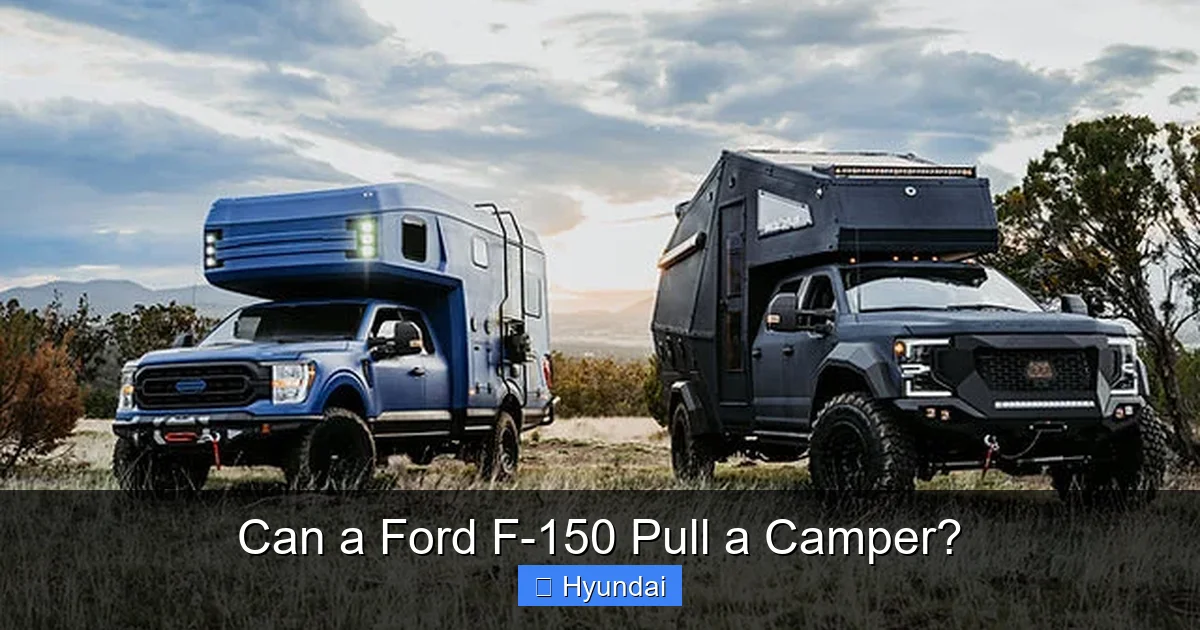
Visual guide about Can a Ford F-150 Pull a Camper?
Image source: carglassadvisor.com
Gross Combined Weight Rating (GCWR)
This is the most important number for towing. The GCWR is the maximum allowable total weight of your fully loaded truck plus the fully loaded camper (including fuel, passengers, cargo, and everything in between). Think of it as the total weight your truck’s powertrain, transmission, and frame are engineered to safely move as a single unit. Your goal is to keep the actual combined weight under this rating. Exceeding it puts extreme stress on your engine, transmission, and brakes, leading to premature wear or catastrophic failure.
Maximum Towing Capacity
This is the figure you see in commercials—”up to 14,000 lbs!” But it’s a best-case scenario number, typically for a 2WD, regular cab, long-bed truck with the highest-output engine and the Max Trailer Tow Package. It assumes a truck-only weight of just the driver (150 lbs). For your actual, real-world truck with a crew cab, 4×4, a full tank of gas, you, your family, and your tools in the bed, your effective towing capacity can be 1,000-2,000 lbs less than that sticker number. Always calculate based on your truck’s actual curb weight.
Payload Capacity
Payload is what your truck can carry inside—passengers, fuel, cargo in the bed, and crucially, the tongue weight of the trailer. Tongue weight is the downward force the trailer’s coupler exerts on the hitch. It should be 10-15% of the trailer’s total weight. For a 6,000 lb camper, you need 600-900 lbs of tongue weight. If your F-150’s payload is only 1,500 lbs, and you have four people (600 lbs), a full tank of gas (200 lbs), and gear (200 lbs), you only have 500 lbs left for tongue weight—making that 6,000 lb camper unsafe, even if its weight is under your towing capacity. You can be under your GCWR but still exceed your payload.
Engine, Axle, and Configuration: Why Your Specific F-150 Matters
Two F-150s sitting side-by-side can have towing capacities that differ by several thousand pounds. Here’s what creates that gap.
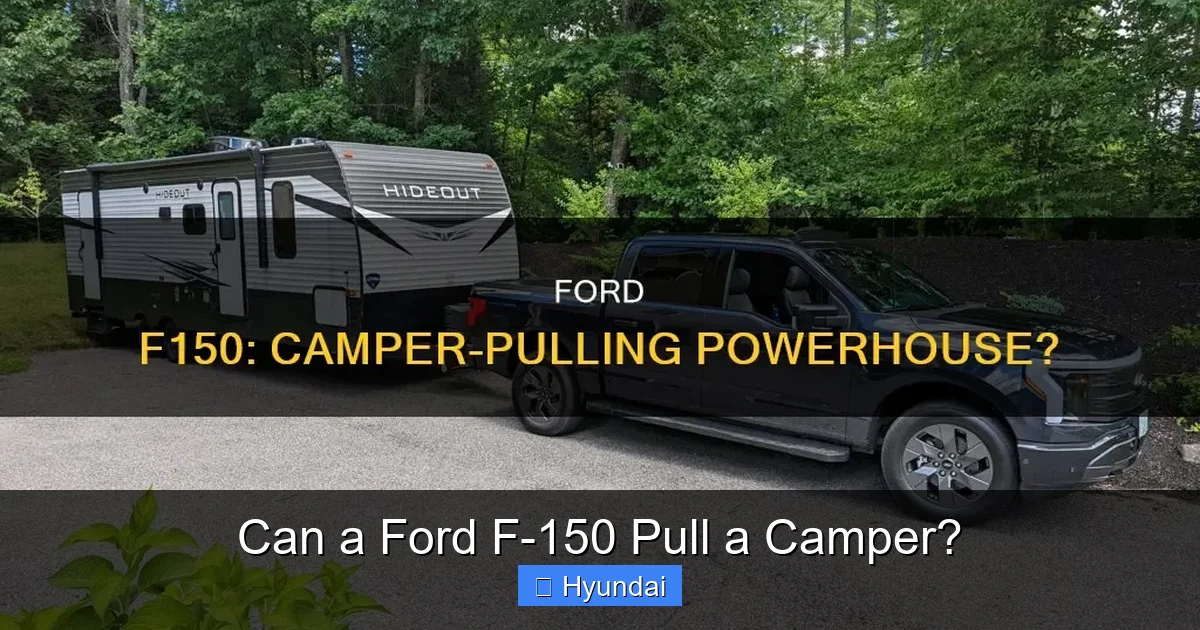
Visual guide about Can a Ford F-150 Pull a Camper?
Image source: shunauto.com
The Powerplant: V8, EcoBoost, or Base V6?
The standard 3.3L V6 is adequate for very light campers (4,000-5,000 lbs). The popular 5.0L V8 and 3.5L EcoBoost V6 are the workhorses for most campers, offering 11,000-14,000 lbs of potential towing when properly configured. The key is the EcoBoost’s immense torque at low RPMs, which is fantastic for getting a heavy load moving. However, for maximum, consistent towing, the 5.0L V8 with the 10-speed transmission is often praised for its smooth, linear power delivery.
The Magic Numbers: Axle Ratio and Tow Package
Your axle ratio (e.g., 3.15, 3.31, 3.55, 3.73) is like the gears on a bicycle. A numerically higher ratio (3.73) gives you more pulling power (torque) but lower top-end fuel economy. A lower ratio (3.15) is for fuel economy but lacks grunt. For serious towing, you want the higher ratios, often bundled in the Max Trailer Tow Package. This package isn’t just a sticker; it includes a heavy-duty radiator, upgraded transmission cooler, integrated trailer brake controller wiring, and sometimes a higher-capacity alternator. If you don’t have the tow package, your truck’s cooling system may overheat on a long grade with a heavy camper.
Cab, Bed, and Drivetrain: The Domino Effect
Choosing a SuperCrew (4-door) cab and a 5.5′ or 6.5′ bed adds hundreds of pounds to the truck’s curb weight compared to a Regular Cab with an 8′ bed. That weight eats into your payload and effective towing capacity. Similarly, 4×4 models are heavier than 4×2. A long bed provides more stability and space for weight distribution but makes the truck harder to maneuver. You must balance your needs for passenger space, cargo bed length, and towing capability. A family of five needing a camper will likely need a SuperCrew, which means they must accept a lower max towing capacity than a single person with a Regular Cab.
Matching Your F-150 to the Perfect Camper
Now that you know your truck’s real-world numbers, you can shop for a camper with confidence. The key is the camper’s Gross Vehicle Weight Rating (GVWR) or its actual wet weight (loaded with water, propane, and your gear). Never use the “dry weight” from a brochure; your camper will be heavier.
Visual guide about Can a Ford F-150 Pull a Camper?
Image source: highlandford.com
Types of Campers and Their Weight Ranges
- Popup Truck Campers: These slide into the bed of your F-150. They are lightweight (1,500-4,000 lbs GVWR) and don’t require a traditional hitch, but they use your truck’s payload entirely. They’re great for off-grid adventures but limit bed access. Some owners pair these with a camper shell for additional weather-protected storage when the camper is off.
- Travel Trailers (Bumper Pull): The most common type, hitched to the rear bumper. They range from tiny teardrops (1,000 lbs) to massive “park models” (over 10,000 lbs). For an F-150, you’ll typically be looking at models between 4,000 and 8,000 lbs GVWR. They require a sturdy hitch and a brake controller.
- Fifth-Wheel Trailers: These connect to a special hitch mounted in the truck bed. They are more stable (no sway) and can be heavier for their size, often allowing a larger camper for the same truck. However, they require a bed-mounted hitch and reduce your bed length significantly.
The 80% Rule: A Smart Safety Margin
While you should never exceed your GCWR, a widely accepted best practice is to keep your actual loaded camper weight at or below 80% of your truck’s maximum rated towing capacity. This buffer accounts for wind, hills, and the unpredictable. If your F-150 is rated for 9,000 lbs, aim for a camper with a GVWR of 7,200 lbs or less. This makes towing easier on your truck, improves fuel economy, and dramatically increases safety margins.
Essential Towing Equipment: You Can’t Skip This
Having the right truck is only half the battle. The gear you connect between the truck and camper is what makes the combination safe and legal.
The Hitch: Class, Capacity, and Type
You need a hitch rated for your camper’s GVWR. For most F-150s towing campers over 3,500 lbs, you’ll need a Class IV or Class V receiver hitch. But more important than the class is the weight-distributing hitch (WDH). A standard “ball mount” simply hangs the trailer’s weight on the rear axle, lightening the front axle and causing trailer sway. A WDH uses spring bars to distribute that tongue weight across all axles of the truck and trailer, leveling the truck and dramatically improving stability. For any camper over 4,000-5,000 lbs, a WDH is not optional—it’s essential. Many WDH systems now have integrated sway control, which is another critical safety feature that damps any side-to-side motion before it becomes a dangerous feedback loop.
Brake Controller and Wiring
If your camper has electric brakes (most over 1,500 lbs do), you must have a brake controller. This device, mounted within easy reach in your cab, sends a signal to the trailer’s brakes when you press your truck’s brake pedal. It allows the trailer to help stop the combined weight. Factory tow packages often have the wiring pre-installed. If not, you’ll need an aftermarket controller and a 7-pin wiring harness. This is a legal requirement in all 50 states.
Tires: Your Connection to the Road
Your F-150’s tires are the only point of contact with the road. Towing places enormous demands on them—extra heat, sidewall stress, and increased stopping distances. You must have tires in excellent condition, properly inflated to the maximum PSI listed on the door jamb (not the tire sidewall) when towing. Under-inflated tires overheat and fail. Worn tires lose traction. Consider upgrading to a premium all-season or all-terrain tire with a higher load range (e.g., LT Load Range E) for maximum safety and durability. Researching the best tires for your specific Ford F-150 model is a wise investment for any towing application.
Safe Towing Practices: From the Driveway to the Highway
With your truck properly equipped and matched to a suitable camper, the final piece is your driving technique and pre-trip routine.
The Pre-Trip Checklist
Before every trip, perform this ritual: Check tire pressures on both truck and camper. Inspect all lug nuts. Verify the hitch is locked and the safety chains are crossed and tight. Connect the electrical plug and test the trailer lights (brake lights, turn signals, running lights). Install the brake controller and set its gain according to the manufacturer’s instructions (usually 6-8 for a loaded camper). Load your camper so weight is balanced side-to-side and front-to-back, ensuring proper tongue weight. Finally, weigh the entire setup at a truck stop scale. This is the only way to know your actual GCWR and payload numbers.
Driving Techniques for the Road
Towing changes everything. Accelerate slowly and brake early. Allow double the normal stopping distance. Take corners wider to avoid the camper’s “off-tracking” where the trailer’s wheels cut inside the truck’s path. Use your side mirrors constantly—your blind spots are now massive. When going downhill, use a lower gear (like “T” or “L” on your transmission) to avoid riding your brakes and causing them to overheat. Be prepared for wind gusts from passing trucks; grip the wheel firmly and make minor corrections. Never make sudden steering inputs.
Weather, Hills, and Altitude
Towing in mountains requires planning. Your engine will lose power at high altitude. Know your truck’s torque curve and plan your passes accordingly. Use lower gears to maintain RPMs on long climbs. On descents, use the same lower gear to control speed. In rain or strong crosswinds, reduce speed significantly. A fully loaded camper acts like a sail. If you feel sway, do not hit the brakes. Gently apply the brake controller to activate the trailer brakes, ease off the accelerator, and steer straight. If equipped, a sway control device will automatically apply the trailer’s brakes on one side to correct it.
Real-World Scenarios: What Can Different F-150s Tow?
Let’s make this concrete with three common F-150 configurations and the camper types that suit them.
Scenario 1: The Lightweight Workhorse
Truck: 2020 F-150 XLT, SuperCrew (5.5′ bed), 4×4, 5.0L V8, 3.55 axle, Max Trailer Tow Package.
Real-World Max Towing: ~9,000 lbs (after accounting for truck weight, 4 passengers, and a full tank).
Payload: ~1,800 lbs.
Camper Match: A mid-size travel trailer with a GVWR of 6,500-7,500 lbs. This leaves a safe 80% margin and ample payload for tongue weight, family, and gear. A pop-up truck camper with a 3,000 lb GVWR would also be a perfect, lightweight match, leaving plenty of payload for bed cargo. Owners often use a tonneau cover to secure and protect gear in the bed while the camper is hitched up.
Scenario 2: The Max-Tow Machine
Truck: 2022 F-150 Limited, SuperCrew (5.5′ bed), 4×2, 3.5L EcoBoost V6, 3.73 axle, Max Trailer Tow Package.
Real-World Max Towing: ~12,500 lbs.
Payload: ~1,700 lbs.
Camper Match: A large travel trailer or a smaller fifth-wheel with a GVWR up to 10,000 lbs. The high torque of the EcoBoost and the 3.73 gears make pulling this weight manageable. However, payload becomes the limiting factor. A 10,000 lb fifth-wheel with a 1,500 lb tongue weight leaves only 200 lbs for people and cargo in the truck—so this setup is best for a couple with minimal gear. The long bed provides space for the fifth-wheel hitch and some storage.
Scenario 3: The Compact, Efficient Towing Rig
Truck: 2018 F-150 XL, Regular Cab (8′ bed), 4×2, 2.7L EcoBoost V6, 3.31 axle.
Real-World Max Towing: ~7,000 lbs.
Payload: ~1,900 lbs.
Camper Match: A small to mid-size travel trailer (4,500-6,000 lbs GVWR) or a lightweight truck camper. The long 8′ bed offers excellent stability and storage. This is a great setup for a solo adventurer or a couple wanting a simple, fuel-efficient towing rig without the bulk of a crew cab.
Conclusion: Knowledge is Your Best Tow Vehicle
So, can a Ford F-150 pull a camper? The definitive answer is yes, the vast majority of them can, provided you do your homework. The F-150’s breadth of configurations means there is almost certainly a model that fits your camping dreams. The process is simple but non-negotiable: 1) Find your truck’s actual GCWR and payload. 2) Find a camper’s actual loaded weight (GVWR). 3) Ensure the camper’s weight is at least 20% below your truck’s max towing capacity and that the tongue weight fits within your payload. 4) Install the correct hitch, sway control, and brake controller. 5) Weigh your complete setup.
Ignorance is the biggest danger on the road. A properly matched F-150 and camper is a fantastic, freedom-inducing combination. But an overloaded or improperly equipped rig is a hazard to everyone. Take the time to understand your truck, respect its limits, and invest in the right equipment. The open road and your favorite campground will be waiting, safely and confidently.
Frequently Asked Questions
What is the maximum camper weight my specific Ford F-150 can tow?
There is no single number. You must look at your truck’s door jamb sticker or owner’s manual for its Gross Combined Weight Rating (GCWR) and payload capacity. Then, subtract your truck’s actual curb weight (with fuel) and the weight of all passengers and cargo. The remainder is your available towing capacity. A dealer can also pull your truck’s exact build sheet to show its ratings.
Do I need a special driver’s license to tow a camper with my F-150?
For most standard F-150/camper combinations (under 10,000 lbs GVWR), a regular driver’s license is sufficient. Requirements vary by state, but generally, if your combined GCWR exceeds 26,000 lbs or the trailer is over 10,000 lbs, you may need a non-commercial Class A or B license. Always check your specific state’s DMV regulations.
How do I calculate the correct tongue weight for my camper?
Tongue weight should be 10-15% of the camper’s total loaded weight. For a 6,000 lb loaded camper, you need 600-900 lbs of downward force on the hitch. You can measure this with a bathroom scale and a tongue weight scale (available at RV stores or online). The goal is to have the truck’s front axle carry at least 45-50% of its total weight when hitched to ensure proper steering and braking.
My F-150 has a tow package, but do I still need a weight-distributing hitch?
Almost certainly, yes. The factory tow package typically includes the wiring and a standard receiver hitch, but not a weight-distributing system. For any camper over about 4,000-5,000 lbs, a weight-distributing hitch with sway control is mandatory to safely transfer weight to all axles and prevent dangerous trailer sway. Your hitch’s rating should exceed your camper’s GVWR.
Can I use my F-150’s factory trailer brake controller for any camper?
Yes, if your F-150 is equipped with the factory-installed brake controller (a common part of the Max Trailer Tow Package), it will work with any standard electric trailer brake system. You simply need to connect the 7-pin wiring harness to the camper’s plug. If your truck does not have the factory controller, you must purchase and install an aftermarket unit.
What is the single most important thing to check before a long trip?
Beyond the pre-trip checklist, the single most important thing is to know your actual, real-world weights. The only way to do this is to drive your fully loaded truck and camper onto a public scale (at a truck stop or recycling center). Get the “combined” weight, then weigh the truck alone. The difference is your camper’s actual weight. Then weigh the truck alone to see your actual payload. This eliminates all guesswork and ensures you are within all safe limits.