
Why Is My Key Fob Not Working After Battery Change on Toyota

Replacing the battery in your Toyota key fob should be a simple fix, but it can leave you stranded if the fob still doesn’t work. This is a surprisingly common issue with several straightforward causes, from an incorrectly installed battery to a need for reprogramming. The good news is that you can often diagnose and solve the problem yourself with some basic checks before needing a dealer.
Key Takeaways
- Incorrect battery installation is the #1 culprit: Using the wrong battery type (like a CR2025 instead of a CR2032) or installing it backwards/upside down will prevent the fob from powering on.
- A defective new battery is possible: Even brand-new batteries can be dead or faulty. Always test the battery with a multimeter or try a known-good spare.
- Reprogramming may be necessary: Some Toyota models, especially those with Smart Key systems, require a simple reset procedure or dealer reprogramming after battery replacement to re-sync with the car.
- Physical damage during the change: Prying open the fob carelessly can damage the internal circuit board, buttons, or the rubber membrane underneath, causing a total failure.
- Signal interference is rare but real: Strong electromagnetic fields or other key fobs nearby can temporarily block the signal, making it seem like the fob is broken.
- Consult your owner’s manual first: It contains the exact battery type, installation diagram, and any required reset procedures specific to your Toyota model and year.
- Systematic troubleshooting saves time and money: Rule out the simple fixes (battery type, orientation) before assuming a more complex electronic or programming issue.
📑 Table of Contents
- Introduction: The “Fix” That Left You Locked Out
- 1. The Most Common Culprit: Incorrect Battery Installation
- 2. The Battery Itself Could Be Defective
- 3. Your Key Fob May Need Reprogramming
- 4. Signal Interference and Other Environmental Factors
- 5. Physical Damage During the Battery Change
- Conclusion: A Systematic Approach to the Solution
Introduction: The “Fix” That Left You Locked Out
You did the responsible thing. You noticed your Toyota key fob’s range shrinking or the buttons feeling unresponsive, so you followed a guide, opened it up, and replaced the little coin cell battery. You snapped it back together, pressed the lock button, and… nothing. The little LED light doesn’t even blink. That familiar wave of frustration and confusion hits. Why would a simple battery change break a perfectly good key fob? It feels like a cruel joke.
First, take a breath. This is an extremely common problem across all car brands, Toyotas included. The act of replacing the battery is just one step in a small chain of events, and if any link in that chain is weak—the wrong battery, a poor connection, a missed reset—the whole system fails. Your key fob is a sophisticated little radio transmitter, and its relationship with your car’s immobilizer system is delicate. This guide will walk you through every possible reason your Toyota key fob isn’t working after a battery change, from the embarrassingly simple to the more complex, and give you the tools to fix it yourself.
1. The Most Common Culprit: Incorrect Battery Installation
Let’s start with the low-hanging fruit, the mistake that accounts for the vast majority of post-battery-change failures. It’s almost always something basic.
Visual guide about Why Is My Key Fob Not Working After Battery Change on Toyota
Image source: hondatheotherside.com
Using the Wrong Battery Type
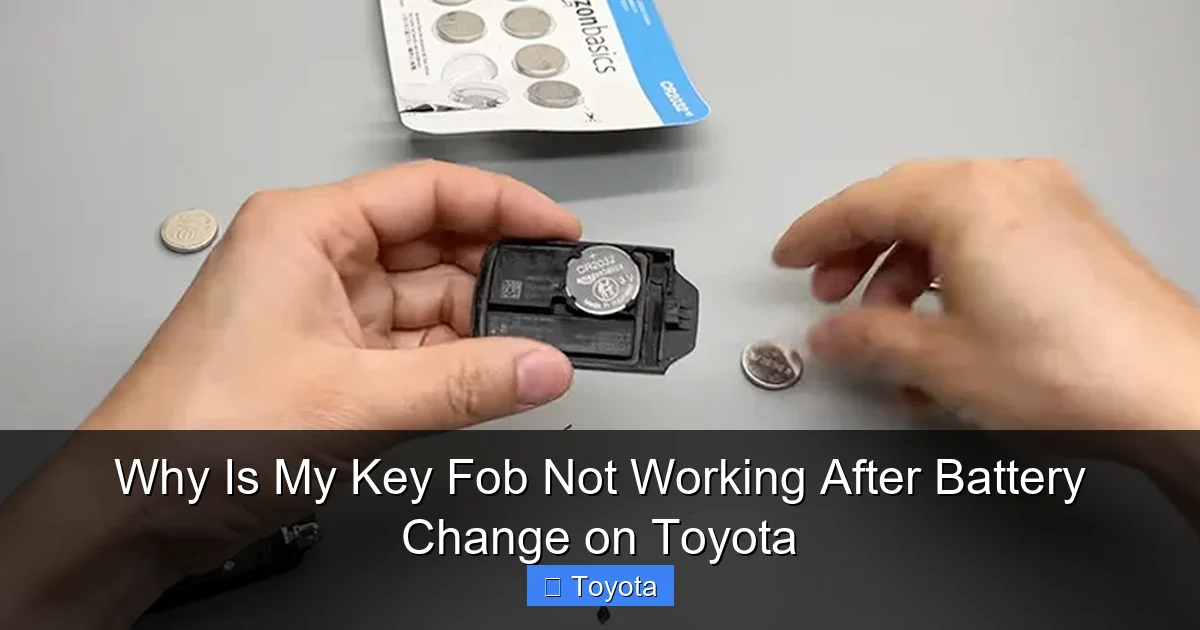
Not all coin cell batteries are created equal. Toyota key fobs most commonly use a CR2032 battery (20mm diameter, 3.2mm thickness). However, a very similar and more common CR2025 (20mm diameter, 2.5mm thickness) is often mistakenly used because it’s easier to find. The CR2025 is thinner and has a lower capacity. While it might *fit* in the slot, it often doesn’t make proper contact with both the positive and negative terminals in the fob’s holder. The result? No power. Always double-check your owner’s manual or the old battery itself for the exact model number. A quick visual check: if the new battery seems noticeably thinner or feels loose in the holder, you have the wrong one.
Pro Tip: Keep the old battery until you confirm the new one works. It’s your perfect reference for size and model.
Installing the Battery Backwards
This seems too obvious to mention, but it happens to the best of us. The positive side of the battery (usually marked with a + plus sign and sometimes a raised nub) must face up or in the direction indicated by the diagram inside the battery compartment. If you install it backwards, the circuit is reversed, and the fob will not power on. The good news? This won’t damage the fob; just pop it out and flip it over.
Poor Contact Due to Dirty or Bent Terminals
When you remove the old battery, take a moment to look at the tiny metal clips (terminals) that hold it in place. Are they bent outward so they don’t grip the battery tightly? Are they corroded or dirty? A poor physical connection means no electrical flow. Gently bend the clips inward with a plastic tool (like a spudger) to ensure they make firm contact with the battery’s sides. Clean any white/green corrosion with a cotton swab dipped in a tiny amount of isopropyl alcohol.
2. The Battery Itself Could Be Defective
We assume new batteries work, but sometimes they’re duds. They could be old stock that has slowly discharged on the shelf, or they were simply manufactured defective.
How to Test a “New” Key Fob Battery
Don’t just assume a fresh-from-the-package battery is good. You have two quick options:
- Use a Multimeter: Set it to DC volts (the V with a solid line and dashed line). Touch the red probe to the battery’s + (positive) side and the black probe to the – (negative) side. A good CR2032 should read very close to 3.0 volts. Anything below 2.8V is suspect.
- The “Known Good” Swap: The easiest test. If you have another Toyota key fob that’s working, carefully swap its battery into the non-working fob. If the previously dead fob now works, your new battery was bad. Conversely, if you put the new battery into the working fob and it dies, the battery is definitely faulty.
This is a critical first step before tearing into more complex diagnostics. A simple battery swap can save you hours of headache.
3. Your Key Fob May Need Reprogramming
This is the big one that confuses people. For many modern Toyotas, especially those with Smart Key Systems (push-button start, keyless entry), the key fob’s internal chip communicates with the car’s immobilizer system. That communication link can sometimes be broken or needs to be refreshed after a total power loss, like when the battery is removed for a period of time.
Visual guide about Why Is My Key Fob Not Working After Battery Change on Toyota
Image source: motorcarnutglass.com
The “Resynchronization” or “Reset” Procedure
Before you panic and call the dealer, try the standard reset procedure. It’s often a simple sequence of button presses with the key in the ignition or near the start button. The exact steps vary by model year and system, but a common one for many Toyotas is:
- Insert the key into the ignition and turn it to the “ON” or “ACC” position (do not start the engine).
- Press and hold the LOCK button on the fob for about 2-5 seconds.
- While still holding the LOCK button, turn the key back to the “OFF” position and remove it.
- Release the LOCK button.
- Press any button on the fob. The doors should lock/unlock, confirming the reset.
Important: Your owner’s manual is the ultimate source for the correct procedure. Search for “key fob reprogramming” or “remote control reset.” If the manual is missing, a quick web search for “[Your Toyota Model & Year] key fob reset after battery change” will usually yield the correct sequence from forums or official guides.
When a Dealer or Locksmith is Required
If the reset procedure doesn’t work, the key’s transponder chip may have lost its unique coding with the car’s immobilizer system. This is more common on later models. Resolving this requires specialized diagnostic software that only Toyota dealerships or certified automotive locksmiths possess. They will connect a computer to your car’s OBD-II port and “relearn” the key fob. This service typically costs between $50 and $150, depending on the shop. It’s not a DIY fix, but it’s important to know this possibility exists so you’re not endlessly troubleshooting a problem that needs professional equipment.
4. Signal Interference and Other Environmental Factors
While less likely than the issues above, external factors can block or disrupt the radio signal between your fob and the car.
Visual guide about Why Is My Key Fob Not Working After Battery Change on Toyota
Image source: i.ytimg.com
Physical Obstructions and Distance
Test the fob right next to the car, preferably with your hand cupped around the fob and the car’s door handle to create a makeshift “waveguide.” If it works from an inch away but not from 10 feet, you might have a weak signal due to a weak battery (we already covered testing that) or a failing internal antenna in the fob. Also, are you testing it in a location with lots of metal (like a parking garage) or near large appliances? These can interfere.
Other Key Fobs and Electronics
If you have multiple key fobs for the same car, try isolating one. A malfunctioning fob can sometimes “jam” the frequency. Also, having two fobs in your pocket at the same time can cause the car’s receiver to get confused. Remove all other keys and fobs from your pocket and try again. Strong electromagnetic fields from things like large speakers, induction cooktops, or even a cell phone charger in the car can cause temporary interference.
5. Physical Damage During the Battery Change
Opening a key fob requires prying. This is the moment where a seemingly perfect fob can be permanently broken.
Cracked Circuit Board or Damaged Buttons
The plastic shell of the fob is held together by small plastic clips. Using a metal tool like a flathead screwdriver can easily crack the internal circuit board or shear off a tiny surface-mount component. It can also damage the delicate rubber membrane that sits under the buttons. If the membrane is torn or a button post is broken, pressing the button won’t complete the circuit. Inspect the fob’s interior carefully after opening it. Look for any cracks, especially around the battery housing area and the button contact pads on the circuit board.
Water or Moisture Ingress
Did you change the battery in a humid bathroom or with a damp cloth? A single drop of moisture inside the fob can short out the sensitive electronics. If you suspect moisture, open the fob and let it air dry completely in a warm, dry place for 24-48 hours. Do NOT use a hair dryer on high heat, as that can melt components.
Conclusion: A Systematic Approach to the Solution
Your Toyota key fob not working after a battery change is almost always a fixable problem. The key is to work through the possibilities logically, starting with the simplest and most common. First, verify you have the correct CR2032 battery and that it’s installed with the positive side facing up. Second, test that battery or swap in a known-good one. Third, perform the manual reset procedure for your specific model year. If those three steps fail, consider the possibility of physical damage from the opening process or the need for professional reprogramming.
Remember, your key fob is a radio device, not just a simple switch. Its health depends on clean power, proper physical connections, and a synchronized handshake with your car. By understanding these basic principles, you empower yourself to solve this frustrating but common issue and get back on the road with confidence. For model-specific guides, your Toyota owner’s manual is an invaluable resource, and online communities for your specific model (like a Toyota RAV4 forum) are full of real-world experiences and solutions.
Frequently Asked Questions
Why is my Toyota key fob not working after I changed the battery and I can’t even unlock the doors manually with the physical key?
This usually points to an issue with the physical key blade itself or the lock cylinder. If the mechanical key is worn or damaged, it won’t turn. Alternatively, if you have a smart key fob with a hidden key, ensure you’re pulling it out correctly and inserting it fully. The problem is likely separate from the fob’s electronics and may require a locksmith.
How do I know if my Toyota needs the key fob reprogrammed after a battery change?
The primary sign is that the fob’s LED light does not illuminate at all when you press any button, even with a confirmed good battery. Additionally, if the car’s dashboard displays a warning like “Key Not Detected” or the push-button start does nothing, reprogramming is often needed. Try the manual reset procedure from your owner’s manual first; if that fails, professional reprogramming is the next step.
Can I use a cheaper, generic CR2032 battery for my Toyota key fob?
Yes, a standard CR2032 from a reputable brand (like Panasonic, Energizer, Duracell) will work perfectly. Avoid very obscure, no-name brands from discount bins, as their quality control can be poor and they may have a shorter shelf life or inconsistent voltage. The important thing is the battery is a genuine CR2032, not a thinner CR2025.
My key fob works intermittently after the battery change. What could cause this?
Intermittent working is a classic sign of a poor connection. The battery may not be seated properly, the contacts could be dirty or slightly bent, or you might have a slightly defective battery that only works under optimal conditions. Re-seat the battery firmly, clean the contacts, and try a different new battery. It could also indicate a failing circuit board that’s sensitive to movement.
Is it expensive to have a Toyota key fob reprogrammed at a dealer?
The cost varies by region and dealership but typically ranges from $50 to $150 for the reprogramming service alone. This is often cheaper than a full key replacement. Some dealers may offer it as part of a larger “key service” package. Always call for a quote first. Independent locksmiths specializing in automotive keys are often a more affordable alternative.
My Toyota’s key fob battery change worked, but now the car won’t start. Is this related?
Yes, it can be directly related. If the key fob wasn’t properly reprogrammed after the battery change, the car’s immobilizer system doesn’t recognize the key’s transponder chip. The car will crank normally but fail to start, often displaying a security indicator light (like a flashing key symbol) on the dashboard. This is a clear sign the key needs to be synced with the car’s computer. You can find more detailed information on this specific issue in our article about why a Toyota might not start.