Do Tesla Chargers Need Gfci Protection

Contents
- 1 Key Takeaways
- 2 📑 Table of Contents
- 3 What Exactly is GFCI Protection? (And Why Should You Care?)
- 4 The Tesla Charger Family: Which One Are We Talking About?
- 5 What Does the Law Say? Decoding the NEC and Local Codes
- 6 Installation Scenarios: GFCI Requirements in Practice
- 7 Beyond the Code: The Real-World Benefits of GFCI
- 8 Addressing Common Myths and Concerns
- 9 The Bottom Line: Your Action Plan
- 10 Conclusion
- 11 Frequently Asked Questions

Liquid Car Polish

Car Trash Can

Magnetic Car Phone Mount

Diesel Fuel Additive
Yes, in most cases, GFCI protection is required for Tesla home chargers by modern electrical codes, especially for outdoor or garage installations. This safety device prevents electric shock by instantly cutting power during a ground fault. While the specific requirement depends on your local jurisdiction and charger type, installing a GFCI-protected circuit is a non-negotiable best practice for safety and code compliance. Always consult a licensed electrician for your specific installation to ensure it meets all NEC and local requirements.
So, you’ve joined the Tesla family. Welcome to the future of driving! You’re loving the instant torque, the tech, and the fact you’ll never visit a gas station again. But then comes the practical question: setting up your home charger. You plug in your Mobile Connector or have your Wall Connector installed, and a friend or an online forum mentions something that makes your heart skip a beat: “You need GFCI protection for that.” What? Why? Is it really necessary? Don’t panic. This is a common point of confusion for new EV owners, and it’s rooted in very important electrical safety science and building codes. Let’s break it down, plain and simple.
Think of GFCI protection as a hyper-aware, super-fast guardian for your electrical circuit. Its job is to protect you from a very specific and dangerous type of electrical shock. When you’re dealing with a high-power device like a Tesla charger that pulls 40, 50, or even 80 amps of electricity, that guardian isn’t just a nice-to-have—it’s often a legal requirement written into the book of rules that governs all electrical work in the United States. The short answer is: Yes, your Tesla home charger almost certainly needs GFCI protection. But the “why” and the “exactly how” are what really matter for your safety, your wallet, and your peace of mind. Let’s dive in.
Key Takeaways
- GFCI is Often Legally Required: The National Electrical Code (NEC) mandates GFCI protection for EV charger circuits in garages, outdoors, and in other specified locations. Most local codes adopt these standards.
- It’s a Critical Safety Device: A GFCI (Ground Fault Circuit Interrupter) protects you from electric shock by detecting tiny imbalances in current and cutting power in milliseconds, potentially saving a life.
- Applies to Both Connector Types: The requirement typically applies to the dedicated circuit feeding your Tesla Wall Connector or the 240V outlet used with the Mobile Connector, not the charger itself.
- Location Matters Most: Indoor, dedicated utility room installations *may* have different rules, but GFCI is still highly recommended. Outdoor, garage, and basement installations almost always require it.
- Professional Installation is Key: A licensed electrician will know your local code, properly size the circuit, and install the correct GFCI breaker or receptacle to ensure safety and compliance.
- It Protects Your Investment: Beyond personal safety, GFCI protection helps prevent damage to your Tesla’s charging system from ground faults, which can be costly to repair.
- Older Homes Often Need Upgrades: If your home has an older electrical panel or non-GFCI circuits, adding a Tesla charger will almost certainly require an upgrade to a GFCI-protected circuit.
📑 Table of Contents
- What Exactly is GFCI Protection? (And Why Should You Care?)
- The Tesla Charger Family: Which One Are We Talking About?
- What Does the Law Say? Decoding the NEC and Local Codes
- Installation Scenarios: GFCI Requirements in Practice
- Beyond the Code: The Real-World Benefits of GFCI
- Addressing Common Myths and Concerns
- The Bottom Line: Your Action Plan
- Conclusion
What Exactly is GFCI Protection? (And Why Should You Care?)
Before we talk about Tesla, let’s talk about the hero of our story: the GFCI. GFCI stands for Ground Fault Circuit Interrupter. Let’s translate that from electrician-speak to human-speak.
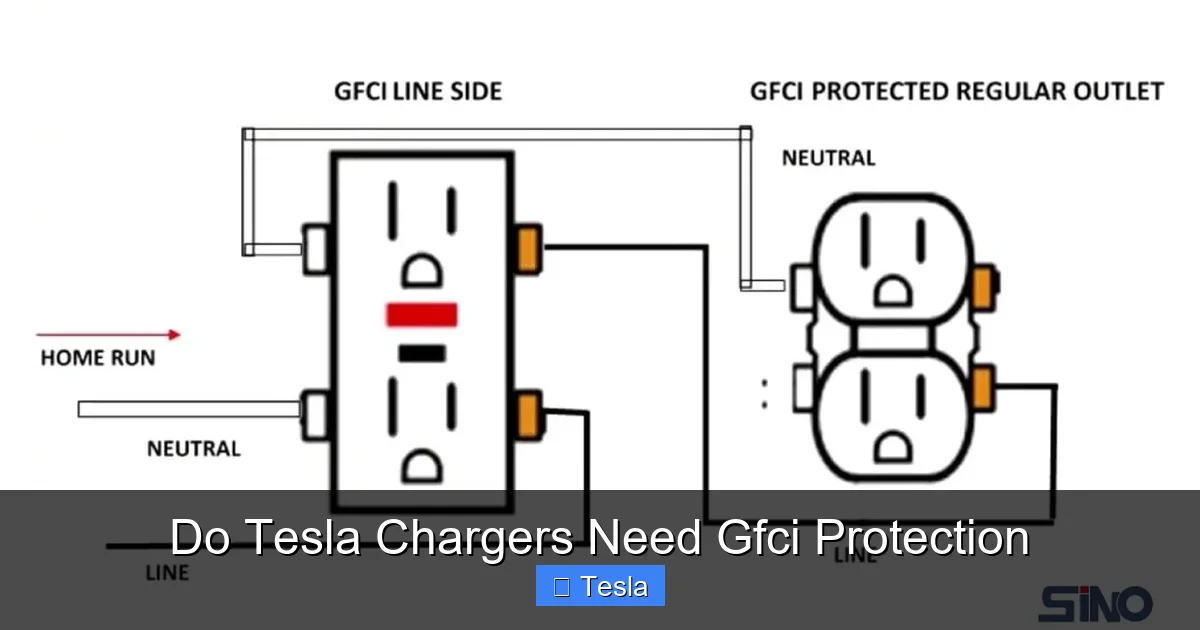
In a normal circuit, electricity flows from the hot wire, through your device (like a charger), and back on the neutral wire. A “ground fault” happens when some of that electricity “leaks” out of the intended path. This can happen if a wire inside your charger is damaged, if moisture gets into a connection, or if you accidentally drop the charger plug into a puddle. That leaked electricity has to go somewhere—often, it finds its way through you, if you happen to be touching a conductive part. That’s electric shock, and it can be fatal, even at the voltages used for EV charging.
How Does a GFCI Actually Work?
A GFCI is brilliantly simple. It constantly monitors the current flowing on the hot and neutral wires. In a healthy circuit, the amount of current going out on the hot wire should be exactly equal to the amount coming back on the neutral wire. They balance perfectly. A GFCI detects an imbalance as tiny as 4-5 milliamps (that’s 0.004 amps!). If it senses even this minute difference—meaning some current is escaping, likely through a person or water—it trips the circuit in as little as 1/40th of a second. That’s faster than a blink. It doesn’t wait for a breaker to blow from an overload; it acts on the *imminent danger* of shock. This is the device that has likely saved countless lives in your bathroom and kitchen outlets.
For your Tesla charger, which is a high-current, often-outdoor-or-in-garage appliance, this protection is paramount. A fault could occur in the charger unit, in the charging cable, or at the plug connection. Without a GFCI, that fault could energize metal parts of the charger or the car’s port, creating a serious electrocution hazard. With a GFCI, the power is cut instantly, making the situation safe.
The Tesla Charger Family: Which One Are We Talking About?
This is a crucial distinction. “Tesla charger” can mean two main things for home use, and the GFCI rules apply slightly differently to each, but the core principle is the same: the circuit needs protection.
Visual guide about Do Tesla Chargers Need Gfci Protection
Image source: sinoevse.com
The Tesla Mobile Connector (The “Portable” Charger)
This is the charger that comes with your Tesla. It’s a flexible cord with a plug on one end (for a 120V or 240V outlet) and the Tesla connector on the other. When you use it on a 240V outlet (like a 14-50 or 10-30), you’re plugging it into an outlet that’s on a dedicated circuit in your electrical panel. The GFCI requirement applies to that dedicated circuit. The code doesn’t care what’s “downstream” of the outlet; it cares that the outlet itself, if it’s in a location requiring GFCI (like a garage), is a GFCI-type receptacle OR that the circuit is protected by a GFCI breaker in the panel. So, if you have a 240V outlet in your garage for your Mobile Connector, that outlet must be GFCI-protected under current NEC rules.
The Tesla Wall Connector (The “Hardwired” Charger)
This is the permanent, mount-on-the-wall charger. It’s typically hardwired directly to a dedicated circuit in your electrical panel (no plug). In this case, the GFCI protection is provided by a GFCI circuit breaker installed in your electrical panel for that specific circuit. The Wall Connector itself does not have a built-in GFCI; it relies on the upstream protection from the breaker. This is the most common and recommended installation method for daily home charging, and it absolutely requires a GFCI breaker for installations in garages, outdoors, or basements per code.
It’s vital to understand this difference because the advice you get from an electrician will be about the circuit breaker or receptacle type, not about modifying the Tesla charger itself. The charger is designed to work on a GFCI-protected circuit.
What Does the Law Say? Decoding the NEC and Local Codes
Here’s where we get to the heart of the “need.” The authority is the National Electrical Code (NEC), published by the National Fire Protection Association (NFPA). It’s a model code that all 50 states and local jurisdictions adopt, often with amendments. The specific rule for EV chargers is found in NEC Article 625, which covers Electric Vehicle Charging Systems.
Visual guide about Do Tesla Chargers Need Gfci Protection
Image source: carcharging.us
The big change came with the NEC 2020 edition. Prior to 2020, the rules were murkier. The 2020 code, which has been adopted by most states and municipalities (though adoption timelines vary), is much clearer. It states that all 125-volt, single-phase, 15- and 20-amp receptacles in garages and accessory buildings require GFCI protection. For higher-amperage EV charging circuits (like the 40A, 50A, or 80A circuits for Teslas), the requirement is broader.
The “Garage, Outdoors, and Basement” Rule
The NEC essentially says: any 250-volt (which covers all 240V Tesla circuits) receptacle installed in the following locations must have GFCI protection:
- Garages and accessory buildings (this is the big one for most home Tesla owners).
- Outdoors (if your outlet or hardwired connection is on an exterior wall).
- Basements (if not considered a finished, dedicated utility space with specific exceptions).
- Crawl spaces and unfinished basements.
For hardwired installations (like the Wall Connector), the GFCI protection must be at the origin of the circuit—meaning a GFCI breaker in the panel.
There is an exception for dedicated, hardwired EV supply equipment installed in a dedicated, enclosed, and readily accessible space like a utility room that is not considered a garage. But this is a narrow exception, and most homeowners will be installing in a garage or on an exterior wall, where the rule is unequivocal: GFCI is required.
Why Your Local Authority Having Jurisdiction (AHJ) Has the Final Say
Here’s the critical part: the NEC is a model. Your local building department or electrical inspector (the AHJ) interprets and enforces it. Some jurisdictions may have adopted NEC 2020, some are still on 2017, and some have their own stricter amendments. This is why the single most important step is to call your local building department or a licensed electrician in your area and ask: “What is the current GFCI requirement for a 240V EV charger circuit in an attached garage?” They will give you the definitive answer for your street. Never rely solely on internet advice for code compliance; the inspector’s word is law on your property.
Installation Scenarios: GFCI Requirements in Practice
Let’s make this concrete with the three most common home installation scenarios for a Tesla.

Visual guide about Do Tesla Chargers Need Gfci Protection
Image source: electricaleducator.com
Scenario 1: Mobile Connector on a 240V Outlet in the Garage
This is the simplest plug-and-play setup. You have a 14-50, 10-30, or 6-50 outlet installed on a dedicated circuit in your garage. That outlet must be a GFCI receptacle if your local code follows NEC 2020 (which most do). The electrician will install a GFCI breaker in the panel or use a GFCI outlet at the end of the circuit. The GFCI breaker is generally preferred for high-amperage circuits as it’s more reliable and protects the entire circuit wiring. If you use a GFCI outlet, it must be the first outlet on the circuit, with any other outlets (unlikely for an EV circuit) being standard receptacles.
Scenario 2: Wall Connector Hardwired in the Garage
This is the clean, permanent solution. The Wall Connector is mounted on the wall and its wires are connected directly to a dedicated circuit breaker in your panel. That circuit breaker must be a GFCI breaker. There is no receptacle, so the protection must be at the panel. Your electrician will install a 50A or 60A GFCI breaker (depending on the Wall Connector amperage setting) to feed the charger. This is the gold standard for safety and code compliance.
Scenario 3: Outdoor Installation (Wall Connector or Mobile Connector Outlet)
Whether it’s on the side of your house or in a carport, GFCI is absolutely mandatory. The code is even stricter for outdoor outlets. For a hardwired Wall Connector outdoors, you need a GFCI breaker. For a Mobile Connector outlet outdoors, you need a GFCI receptacle in a weatherproof box with an in-use cover. The entire assembly must be rated for outdoor use (NEMA 3R or better). The combination of moisture and high current makes GFCI protection non-negotiable.
Practical Tip: When planning your install, discuss GFCI with your electrician upfront. A standard 50A breaker costs about $10-15. A 50A GFCI breaker costs $50-100. The labor is the same. It’s a small price to pay for life-saving safety and passing inspection. If an electrician suggests skipping GFCI for a garage installation, that is a major red flag. You should seek a second opinion.
Beyond the Code: The Real-World Benefits of GFCI
Okay, the code says “do it.” But what’s actually in it for you, besides avoiding a fine from the inspector? A lot, as it turns out.
1. It’s Your Primary Defense Against a Silent Killer
Electric shock from a 240V circuit is not like getting a zap from a doorknob. It can cause ventricular fibrillation (the heart quivers uselessly), severe burns, and death. A fault might not trip a standard breaker because it’s not an overload (too much current); it’s a leak (current finding an unintended path). A GFCI is the only device designed to catch this specific, deadly scenario. You are grounding your car (literally) and connecting a high-power device to it. A GFCI ensures that if there’s any path to ground that isn’t the neutral wire, power is killed.
2. It Protects Your Expensive Tesla Equipment
A ground fault isn’t just dangerous to you; it can be devastating to your charger and your car’s onboard charging system. A slow, intermittent leak might not trip anything but can slowly damage sensitive electronics. A sudden major fault could cause a surge that fries components. The GFCI’s rapid response prevents this damage, protecting your $500-$1,800 investment in a Tesla charger and the even more expensive charging circuitry inside your vehicle.
3. It’s Required for Home Insurance and Resale
If an electrical fire or shock incident occurs and an investigation finds your charger was on a non-GFCI circuit where code required it, your home insurance company could deny a claim. It would be considered an unpermitted, non-compliant modification. Furthermore, when you sell your home, a proper, permitted, and code-compliant EV charger installation is a huge selling point. A DIY job without permits and without GFCI is a liability that can scare off buyers or kill a deal during inspection. Investing in a proper, GFCI-protected install now protects your home’s value. You might also want to review your car insurance policy to understand any liability coverage related to your home charging setup.
4. Future-Proofing for Stricter Codes
Electrical codes only get stricter. What might be a “recommendation” today could be a hard requirement in the next NEC cycle. By installing a GFCI breaker now, you’re already ahead of the curve. If you ever upgrade your charger to a higher-amperage model or add a second circuit, you’ll already have the safety foundation in place.
Addressing Common Myths and Concerns
We hear you. The idea of adding a $100 breaker and dealing with potential “nuisance tripping” can give pause. Let’s address the real concerns.
“But My Tesla Charger Has Its Own Safety Systems. Isn’t That Enough?”
This is a great question. Yes, your Tesla Wall Connector and Mobile Connector have sophisticated internal safety systems: they communicate with the car, check for proper grounding, monitor temperature, and have overcurrent protection. These are essential. But they are not a substitute for a GFCI. Their protections are designed for the charger’s internal operation. A GFCI protects the entire branch circuit wiring from the panel to the charger. It’s a layer of protection at a different point in the system. Think of it like seatbelts (GFCI) and airbags (charger safety systems). You want both. The charger’s systems might not detect a tiny ground fault in the Romex cable running through your wall; a GFCI will.
“Will My GFCI Trip All the Time? It’s So Annoying!”
This is the most common complaint, and it’s valid. Nuisance tripping can happen, but it’s usually due to one of three things:
- A Fault: If it trips, first assume there’s a real problem—a damaged cable, moisture in a connection, or a failing charger. Have it inspected.
- Leakage Current on Long Runs: Very long cable runs from the panel to the charger (over 100 feet) can have a small, cumulative leakage current through the insulation that can slowly trip a sensitive GFCI. An electrician can sometimes adjust the GFCI breaker’s sensitivity (trip curve) or recommend a specific brand/model less prone to this.
- Shared Neutral Issues: If the circuit is not truly dedicated (sharing a neutral with another circuit, which is illegal for a 240V EV circuit), it can cause immediate tripping. A proper, dedicated circuit with its own neutral (or a 2-pole GFCI breaker that monitors both hots and the neutral together) solves this.
A quality GFCI breaker from a reputable brand (Square D QO, Siemens, Eaton, or GE) installed correctly on a dedicated, properly wired circuit should be very reliable. If tripping is frequent, diagnose the fault—don’t just remove the GFCI.
“Can I Just Use a GFCI Outlet Adapter?”
No. For a 240V, 40-50 amp circuit, a standard GFCI receptacle does not exist in that amperage. You cannot plug a 14-50 plug into a GFCI adapter. The protection must be at the breaker level for these high-amperage circuits. For a 120V Mobile Connector on a 20A circuit, a GFCI outlet is fine and required in a garage. But for your main 240V charging circuit, it’s a GFCI breaker or nothing.
The Bottom Line: Your Action Plan
So, what do you do now? Here is your step-by-step guide to a safe, compliant, and worry-free Tesla charging setup.
- Assume GFCI is Required. Unless your electrician can cite a specific local code exemption for your exact garage/basement/outdoor location, plan on it. It’s the safest and most compliant default position.
- Hire a Licensed, Insured Electrician. Do not DIY a 240V circuit. This is dangerous work that requires permits and inspections. Get multiple quotes. Ask them explicitly: “Will you be installing a GFCI breaker for this circuit to meet NEC 2020 requirements for a garage installation?” Their answer tells you everything.
- Get a Permit. A good electrician will pull the permit from your city/county. This ensures an inspector will verify the work meets code, including the GFCI requirement. This is for your safety and protects your home’s value.
- Specify Your Equipment. Tell the electrician you are installing a Tesla charger (Mobile Connector on a 14-50 outlet, or a Wall Connector). They will then know to provision a 50A or 60A circuit with a GFCI breaker. If you’re using the Mobile Connector, specify the outlet type (NEMA 14-50 is most common).
- Consider the Panel. If you have an old, full, or incompatible electrical panel (like a Zinsco or Federal Pacific), you may need a panel upgrade to accommodate a GFCI breaker, which is physically larger. This is a bigger job, but it’s a critical safety upgrade for your entire home, not just the charger.
- Document Everything. Keep the permit, inspection report, and the electrician’s invoice. This is your proof of a legal, compliant installation for insurance and when you sell your home. You might also want to ensure your rental car insurance is up to date if you ever need a substitute vehicle while your Tesla is being serviced.
Investing in a proper, GFCI-protected installation is not an extra cost; it’s an investment in safety, compliance, and the long-term enjoyment of your Tesla. It’s the last step in the home charging setup that lets you plug in with total confidence, knowing you, your family, your car, and your home are protected. Don’t cut this corner. Get it done right.
Conclusion
The question “Do Tesla chargers need GFCI protection?” has a clear, resounding answer for the vast majority of homeowners: Yes. Driven by the NEC 2020 and local adoptions, GFCI protection for 240V EV circuits in garages and outdoors is now the standard. This isn’t bureaucratic red tape; it’s a fundamental, life-saving technology that protects against the unique dangers of high-voltage EV charging. Whether you use the Mobile Connector on a dedicated outlet or a permanently installed Wall Connector, the circuit must be protected by a GFCI breaker (or in rare indoor cases, a GFCI receptacle).
Your action is simple: engage a qualified electrician, insist on a permit, and verify the installation includes a GFCI breaker for your dedicated charger circuit. This one step ensures you are legally compliant, maximizes safety for you and your property, protects your significant investment in your Tesla and its charger, and provides invaluable peace of mind every time you plug in. Your Tesla is a marvel of modern engineering—give it the safe, code-compliant home it deserves. When in doubt, always defer to your local building authority and a licensed professional. Safe charging!
Frequently Asked Questions
Is a GFCI breaker required for a Tesla Wall Connector in a garage?
Yes, under NEC 2020 (adopted by most areas), a hardwired 240V EV charger like the Wall Connector installed in a garage must be on a circuit protected by a GFCI breaker. This is the primary method of providing the required ground fault protection.
Can I use a standard outlet for my Tesla Mobile Connector without GFCI?
No, if the outlet is in a garage, outdoors, or a basement, NEC 2020 requires it to be a GFCI-protected receptacle. For a 240V Mobile Connector circuit, this typically means having a GFCI breaker in the panel, as standard 240V GFCI receptacles for 40-50A are not common.
What happens if my GFCI breaker trips? Is that normal?
Occasional tripping can indicate a real ground fault (damaged cable, moisture) that must be addressed. Frequent nuisance tripping on a new, dedicated circuit may indicate an issue like excessive cable length or a faulty breaker and should be diagnosed by an electrician. It should not be ignored or bypassed.
Do I need GFCI protection for an indoor, dedicated utility room installation?
There is a narrow exception in NEC 2020 for dedicated, enclosed, and readily accessible spaces like a utility room that is not part of the garage. However, many local jurisdictions do not adopt this exception or interpret it strictly. You must check with your local AHJ. When in doubt, install the GFCI.
Will a GFCI breaker add significant cost to my Tesla charger installation?
The cost increase is minimal. A standard 50A breaker is about $10-15, while a 50A GFCI breaker is $50-100. The labor to install it is the same. The added cost is a tiny fraction of the total installation and is a critical investment for safety and code compliance.
My home is old and has a fuse box or old panel. Can I still install a GFCI?
You likely can, but it may require a panel upgrade. Older panels (Zinsco, Federal Pacific) or full panels may not have space for a new GFCI breaker or may not be compatible. An electrician can assess your panel. A panel upgrade is a major but worthwhile safety investment for your entire home.