Can I Drive My Toyota Without a Catalytic Converter?

Contents
- 1 Key Takeaways
- 2 📑 Table of Contents
- 3 Can I Drive My Toyota Without a Catalytic Converter? The Straight Answer
- 4 What Does a Catalytic Converter Actually Do?
- 5 The Legal Reality: Why It’s a Crime, Not Just a Choice
- 6 The Performance and Mechanical Impact on Your Toyota
- 7 The Audible and Olfactory Signs: It’s Impossible to Hide
- 8 What To Do If Your Toyota’s Catalytic Converter is Stolen or Damaged
- 9 The Bottom Line: A Firm “No” for Public Road Use
- 10 Frequently Asked Questions


Driving your Toyota without a catalytic converter is technically possible, but it is illegal in all 50 states and comes with serious consequences. Your car will fail emissions tests, trigger constant check engine lights, pollute the environment excessively, and likely suffer from poor performance and increased engine wear. The loud, raspy exhaust note is a clear giveaway. If your converter is stolen or damaged, the only legal options are to replace it immediately or sell the vehicle as-is.
Key Takeaways
- It is illegal: Federal law (the Clean Air Act) and state laws prohibit operating a vehicle without its required emissions equipment, including the catalytic converter.
- The car will run, but poorly: Your Toyota’s engine computer (ECU) will detect the missing sensor and run in a limited “limp mode,” causing poor fuel economy, loss of power, and potential long-term engine damage.
- Extreme noise and pollution: Expect a very loud, raucous exhaust note. The vehicle will emit toxic pollutants—carbon monoxide, hydrocarbons, and nitrogen oxides—hundreds of times over the legal limit.
- You will fail inspections: Any state-mandated emissions or safety inspection will result in an immediate fail. You cannot legally register or renew the registration for your Toyota without a functioning catalytic converter.
- Comprehensive risks: Beyond legal penalties, you risk fines, failed inspections, engine damage, contributing to severe air pollution, and having your vehicle flagged or impounded during a traffic stop.
📑 Table of Contents
- Can I Drive My Toyota Without a Catalytic Converter? The Straight Answer
- What Does a Catalytic Converter Actually Do?
- The Legal Reality: Why It’s a Crime, Not Just a Choice
- The Performance and Mechanical Impact on Your Toyota
- The Audible and Olfactory Signs: It’s Impossible to Hide
- What To Do If Your Toyota’s Catalytic Converter is Stolen or Damaged
- The Bottom Line: A Firm “No” for Public Road Use
Can I Drive My Toyota Without a Catalytic Converter? The Straight Answer
Let’s cut to the chase. If you’re asking, “Can I drive my Toyota without a catalytic converter?” the short, blunt answer is: Yes, the engine will likely still start and move the vehicle. But here’s the critical part you need to understand: No, you absolutely cannot and must not drive it on public roads legally. It’s not a matter of opinion or a gray area of the law; it’s a clear, federal and state violation with real penalties. Your Toyota was engineered, certified, and sold with a specific emissions control system, and that catalytic converter is a non-negotiable, integral part of it. Removing it or driving with one that is stolen or severely damaged isn’t just a bad idea—it’s a crime in every state. This isn’t about being a stickler for rules; it’s about public health, environmental law, and the designed function of your vehicle. While you might be able to physically turn the key and hear the engine roar (quite literally, as we’ll discuss), the moment you pull onto a public street, you are breaking the law and exposing yourself to significant risk. The purpose of this article is to move beyond the simplistic “can it run” question and dive deep into the why you shouldn’t, covering the legal, mechanical, environmental, and practical realities for every Toyota owner, from a Corolla to a Land Cruiser.
What Does a Catalytic Converter Actually Do?
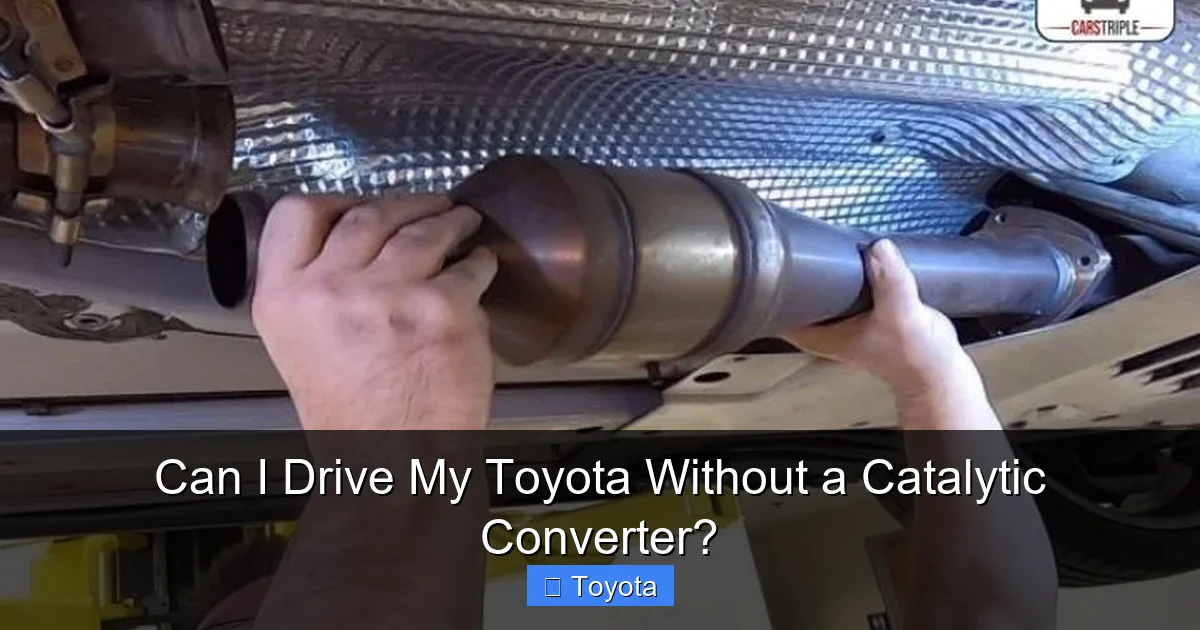
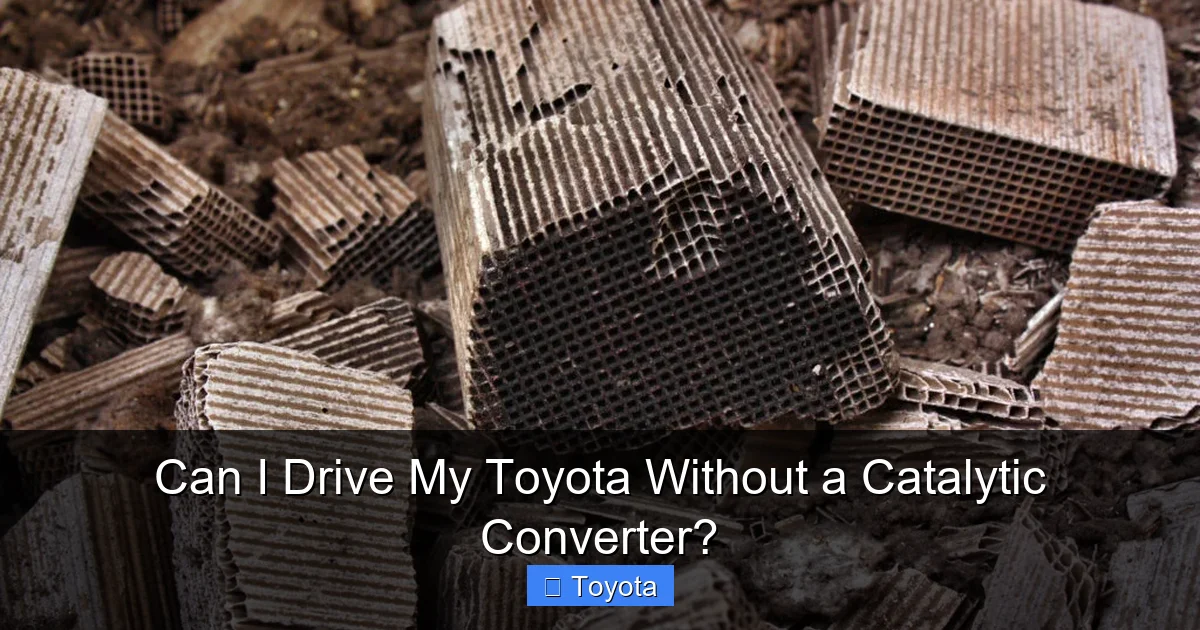
To understand why driving without one is so bad, you first need to grasp its job. Think of your catalytic converter as a high-temperature, chemical processing plant strapped to the bottom of your car. Its sole purpose is to clean up the toxic gases your engine produces as a byproduct of combustion. Inside its ceramic or metallic honeycomb core, coated with precious metals like platinum, palladium, and rhodium, a series of chemical reactions occur. These reactions convert three primary harmful emissions into much less harmful substances before they exit the tailpipe.

Visual guide about Can I Drive My Toyota Without a Catalytic Converter?
Image source: mycarmakesnoise.com
The Three Pollutants It Targets
- Carbon Monoxide (CO): A colorless, odorless, and deadly poison. The converter transforms it into harmless carbon dioxide (CO2).
- Hydrocarbons (HC): Unburned fuel vapors that contribute to smog and ozone formation. These are oxidized into carbon dioxide and water (H2O).
- Nitrogen Oxides (NOx): A primary cause of urban smog and acid rain. The converter reduces these into harmless nitrogen (N2) and oxygen (O2).
Without this device, your Toyota’s exhaust would spew these raw pollutants directly into the air we breathe. For context, a car without a functioning catalytic converter can emit hundreds of times more pollutants than a compliant vehicle. This is why the government mandated them for all US vehicles starting in the 1975 model year, and why tampering with or removing them is a federal offense under the Clean Air Act. Your Toyota’s Engine Control Unit (ECU) is also programmed to monitor the converter’s efficiency via oxygen sensors (O2 sensors) placed before and after it. When those sensors report a problem or the rear sensor sees no change in exhaust composition, it triggers the check engine light and alters engine performance.
The Legal Reality: Why It’s a Crime, Not Just a Choice
This is the most important section. The legality isn’t a suggestion; it’s the law. The federal Clean Air Act, enforced by the Environmental Protection Agency (EPA), prohibits the removal or tampering of any emissions control device on a motor vehicle that is operated on public roads. This includes the catalytic converter, exhaust gas recirculation (EGR) system, and evaporative emissions system. States then adopt and enforce these federal standards, often with their own additional penalties.
Visual guide about Can I Drive My Toyota Without a Catalytic Converter?
Image source: mycarmakesnoise.com
Federal and State Violations
If a police officer or a state inspector determines your Toyota is operating without its catalytic converter, you are committing a violation. The specific penalties vary by state but can include:
- Heavy Fines: These can range from several hundred to several thousand dollars.
- Failed Vehicle Inspection: Your car will automatically fail any emissions or safety inspection. You cannot legally renew your registration without passing.
- Traffic Stop and Citation: You can be pulled over and issued a citation specifically for the missing emissions equipment.
- Vehicle Impoundment: In some jurisdictions, especially if you are a repeat offender, the vehicle can be impounded until the equipment is reinstalled and the vehicle passes inspection.
- Denied Insurance Claims: In the event of an accident, an insurance company may deny a claim if they discover the vehicle was not in compliance with federal and state motor vehicle laws at the time of the incident.
Some states have even more specific laws. For example, in California, which has the strictest emissions standards (CARB), a vehicle without a catalytic converter will not only fail smog but is considered a gross polluter. Selling such a vehicle is also illegal. The notion that this is a “modification” or a “performance upgrade” is a dangerous myth sold by unscrupulous shops. It is, in legal terms, tampering. For more on the general legality across all car makes, you can read our detailed guide on whether you can drive any car without a catalytic converter.
The Performance and Mechanical Impact on Your Toyota
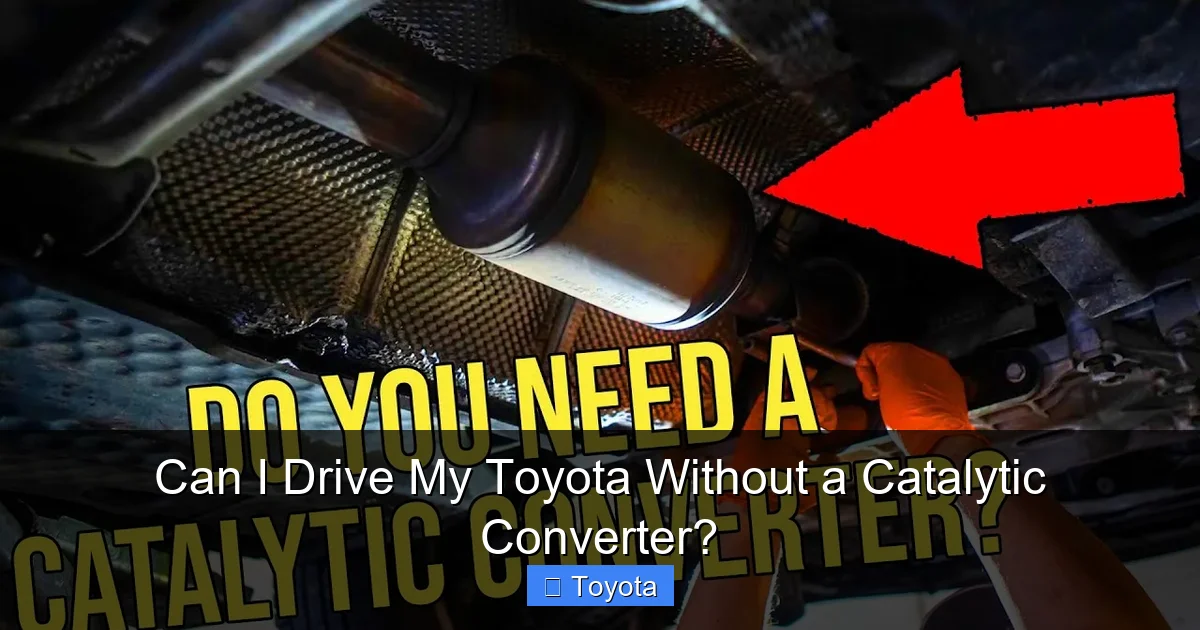
Beyond the legal headache, your Toyota’s engine and computer are going to have a very bad time. The catalytic converter is not an optional performance part; it’s a calibrated component of the entire exhaust and engine management system. When it’s missing, the ECU gets frantic signals from the O2 sensors and reacts in ways that harm the engine.
Visual guide about Can I Drive My Toyota Without a Catalytic Converter?
Image source: i.ytimg.com
The “Check Engine Light” Party and Limp Mode
The first thing you’ll notice (if the theft didn’t already trigger it) is a constantly illuminated Check Engine Light. This is your car crying for help. The most common diagnostic trouble codes (DTCs) will be P0420 (Catalyst System Efficiency Below Threshold) and P0430. Once these are set, the ECU often enters a default or “limp” mode. In this mode, it ignores its optimized fuel maps and runs on generic, overly rich fuel trims to try and protect the engine from the now-uncontrolled exhaust gases. The result? Terrible fuel economy (you’ll be filling up much more often), a rough idle, and a noticeable loss of power and acceleration. Your smooth, reliable Toyota Camry or RAV4 will feel sluggish and unresponsive.
Long-Term Engine Damage Risk
The rich fuel mixture needed in limp mode can cause unburned gasoline to wash the oil off the cylinder walls, increasing wear. More critically, the oxygen sensors themselves, which are expensive, can be damaged by the extreme heat and unfiltered exhaust gases. The exhaust leak created by the missing converter (it’s a major restriction point) can also lead to exhaust manifold leaks, which are another expensive repair. Over time, this constant stress and inefficient combustion can lead to premature failure of oxygen sensors, damage to the muffler and other exhaust components from excessive heat, and increased carbon buildup in the engine. It’s a cascade of problems that starts with a missing $500-$2000 part and can end in thousands in engine repairs.
The Audible and Olfactory Signs: It’s Impossible to Hide
Driving a Toyota without a catalytic converter is the automotive equivalent of walking into a room and announcing your presence with a foghorn. You cannot be discreet. The changes are obvious to anyone with ears or a nose.
The Loud, Raspy Exhaust Note
The catalytic converter is a major muffling component in the exhaust system. Its dense, honeycomb structure creates backpressure that quiets the engine’s raw exhaust pulses. Remove it, and you remove a significant silencer. The sound transforms from a refined, muted purr or hum into a loud, raspy, often tinny roar. It’s especially noticeable on acceleration. The sound will be dramatically louder inside the cabin and outside the vehicle. This is a primary way police officers and emissions inspectors identify suspect vehicles. It’s not a “deep, aggressive sound” like a performance exhaust; it’s a harsh, unpleasant, and obviously illegal noise.
The Smell of Raw, Unburned Fuel
Because the engine is running inefficiently in its default mode, you’ll often smell a strong odor of unburned gasoline or raw fuel from the exhaust, especially when idling or accelerating. This is the direct result of the rich fuel mixture not being completely burned in the combustion chamber and then not being cleaned by the converter. You might also notice a sulfur-like “rotten egg” smell if the engine is running exceptionally rich, as sulfur in the fuel isn’t being converted to sulfur dioxide properly. These smells are not just annoying; they are indicators of excessive pollution and poor engine health.
What To Do If Your Toyota’s Catalytic Converter is Stolen or Damaged
This is the most common scenario that leads owners to ask this question. Catalytic converter theft has skyrocketed due to the value of the precious metals inside. If you wake up to find your Toyota’s converter cut from the exhaust, what are your options?
- Option 1: Replace It Immediately (The Only Legal Choice). This is the unequivocal answer. Contact your insurance company (comprehensive coverage may cover the theft after your deductible) and a reputable mechanic or exhaust shop. You must install a new, compliant catalytic converter. For Toyota models, using an Original Equipment Manufacturer (OEM) part is often recommended to ensure full compliance and performance, though aftermarket CARB-compliant converters are an option. Taking your Toyota to a certified Toyota dealer or a trusted independent shop is the safest path to getting the correct part installed and ensuring your ECU recognizes it.
- Option 2: Sell the Vehicle “As-Is” (The Last Resort). If the cost of replacement exceeds the value of the car and you cannot afford it, your only other legal path is to sell the vehicle in its non-compliant state. You must be 100% transparent with any buyer that the catalytic converter is missing and the car cannot be legally registered or driven on the road. Selling a car without disclosing this is fraudulent. The sale will likely be for a very low price to a scrapyard or a buyer looking for a project. You can learn more about the process and legalities of selling a car without its catalytic converter.
- Option 3: Park It Indefinitely (The Practical Reality). If you cannot afford a replacement and cannot sell it, the only legal way to “store” the vehicle is to keep it off public roads entirely. This means a private driveway, garage, or enclosed lot. You cannot even move it on public roads to get it to a scrapyard without a temporary permit, which you likely won’t get without proof of emissions compliance in most states. This turns your car into an expensive, immobile lawn ornament.
Never choose the path of simply installing a straight pipe or an empty “test pipe” and driving. The noise, the check engine light, and the inevitable traffic stop make it a losing proposition. Furthermore, a bad or clogged converter can also cause overheating issues, as detailed in our article on how a bad catalytic converter can lead to engine overheating.
The Bottom Line: A Firm “No” for Public Road Use
So, can you drive your Toyota without a catalytic converter? The mechanical answer is yes, the engine might run. The legal, environmental, and practical answer is a resounding NO. The risks far outweigh any perceived short-term benefit of saving on a replacement part. You are choosing to drive an illegally modified vehicle that pollutes at an alarming rate, will fail any inspection, will alert authorities with its loud exhaust, will hurt your wallet through poor fuel economy and potential engine damage, and will almost certainly result in costly fines and legal trouble. Your Toyota is a marvel of reliability and engineering, but it’s designed to work as a complete system. Removing a core component like the catalytic converter breaks that system and voids the very purpose of the vehicle’s design and legal certification. The responsible, legal, and smart course of action is always to replace a stolen or failed catalytic converter with a proper, compliant unit as soon as possible. If that’s not financially feasible, the vehicle must be sold or stored off public roads. There is no safe or legal middle ground for daily driving.
Frequently Asked Questions
Is it illegal to drive a Toyota without a catalytic converter?
Yes, it is a federal crime under the Clean Air Act and a violation in every state to operate a vehicle on public roads without its required catalytic converter. You can be fined, fail inspections, and have your vehicle impounded.
Will my Toyota’s check engine light come on if the catalytic converter is missing?
Almost certainly, yes. The engine computer monitors the oxygen sensors before and after the converter. A missing converter causes a significant discrepancy in readings, triggering codes like P0420 and illuminating the check engine light immediately.
How much does it cost to replace a catalytic converter on a Toyota?
The cost varies widely by model and year but typically ranges from $1,000 to over $3,000 for parts and labor at a dealership. Aftermarket parts can be cheaper but must be CARB-compliant for states like California. This is one of the most expensive common repairs due to the precious metals inside.
Why are catalytic converters being stolen from Toyotas so frequently?
Catalytic converters contain valuable precious metals (platinum, palladium, rhodium). Older Toyota models like the Prius, Tacoma, and Tundra are often targeted because they have higher concentrations of these metals and are easier to access with a saw.
How long does it take to replace a catalytic converter on a Toyota?
A professional mechanic can typically replace a catalytic converter in 2 to 4 hours, depending on the model and whether the exhaust system is rusted. Some models require removing other components, which can increase labor time.
Can I just put a straight pipe on my Toyota to bypass a bad converter?
No. This is illegal for street use. While it might make the car run temporarily, it will cause constant check engine lights, poor performance, failed inspections, and excessive noise and pollution. It is not a legal or mechanically sound solution.