
Are Toyota Tacomas 4-wheel Drive?

Yes, Toyota Tacomas are available with 4-wheel drive (4WD), but not all models come standard with it. Depending on the trim, cab configuration, and model year, buyers can choose between rear-wheel drive (RWD) or part-time 4WD systems designed for off-road performance and tough terrain.
Key Takeaways
- Not all Tacomas are 4WD: Only specific trims and configurations offer 4-wheel drive; base models often come with rear-wheel drive.
- Part-time 4WD system: Most 4WD Tacomas use a part-time system ideal for off-roading and slippery conditions, not daily on-road use.
- TRD Off-Road and TRD Pro trims: These performance-focused models come standard with 4WD and enhanced off-road features like crawl control and locking rear differentials.
- Manual and automatic options: 4WD is available with both manual and automatic transmissions, depending on the model year and trim.
- Fuel economy impact: 4WD models typically get slightly lower gas mileage than their RWD counterparts due to added weight and drivetrain drag.
- Easy to engage: Modern Tacomas feature electronic shift-on-the-fly 4WD, allowing drivers to switch between 2WD and 4WD at speeds up to 55 mph.
- Great for adventure: The 4WD system makes the Tacoma a top choice for overlanding, camping, and tackling rugged trails.
📑 Table of Contents
Are Toyota Tacomas 4-Wheel Drive?
If you’re in the market for a reliable, rugged pickup truck that can handle everything from daily commutes to weekend off-roading adventures, the Toyota Tacoma is likely on your shortlist. Known for its legendary durability, strong resale value, and off-road capability, the Tacoma has been a favorite among truck enthusiasts for decades. But one question keeps popping up: Are Toyota Tacomas 4-wheel drive?
The short answer is yes — but with an important caveat. Not every Tacoma comes with 4-wheel drive (4WD) as standard. Whether or not your Tacoma has 4WD depends on the trim level, cab configuration, and model year you choose. Some models are built purely for on-road efficiency and come with rear-wheel drive (RWD), while others are purpose-built for off-road performance and include a robust 4WD system.
Understanding the difference between 4WD and other drivetrain options is key to making the right choice. 4WD sends power to all four wheels simultaneously, improving traction in mud, snow, sand, and rocky terrain. This makes it ideal for drivers who frequently venture off the beaten path or live in areas with harsh weather conditions. On the other hand, RWD is lighter, more fuel-efficient, and perfectly adequate for city driving and light hauling.
In this guide, we’ll dive deep into the world of Toyota Tacoma 4WD systems. We’ll explore which trims offer 4WD, how the system works, the benefits and trade-offs, and how to decide whether 4WD is right for your lifestyle. Whether you’re planning a cross-country overlanding trip or just want peace of mind during winter storms, this article will help you understand everything you need to know about Tacoma’s 4-wheel drive capabilities.
Understanding 4WD in the Toyota Tacoma
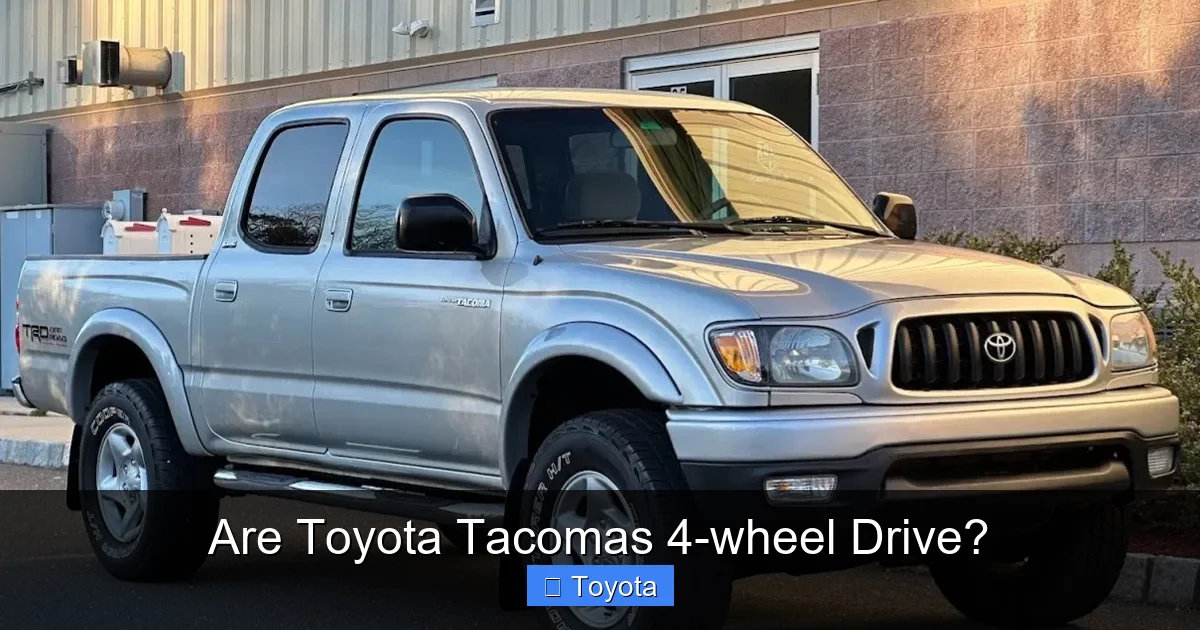
Visual guide about Are Toyota Tacomas 4-wheel Drive?
Image source: bringatrailer.com
To truly grasp whether a Toyota Tacoma is 4-wheel drive, it’s important to understand what 4WD actually means — and how Toyota implements it in the Tacoma. Unlike all-wheel drive (AWD), which automatically distributes power to all four wheels based on traction needs, 4WD is typically a part-time system that the driver manually engages when needed.
In the case of the Tacoma, most 4WD models use a part-time 4WD system. This means that under normal driving conditions, the truck operates in rear-wheel drive (2WD) to save fuel and reduce wear on the drivetrain. When the driver anticipates slippery or uneven terrain, they can shift into 4WD mode, which locks the front and rear axles together, sending equal power to all four wheels.
How the Tacoma’s 4WD System Works
The Tacoma’s 4WD system is designed for simplicity and reliability. On most models, you’ll find a transfer case with a lever or electronic switch that allows you to select between 2WD, 4H (4WD High), and 4L (4WD Low). Some newer models feature an electronic push-button or dial system for easier operation.
– 2WD: Power is sent only to the rear wheels. This is the default mode for everyday driving and offers the best fuel economy.
– 4H (4WD High): All four wheels receive power. This mode is ideal for wet roads, light snow, gravel, or mild off-roading. You can typically engage 4H at speeds up to 55 mph.
– 4L (4WD Low): This low-range gearing provides maximum torque and control for extreme off-road conditions like steep inclines, deep mud, or rock crawling. 4L should only be used at very low speeds (under 15 mph).
One of the standout features of the Tacoma’s 4WD system is its shift-on-the-fly capability. This means you don’t have to come to a complete stop to switch between 2WD and 4H — a huge advantage when conditions change quickly, like driving from dry pavement into a muddy trail.
Electronic vs. Manual Engagement
Older Tacoma models (pre-2016) often used a mechanical lever to engage 4WD, requiring the driver to get out and lock the front hubs manually on some versions. While this added a step, it also reduced complexity and increased durability.
Modern Tacomas (2016 and newer) have largely transitioned to electronic 4WD engagement. A dashboard switch or rotary dial allows drivers to toggle between drive modes with the push of a button. This makes it easier and faster to adapt to changing terrain, especially for less experienced off-roaders.
Some high-end trims, like the TRD Pro, also include advanced features such as a locking rear differential, crawl control, and multi-terrain select — all designed to maximize traction and control in challenging environments.
Which Tacoma Trims Come with 4WD?

Visual guide about Are Toyota Tacomas 4-wheel Drive?
Image source: bringatrailer.com
Now that we understand how the 4WD system works, let’s look at which Tacoma trims actually offer it. The availability of 4WD varies significantly across the lineup, so it’s crucial to know what you’re getting when you shop.
Base and Mid-Level Trims
The entry-level SR and SR5 trims are available in both rear-wheel drive (RWD) and 4WD configurations. However, 4WD is not standard — it’s an optional upgrade. If you’re looking for a budget-friendly Tacoma with 4WD, the SR or SR5 with the 4WD package is a solid choice. These models come with the same 4WD system as higher trims but with fewer luxury and tech features.
For example, a 2023 Tacoma SR with 4WD and an automatic transmission starts around $33,000, while the same model with RWD is about $2,000 less. The 4WD version includes skid plates, a locking rear differential (on some models), and enhanced off-road suspension.
TRD Off-Road and TRD Pro
If you’re serious about off-roading, the TRD Off-Road and TRD Pro trims are where the Tacoma truly shines — and both come standard with 4WD.
The TRD Off-Road trim includes features like:
– Electronically controlled locking rear differential
– Multi-Terrain Select (MTS) system
– Crawl Control (CC)
– Bilstein shock absorbers
– Skid plates for the engine, transfer case, and fuel tank
These features make the TRD Off-Road ideal for overlanding, trail riding, and tackling moderate to difficult terrain.
The TRD Pro takes it a step further. It’s the most off-road-capable Tacoma in the lineup, with:
– FOX internal bypass shocks
– TRD-tuned front springs
– TRD Pro skid plate
– LED fog lights
– Exclusive exterior styling
Both trims are available only with 4WD and come with either a 6-speed automatic or 6-speed manual transmission (depending on model year). The TRD Pro is particularly popular among off-road enthusiasts and has a strong following in the overlanding community.
Limited and Other Trims
The Limited trim focuses more on comfort and technology than off-road performance. While it does offer 4WD as an option, it’s not standard. The Limited comes with premium features like leather seats, a larger infotainment screen, and advanced safety tech, but it lacks some of the rugged off-road hardware found on the TRD models.
Other trims, like the Trail Edition (a special version based on the TRD Off-Road), also come standard with 4WD and additional off-road upgrades such as all-terrain tires and a reinforced rear bumper.
Cab and Bed Configurations
It’s also worth noting that 4WD availability can depend on the cab and bed size you choose. For example:
– Regular Cab: Available with 4WD on most trims.
– Access Cab: 4WD is widely available.
– Double Cab: 4WD is standard on TRD Off-Road and TRD Pro, optional on others.
Longer bed options (6-foot bed) are typically only available on Double Cab models, and 4WD is commonly offered with these configurations.
4WD vs. AWD: What’s the Difference?
Visual guide about Are Toyota Tacomas 4-wheel Drive?
Image source: tighttorque.com
Many people confuse 4-wheel drive (4WD) with all-wheel drive (AWD), but they’re not the same — and the Tacoma does not offer AWD. Understanding the difference can help you make a better decision.
How 4WD Works
As mentioned earlier, 4WD is a part-time system that sends equal power to all four wheels when engaged. It’s designed for off-road use and low-traction conditions. Because all four wheels turn at the same speed, 4WD can cause drivetrain binding on dry pavement, so it should only be used off-road or in slippery conditions.
The Tacoma’s 4WD system is mechanically simple and highly durable, making it ideal for rugged use. It’s also serviceable — many owners perform maintenance and upgrades themselves.
How AWD Works
AWD, on the other hand, is always active and automatically distributes power between the front and rear axles based on traction. It’s common in SUVs and crossovers like the Toyota RAV4 or Highlander. AWD is great for light snow and rain but isn’t built for serious off-roading.
The Tacoma does not offer AWD. Toyota has stuck with traditional 4WD for the Tacoma because it’s better suited for the truck’s intended use — hauling, towing, and off-roading.
Why Toyota Chose 4WD Over AWD
Toyota’s decision to use 4WD instead of AWD in the Tacoma comes down to durability, simplicity, and performance. 4WD systems are generally more robust and better at handling heavy loads and extreme conditions. They also allow for features like low-range gearing (4L), which is essential for rock crawling and steep climbs.
AWD systems, while convenient, are more complex and less capable in true off-road scenarios. For a truck designed to go anywhere, 4WD is the logical choice.
Benefits of Choosing a 4WD Tacoma
So, why should you consider a 4WD Tacoma? While it may cost more upfront and reduce fuel economy slightly, the benefits often outweigh the drawbacks — especially if you plan to use your truck for more than just commuting.
Superior Off-Road Performance
The most obvious advantage of 4WD is improved traction in challenging conditions. Whether you’re driving through deep snow, muddy trails, or sandy deserts, 4WD gives you the confidence to keep moving.
The Tacoma’s 4WD system, especially on TRD models, is engineered for real-world off-roading. Features like crawl control act like an off-road cruise control, automatically managing throttle and braking to maintain a steady speed over rough terrain. Multi-Terrain Select lets you choose the best driving mode for mud, sand, or rocks.
Enhanced Safety in Winter Weather
Even if you don’t plan to go off-roading, 4WD can be a lifesaver in winter. Snow-covered roads, icy driveways, and slushy highways become much more manageable with all four wheels pulling you forward.
Many Tacoma owners in northern climates swear by their 4WD models during snowstorms. While 4WD doesn’t improve braking, it significantly enhances acceleration and hill-climbing ability — two critical factors in winter driving.
Increased Resale Value
Tacomas are already known for holding their value better than most trucks. Adding 4WD increases resale value even further. Buyers know that a 4WD Tacoma is more versatile and capable, making it a smarter long-term investment.
In fact, used 4WD Tacomas often sell for thousands more than their RWD counterparts — especially in regions with harsh weather or outdoor recreation.
Towing and Hauling Capability
While 4WD doesn’t directly increase towing capacity, it does improve stability and control when towing heavy loads on uneven or slippery surfaces. If you plan to tow a trailer through mountain passes or down gravel roads, 4WD provides extra peace of mind.
The Tacoma’s 4WD system works seamlessly with its towing package, which includes a transmission cooler, trailer sway control, and a hitch receiver.
Peace of Mind for Adventure Seekers
For overlanders, campers, and outdoor enthusiasts, 4WD is non-negotiable. The ability to reach remote trailheads, cross streams, or navigate rocky paths opens up a world of adventure.
Many Tacoma owners use their trucks as mobile bases for weekend trips, and 4WD ensures they can get to their destination — and back home safely.
Drawbacks of 4WD in the Tacoma
While 4WD offers many advantages, it’s not without its downsides. It’s important to weigh these before making a decision.
Lower Fuel Economy
4WD adds weight and mechanical drag, which reduces fuel efficiency. On average, a 4WD Tacoma gets about 1–2 miles per gallon less than a comparable RWD model.
For example, a 2023 Tacoma SR5 Double Cab with RWD and the 3.5L V6 engine gets around 20 mpg combined. The same truck with 4WD drops to about 18 mpg combined. Over time, this can add up — especially if you drive long distances.
Higher Upfront Cost
4WD is an optional upgrade on most trims, adding $2,000 to $3,000 to the price. While this may not seem like much, it can push a base model into a higher price bracket.
Additionally, 4WD models often come with other off-road packages that increase the cost further.
Not Needed for City Driving
If you live in a mild climate and rarely leave paved roads, 4WD may be overkill. You’ll pay more upfront and at the pump for a feature you’ll rarely use.
That said, even city drivers can benefit from 4WD during unexpected weather events or when visiting rural areas.
Maintenance Considerations
4WD systems require occasional maintenance, such as fluid changes in the transfer case and differentials. While not overly complex, it’s an added responsibility compared to RWD models.
However, Toyota’s 4WD system is known for its reliability, and many owners go years without issues.
How to Choose the Right Tacoma for You
Deciding whether to get a 4WD Tacoma comes down to your lifestyle, driving habits, and budget. Here are some tips to help you choose:
Ask Yourself Key Questions
– Do I frequently drive in snow, rain, or mud?
– Will I be off-roading, overlanding, or camping in remote areas?
– Do I need to tow or haul heavy loads on uneven terrain?
– Am I willing to pay more upfront and at the pump for added capability?
If you answered “yes” to any of these, 4WD is likely worth it.
Test Drive Both Options
If possible, test drive a RWD and 4WD Tacoma back-to-back. Pay attention to how they feel on different surfaces. You may notice the 4WD model feels more planted and confident, especially on gravel or wet pavement.
Consider Your Long-Term Plans
Even if you don’t need 4WD now, you might in the future. If you plan to keep your truck for 10+ years, investing in 4WD could pay off down the road — both in usability and resale value.
Look at Certified Pre-Owned Options
If the cost of a new 4WD Tacoma is out of reach, consider a certified pre-owned (CPO) model. Toyota’s CPO program includes a thorough inspection, warranty, and often lower mileage, making it a smart way to get into a 4WD Tacoma at a lower price.
Conclusion
So, are Toyota Tacomas 4-wheel drive? The answer is: it depends. While not all Tacomas come with 4WD, many trims — especially the TRD Off-Road and TRD Pro — offer it as standard or as a highly recommended option. The 4WD system in the Tacoma is a proven, reliable setup designed for real off-road performance, winter driving, and outdoor adventures.
Choosing a 4WD Tacoma means gaining superior traction, enhanced safety, and greater versatility — but it also comes with a higher price tag and slightly lower fuel economy. For drivers who value capability and peace of mind, the benefits far outweigh the costs.
Whether you’re tackling mountain trails, hauling gear to a job site, or just want a truck that can handle whatever Mother Nature throws at it, a 4WD Toyota Tacoma is one of the most dependable choices on the market. With its legendary durability, strong resale value, and off-road prowess, it’s no wonder the Tacoma remains one of America’s favorite pickup trucks.
Frequently Asked Questions
Do all Toyota Tacomas come with 4WD?
No, not all Toyota Tacomas come with 4-wheel drive. While many trims offer 4WD as an option, base models like the SR often come standard with rear-wheel drive. You must specifically choose the 4WD configuration when ordering or purchasing.
Can you add 4WD to a Tacoma later?
No, you cannot add 4WD to a Tacoma after purchase. The 4WD system is integrated into the chassis and drivetrain during manufacturing. If you want 4WD, you must buy a model that was originally equipped with it.
Is 4WD worth it for city driving?
For most city drivers, 4WD is not necessary unless you live in an area with frequent snow, rain, or poor road conditions. However, it can provide added confidence during winter storms or occasional off-road trips.
What’s the difference between 4H and 4L in a Tacoma?
4H (4WD High) is for moderate off-roading and slippery roads at normal speeds. 4L (4WD Low) provides maximum torque and control for extreme terrain and should only be used at very low speeds, under 15 mph.
Does 4WD affect towing capacity?
4WD does not increase towing capacity, but it improves stability and control when towing on uneven or slippery surfaces. The Tacoma’s towing capacity remains the same whether it’s RWD or 4WD.
Can you drive a 4WD Tacoma in 2WD most of the time?
Yes, you can and should drive a 4WD Tacoma in 2WD during normal conditions. This saves fuel and reduces wear on the drivetrain. Only engage 4WD when needed for off-road or low-traction situations.
