
Is the Toyota Highlander a Midsize or Full-size Suv?

The Toyota Highlander is unambiguously classified as a midsize SUV by industry standards, Toyota itself, and automotive journalists. While its generous three-row seating and substantial size can *feel* full-size to occupants, its exterior dimensions, platform architecture, and direct competitors (like the Ford Explorer and Honda Pilot) firmly place it in the midsize segment. The larger, three-row Grand Highlander, introduced for 2024, is Toyota’s true entry into the full-size SUV arena.
Key Takeaways
- Official Classification: Toyota, automotive media, and consumer guides consistently categorize the Highlander as a midsize three-row SUV.
- Size vs. Segment: Its spacious interior and third row create a “full-size feel,” but its wheelbase, length, and platform are designed for the midsize class.
- The Grand Highlander Distinction: For 2024, Toyota introduced the Grand Highlander, which is larger and targets the full-size SUV segment, clarifying the standard Highlander’s position.
- Competitor Alignment: The Highlander directly competes with other midsize three-row SUVs like the Ford Explorer, Honda Pilot, and Kia Telluride.
- Practical Implications: Its midsize status means easier parking and maneuverability than a true full-size SUV like a Chevrolet Tahoe or Toyota Sequoia, while still offering excellent family space.
[FEATURED_IMAGE_PLACEHOLDER]
📑 Table of Contents
Introduction: The Great SUV Size Debate
If you’re in the market for a spacious, three-row family SUV, the Toyota Highlander is almost certainly on your shortlist. It’s a perennial favorite, known for its reliability, comfort, and strong resale value. But as you compare vehicles, a fundamental question arises: Is the Toyota Highlander a midsize or full-size SUV? This isn’t just semantic trivia; the classification affects everything from parking and fuel economy to your choice among competitors. The answer, while sometimes muddied by the Highlander’s impressive interior space, is clear-cut. Let’s break down the facts, the dimensions, and the market context to put this question to bed once and for all.
Many buyers look at the Highlander’s available seating for eight and its massive cargo capacity and think, “That’s a full-size SUV!” You’re not wrong to feel that way—it’s huge inside! However, the automotive industry uses specific exterior measurements and platform engineering to define segments. By those objective metrics, the Highlander sits comfortably, and intentionally, in the midsize category. To understand why, we need to look at the numbers, its competitors, and a new player from Toyota itself that has recently entered the full-size fray.
The Official Verdict: Midsize Through and Through
What Toyota Says
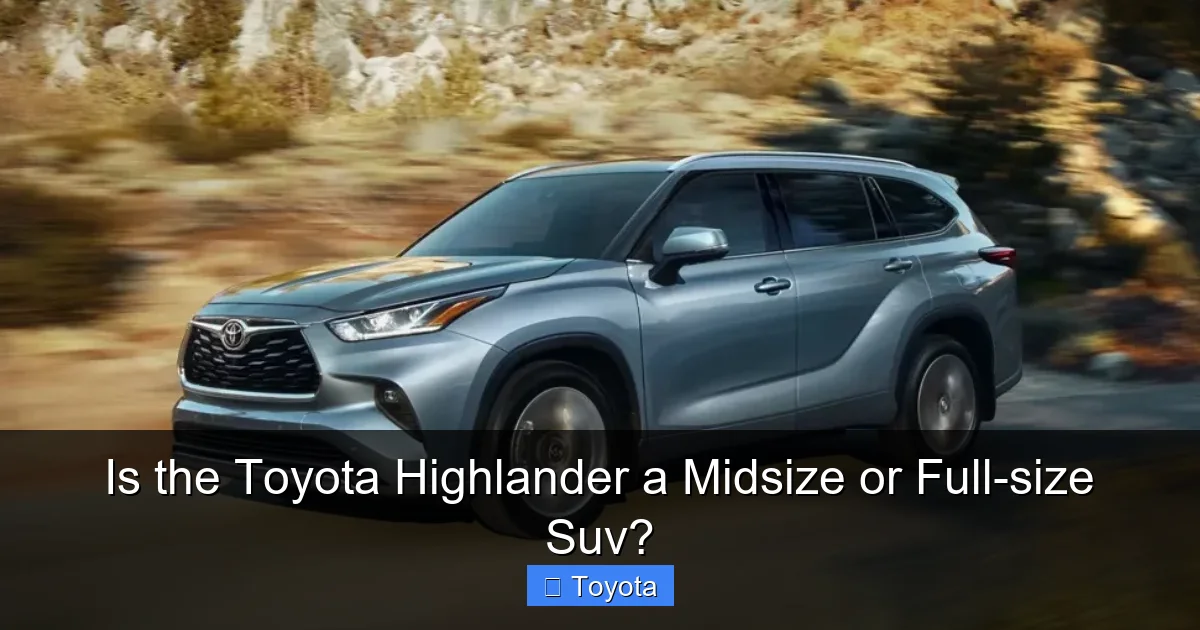
The most authoritative source is the manufacturer. Toyota’s own marketing materials, website configurations, and press releases have never labeled the standard Highlander as a full-size SUV. It is always presented as a “midsize SUV” or “midsize crossover.” The vehicle’s official model code (for the current generation) is part of Toyota’s “X” platform family, shared with the midsize RAV4 and the midsize/large hybrid-focused platform, not the body-on-frame platform used for the full-size Sequoia. This engineering pedigree is a dead giveaway.
Visual guide about Is the Toyota Highlander a Midsize or Full-size Suv?
Image source: motorbiscuit.com
Industry Consensus
Every major automotive publication and consumer guide agrees. Edmunds, Kelley Blue Book, Consumer Reports, and Car and Driver all classify the Highlander in the “Midsize SUV” or “3-Row Midsize SUV” category. When they create comparison tests, they line it up against the Ford Explorer, Honda Pilot, Kia Telluride, and Hyundai Palisade—all universally accepted midsize rivals. They do not compare it directly to the Chevrolet Tahoe, GMC Yukon, or Toyota’s own Sequoia, which are the benchmarks for the full-size segment.
Head-to-Head: Dimensions Don’t Lie
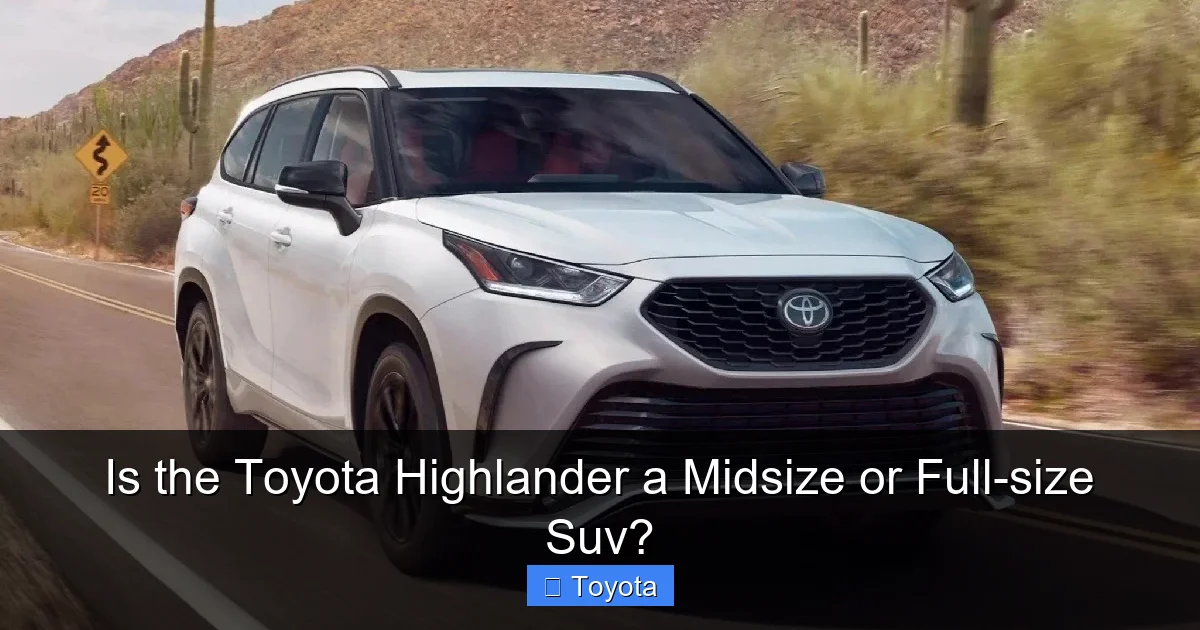
While feelings are important, cold, hard data provides the ultimate answer. Let’s compare the key exterior dimensions of the 2024 Toyota Highlander to a representative full-size SUV (the 2024 Chevrolet Tahoe) and its midsize rival (the 2024 Honda Pilot).
Visual guide about Is the Toyota Highlander a Midsize or Full-size Suv?
Image source: motorbiscuit.com
- Overall Length: Highlander (198.9 in) vs. Honda Pilot (199.9 in) vs. Chevrolet Tahoe (210.7 in). The Tahoe is over a foot longer.
- Wheelbase: Highlander (112.2 in) vs. Honda Pilot (113.8 in) vs. Chevrolet Tahoe (126.7 in). The Tahoe’s wheelbase is nearly a foot longer, which dramatically affects interior space layout and turning radius.
- Width (excluding mirrors): Highlander (76.0 in) vs. Honda Pilot (78.6 in) vs. Chevrolet Tahoe (80.5 in). The Tahoe is significantly wider.
- Height: Highlander (70.7 in) vs. Honda Pilot (71.0 in) vs. Chevrolet Tahoe (77.3 in). The Tahoe is nearly 7 inches taller.
What This Means: The Highlander’s dimensions are almost identical to the Honda Pilot’s and are within an inch or two of other midsize competitors. They are all substantially smaller in every key exterior measurement than a body-on-frame full-size SUV like the Tahoe. The Highlander’s unibody construction is also a hallmark of the crossover/midsize SUV segment, while full-size SUVs typically use a body-on-frame truck platform for maximum towing and hauling capability.
The “But It Feels So Big!” Factor: Interior Space Explained
So why the confusion? The Highlander’s interior packaging is exceptionally efficient. Its wheelbase is used to maximize passenger and cargo room within a relatively compact exterior footprint. The third row, while not as spacious as a full-size SUV’s, is genuinely usable for children and smaller adults on shorter trips. This creates a cognitive dissonance: a vehicle that drives and parks like a midsize SUV but offers space that seems full-size.
This efficient packaging is a key selling point. You get family-hauling capability without the daunting size of a Tahoe or Sequoia. For many families, the Highlander’s third row is “good enough,” making the jump to a full-size SUV unnecessary. However, if you frequently need to transport adults in the third row or require maximum towing capacity (the Highlander maxes out at 5,000 lbs, while a Tahoe can tow up to 8,000+ lbs), the full-size segment becomes relevant. The Highlander’s interior volume is class-leading for the midsize segment, not evidence of a misclassified vehicle.
The Game-Changer: Enter the Grand Highlander
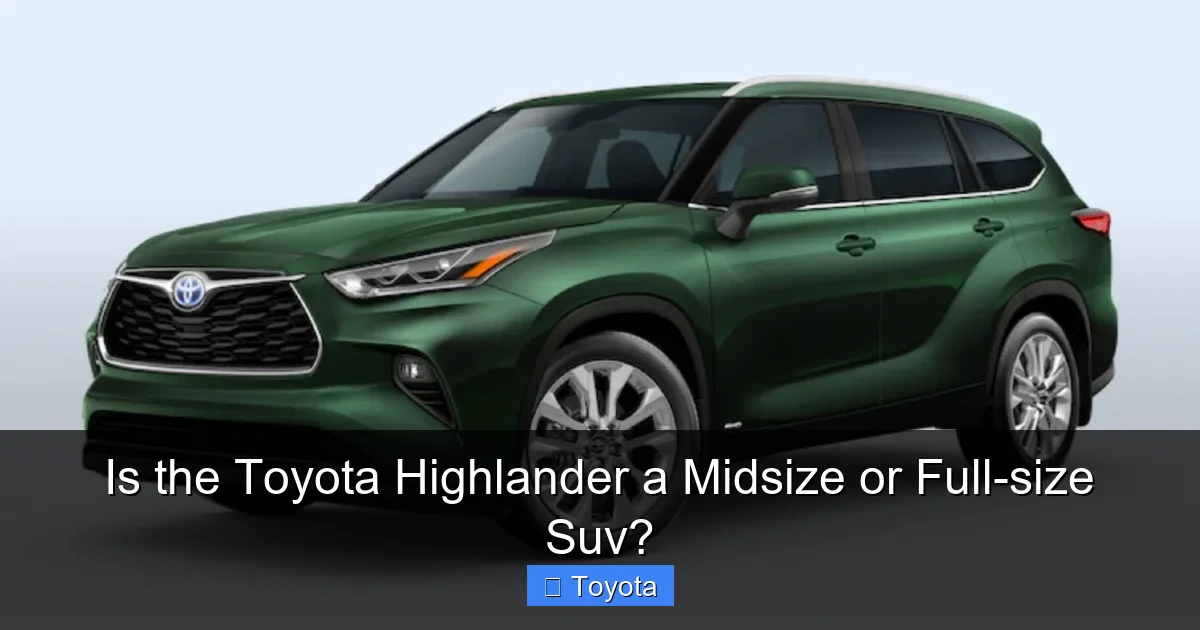
For the 2024 model year, Toyota resolved any lingering ambiguity by expanding the lineup. The new Toyota Grand Highlander is a distinct model slotting between the standard Highlander and the body-on-frame Sequoia. It is larger in every exterior dimension than the standard Highlander and offers even more generous third-row space and cargo room. Toyota explicitly markets the Grand Highlander as a “large SUV” or “three-row SUV” targeting families who find the Highlander’s third row a bit tight but aren’t ready for the size or fuel consumption of a Sequoia.
Visual guide about Is the Toyota Highlander a Midsize or Full-size Suv?
Image source: motorbiscuit.com
This move is a direct acknowledgment of market demand. Some buyers want more space than the midsize segment provides but want the unibody comfort and car-like driving dynamics of a crossover rather than a truck-based SUV. The Grand Highlander fills that niche. With its arrival, the standard Highlander’s identity as the midsize offering in Toyota’s three-row family is cemented. If you test-drive a Highlander and think, “I need more room,” your next step should be looking at the Grand Highlander or a full-size body-on-frame SUV, not questioning the Highlander’s segment.
How to Choose: Midsize vs. Full-Size for Your Needs
When the Midsize Highlander is the Perfect Choice
Choose the standard Toyota Highlander if: Your third-row needs are primarily for children or occasional adult use. You prioritize easier daily driving, parking, and better fuel economy (the hybrid model is excellent). Your towing needs are moderate (boats, small campers). You want a vehicle that feels manageable in size but doesn’t force constant compromises on passenger space. The Highlander excels in this sweet spot. For those interested in maximizing efficiency, learning how to check the AWD system on a Toyota Highlander can help ensure you get the most out of its capable all-wheel-drive setup for varying conditions.
When You Should Look at Full-Size (or the Grand Highlander)
Look beyond the Highlander if: You regularly seat adults in the third row for long distances. You need maximum towing capacity (over 5,000 lbs). You require the utmost in cargo volume behind the third row. You prefer the rugged, body-on-frame durability and higher maximum payload of a truck-based SUV. In this case, explore the Toyota Grand Highlander for a crossover feel with more space, or the Toyota Sequoia, Ford Expedition, or Chevrolet Tahoe for full-size, body-on-frame capability. Understanding the specific maintenance needs of larger vehicles is also key; for instance, knowing how to reset the maintenance light on a Toyota Highlander is useful, but procedures can differ on even larger models.
Frequently Asked Questions
Is a Toyota Highlander bigger than a 4Runner?
Yes, the Highlander is larger than the 4Runner in most interior dimensions, particularly passenger and cargo space. However, the 4Runner is a body-on-frame, true off-road capable SUV, while the Highlander is a unibody crossover focused on on-road comfort and family hauling. They serve different primary purposes despite some overlap in size perception.
Can a Toyota Highlander be considered a full-size SUV based on its seating?
No. While it offers three rows of seating, the industry classification is based on exterior dimensions and platform, not just passenger capacity. Its wheelbase and overall length are well within midsize parameters. A full-size SUV typically has a significantly longer wheelbase and more generous third-row space for adults.
What is the main competitor to the Toyota Highlander?
Its primary competitors are the Honda Pilot, Ford Explorer, Kia Telluride, and Hyundai Palisade. These are all recognized as midsize, three-row SUVs and are the vehicles most often compared in reviews and by shoppers alongside the Highlander.
Does the Toyota Highlander have enough room in the third row?
For its midsize class, the Highlander’s third row is competitive and suitable for children and smaller adults on shorter trips. It is not as spacious as the third rows in full-size SUVs like the Chevrolet Tahoe or the larger Grand Highlander. It’s best described as an occasional-use third row.
Is the Grand Highlander a full-size SUV?
The Grand Highlander is larger than the standard Highlander and is positioned as a “large SUV.” While it pushes the boundaries of the midsize segment and offers more space, it still uses a unibody crossover platform. It is Toyota’s answer for buyers who want more room than the Highlander provides but may not need the absolute maximum size and truck-based nature of the Sequoia. It effectively bridges the gap between midsize and full-size.
Should I buy a Highlander or a full-size SUV?
Test drive both. If you prioritize easier daily driving, parking, and better fuel economy and your third-row needs are modest, the Highlander is likely sufficient. If you regularly carry adults in the third row, need maximum towing capacity, or require the largest possible cargo volume, you should test a full-size SUV like the Sequoia, Tahoe, or Expedition, as well as the Grand Highlander, to feel the difference in size and capability firsthand.
