Are All Jeep 4.0 Engines the Same?

Contents
- 1 Key Takeaways
- 2 📑 Table of Contents
- 3 The Legendary Lineage: A Brief History of the 4.0L
- 4 Technical Deep Dive: What Actually Changed?
- 5 Model Year & Application Breakdown: XJ, TJ, WJ
- 6 Common Issues & The “Best” Years
- 7 Parts Compatibility: The Practical Reality
- 8 Maintenance, Upgrades, and the Aftermarket
- 9 Conclusion: Knowledge is Power (and Savings)
- 10 Frequently Asked Questions


No, not all Jeep 4.0L engines are the same. While they share a famous reputation for durability and a core inline-6 design, significant changes occurred from 1987 to 2006. Differences in cylinder heads, fuel injection systems, engine control units, and emissions equipment mean parts are not always interchangeable. The 1996-2006 “High Output” (HO) version is the most refined and powerful, while earlier 1991-1995 models are simpler but less powerful. Identifying your specific engine’s year and model is crucial for any repair or upgrade project.
If you’re a Jeep enthusiast or owner, you’ve heard the legends. The 4.0L inline-6 is the stuff of myths—a torquey, simple, and famously reliable engine that powered America’s favorite off-roaders for two decades. It’s the heart of the Cherokee, Wrangler, and Grand Cherokee. But here’s the million-dollar question that sparks endless forum debates: Are all Jeep 4.0 engines the same? The short, frustrating answer is: no. While they share a glorious lineage, assuming every 4.0L is a bolt-in, identical twin is a fast track to a costly mistake. Let’s pop the hood and see what really makes these engines different.
Think of the Jeep 4.0L family like a long-running TV series. The main character—that sturdy iron block and stout crankshaft—stays mostly the same. But the writing, guest stars, and special effects changed dramatically over its 20-year run. Understanding these “seasons” (model years) is key to keeping your Jeep running right. Whether you’re buying a used Jeep, sourcing parts for a repair, or considering a swap, this guide will decode the differences. We’ll break down the history, the technical splits, and give you the practical knowledge to identify exactly what’s under your hood.
Key Takeaways
- Core Design is Consistent: All Jeep 4.0L engines are fuel-injected, overhead-valve (OHV) inline-6 cylinders with a 4.0-liter displacement and a reputation for bulletproof reliability.
- Major Split: Pre-1996 vs. 1996-2006: The biggest difference is the 1996 introduction of the “High Output” (HO) version, featuring a revised cylinder head, camshaft, and intake manifold for significantly more power.
- Electronics & Emissions Evolved: Early engines (1987-1995) used simpler Renix or early Chrysler electronics. 1996+ models required OBD-II compliance, adding more complex sensors and computer systems.
- Parts Interchangeability is Limited: You cannot assume parts from a 1990 Cherokee will fit a 2002 Wrangler. Heads, intake manifolds, and many sensors are generation-specific.
- Block and Crank are Mostly Shared: The short block (crank, rods, pistons) remained largely unchanged from 1991 onward, providing a solid foundation for rebuilds across many years.
- Mounts and Accessories Vary: Engine mount locations, power steering pump brackets, and alternator positions differ between the XJ Cherokee, TJ Wrangler, and WJ Grand Cherokee applications.
- Identifying Your Engine is Step One: Always check the VIN or engine code (like 0331 for a common 1996-2000 head) before buying parts to ensure compatibility.
📑 Table of Contents
- The Legendary Lineage: A Brief History of the 4.0L
- Technical Deep Dive: What Actually Changed?
- Model Year & Application Breakdown: XJ, TJ, WJ
- Common Issues & The “Best” Years
- Parts Compatibility: The Practical Reality
- Maintenance, Upgrades, and the Aftermarket
- Conclusion: Knowledge is Power (and Savings)
The Legendary Lineage: A Brief History of the 4.0L
To understand the differences, we must start at the beginning. The Jeep 4.0L wasn’t born in a vacuum. Its story started in the 1960s with the AMC-designed 258 cubic inch (4.2L) inline-6, a workhorse known for low-end torque and indestructible construction. When Chrysler bought AMC in 1987, they inherited this engine for the new Jeep Cherokee (XJ) and Wrangler (YJ).
The 4.0L is Born (1987-1990)
The first “4.0L” was essentially a stroked 4.2L. Chrysler increased the crankshaft stroke from 3.895″ to 4.0″, upping displacement to 241 cubic inches (4.0L). In these earliest years (1987-1990), the engine was still carbureted in some markets but primarily used a sophisticated (for the time) multi-point fuel injection system controlled by a Renix (Renault/Chrysler) computer. These engines produced about 173 hp and 220 lb-ft of torque. They are rare today and have a distinct, simpler wiring harness and sensor layout compared to later models.
The 1991-1995 “Renix” Era
For 1991, the engine got a slight refresh with a new cylinder head casting (often called the “253” head) and continued using the Renix engine control module (ECM). This era is beloved by purists for its mechanical simplicity and lack of complex emissions controls. Power ratings hovered around 190 hp. These engines are very robust but lack the power and refinement of later versions. Their fuel injection system is sequential but managed by a computer that predates the OBD-I standard Chrysler fully adopted later.
The Game Changer: 1996 High Output (HO) Introduction
For the 1996 model year, Chrysler performed a major overhaul to meet upcoming OBD-II emissions regulations and boost lagging performance claims. This created the definitive split in the 4.0L family. The new “High Output” (HO) version featured:
- A completely new cylinder head casting (the infamous 0331 head for 1996-2000, prone to cracking if overheated).
- A more aggressive camshaft profile.
- A revised, longer intake manifold.
- Improved flowing exhaust ports.
- A new Chrysler-designed powertrain control module (PCM).
Power jumped to 190 hp but, more importantly, torque curve improved. This 1996-2006 engine is what most people picture when they think of the “Jeep 4.0.” However, even within this HO era, there are important variations, as we’ll see.
Technical Deep Dive: What Actually Changed?
So we know the history, but what parts are different? Let’s get mechanical. The changes weren’t just skin deep; they affected the breathing, breathing control, and mounting of the engine.
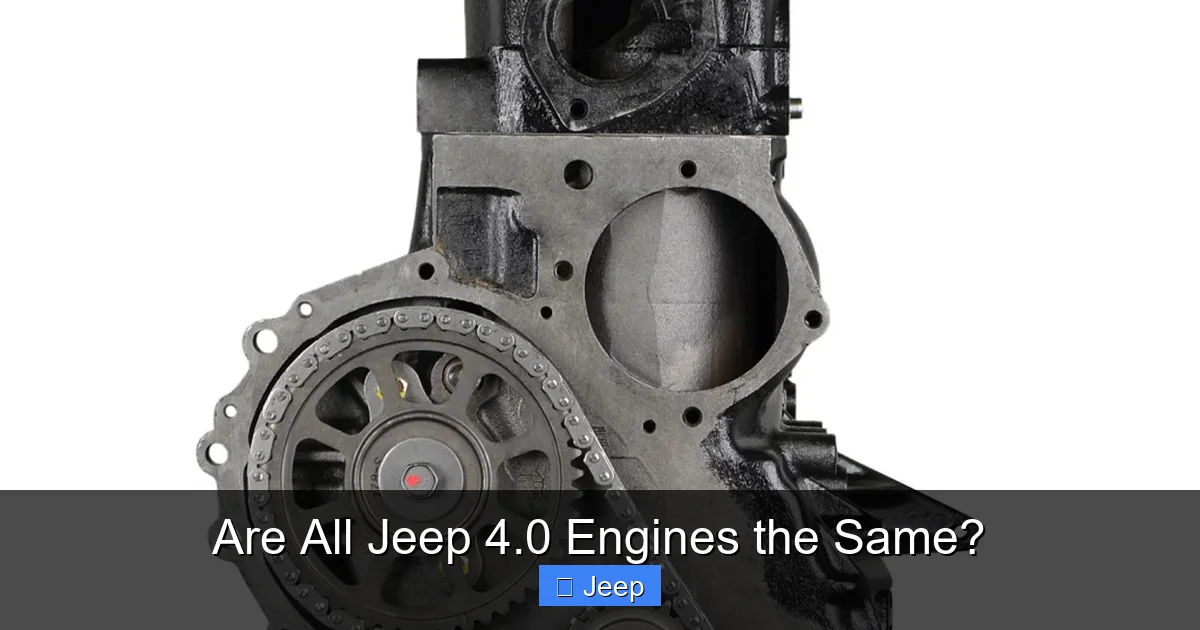
Visual guide about Are All Jeep 4.0 Engines the Same?
Image source: powertrainproducts.net
Cylinder Heads: The Most Critical Difference
The cylinder head is the single biggest point of divergence. You cannot swap a pre-1996 head onto a 1996+ block without serious machine work and compatibility issues.
- Pre-1996 Heads (253, etc.): These have smaller intake and exhaust ports. They use a different head bolt pattern and different rocker arm geometry. They are generally considered more robust and less prone to cracking than the early 0331 head.
- 1996-2000 0331 Head: This is the classic HO head. It flows much better but has a known weakness: the number 4 and 6 cylinder head bolts are too close to the water jacket, making it susceptible to cracking between the bolt holes if the engine overheats severely. This is a well-documented failure point.
- 2001-2006 “TUPY” or “051” Head: For the 2001 model year, Jeep finally fixed the 0331’s flaw with a new casting (TUPY or 051). It has redesigned, thicker sections around the problematic bolt holes. It also has slightly different valve cover bolt patterns and may use different rocker shafts. This is the most robust and desirable 4.0L head.
Practical Tip: If you’re rebuilding or replacing a head, identifying the casting number on the head itself is non-negotiable. A 2003 engine’s head is not a direct swap for a 1997’s.
Fuel Injection & Engine Management Systems
The “brain” of the engine changed completely.
- Renix System (1987-1995): Uses a Renix ECM. Sensors are different (like a throttle position sensor that is a potentiometer vs. a separate idle air control motor). The wiring harness is unique. This system is tunable but less common now.
- Chrysler PCM (1996-2006): This is the standard. It’s an OBD-II compliant computer. The sensor suite expanded dramatically (more oxygen sensors, a mass airflow sensor on later models, etc.). The connector plugs and pinouts are different from Renix.
You cannot just plug a 1994 Renix wiring harness into a 2000 PCM. The entire system must be considered as a unit. This is why engine swaps within the 4.0L family often require bringing the complete donor engine’s computer and wiring.
Intake Manifolds and Accessories
The HO engine’s longer intake manifold is a key visual identifier. But it’s not just length.
- The 1996+ intake has a different thermostat housing and coolant hose routing.
- Power steering pump brackets differ between XJ, TJ, and WJ applications. A Cherokee’s accessories may not bolt directly to a Wrangler’s engine without adapter brackets.
- The alternator position and mounting can vary, affecting serpentine belt routing.
These “small” differences are the bane of junkyard engine swaps. What looks like a perfect bolt-in may leave you with a misaligned power steering pump or a coolant leak because the thermostat housing doesn’t match your radiator hoses.
Model Year & Application Breakdown: XJ, TJ, WJ
The platform the engine is dropped into matters. A 4.0L in a 1999 Jeep Cherokee (XJ) is not identical to one in a 1999 Jeep Wrangler (TJ), even if the base engine code is the same.
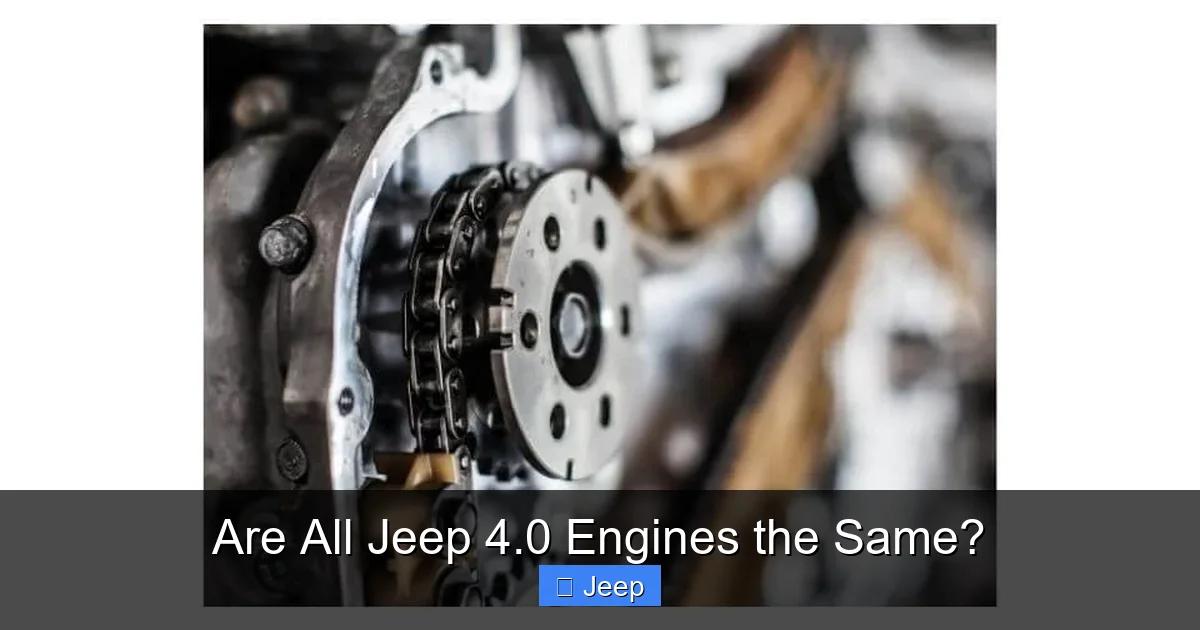
Visual guide about Are All Jeep 4.0 Engines the Same?
Image source: jeepmodified.com
Cherokee (XJ) 1987-2001
The XJ is the most common home for the 4.0L. The engine bay layout is well-documented. The 1991-1995 XJ engines are Renix. The 1996-2001 XJ engines are HO. The 1997-2001 models have a slightly different intake manifold (with a resonator box) compared to the 1996 model year. The 2000-2001 models may have a different style of fuel rail and injectors.
Wrangler (TJ) 1997-2006
The TJ Wrangler got the HO engine from day one (1997 model). However, the engine mounts are different from the XJ. The accessory drive (power steering, AC) is also uniquely configured for the TJ’s tighter engine bay. A TJ engine will physically bolt into an XJ, but you’ll likely need to swap the intake manifold (to match the XJ’s throttle body and IAC motor location) and possibly the motor mounts. This is a crucial point if you’re considering an engine replacement. For specific performance upgrades, you might want to check resources like the top 10 Jeep Wrangler 4.0 spark plugs guide, as plug type and gap can vary slightly by year and head design.
Grand Cherokee (WJ) 1999-2004
The WJ Grand Cherokee’s 4.0L is a different animal in terms of packaging. It uses the same HO block and 0331/TUPY heads, but the intake manifold is completely different (no throttle body on the front, it’s drive-by-wire later). The accessory brackets are unique to the WJ. The rear of the engine also has a different bellhousing pattern and mount points. Swapping a WJ engine into an XJ/TJ is a major fabrication project, not a simple bolt-in.
Common Issues & The “Best” Years
Not all 4.0Ls are created equal in terms of known problems. Your “best” year depends on your priority: absolute reliability, maximum power, or OBD-II compliance.
Visual guide about Are All Jeep 4.0 Engines the Same?
Image source: i.ebayimg.com
The 0331 Head Crack (1996-2000)
As mentioned, the 1996-2000 0331 head is the Achilles’ heel. Cracking typically occurs between the #4 and #6 cylinder head bolts on the exhaust side. This is often triggered by overheating, but the design is inherently weak. Symptoms include chronic coolant loss with no visible leak, white smoke, and milky oil. The fix is a replacement with a 2001+ TUPY head or a aftermarket aluminum head. If you’re looking at a used 1996-2000 Jeep, a thorough cooling system inspection and a compression/leak-down test is mandatory.
Oil Pan and Front Cover Leaks
These are the most common, annoying leaks on high-mileage 4.0Ls. The rubber seals on the oil pan and the front cover (behind the timing cover) dry out. The repair requires removing the oil pan or front cover, which is labor-intensive. These leaks plague all years but become common after 150,000 miles.
Which Years Are “Best”?
For a balanced view of reliability and power, the 2001-2006 models are widely considered the best. They have the robust TUPY head, refined PCM, and OBD-II system. They made 190 hp and 225 lb-ft of torque. For the purist who wants simplicity and is willing to sacrifice a bit of power, a well-maintained 1991-1995 Renix engine is incredibly tough, with fewer electronics to fail. Avoid 1996-2000 models unless you have verified the head is in perfect condition or it has already been replaced with a TUPY head.
Parts Compatibility: The Practical Reality
This is the most important section for DIYers. Here’s a quick-reference guide for common parts.
- Short Block (1991-2006): Mostly interchangeable. Pistons, rods, and crankshaft are the same across the HO years. A 1991 block is different (4.2L stroke), but a 1992 block can be a base for an HO build.
- Cylinder Heads: Never assume interchangeability. Pre-1996 heads won’t bolt to a 1996+ block. 0331 (96-00) and TUPY (01-06) are not the same. Intake manifolds must match the head.
- Intake Manifolds: Match the head and throttle body style. XJ and TJ manifolds are different. 1996 is a one-year-only manifold.
- Fuel Injectors: 1996-2000 injectors are different flow rates from 2001-2006. They are not interchangeable.
- Engine Computers (PCM/ECM): Completely generation-specific. A 1999 PCM will not run a 2003 engine correctly without extensive reprogramming or swapping the entire harness and sensors.
- Motor Mounts: XJ, TJ, and WJ all use different mount brackets and insulator designs.
- Oil Filter: The filter adapter changed. Early engines (Renix) used a canister-style filter with a separate cap. Later HO engines use a cartridge-style filter that screws onto a fixed adapter. The part numbers are different.
When in doubt, use your VIN to look up the exact engine code and application. Online forums for specific model years (like the Cherokee Forum or Wrangler Forum) are invaluable resources for cross-referencing part numbers.
Maintenance, Upgrades, and the Aftermarket
The good news is that the 4.0L’s popularity means an enormous aftermarket exists. But you must buy for your specific engine.
Oil & Filter Changes
This is the easiest. For 1996-2006 models, you’ll typically need a Cartridge Oil Filter (like the Mopar 68048965AA) and 6 quarts of 5W-20 or 5W-30 oil (check your manual, later models preferred 5W-20). For 1991-1995, you need a Canister Oil Filter (like the Mopar 5202847) and a filter cap o-ring. Using the wrong filter type is a common mistake.
Spark Plugs and Wires
The 4.0L uses one spark plug per cylinder, located under the exhaust manifold—a pain to reach. Gap is typically 0.035″ for most years, but verify. The 1996+ engines have a different coil-on-plug (COP) design compared to the older distributor cap and rotor system. The best spark plugs for a Jeep Wrangler 4.0 will be platinum or iridium for longevity, but the exact part number (e.g., NGK 6510 or Champion 7034) must be confirmed for your year and head type. Spark plug wires for the HO are also specific.
Performance Mods: What Works?
The 4.0L is a torque motor, not a horsepower motor. The most effective mods are:
- Exhaust: A true dual exhaust or a high-flow cat-back system can free up some power. Header options exist but require careful fitment checking.
- Intake: A cold-air intake can improve throttle response. Ensure it’s designed for your specific intake manifold and throttle body.
- Gearing: The 4.0L loves low gears. If you add larger tires (like 33s or 35s), re-gearing your axle ratios (to 4.10 or 4.56) is the single best way to regain performance and fuel economy. Speaking of tires, for off-road use, you’ll want something robust. Check out guides on the best 35-inch all-terrain tires for Jeep Wrangler or all-terrain tires for the Unlimited to match your new gearing and lift.
- Programming: A custom tune from a company like SCT or Diablosport can optimize the 1996+ PCM for minor intake/exhaust mods and adjust shift points in the automatic transmission.
Remember, the 4.0L’s redline is low (around 5,000 RPM). It’s designed for grunt, not revs. Don’t expect huge horsepower gains without forced induction, which is a complex and expensive project.
Conclusion: Knowledge is Power (and Savings)
So, are all Jeep 4.0 engines the same? emphatically, no. They are a family—a very close, resilient family—but they have distinct personalities shaped by two decades of engineering changes. The core inline-6 DNA is there: that smooth, torquey, go-anywhere character. But the details matter immensely.
Before you buy a used Jeep, ask for the VIN and decode it. Before you buy a “bolt-on” engine from a salvage yard, confirm the year, head casting number, and application (XJ, TJ, WJ). Before you order parts, double-check your engine bay. The differences between a Renix and a PCM engine, between an 0331 and a TUPY head, are the difference between a weekend wrenching project and a month-long headache.
The Jeep 4.0L’s legend is built on its simplicity and strength. By understanding its evolution, you honor that legacy. You become a smarter owner, a better diagnostician, and you’ll save a fortune on mis-ordered parts. That iron-block, six-cylinder heart has powered millions of adventures. Treat it right by giving it the specific, correct care it deserves based on its actual birth year. Your Jeep—and your wallet—will thank you.
Frequently Asked Questions
Can I put a 1998 Jeep Cherokee 4.0L engine into a 2002 Jeep Wrangler?
Physically, the block will bolt in, but it’s not a simple swap. You must also transfer the 1998 engine’s wiring harness, PCM, intake manifold (to match the Wrangler’s throttle body), and motor mounts. The 1998 has the 0331 head, which is less desirable than the 2002’s TUPY head. It’s often more practical to find an engine from the same model year or a later HO engine with all its配套 parts.
What is the difference between a 4.0L and a 4.0L HO engine?
The “HO” (High Output) designation started in 1996. The key differences are a revised cylinder head with better-flowing ports, a more aggressive camshaft, a longer intake manifold, and a different engine computer. This resulted in a noticeable improvement in power and torque over the pre-1996 “Renix” engines. All 1996-2006 4.0Ls are technically HO engines.
Is the 1996-2000 0331 head really that bad?
It has a documented weakness. The casting has thin metal between the #4 and #6 cylinder head bolts and the water jacket. If the engine ever overheats significantly (like from a failed thermostat, water pump, or radiator), it can crack in this area, leading to coolant in the oil or cylinders. Many owners proactively replace it with a 2001+ TUPY head or an aftermarket aluminum head for peace of mind, especially in high-heat situations like rock crawling or towing.
Which Jeep 4.0L year is the most reliable?
For a combination of robust design and modern OBD-II electronics, the 2001-2006 models are generally considered the most reliable. They have the fixed TUPY head, refined fuel injection, and fewer “first-year” bugs. A well-maintained 1991-1995 Renix engine is also incredibly simple and tough, but lacks the power and OBD-II diagnostics of later models. Avoid 1996-2000 models unless the head history is known and documented as good.
Do all Jeep 4.0 engines use the same oil filter?
No. There is a major split. 1991-1995 engines (Renix) use a traditional spin-on canister filter with a separate cap (Mopar 5202847). 1996-2006 engines (HO) use a cartridge-style filter that screws onto a fixed adapter on the engine block (Mopar 68048965AA). Using the wrong type will cause a major leak or prevent installation.
Can I upgrade my 4.0L with a 4.0L from a different Jeep model?
You can, but it’s complex. Swapping between XJ Cherokee and TJ Wrangler is the most common and feasible, but requires careful parts compatibility checks (intake manifold, motor mounts, possibly the exhaust manifold). Swapping in a WJ Grand Cherokee engine is a major fabrication project due to different bellhousing, mounts, and accessories. Always plan to bring the complete donor engine’s computer, wiring, and intake system to ensure compatibility.