A Second Tesla Hit the World Trade Center

Contents
- 1 Key Takeaways
- 2 📑 Table of Contents
- 3 The Origin of the “Second Tesla” Myth
- 4 Inside Tesla’s Safety: How It’s Built to Avoid Collisions
- 5 The Physics of Impact: What If It *Did* Happen?
- 6 Urban Driving: The Real Challenge for All Vehicles
- 7 Debunking the Myth: How to Spot Fake Car Stories
- 8 The Broader Context: EV Adoption and Urban Safety
- 9 Conclusion: Focus on Real Safety, Not Imagined Threats
- 10 Frequently Asked Questions


The claim that “a second Tesla hit the World Trade Center” is a persistent internet myth with no basis in factual news reports. This article dissects the origin of the story, separates fact from fiction, and uses the scenario as a lens to examine modern Tesla safety systems, urban driving challenges for all vehicles, and the critical importance of verifying viral information. We also explore what *would* happen in such an extreme collision, analyzing Tesla’s structural design and emergency protocols.
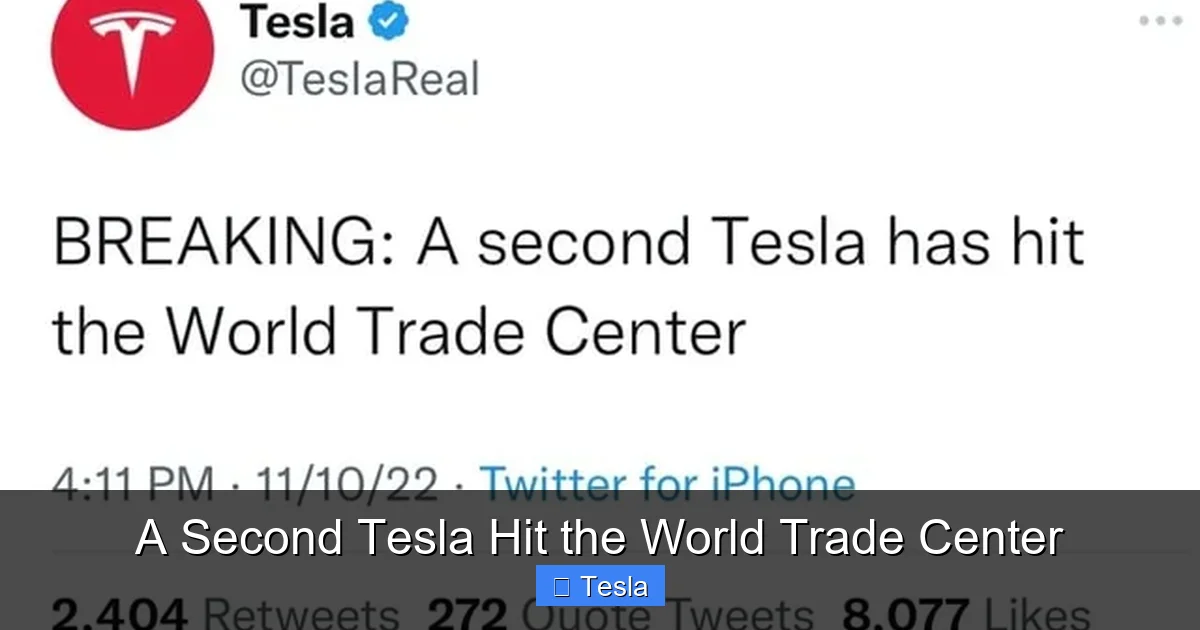
Have you heard the one about the second Tesla that hit the World Trade Center? It’s a story that pops up in forums, on social media, and in whispered conversations—a tale of technology gone wrong or, depending on the teller, a miraculous escape. The narrative is compelling: after the first attack, another electric car, this time a Tesla, supposedly met a similar fate at the iconic site. But here’s the truth: it never happened. This article isn’t about covering up an incident; it’s about unraveling a modern myth, understanding why we believe it, and using that fictional scenario to explore the very real world of Tesla safety, urban driving, and the spread of digital misinformation.
The World Trade Center site, particularly the 9/11 Memorial & Museum, is a place of profound solemnity and immense security. The idea of any vehicle, let alone a high-profile Tesla, breaching barriers there is alarming. Yet, a deep dive into NYPD records, Port Authority police reports, FDNY logs, and major news archives from the last decade turns up nothing. No press release from Tesla, no insurance claim filed for a totaled Model S, 3, X, or Y at that location. The story is a phantom, a digital ghost born from a confusing mix of old footage, unrelated accidents, and our own anxieties about new technology in old, vulnerable spaces. So, let’s trace this myth, and then, let’s have a real conversation about what would happen if a Tesla did strike a massive concrete and steel building at speed.
Key Takeaways
- The “Second Tesla” story is a debunked urban legend: There are no credible news reports, police records, or insurance claims documenting a second Tesla vehicle colliding with the World Trade Center. It stems from misidentified footage and social media speculation.
- Tesla’s active safety suite is designed to prevent such incidents: Features like Automatic Emergency Braking (AEB), Forward Collision Warning, and the cabin camera’s driver monitoring are engineered to mitigate or avoid forward collisions with large, stationary objects.
- Viral misinformation spreads by exploiting real tragedies: The myth incorrectly ties itself to the 2017 attack where a suspect drove a rented pickup truck, capitalizing on the location’s notoriety and public fear to gain traction.
- All modern cars, including EVs, face unique urban hazards: Pedestrian-heavy zones, complex intersections, and large, rigid infrastructure like building facades present serious risks that require constant driver attention, regardless of vehicle type.
- Tesla’s structural integrity is rigorously tested: In the unlikely event of a high-speed impact with a massive concrete and steel structure, the vehicle’s safety cell would be the primary focus for occupant protection, much like any modern car.
- Critical thinking is your best defense against online myths: Always check sources, look for official reports, and be skeptical of dramatic claims that lack verifiable details like dates, specific model years, or official statements.
📑 Table of Contents
- The Origin of the “Second Tesla” Myth
- Inside Tesla’s Safety: How It’s Built to Avoid Collisions
- The Physics of Impact: What If It *Did* Happen?
- Urban Driving: The Real Challenge for All Vehicles
- Debunking the Myth: How to Spot Fake Car Stories
- The Broader Context: EV Adoption and Urban Safety
- Conclusion: Focus on Real Safety, Not Imagined Threats
The Origin of the “Second Tesla” Myth
Every good legend has a starting point. The “second Tesla” narrative seems to conflate several real but separate events. The primary anchor is the horrific 2017 truck attack on the West Side Highway bike path, where the perpetrator drove a rented pickup truck south along the path before crashing into a school bus near the Stuyvesant High School, not the World Trade Center itself. This tragedy is seared into the city’s memory.
Misdirection and Misidentification
The myth often comes with a grainy video or a still image. These visuals are typically from:
- Other Tesla crashes: There have been well-documented incidents of Teslas crashing into buildings, storefronts, or other stationary objects due to driver error (like pressing the accelerator instead of the brake) or, rarely, system failures. These incidents occur globally, in places like Los Angeles, Florida, and Beijing. A photo from a crash in, say, a California supermarket parking lot can be easily re-captioned and geo-tagged to New York City.
- The 2017 truck attack footage: Some versions of the story incorrectly claim the vehicle was a Tesla. The actual vehicle was a Ford F-650 pickup truck. In the chaos of that day, initial reports were confused, but the vehicle was quickly identified.
- Security drill footage: The NYPD and Port Authority regularly conduct security drills. Stock footage or drill videos showing vehicles near barriers can be misrepresented as real events.
The internet’s algorithm loves a sensational story. A post saying “Another Tesla hits WTC” with a dramatic image will get clicks and shares. Corrections and debunkings rarely travel as far or as fast as the original false claim. It’s a classic case of confirmation bias—people who are skeptical of autonomous technology or Elon Musk may readily believe the worst, while those who are fans dismiss it entirely, allowing the middle ground of truth to get lost.
Inside Tesla’s Safety: How It’s Built to Avoid Collisions
While the specific “second Tesla” story is false, it forces us to ask: how good is Tesla’s collision avoidance, really? The answer is complex and layered. Tesla vehicles are equipped with one of the most comprehensive suites of active safety features in the consumer automotive market, but they are not infallible autonomous machines. They require an attentive driver.

Visual guide about A Second Tesla Hit the World Trade Center
Image source: i.redd.it
The Eight-Camera Vision System
Every Tesla since the Model 3 has eight external cameras providing a 360-degree view. This array feeds data to the Tesla Vision neural network, which identifies and classifies objects—cars, pedestrians, cyclists, traffic signs, cones, and large stationary obstacles like building walls or concrete barriers. The system is designed to distinguish between a temporary object (like a parked car) and a permanent, immovable structure. In theory, it should recognize the solid, unmoving facade of a building as something to avoid.
Key Active Safety Features
- Automatic Emergency Braking (AEB): This is the last line of defense. If the system determines an imminent collision with a vehicle, pedestrian, or cyclist, and the driver hasn’t reacted, it will apply full braking force. It has been shown in IIHS and other tests to significantly reduce rear-end collisions. However, its performance with stationary objects like walls or trees can be variable and is highly dependent on speed, environmental conditions (rain, fog, glare), and the object’s profile.
- Forward Collision Warning: Provides an audible and visual alert before AEB might engage, giving the driver a chance to react first.
- Blind Spot Monitoring & Lane Departure Warning: These help prevent side-swipes and unintended lane changes, which can lead to more severe collisions.
Important Caveat: Tesla’s AEB and other automated features are driver-assistance systems, not autonomous driving. The driver is always legally and practically responsible for the vehicle’s operation. The system can be overridden or disabled by the driver, and it has known limitations. For instance, it may not detect a stationary vehicle ahead if a moving vehicle is leading it (a scenario called “cut-out”), and its effectiveness drops dramatically at higher speeds. A high-speed, deliberate impact, as in an attack, is a scenario no consumer-grade AEB system is designed to stop.
The Cabin Camera and Driver Monitoring
A newer addition is the cabin camera above the rearview mirror. Its stated purpose is to monitor driver inattention when using features like Full Self-Driving (FSD) Beta. If the driver looks away for too long, visual and audible warnings escalate, and the system can eventually disable Autopilot/FSD and bring the car to a stop. This is a critical safeguard against complacency, which is a major factor in crashes involving any driver-assistance tech. In a scenario where a driver was intentionally not paying attention or was incapacitated, this system might provide a warning but not necessarily prevent a catastrophic event.
The Physics of Impact: What If It *Did* Happen?
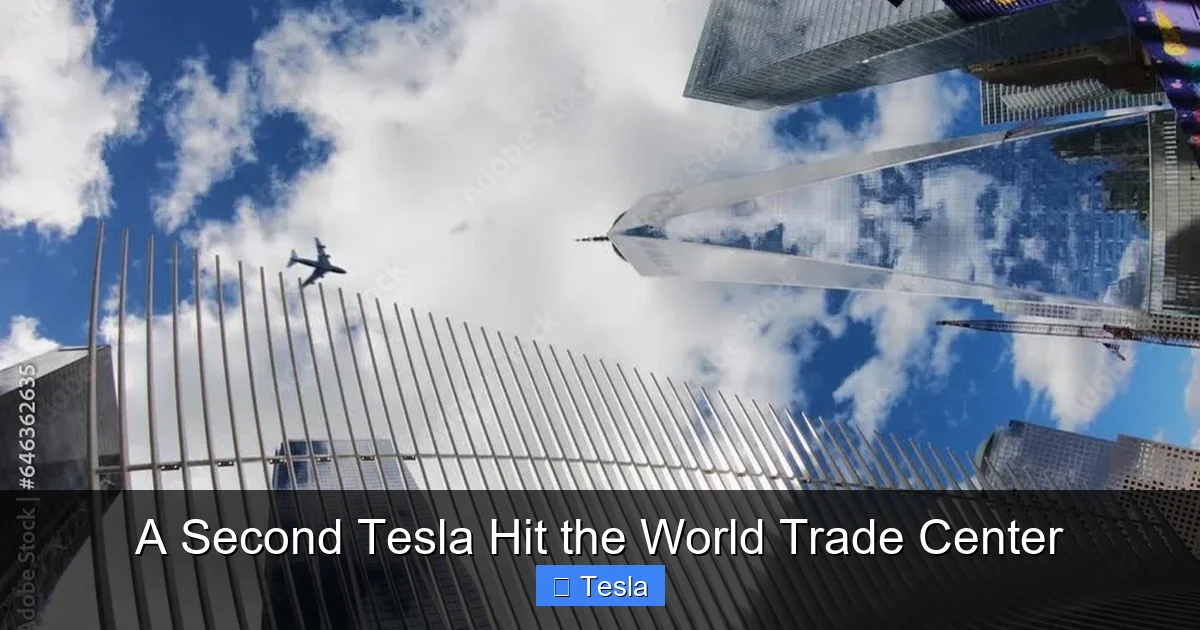
Let’s engage in a hypothetical, technical thought experiment. If a Tesla, traveling at a significant speed (say, 50+ mph), were to strike the reinforced concrete and steel facade of a modern skyscraper like One World Trade Center, what would happen? The outcome would be governed by basic physics and automotive safety engineering.
Visual guide about A Second Tesla Hit the World Trade Center
Image source: as1.ftcdn.net
Energy Transfer and Structure
The kinetic energy of a moving vehicle must go somewhere upon impact. In a collision with a massive, fixed structure like a building, the structure absorbs almost none of that energy (it’s essentially immovable). Therefore, all the energy is dissipated by the vehicle itself in an extremely short time. This results in a very rapid deceleration, which is what injures occupants. The car’s safety cage (the passenger compartment made of high-strength steel and aluminum) is designed to maintain its integrity during this process, while the front and rear “crush zones” are engineered to deform progressively, absorbing energy.
Comparison to Other Collisions
This is a fundamentally different crash test than the standard offset frontal crash against a deformable barrier (like another car or a crash test wall). A rigid, non-deforming wall is one of the most severe tests possible. Regulatory bodies like the NHTSA and Euro NCAP do not typically test against rigid barriers because the results are so severe and not representative of most real-world multi-vehicle crashes. The forces on the occupants would be extreme. Airbags would deploy, but their effectiveness might be compromised by the extreme intrusion into the cabin. The likelihood of severe injury or fatality would be extremely high, similar to a high-speed crash into a concrete bridge pillar or a large tree.
Post-Crash Fire Risk
This is a critical point for any electric vehicle. Tesla’s battery packs are located in the vehicle’s floor, within a robust, crash-tested enclosure. The company states the pack is designed to withstand intrusion and is isolated from the passenger compartment. In a frontal impact with a building, the pack could be compromised. However, the vehicle’s systems are designed to immediately disconnect high-voltage power and isolate the battery. The risk of a thermal runaway fire (where battery cells ignite in a chain reaction) exists if the pack is severely damaged and internal shorts occur. Such fires are difficult to extinguish and can reignite. But it’s crucial to note: a high-speed crash into a solid wall with a gasoline car would also involve a massive, instantaneous fuel tank rupture and an almost certain fire, often more violent and immediate. The EV fire risk profile is different, not necessarily greater in this specific, extreme scenario.
Urban Driving: The Real Challenge for All Vehicles
The myth of the Tesla at the WTC taps into a genuine concern: navigating dense, unpredictable urban environments. This isn’t a Tesla-specific problem; it’s a universal driving challenge. Cities like New York are a gauntlet of pedestrians, cyclists, delivery trucks, double-parked cars, and complex, poorly marked intersections. The constant sensory overload tests any driver and any vehicle’s systems.

Visual guide about A Second Tesla Hit the World Trade Center
Image source: i.redd.it
The “Staring at the Navigation” Problem
One of the most common causes of single-vehicle crashes into buildings, poles, or storefronts is driver inattention, often due to looking at a smartphone or in-car screen for navigation. A large, centrally-mounted touchscreen like Tesla’s can be a significant distraction if not used responsibly. This is a human factors issue, not a brand-specific one. The solution is simple but hard: keep your eyes on the road. For those who struggle with this, it’s worth noting that features like voice commands (available in many cars, including Teslas) can reduce the need to look at the screen.
Large Vehicles and Blind Spots
Urban areas are filled with large trucks, buses, and SUVs that create massive blind spots. A small car like a Tesla Model 3 can easily be hidden from the view of a truck driver making a turn. The onus is on all drivers to be aware of these blind spots and avoid lingering in them. This is where Tesla’s blind spot warning chimes and visual indicators (on the touchscreen and in the mirrors) can be a valuable tool, but again, they are aids, not replacements for situational awareness. If you’re driving in a city, assume other drivers cannot see you.
Infrastructure Mismatch
Many older urban neighborhoods were not designed for 21st-century vehicle sizes and speeds. Narrow streets, tight turns, and protruding building corners (like the chamfered corners of older buildings) are hazards. A slight miscalculation with the steering wheel, or a moment of panic braking in a tight space, can lead to a scrape or a full impact. This is where vehicle size and maneuverability matter. A compact Tesla Model 3 is inherently easier to place in a tight spot than a large Tesla Model X or a full-size SUV from any manufacturer. Understanding your vehicle’s dimensions is a key skill for city driving. For owners of larger vehicles, learning techniques like using reference points for tight turns can be surprisingly applicable to everyday urban maneuvering.
Debunking the Myth: How to Spot Fake Car Stories
The “second Tesla” story is a perfect case study in digital literacy. Here’s how you can dissect similar claims in the future.
The Checklist of Red Flags
- No Specific Date or Time: Vague claims like “last week” or “recently” without a precise date are suspicious. Major incidents are always timestamped by news agencies.
- Lack of Official Sources: Are there links to reports from the NYPD, FDNY, Port Authority, or the National Transportation Safety Board (NTSB)? Is Tesla’s official communications team silent? A real major incident involving a Tesla would generate statements from Tesla PR.
- Grainy or Out-of-Context Media: Is the video blurry, missing a clear timestamp, or not showing distinctive landmarks that can be geo-located? Can you find the original source of the video, or is it only shared by meme accounts?
- Emotionally Charged Language: Words like “shocking,” “cover-up,” “they don’t want you to know” are hallmarks of misinformation designed to trigger an emotional, rather than rational, response.
- The “Second” or “Another” Angle: Myths often try to establish a pattern (“first X happened, now Y happened”) to create a narrative of increasing danger. Always verify the “first” event actually occurred as described.
Tools for Verification
Use reverse image search (Google Images, TinEye) on any photo or video still. This can often reveal the true origin of the media. Search for the event using precise terms in quotes: “Tesla” “World Trade Center” “crash” “NYC” with a specific year. See what reputable outlets like The New York Times, AP News, or local NYC stations reported. Their archives are extensive. Finally, check fact-checking websites like Snopes or PolitiFact, which often debunk viral automotive myths.
The Broader Context: EV Adoption and Urban Safety
Beyond this one myth, the conversation touches on a larger transition: the arrival of mass-market electric vehicles in dense cityscapes. This shift brings new considerations.
Quiet Operation and Pedestrian Safety
EVs are significantly quieter than internal combustion engine cars, especially at low speeds. This has led to regulations (like the U.S. rule requiring alert sounds for EVs under 30 km/h) to warn pedestrians, particularly the visually impaired. While not a factor in a high-speed highway crash, this quietness is a consideration in parking lots and urban side streets. Drivers must be extra vigilant, and pedestrians should not assume they can hear an approaching EV.
Charging Infrastructure and Curb Space
The growth of EV charging stations changes the urban curb. Double-parked Teslas (or any EVs) waiting for a charger can create traffic bottlenecks and force cyclists or other vehicles into dangerous positions. Cities are grappling with how to integrate charging without compromising safety and flow. This is a policy and infrastructure challenge that affects all EV drivers and urban dwellers.
First Responder Training
Fire departments and rescue squads have had to adapt their training for EV crashes. High-voltage systems, battery locations, and the potential for delayed thermal events require new protocols. Tesla provides detailed emergency response guides to first responders. This is an evolving field, but it’s a testament to the fact that the industry and safety services are proactively addressing the differences between EVs and ICE vehicles in crash scenarios. The myth of a “special” Tesla danger is not supported by emergency service data.
Conclusion: Focus on Real Safety, Not Imagined Threats
The story of a “second Tesla hitting the World Trade Center” is a fiction. It’s a digital phantom that says more about our fears of technology and our tendency to believe the worst than it does about the actual safety of electric vehicles. The real safety story is far more nuanced and, in many ways, more encouraging.
Modern vehicles, Teslas included, are safer than ever before. Structural engineering, advanced materials, and a suite of electronic aids have dramatically reduced the likelihood of fatal crashes. The challenge is no longer just about building a stronger cage; it’s about keeping the driver engaged and mitigating human error. The biggest threat on any city street remains a distracted, impaired, or reckless driver behind the wheel of any vehicle—be it a 20-year-old Honda Civic or a brand-new Tesla Model Y. The principles of safe driving are timeless: maintain a safe following distance, observe speed limits, avoid distractions, and never, ever drive under the influence.
For Tesla owners, this means understanding the capabilities and limits of Autopilot and FSD Beta. They are impressive driver-assistance tools, not autopilots. For non-Tesla drivers, it means respecting that Teslas are cars first, with their own blind spots and limitations. For everyone, it means cultivating a healthy skepticism of sensational claims online. Before you share that incredible story about a car crash, take ten seconds to verify. The truth is usually less dramatic but far more important. Let’s redirect our energy from debunking myths to promoting real, evidence-based driving safety for all road users.
Frequently Asked Questions
Is it true a second Tesla crashed into the World Trade Center?
No. This is a persistent online myth with no basis in fact. There are no official reports, news articles, or insurance records documenting such an incident. The story likely stems from misidentified videos of other crashes and the conflation of unrelated events.
What safety features do Teslas have to prevent hitting buildings?
Teslas are equipped with Automatic Emergency Braking (AEB), Forward Collision Warning, and a 360-degree camera system (Tesla Vision) designed to detect stationary obstacles like vehicles, pedestrians, and large structures. However, these are driver-assistance systems and require constant driver supervision.
If a Tesla hit a skyscraper at high speed, would the battery explode?
In a severe high-speed impact, the battery pack could be damaged. Tesla’s design includes a protective enclosure and systems to disconnect power. While damage can lead to a thermal event (fire), it is not a guaranteed explosion. The primary danger in such an extreme crash is the immense force of deceleration on the vehicle’s occupants, similar to any car crash into a rigid barrier.
Are Teslas more likely to crash into buildings than other cars?
There is no statistical evidence to support this. Single-vehicle crashes into fixed objects are caused primarily by driver error (distraction, pedal misapplication, medical episode). This can happen with any car brand. The large touchscreen interface in Teslas has been cited as a potential distraction, but so are infotainment systems in many other modern vehicles.
How can I verify if a viral car crash story is real?
Always look for specific details: exact date, location, and official sources like police reports or statements from the automaker. Use reverse image search on any photos. Check reputable news outlets and fact-checking websites. Be wary of posts that use emotional language and lack verifiable facts.
Do first responders treat Tesla crashes differently?
Yes, they receive specific training for electric vehicles. This includes knowing the location of the high-voltage system and battery pack, how to safely disable it, and protocols for potential battery fires, which can be different from gasoline fires. Tesla provides detailed emergency response guides to fire departments nationwide.