
How Often Should I Change Oil in a 2017 Toyota Sienna?

For a 2017 Toyota Sienna, the standard manufacturer recommendation is to change the oil every 10,000 miles or 12 months when using 0W-20 synthetic oil. This interval is made possible by the advanced synthetic formulation and the vehicle’s sophisticated Oil Maintenance Monitor system. However, if your driving consists mostly of “severe conditions” like frequent short trips, extreme temperatures, or heavy loads, you should shorten this to every 5,000 miles. Always consult your owner’s manual and trust the vehicle’s oil life monitor for the most accurate guidance tailored to your specific driving habits.
Key Takeaways
- Standard Interval is 10k Miles: With 0W-20 synthetic oil, Toyota recommends a 10,000-mile/12-month interval under normal driving conditions.
- Synthetic Oil is Mandatory: The 2017 Sienna’s 3.5L V6 engine requires 0W-20 synthetic oil for proper lubrication and to achieve the extended drain interval.
- “Severe Service” Shortens Interval: Driving in conditions like extreme cold/heat, stop-and-go traffic, or towing requires changing oil every 5,000 miles.
- Trust the Oil Life Monitor: The vehicle’s computer calculates oil degradation based on engine revolutions, temperature, and driving patterns. Change oil when the maintenance light illuminates.
- Always Change the Filter: Replace the oil filter with every oil change. A high-quality filter is crucial for protecting your engine from contaminants.
- DIY vs. Professional: You can save money by changing it yourself, but a professional service ensures proper disposal, a multi-point inspection, and resets the maintenance light correctly.
📑 Table of Contents
Understanding Your 2017 Toyota Sienna’s Manufacturer Recommendations
Your 2017 Toyota Sienna is a marvel of reliable family transportation. It’s built on a platform known for longevity, with the 3.5-liter V6 engine (the 2GR-FKS) being a workhorse that can easily surpass 300,000 miles with proper care. The absolute cornerstone of that care is timely engine oil changes. Ignoring this simple service is the fastest path to expensive engine repairs.
So, what does Toyota itself say? The official recommendation, found in your owner’s manual, is clear: change the engine oil every 10,000 miles or 12 months, whichever comes first, when using Toyota Genuine Motor Oil or an equivalent 0W-20 synthetic oil that meets Toyota’s standards. This is a significant jump from the old 3,000-mile rule of thumb from the era of conventional oil. This extended interval is not just a marketing ploy; it’s a testament to the improved thermal stability and resistance to breakdown that modern full synthetic oils provide.
Decoding “Normal” vs. “Severe” Driving Conditions
The 10,000-mile interval applies only to what Toyota classifies as “normal” driving. It’s crucial to honestly assess your driving style and environment, as most drivers fall into the “severe” category. Severe service conditions include:
- Frequent trips of less than 5 miles in cold weather.
- Extensive idling or prolonged driving in stop-and-go traffic.
- Driving in extremely hot (above 100°F) or cold (below 0°F) climates.
- Accelerated driving, heavy braking, or carrying/towing heavy loads.
- Driving on dusty, sandy, or muddy roads.
If any of these sound like your typical week, you should adhere to the severe service schedule, which recommends an oil change every 5,000 miles or 6 months. The reason is simple: these conditions cause the oil to degrade faster through thermal stress, fuel dilution (from incomplete combustion during short trips), and contamination from particulates.
The Critical Role of 0W-20 Synthetic Oil
You cannot use conventional oil in your 2017 Sienna and expect the 10,000-mile interval to be safe. The engine is designed with tight tolerances that benefit from the superior flow properties of a 0W-20 synthetic. The “0W” means it flows like a thinner oil in cold starts (the “W” stands for winter), providing immediate lubrication to critical parts upon startup—which is when 80% of engine wear occurs. The “20” indicates its viscosity at operating temperature.
Using the correct oil is non-negotiable. It ensures proper fuel economy (a key feature of the Sienna), reduces emissions, and protects components like variable valve timing systems that are sensitive to oil quality. Always check that the oil you use carries the Toyota-approved specification, often marked as “ILSAC GF-6” or meets API SP standards. For more details on the differences between oil types, you can read our comprehensive guide on how often to change synthetic oil in a car.
The Genius of the Oil Maintenance Monitor (OMM) System
This is your best friend. Your 2017 Sienna is not a dumb machine; it’s equipped with an intelligent Oil Maintenance Monitor (OMM) system. This computer algorithm doesn’t just count miles; it calculates oil life. It monitors engine speed, coolant temperature, and driving patterns to determine how much the oil has actually degraded.

Visual guide about How Often Should I Change Oil in a 2017 Toyota Sienna?
Image source: video-thumbnails-1a.s3.amazonaws.com
Here’s how it works: When you start your car, the multi-information display on the dash may show “Oil Life: 100%.” As you drive, this percentage steadily decreases based on the factors mentioned above. A long highway cruise at steady speed degrades oil much slower than a 20-minute commute with dozens of stoplights. The system is calibrated to trigger a “Maintenance Required” light on your dashboard when the oil life reaches 15% or less, giving you ample time to schedule a service.
How to Check and Reset Your Oil Life Monitor
Checking your oil life is simple. Turn the ignition to “ON” (do not start the engine). Use the trip/odometer button on your instrument cluster to navigate until you see the “Oil Maintenance Required” or “Oil Life” percentage display. This should be your primary indicator, not a calendar or a preset mileage number.
After a professional or DIY oil change, the system must be reset. If it’s not reset, the light will come on prematurely, and the calculation will be thrown off. You can reset it yourself: With the car on “ON,” turn the key to “OFF,” then back to “ON” while holding the trip/odometer button. The display will count down and reset to 100%. Alternatively, any Toyota technician or reputable shop will do this as part of the service. For a general understanding of maintenance systems in new cars, our article on when to change oil in a new car provides helpful context.
The Non-Negotiable: Oil Filter Replacement
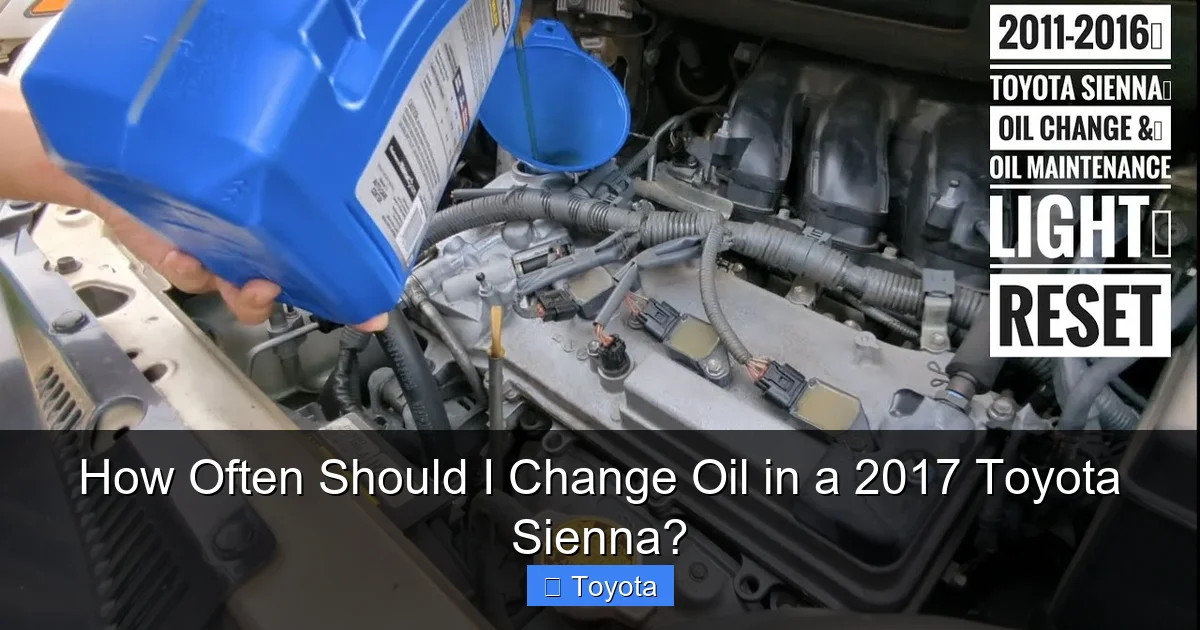
An oil change is incomplete without a new oil filter. The filter’s job is to capture metal shavings, carbon deposits, and other microscopic contaminants that circulate in your engine oil. A clogged filter restricts oil flow, causing starvation and wear. The filter on your Sienna is a cartridge-style filter, located under the engine, which is easy to access and replace.
Visual guide about How Often Should I Change Oil in a 2017 Toyota Sienna?
Image source: i.ytimg.com
The rule is absolute: change the oil filter with every oil change. There is no scenario where you skip it. When choosing a filter, opt for a reputable brand like Toyota Genuine, WIX, Fram, or Mobil 1. A cheap filter can have poor-quality media that doesn’t trap particles effectively or a faulty bypass valve that sends unfiltered oil through the engine. To understand the critical role of this component, read our dedicated piece on how often to change an oil filter.
DIY vs. Professional Oil Change: Weighing Your Options
Changing the oil in a Sienna is a straightforward, beginner-friendly task that takes about 30 minutes and requires basic tools (socket wrench, oil filter wrench, drain pan, funnel). If you enjoy working on your vehicle, it can save you $30-$50 per service. However, there are significant advantages to a professional service:

Visual guide about How Often Should I Change Oil in a 2017 Toyota Sienna?
Image source: motorbiscuit.com
- Comprehensive Inspection: A technician will check fluid levels (coolant, brake, transmission), tire pressure, belts, hoses, and perform a basic safety check.
- Proper Disposal: They handle the old oil and filter recycling for you, which is both convenient and environmentally responsible.
- Warranty & Record: Keeping all service records at a dealership or certified shop is invaluable for warranty claims and future resale.
- Peace of Mind: No risk of cross-threading the drain plug, over/under-filling, or forgetting to reset the OMM.
If you DIY, be meticulous. Use the correct oil (0W-20, about 6.4 quarts with filter), torque the drain plug to spec (30 ft-lbs), lubricate the new filter’s O-ring with fresh oil, and reset the maintenance light. The cost of a DIY change is primarily the price of the oil and filter.
What About Other Fluids? A Holistic Maintenance View
While engine oil is the lifeblood, your Sienna’s health depends on a complete fluid regimen. Neglecting these can cause just as much damage as skipped oil changes. For instance, coolant/antifreeze prevents overheating and corrosion; its change interval is typically every 100,000 miles but should be checked annually. Transmission fluid is another critical one; for the 2017 Sienna’s 6-speed automatic, Toyota states it’s “lifetime” fluid, but many experts recommend a check and potential change around 60,000-100,000 miles for optimal longevity, especially in severe service. Understanding the schedule for all your vehicle’s fluids is key. You can learn more about coolant intervals for Toyotas here.
Frequently Asked Questions
Can I use 5W-30 oil in my 2017 Toyota Sienna instead of 0W-20?
No. Toyota specifically designed the 2GR-FKS engine for 0W-20 oil. Using a different viscosity can affect fuel economy, variable valve timing operation, and may void part of your powertrain warranty. Always use the oil grade specified in your owner’s manual.
My Oil Maintenance light came on. How long can I drive before getting an oil change?
When the “Maintenance Required” light illuminates, it means your oil life is at 15% or less. You should schedule an oil change within the next 500 miles or as soon as possible. Driving beyond this point risks severe engine wear as the oil’s protective additives are depleted.
How do I reset the Oil Maintenance light after changing the oil myself?
Turn the ignition to “ON” (do not start). Use the odometer/trip button to display the odometer reading. Turn the key to “OFF,” then back to “ON” while continuing to hold the button. The display will show a series of dashes and then reset to “100%” after a few seconds. Release the button.
Is it okay to change my oil more often than the recommended interval?
Yes, changing your oil more frequently (e.g., every 5,000 miles) will not harm the engine and can provide extra peace of mind, especially in severe conditions. It’s a low-cost insurance policy. The only downside is the additional expense and environmental impact of more frequent oil disposal.
My Sienna has 150,000 miles. Should I still follow the 10,000-mile interval?
For high-mileage engines (over 100k miles), some owners prefer to shorten the interval to 7,500 miles as a precaution, even with synthetic oil. Worn seals and slightly larger internal clearances can sometimes benefit from fresher oil. Monitor your engine’s consumption and condition, and consider a high-mileage synthetic oil.
How can I manually check my oil level and condition between changes?
Park on level ground, engine off or after a short warm-up. Pull the dipstick, wipe it clean, reinsert fully, then pull again. Check that the oil level is between the “Min” and “Max” marks. Also, look at the oil’s color: it should be amber and translucent. If it’s very dark black, gritty, or milky (which indicates coolant leak), have it inspected immediately.
