
What Is the Scheduled Maintenance for a 2017 Toyota Camry

Adhering to the factory scheduled maintenance for your 2017 Toyota Camry is non-negotiable for reliability and value. This comprehensive guide breaks down the exact service intervals—from oil changes every 5,000 miles to major inspections at 100,000 miles—detailing what Toyota recommends at each step. Following this schedule protects your engine, ensures safety, maintains your warranty, and saves you from costly repairs down the road. We’ll walk you through each service point with practical tips to keep your Camry running smoothly for years.
Your 2017 Toyota Camry is more than just a car; it’s a reliable partner designed to deliver years of smooth, trouble-free transportation. But like any sophisticated machine, it demands respect through a disciplined maintenance regimen. The factory-scheduled maintenance plan isn’t a suggestion from Toyota—it’s a meticulously engineered roadmap created by the same engineers who built your engine and transmission. Ignoring it is the fastest way to turn your dependable Camry into a source of stress and unexpected expense. This guide will decode everything you need to know about the scheduled maintenance for your 2017 Camry, transforming you from a casual driver into an informed owner who can confidently discuss service intervals with any technician.
Key Takeaways
- The schedule is your Camry’s longevity blueprint: Toyota’s mileage-based intervals are engineered to address wear before it becomes a major failure, directly impacting the car’s lifespan and resale value.
- Oil changes are the cornerstone: The 5,000-mile/6-month interval for conventional oil (or 10,000 miles for synthetic) is the most critical repeated service to prevent engine sludge and wear.
- Tire maintenance is a safety and efficiency pillar: Regular rotations (every 5,000 miles) and pressure checks ensure even tread wear, optimal fuel economy, and safe handling, especially important for a sedan like the Camry.
- Fluids are your car’s lifeblood: Beyond oil, the schedule mandates checks and replacements for coolant, brake fluid, transmission fluid, and washer fluid at specific intervals to prevent system corrosion and failure.
- Inspections catch small problems early: Each service visit includes multi-point inspections of brakes, belts, hoses, steering, and suspension, allowing technicians to identify and recommend minor fixes before they escalate.
- The maintenance light is a helpful reminder, not a diagnosis: Understanding how to reset the maintenance required light after service is useful, but it does not replace the need for the actual scheduled work outlined in your owner’s manual.
- Keeping records protects your warranty: Meticulous documentation of all scheduled maintenance, performed at a Toyota dealer or certified shop, is essential for validating warranty claims on powertrain components.
📑 Table of Contents
- Understanding the 2017 Camry Maintenance Schedule: The Big Picture
- The 5,000-Mile / 6-Month Service: The Foundation of Engine Health
- The 10,000-Mile / 12-Month Service: Building on the Foundation
- The 30,000-Mile Service: A Major Milestone
- The 60,000-Mile Service: The Half-Century Mark
- The 100,000-Mile Service: The Century Mark & Long-Term Care
- Seasonal & General Maintenance Best Practices
- Conclusion: Your Investment in Peace of Mind
Understanding the 2017 Camry Maintenance Schedule: The Big Picture
Before we dive into the specific mileage markers, it’s crucial to understand the philosophy behind the schedule. Toyota divides maintenance into two primary categories: regular interval services (occurring frequently, like every 5,000 or 10,000 miles) and major interval services (occurring at higher milestones like 30,000, 60,000, and 100,000 miles). The regular intervals handle consumable items—oil, filters, tire rotations—while the major intervals involve more in-depth inspections and the replacement of longer-life fluids and components. The schedule is also “mileage or time” based, meaning you should adhere to whichever comes first. For example, an oil change is due every 5,000 miles or every 6 months, even if you’ve driven less.
Your owner’s manual is the ultimate authority, containing the exact factory table for your specific Camry model (LE, SE, XLE, etc.) and engine (2.5L 4-cylinder or 3.5L V6). While this guide covers the standard expectations, you should always cross-reference with your manual. Factors like severe driving conditions—frequent short trips, extreme temperatures, dusty environments, or heavy towing—can accelerate wear. Toyota often provides a “severe service” schedule that shortens some intervals. If your driving pattern fits this description, you should follow the more aggressive schedule to protect your investment.
Where to Find Your Official Schedule
The definitive source is the Maintenance Schedule section in your owner’s manual. It’s typically presented as a clear grid or table with mileage columns (e.g., 5k, 10k, 15k, etc.) and rows listing each service item. You’ll also find a helpful maintenance log at the back to stamp or sign off on each completed service. Many Toyota dealers also provide digital copies or can print one for you. Keeping this manual in your car is a smart habit.
The 5,000-Mile / 6-Month Service: The Foundation of Engine Health
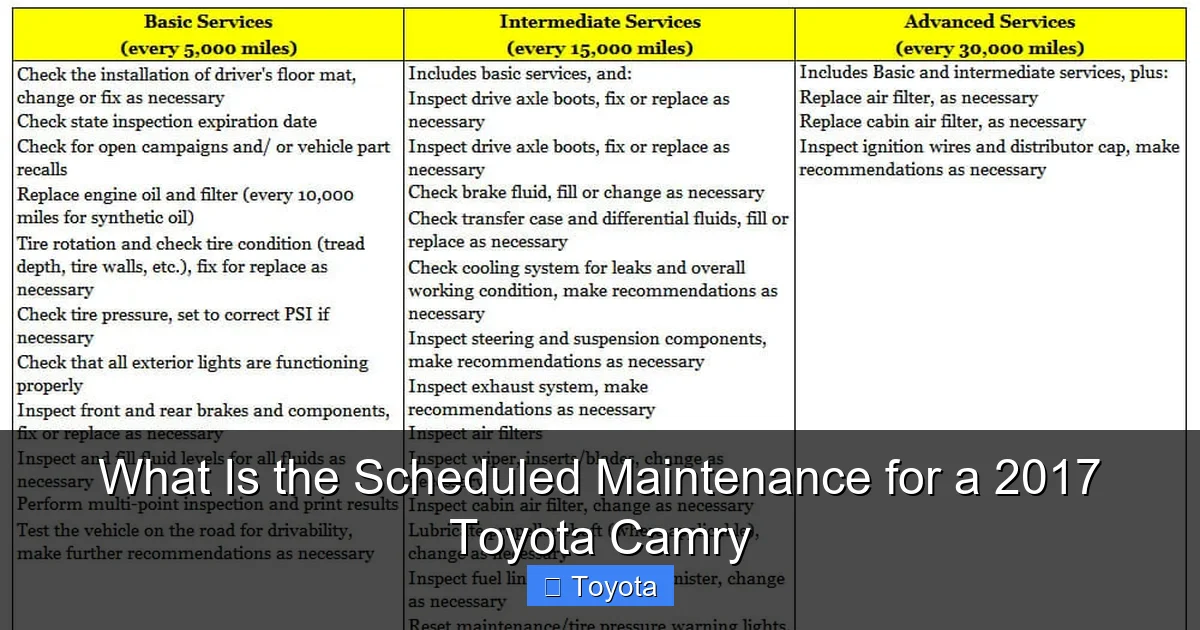
This is the most frequent and arguably the most important service on your list. At its core is the engine oil and filter change. For the 2017 Camry, Toyota recommends using genuine Toyota motor oil or an equivalent meeting Toyota’s specification. The type of oil dictates the interval:
Visual guide about What Is the Scheduled Maintenance for a 2017 Toyota Camry
Image source: res.cloudinary.com
- Conventional Oil: Change every 5,000 miles or 6 months.
- Synthetic Oil: Change every 10,000 miles or 12 months.
Most 2017 Camrys left the factory with a synthetic blend or full synthetic oil, so the 10,000-mile interval is common. However, if you use conventional oil or have a vehicle that was initially filled with it, stick to the 5,000-mile rule. Using the correct oil viscosity (likely 0W-20 for the 2.5L and 5W-20 for the 3.5L) is critical for fuel economy and engine protection.
This service is about more than just oil. It’s a comprehensive check-up that includes:
- Tire Rotation: Essential for even tread wear and prolonging tire life. The Camry’s front-wheel-drive layout causes front tires to wear faster, so rotating them every 5,000 miles balances the wear pattern.
- Multi-Point Inspection: The technician will check fluid levels (coolant, brake, power steering, washer), tire pressure and condition, lights, wiper blades, and look for any leaks.
- Brake Inspection: Measuring brake pad thickness and inspecting rotors for wear or scoring.
- Air Filter Check: The engine air filter is typically inspected and replaced if needed at this interval.
Practical Tip: While the maintenance light will remind you of this service, learn how to check your oil level manually. Pop the hood, pull the dipstick, wipe it clean, reinsert it fully, and then check the level. It should be between the “F” and “L” marks. Doing this once a month between services can alert you to a potential leak or consumption issue early. If you’re ever unsure about your tire pressure, the recommended PSI is found on a sticker inside the driver’s door jamb—not on the tire sidewall. Proper inflation is a huge factor in ride quality, handling, and fuel economy, topics we cover in our guide on correct tire pressure which applies similar principles to your Camry.
The 10,000-Mile / 12-Month Service: Building on the Foundation
If you’re on the synthetic oil schedule, your 10,000-mile visit coincides with a 12-month mark. This service largely mirrors the 5,000-mile service but with a few key additions and a focus on items that degrade slightly less quickly. The oil and filter change and tire rotation remain central. The multi-point inspection becomes even more important at this stage.

Visual guide about What Is the Scheduled Maintenance for a 2017 Toyota Camry
Image source: carmanualsonline.info
The notable additions at 10,000 miles often include:
- Cabin Air Filter Replacement: This filter cleans the air entering your HVAC system from pollen, dust, and pollutants. A clogged cabin filter reduces airflow and puts strain on the blower motor. It’s a quick, inexpensive fix that dramatically improves interior air quality.
- More Detailed Inspection: The technician will perform a more thorough check of the brake system, suspension components (shocks/struts, bushings), and steering linkage. They’ll also inspect the drive belts (serpentine belt) for cracks or fraying.
This is also a good interval to have your wheel alignment checked. Hitting potholes or curbs can knock your Camry out of alignment, causing uneven tire wear and a pull to one side. While not always on the strict schedule, an alignment check every 15,000-20,000 miles is a wise preventative measure.
The 30,000-Mile Service: A Major Milestone
Reaching 30,000 miles is a significant checkpoint. This major service incorporates all items from the previous intervals but adds several critical replacements and inspections that are vital for your Camry’s long-term health. It’s more comprehensive and consequently more expensive, but it’s an investment that prevents cascading problems.

Visual guide about What Is the Scheduled Maintenance for a 2017 Toyota Camry
Image source: ncitadvantage-com.cdn-convertus.com
Key components addressed at 30,000 miles typically include:
- Engine Air Filter Replacement: While inspected at 5k/10k, it’s usually replaced at 30k to ensure optimal engine breathing and performance.
- Fuel Filter Replacement: On most 2017 Camry models, the fuel filter is integrated into the fuel pump assembly inside the tank and is not serviceable until much later (often 100k+). However, if your model has an in-line fuel filter, it may be replaced here. Your manual will specify.
- Transmission Fluid Inspection/Service: This is a crucial one. For the 6-speed automatic transmission in the 2.5L models, Toyota often recommends a “fluid exchange” or inspection at 30,000 miles. For the 8-speed in the 3.5L V6, the first service might be at 60,000 miles. Transmission fluid degrades over time, and a proactive service can extend transmission life dramatically. This is a common point of confusion, so your manual’s exact recommendation is essential.
- Coolant System Service: The engine coolant (antifreeze) degrades and loses its protective properties. At 30,000 miles, it’s often inspected, and a full drain-and-fill may be recommended at 60,000 or 100,000 miles depending on the type of coolant used.
- Brake Fluid Flush: Brake fluid is hygroscopic, meaning it absorbs moisture from the air over time. This lowers its boiling point and can lead to brake fade or internal corrosion. A flush is typically recommended every 30,000 miles or 2-3 years.
- Spark Plug Replacement: For the 2.5L 4-cylinder, plugs are often replaced at 30,000 miles. The 3.5L V6 may go to 60,000 miles. Worn plugs cause misfires, poor fuel economy, and hard starts.
- Comprehensive Chassis Lubrication: Greasing front suspension and steering components if applicable (some later models have sealed-for-life parts).
This service is also when a very detailed inspection of all belts, hoses, and the exhaust system should be performed.
The 60,000-Mile Service: The Half-Century Mark
The 60,000-mile service is essentially a repeat and reinforcement of the 30,000-mile service, with a few new items added. It’s the second major milestone. You can expect all the 30k items (oil change, filter replacements, brake fluid flush, etc.) to be performed again, as their intervals have come due for the second time.
New items at 60,000 miles frequently include:
- Transmission Fluid Service (if not done at 30k): For many V6 Camrys, this is the first transmission fluid service. This is non-negotiable for transmission longevity.
- Differential Fluid Service (AWD Models): If you have a 2017 Camry AWD (available on SE and XLE V6), the rear differential fluid must be changed at this interval.
- Spark Plug Replacement (if not done at 30k): For the 4-cylinder engines that had a 60k plug interval.
- Thorough Inspection of Major Components: An even closer look at the timing belt/chain (the Camry uses a timing chain, which is generally “lifetime” but still inspected), water pump, and all major hoses for any signs of impending failure.
- Battery Check: A thorough load test on the battery. At 6 years old, it’s nearing the end of its typical lifespan.
This service is about proactive replacement of wear items before they fail in a inconvenient or damaging way. The cost of a fluid flush is minor compared to a tow bill and a rebuilt transmission.
The 100,000-Mile Service: The Century Mark & Long-Term Care
Hitting 100,000 miles is a testament to your Camry’s durability and your commitment to maintenance. This is the most extensive service on the schedule. It includes everything from the 60,000-mile service plus several long-overdue replacements that are critical for the next 100,000 miles.
Major items at 100,000 miles typically include:
- All Fluids Changed: This is the big one. Engine oil (of course), transmission fluid, differential fluid (AWD), coolant, and brake fluid should all be fresh. This gives you a clean slate for the next 100k.
- Timing Chain Inspection: While Toyota timing chains are designed to last the life of the engine, at 100k miles a thorough inspection for wear, tensioner condition, and guide integrity is mandatory. Listen for any rattling on cold start—a potential sign of wear.
- Water Pump Inspection: Often driven by the timing chain, the water pump’s condition is assessed. Replacement is not routine but is recommended if any signs of leakage or bearing wear are found.
- Major Suspension & Steering Overhaul: All bushings, ball joints, tie rod ends, and shock absorbers/struts are thoroughly inspected. Worn components are typically replaced at this stage. The hold button on your Camry might be related to transmission or hill-hold functions, but it’s not directly tied to this 100k service—it’s more of a driver-assist feature you should be familiar with for daily use.
- Fuel System Cleaning: A professional fuel system cleaning (injectors, throttle body, intake valves) can restore performance and fuel economy that may have degraded over 100k miles.
- Complete Battery Replacement: Statistically, your original battery is likely at the end of its life. Proactively replacing it prevents a stranded situation.
After the 100k service, the cycle essentially resets. You’ll continue with your 5k/10k oil changes and tire rotations, with the next major fluid and inspection milestone coming at 120k-150k miles, depending on the specific item.
Seasonal & General Maintenance Best Practices
The scheduled maintenance plan is your backbone, but smart owners layer on additional care. Seasonal checks are a perfect example. Before winter, ensure your coolant mixture is correct for freezing temperatures (a refractometer test is best), check your battery’s cranking amps (cold weather kills weak batteries), and switch to winter wiper blades if you live in a snowy climate. Before summer, verify your air conditioning is blowing cold and check all fluid levels as heat increases evaporation.
Additionally, cultivate these habits:
- Monthly: Check tire pressure when cold. Check all fluid levels (oil, coolant, brake, washer). Look under the car for leaks.
- Every Fill-Up: Clean your windshield. A clean windshield reduces eye strain and improves visibility.
- Listen and Feel: Pay attention to new noises (squeals, clunks, rattles), vibrations, or changes in braking/steering feel. Report these to your technician immediately—they are your car’s way of talking to you.
- Wash Regularly: Road salt and grime accelerate corrosion, especially on brake components and undercarriage.
Understanding your vehicle’s systems helps. For instance, knowing the size of your Camry’s gas tank (typically 15.8 gallons) gives you a better sense of your real-world range and helps you diagnose fuel gauge issues. Similarly, being aware of your tire size (common sizes are P215/55R17 or P225/50R18) is crucial when replacing tires or checking for correct inflation, which you can learn more about in our dedicated article on 2017 Camry tire sizes.
Conclusion: Your Investment in Peace of Mind
Following the scheduled maintenance for your 2017 Toyota Camry is the single most effective way to ensure it delivers on its legendary promise of reliability. It’s a contract between you and your vehicle: you provide the care, and it provides safe, dependable transportation. The upfront cost of regular maintenance is a fraction of the cost of major repairs, not to mention the invaluable benefit of avoiding a breakdown on a road trip or during your daily commute. Keep your owner’s manual handy, establish a relationship with a trusted Toyota technician or dealer, and keep meticulous records of every service. When the time comes to sell, a fully documented maintenance history will make your Camry stand out and command a higher price. Treat your Camry well, and it will reward you with hundreds of thousands of miles of driving pleasure.
Frequently Asked Questions
What is the oil change interval for a 2017 Toyota Camry?
It depends on the oil type. With conventional oil, change every 5,000 miles or 6 months. With synthetic oil (which most 2017 Camrys use), the interval extends to every 10,000 miles or 12 months. Always follow the recommendation in your owner’s manual.
How often should I rotate the tires on my 2017 Camry?
Tire rotations should be performed every 5,000 miles to promote even tread wear. This is typically done at every other oil change if you’re on the 10,000-mile synthetic oil schedule.
How do I reset the “Maintenance Required” light on my 2017 Camry?
After completing the scheduled service, you can reset the light. Turn the ignition to “ON” (do not start). Using the odometer display, navigate to the “Settings” menu, select “Maintenance,” and then “Reset.” Confirm the reset. The light should go out. Note that resetting the light does not complete the maintenance work itself.
Can I use a different brand of oil than Toyota genuine oil?
Yes, as long as the oil meets Toyota’s official specification and has the correct viscosity (likely 0W-20 for the 2.5L 4-cylinder). Look for oils with the API “Starburst” symbol and that state they meet Toyota’s requirements (e.g., “Toyota Genuine Motor Oil” or an equivalent ILSAC GF-6 standard).
When does the coolant need to be replaced?
For the 2017 Camry, the factory fill coolant is designed to last a long time. The schedule often calls for an inspection at 30,000 miles and a full replacement at 100,000 miles or 10 years, whichever comes first. Severe service may require earlier replacement.
What are the most critical services at the 60,000-mile mark?
The most critical are transmission fluid service (especially for the 3.5L V6 with the 8-speed transmission), spark plug replacement, brake fluid flush, and a comprehensive inspection of all belts, hoses, and suspension components. Proactively addressing these items is key to avoiding expensive future repairs.
