
How Often Should I Change the Engine Air Filter on a Toyota Sienna?

For a Toyota Sienna, Toyota typically recommends changing the engine air filter every 30,000 miles or every 2 years, whichever comes first. However, this is a general guideline. Your actual replacement interval can be significantly shorter if you frequently drive in dusty, polluted, or high-traffic areas. Regularly inspecting the filter is the best practice, as a clogged filter reduces fuel economy, lowers engine power, and can cause long-term damage. Ultimately, a simple visual check is more reliable than a rigid mileage schedule for ensuring your Sienna’s performance and longevity.
Key Takeaways
- Stick to the 30k/2-Year Rule as a Baseline: Toyota’s official maintenance schedule for the Sienna suggests replacing the engine air filter every 30,000 miles or 24 months. This is your starting point for planning.
- Your Driving Environment is the Biggest Factor: If you drive on dirt roads, in heavy construction zones, or in areas with high pollen or pollution, you may need to change the filter every 10,000-15,000 miles.
- Learn to Check It Yourself: The filter is easy to access and inspect. A quick visual check every oil change (every 5,000-10,000 miles) lets you see dirt and debris buildup before it becomes a serious problem.
- A Dirty Filter Hurts Performance and Economy: A clogged filter restricts airflow, forcing the engine to work harder. Expect reduced horsepower, poorer fuel economy (by up to 10%), and a possible “rough idle.”
- DIY is Simple and Saves Money: Replacing the engine air filter on a Sienna is a straightforward 10-15 minute job requiring no tools on most models. The part costs $15-$40, versus $70-$120 at a shop.
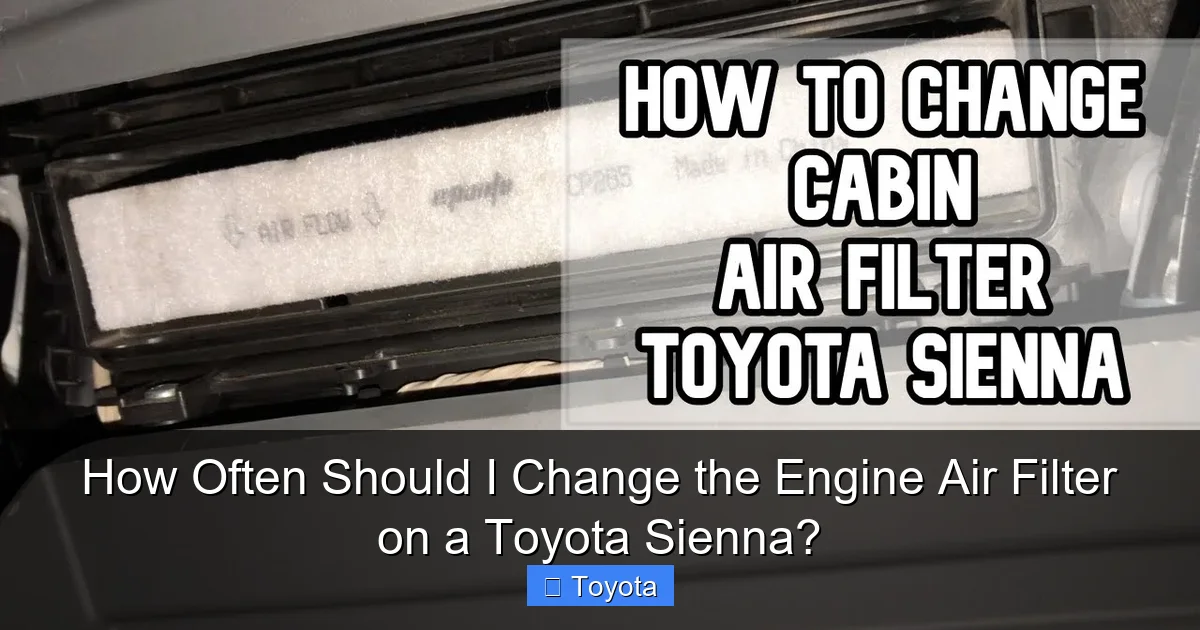
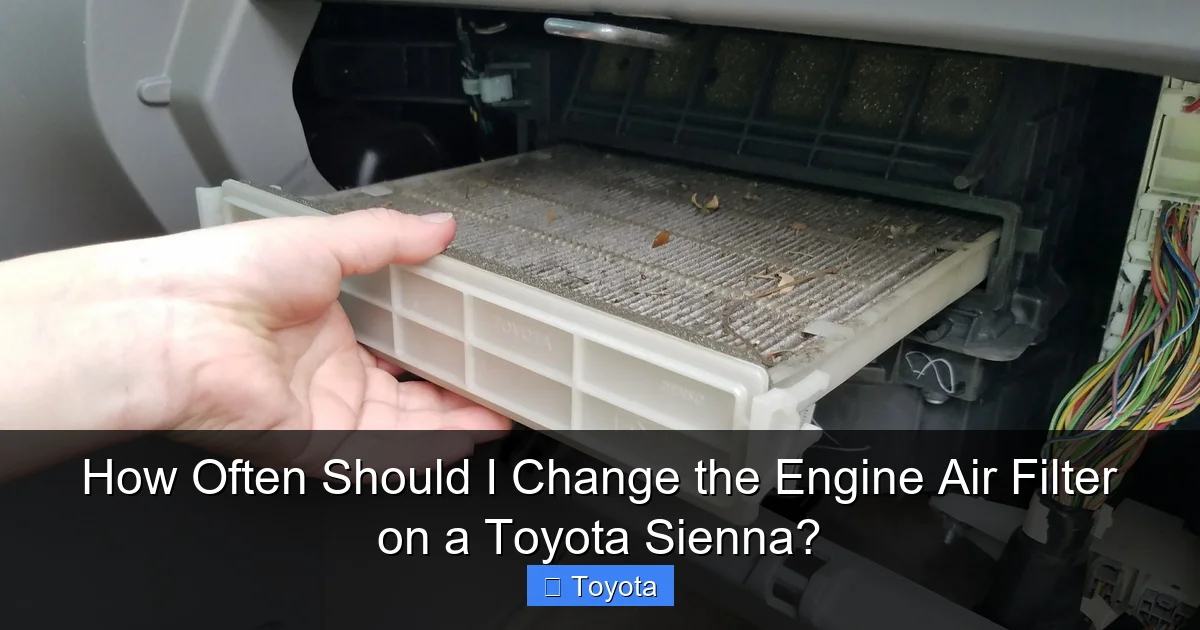
- Never Confuse It With the Cabin Air Filter: The engine air filter cleans air entering the engine. The cabin air filter cleans air entering your minivan’s interior. They are two different filters with different service intervals.
- High-Mileage Siennas Need Extra Attention: On a Sienna with over 150,000 miles, consider inspecting the filter with every oil change. Worn engines can be more sensitive to airflow restrictions.
📑 Table of Contents
- Understanding the Critical Role of Your Sienna’s Engine Air Filter
- Toyota’s Official Recommendations and Model Year Variations
- Real-World Factors That Shorten Your Replacement Interval
- How to Check Your Engine Air Filter: A Simple DIY Guide
- DIY vs. Professional Replacement: Making the Right Choice
- The True Cost: What Happens If You Ignore the Air Filter?
- Conclusion: A Simple Habit for a Healthy, Long-Lasting Sienna
Understanding the Critical Role of Your Sienna’s Engine Air Filter
Imagine your Toyota Sienna’s engine as a giant, powerful set of lungs. To breathe deeply and perform at its best, it needs clean, unrestricted air. That’s the sole job of the engine air filter: to be the gatekeeper. It sits in the air intake system, trapping dust, pollen, dirt, debris, and even insects before they can enter the combustion chambers. Without it, these abrasive particles would grind against delicate engine components like pistons and cylinder walls, causing catastrophic wear in a matter of miles.
For a vehicle like the Sienna, which is often used for family road trips, hauling cargo, and commuting in all kinds of conditions, this little filter is a workhorse. It works tirelessly every time you start the engine. When it’s clean and functioning properly, you likely don’t even notice it. But when it becomes clogged with contaminants, the effects ripple through your entire driving experience. It’s not just an “optional” maintenance item; it’s a fundamental component for protecting your $3,000-$6,000 engine investment and ensuring your minivan remains reliable and efficient for years to come.
How the Engine Air Filter Works in Your Minivan
The air filter is typically housed in a rectangular or round plastic box called the air filter housing, located in the engine bay. As the engine sucks in air for combustion, that air is forced through the filter media—a pleated, porous material usually made from cotton, paper, or synthetic fibers. The tiny gaps in this media allow air molecules to pass through while capturing solid particles. Modern filters are designed to be highly efficient, often stopping 95-99% of contaminants without significantly restricting airflow.
In your Sienna, the filter’s location means it’s exposed to the heat of the engine bay and the elements drawn in from the front grille. Over time, the accumulated grime on the filter media begins to physically block the passage of air. Think of it like trying to breathe through a thick, damp cloth—it gets harder and harder to pull enough air through. The engine’s computer (ECU) detects this restriction via sensors and compensates by dumping more fuel into the mixture to maintain power, a state known as running “rich.” This is the starting point for all the problems a neglected filter causes.
The Cascade of Problems Caused by a Clogged Air Filter
When airflow is restricted, your Sienna’s engine cannot operate at its optimal air-to-fuel ratio (the ideal is 14.7 parts air to 1 part fuel). The immediate consequences are noticeable:
- Reduced Power and Acceleration: The engine feels sluggish, especially when trying to pass on the highway or merge. You’ll press the gas pedal and feel a delay before the van responds. This is because the engine is literally starved for oxygen needed for efficient combustion.
- Poor Fuel Economy: This is a big one for a family hauler. The engine’s computer, sensing the lean condition (less air), adds more fuel to compensate. This rich mixture burns less efficiently, meaning you’ll be visiting the gas station more often. Studies show a severely clogged filter can reduce MPG by 5-10%.
- Rough Idle and Misfires: At a stoplight, your Sienna’s engine might shudder or feel rough. In extreme cases, the imbalance can cause spark plugs to foul or lead to misfires, triggering the dreaded check engine light. While a dirty air filter is a common cause, it’s important to get the code read properly to diagnose the exact issue.
- Increased Engine Wear: If the filter is so clogged that it collapses or allows dirt to bypass it (through a failed seal), abrasive particles enter the engine. This leads to accelerated piston ring and cylinder wall wear, a costly repair that no Sienna owner wants to face.
Toyota’s Official Recommendations and Model Year Variations
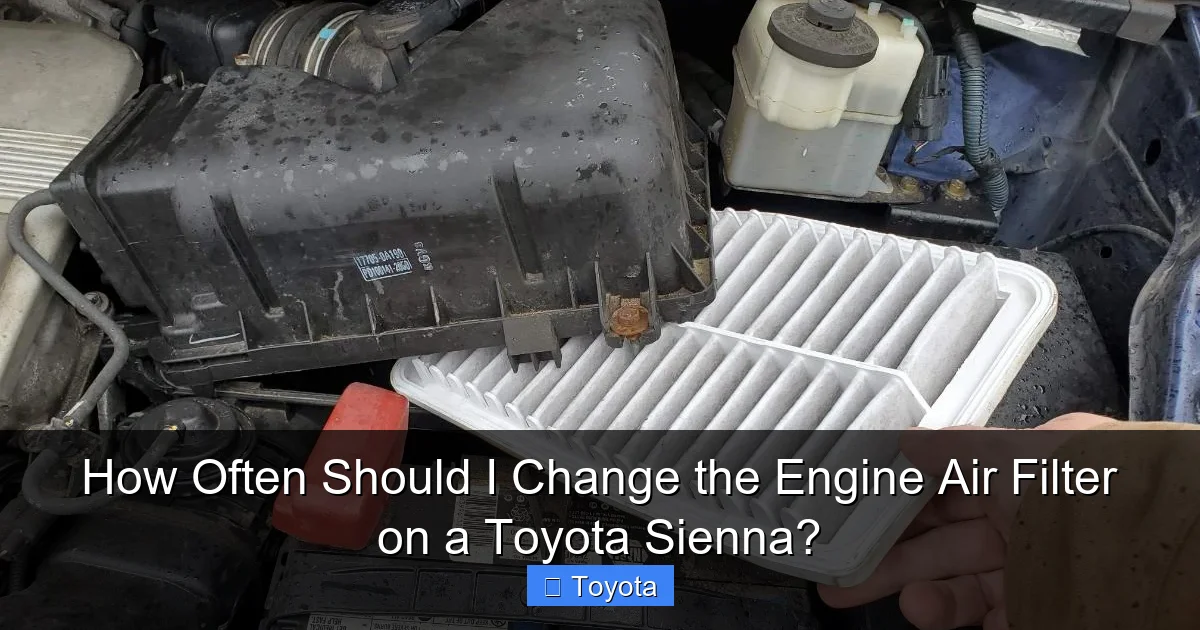
To answer the core question directly, we turn to the source: Toyota’s factory maintenance schedule. For the Toyota Sienna, the general recommendation for engine air filter replacement is every 30,000 miles or every 24 months, whichever comes first. This interval is baked into the “maintenance-required” system in most model years, which will remind you via the dashboard multi-information display when it’s time for this specific service, among others.
Visual guide about How Often Should I Change the Engine Air Filter on a Toyota Sienna?
Image source: practicalmechanic.com
However, it’s crucial to understand that this is a “normal” driving condition interval. Toyota defines “normal” as mostly highway driving in relatively clean, non-dusty environments. For the Sienna, which has seen multiple generations (from the XL10 to the current XL40), this 30k/24-month guideline has been consistent for the last 15 years. But you should always double-check your specific model year’s owner’s manual, as there can be slight variations. For instance, some older models (pre-2004) or certain market-specific versions might have a 15k-mile interval for extreme conditions.
Decoding the “Severe” vs. “Normal” Service Schedule
Every Toyota owner’s manual includes two maintenance schedules: “Normal” and “Severe.” The “Severe” schedule is what most Sienna drivers actually fall under, and it shortens many intervals, including the air filter. Conditions that classify as “Severe” include:
- Driving primarily in heavy city traffic with frequent stops and starts.
- Operating in extremely dusty, sandy, or muddy areas (common for Siennas used for camping, worksite transport, or in agricultural regions).
- Driving in areas with high air pollution or pollen counts.
- Extensive idling or short-trip driving (where the engine never fully warms up, allowing moisture to accumulate in the oil and air intake).
- Towing a trailer or camper on a regular basis, which puts additional load and heat on the engine.
If your Sienna’s life matches any of the above, you should adopt the “Severe” schedule, which often calls for air filter inspection at every oil change and replacement every 15,000-20,000 miles. For a family that takes the Sienna on vacation to national parks (dusty trails) or lives in a desert region, this more aggressive schedule is not overly cautious—it’s necessary.
Real-World Factors That Shorten Your Replacement Interval
Mileage and time are just numbers on a calendar. The true health of your air filter depends entirely on the volume and type of contaminants it has trapped. Let’s break down the key factors that can turn a 30,000-mile filter into a 10,000-mile filter.
Visual guide about How Often Should I Change the Engine Air Filter on a Toyota Sienna?
Image source: i.ytimg.com
The Environment You Drive In
This is the single most important variable. A Sienna driven exclusively on clean, paved highways in a rural area will have a filter that looks almost new at 30,000 miles. Contrast that with a Sienna that:
- Follows trucks on gravel or dirt roads: This throws a constant spray of fine silica dust into the air intake. Silica is incredibly abrasive and will fill a filter’s pleats quickly.
- Operates in urban areas with high pollution: Particulate matter (PM2.5, soot) from diesel engines and industrial activity is finer and can embed deeper into filter media.
- Experiences heavy pollen seasons: While not abrasive, pollen can saturate a filter, especially when combined with moisture, reducing its effectiveness and potentially leading to mildew smells in the cabin if the cabin filter is also affected.
- Drives through construction zones: sawdust, drywall dust, and fine concrete particles are excellent at clogging filters rapidly.
If your Sienna’s life involves any of these conditions regularly, mentally halve the recommended interval. It’s better to change it too soon than too late.
Driving Style and Vehicle Usage
How you use your Sienna matters. A vehicle used for daily, short 5-mile school runs and grocery trips will accumulate contaminants differently than one used for weekly 300-mile highway trips. Short trips don’t allow the engine to reach full operating temperature, which can cause moisture from the air to condense in the air intake system. This moisture can mix with dust to form a muddy paste that cakes onto the filter, restricting airflow more than dry dust alone. Furthermore, if your Sienna is frequently loaded with 7-8 passengers and luggage, the engine works harder overall, pulling in more air volume and thus more contaminants over the same distance.
The Age and Condition of Your Sienna
This is a critical point for owners of high-mileage Siennas. A well-maintained 200,000-mile Sienna with a history of regular air filter changes is a testament to Toyota’s durability. However, as engines age, clearances can wear slightly, and the engine management system might run slightly less efficiently. An older engine can be more sensitive to airflow restrictions. Therefore, for Siennas with over 150,000 miles, we strongly recommend inspecting the air filter at every oil change (every 5,000-7,500 miles) and being prepared to replace it at the first sign of significant dirt. A clean air filter helps an aging engine breathe easier and perform as well as it can. If you’re considering a high-mileage Sienna, its maintenance history—including air filter changes—is a key indicator of its overall health. For more on this, you can read our article on Should I Buy a Toyota Sienna With 200K Miles?.
How to Check Your Engine Air Filter: A Simple DIY Guide
You don’t need a mechanic’s license to know if your filter needs changing. It’s one of the easiest checks on your Sienna. You should visually inspect the filter at least once or twice a year, or at every oil change if you drive in severe conditions. The process takes 5 minutes.
Visual guide about How Often Should I Change the Engine Air Filter on a Toyota Sienna?
Image source: practicalmechanic.com
Step 1: Open the Hood. The air filter housing is in the engine bay. First, you need to get the hood up. The release latch is inside the car, under the dashboard on the driver’s side. Pull it. Then, go to the front of the Sienna, find the secondary latch under the hood lip (usually near the center or slightly to the passenger side), and slide it to release the hood. Use the prop rod to hold it open. If you’re unfamiliar with this process, our detailed guide on how to open the hood on a Toyota Sienna has step-by-step photos for all model years.
Step 2: Locate the Air Filter Housing. It’s a large, usually black plastic box (about the size of a shoebox to a small breadbox) sitting on top of or to the side of the engine. It has a large hose (the air intake tube) going from it to the throttle body on the engine. On most Siennas (1998-2020 models), it’s right next to the engine, on the driver’s side. On the newest hybrid models, the location is similar but may have additional wiring.
Step 3: Open the Housing. Most Sienna air filter housings are secured with simple metal clips (usually 2-4) or a couple of screws. There is no need for tools for the clip-style housings; just squeeze the clips and lift the top off. If it has screws, a standard Phillips screwdriver will do. Gently open the lid. Be careful not to force it, as older plastic can become brittle.
Step 4: Remove and Inspect the Filter. Lift the old filter out. It’s a rectangular or round pleated element. Now, hold it up to the sun or a bright light.
- Good: You can see light easily through most of the pleats. The filter media is a light off-white or tan color.
- Replace Soon: The pleats are noticeably darker gray or light brown. You can still see some light, but it’s dim.
- Replace Immediately: The filter is dark brown or black. You cannot see any light through the pleats. It may feel caked with dirt. If it’s wet or has leaves/insects stuck to it, replace it now.
Step 5: Clean the Housing (Optional but Recommended). While the filter is out, use a clean, dry rag to wipe out any loose debris from the inside of the housing. This prevents that dirt from falling onto the new filter once installed. Also, check the rubber gasket or seal around the housing for cracks or damage.
Step 6: Install the New Filter. Place the new filter in the housing, ensuring it sits flat and the rubber gasket faces upward (or as indicated on the filter). The filter is keyed—it only fits one way. Close the lid and snap the clips securely. Make sure the lid is sealed tightly all around. Any air leak will bypass the filter entirely.
DIY vs. Professional Replacement: Making the Right Choice
Once you’ve determined your filter is dirty, you have two choices: do it yourself or take it to a shop. For the engine air filter on a Toyota Sienna, the decision is often straightforward.
The Case for DIY: Simple, Cheap, and Empowering
This is the quintessential “easy maintenance” task. The engine air filter replacement on a Sienna is designed for the average owner. You need no special tools (maybe a screwdriver if your housing uses screws). The entire process, from opening the hood to closing it with a new filter, takes 10-15 minutes for a first-timer and under 5 for someone who’s done it before. The part itself is inexpensive. A standard Fram, Purolator, or Toyota OEM filter for a Sienna typically costs between $12 and $35 at any auto parts store or online. Even a premium filter like a K&N (which is washable and reusable) costs $40-$60 but can last the life of the vehicle with periodic cleaning. By doing it yourself, you save $50-$100 in labor costs every time. Plus, you gain a deeper familiarity with your vehicle and the satisfaction of maintaining it yourself.
When to Consider a Professional
There are a few scenarios where a professional touch might be warranted. If the air filter housing is unusually dirty with caked-on mud or oily residue, a mechanic might also clean the mass air flow (MAF) sensor, which sits in the intake tube. A dirty MAF sensor can cause similar performance issues to a clogged filter. Additionally, if you’re already at the shop for other services like an oil change, tire rotation, or a transmission fluid change, it’s often convenient to have them knock out the air filter for a small additional fee. But for the core task itself, there is no technical complexity. If you can open a lunchbox, you can change a Sienna air filter.
A Note on “Performance” and Reusable Filters
You might see high-flow cotton gauze filters (like K&N) marketed to increase horsepower. The theory is that less restrictive media allows more air in. For a naturally aspirated engine like the Sienna’s 3.5L V6, the real-world gains are minimal (often 1-3 horsepower, if any) and only at full throttle. The primary benefit of these reusable filters is long-term cost savings and reduced waste. However, they require proper cleaning and re-oiling every 30,000-50,000 miles. If you go this route, follow the manufacturer’s cleaning instructions exactly. Using too much oil can foul the MAF sensor, leading to poor performance and check engine lights.
The True Cost: What Happens If You Ignore the Air Filter?
It’s easy to think of the air filter as a passive, out-of-sight component. But neglecting it has a direct and measurable financial impact, far beyond the $20 cost of a new filter.
The Immediate Hit: Your Fuel Budget
As mentioned, a clogged filter reduces fuel economy. Let’s put numbers to it. A 2021 Toyota Sienna AWD has an EPA rating of 19 MPG city / 24 MPG highway / 21 MPG combined. If you average 15,000 miles per year and pay $3.50 per gallon for regular unleaded, your annual fuel cost at 21 MPG is about $2,500. Now, imagine a 7% drop in fuel economy due to a severely clogged filter. That’s 21 MPG dropping to about 19.5 MPG. Your annual mileage now costs roughly $2,700—an extra $200 per year for doing nothing more than a $20 filter change. That’s a terrible return on investment.
The Long-Term Damage: Engine Repair Bills
The real danger is bypass. If the filter element becomes so saturated with dirt that it collapses or the housing seal fails, dirt is ingested directly into the cylinders. This is like pouring fine sand into your engine’s combustion chambers. The resulting scoring on piston rings and cylinder walls leads to excessive oil consumption, loss of compression, and ultimately, a need for a major engine rebuild or replacement. While a single neglected air filter isn’t the sole cause of such a failure (poor overall maintenance is), it is a significant contributing factor. A rebuilt engine for a Sienna can cost $4,000-$8,000. The preventive cost of a $20 filter and 15 minutes of your time is an astronomical bargain in comparison.
Secondary System Strain
A struggling engine affects other components. The catalytic converter, a critical and expensive ($1,500+) emissions component, can be overloaded by a consistently rich fuel mixture from the air-starved engine, leading to premature failure. The oxygen sensors can also be fouled. Furthermore, the extra strain on the engine can increase wear on belts, tensioners, and motor mounts over time. It’s a classic case of a small, cheap part preventing a chain reaction of expensive failures.
Conclusion: A Simple Habit for a Healthy, Long-Lasting Sienna
So, how often should you change the engine air filter on your Toyota Sienna? The definitive answer is a blend of the manufacturer’s schedule and your own real-world observation. Start with the 30,000-mile or 2-year guideline. Then, adjust based on your environment. If your Sienna sees dusty roads, city grime, or heavy use, plan on the 15,000-20,000-mile range. The most powerful tool you have is your own eyes. Get in the habit of checking the filter at every oil change. It’s a 30-second look that tells you everything you need to know. If it’s dark and dirty, change it. If it’s still light and clean, reset your mental clock.
For a vehicle designed to carry your family safely for hundreds of thousands of miles, like the legendary Toyota Sienna, these small, inexpensive maintenance acts are what separate the 200,000-mile stories from the 100,000-mile problems. A clean air filter means a happy, efficient, and long-lived engine. It’s the easiest and most cost-effective insurance policy you can buy for your minivan. Don’t overthink it. When in doubt, look at the filter. If it looks dirty, replace it. Your Sienna’s performance, your fuel economy, and your peace of mind will thank you.
Frequently Asked Questions
Can I clean and reuse a standard paper engine air filter?
No. Standard disposable paper filters are not designed to be cleaned. Attempting to blow out or wash them damages the filter media and compromises its ability to trap fine particles. Always replace a dirty paper filter with a new one.
What are the symptoms of a clogged engine air filter?
The most common signs are reduced fuel economy, a noticeable lack of power when accelerating, a rough or uneven idle, and in some cases, a check engine light. You might also hear a sucking or whistling noise from the engine bay.
Is the engine air filter the same as the cabin air filter?
No, they are completely different. The engine air filter cleans air going into the engine for combustion. The cabin air filter cleans air entering the passenger compartment through the HVAC system. They have different locations and service intervals. The cabin filter is often changed more frequently for interior air quality.
How much does a Toyota Sienna engine air filter cost to replace?
The filter part itself costs between $12 and $40 for a standard OEM or quality aftermarket replacement. If you have a shop do it, labor adds another $50-$90, bringing the total to $70-$130. DIY replacement takes about 10 minutes and only costs the price of the filter.
Can a dirty air filter cause a Sienna to fail an emissions test?
Indirectly, yes. A clogged filter causes the engine to run rich (too much fuel), which increases hydrocarbon (HC) and carbon monoxide (CO) emissions. If your Sienna is already on the edge of passing an emissions test, a dirty filter could push it over the limit.
What happens if I put the new air filter in backwards?
The filter is designed with a specific airflow direction, usually indicated by an arrow on the plastic frame. Installing it backwards restricts airflow severely, causing immediate poor performance and potential engine strain. Always ensure the arrow on the filter points toward the engine (toward the throttle body), not toward the outside air intake.
