
At What Speed Do Toyota Hybrid Cars Switch to Petrol

Contrary to popular belief, there is no single, universal speed at which all Toyota hybrid cars switch to petrol. The transition is a complex, real-time decision made by the vehicle’s computer based on a combination of factors including your speed, how aggressively you press the accelerator, the battery’s charge level, and even external conditions like temperature. While many models can operate on electric power alone up to around 45 mph (70 km/h) under gentle driving, the engine will often engage at lower speeds during hard acceleration or when the battery is low. Understanding these dynamics is key to maximizing your hybrid’s fuel efficiency and electric-only range.
Key Takeaways
- No Fixed Speed: There is no one-size-fits-all speed limit. The switch depends on multiple simultaneous inputs to the hybrid computer.
- Battery Charge is Critical: A high state of charge (SOC) allows for longer and faster electric-only driving. A depleted battery forces earlier engine engagement.
- Throttle Input Trumps Speed: Aggressive acceleration will trigger the petrol engine even at very low speeds, regardless of battery charge.
- Model Variations Exist: Different Toyota hybrids (Prius, RAV4, Camry) have slightly different electric-only speed thresholds and behaviors based on motor and battery design.
- Conditions Matter: Extreme temperatures, steep inclines, and using accessories like air conditioning can prompt earlier engine activation to maintain performance and comfort.
- EV Mode is a Choice: Many models offer a dedicated EV button that prioritizes electric-only driving within its limits (usually low speed and gentle throttle), but it has constraints.
- Smooth Driving is Key: The most effective way to stay in electric mode is through predictable, gentle driving that minimizes high power demands.
📑 Table of Contents
- Understanding the Hybrid Synergy Drive: It’s Not a Simple Switch
- The Myth of a Single Switch Speed: Why 45 MPH Isn’t a Law
- Model-Specific Behaviors: Prius vs. RAV4 Hybrid vs. Camry Hybrid
- Maximizing Your Electric-Only Driving: Practical Tips
- Debunking Common Hybrid Myths and Misconceptions
- Conclusion: Embrace the System, Don’t Fight It
Understanding the Hybrid Synergy Drive: It’s Not a Simple Switch
To grasp when your Toyota hybrid uses petrol, you must first understand that it doesn’t have a traditional transmission with fixed gears. Instead, it uses Toyota’s pioneering Hybrid Synergy Drive system. This is a continuously variable, computer-controlled blending of power from two sources: the petrol engine and the electric motor(s). Think of it not as a “switch” but as a smart, infinitely variable “dimmer” for power sources. The system’s brain, the Power Control Unit (PCU), is constantly processing dozens of data points every second to decide the most efficient power mix. This decision is a calculation, not a preset rule based on speed alone. For instance, you could be cruising at 50 mph with the engine off if you’re on a flat road with a charged battery and gentle throttle. Conversely, you could have the engine on at 15 mph if you slam the accelerator to merge into traffic. The myth of a single switch speed, often cited as 45 mph, is a useful generalization but a dangerous oversimplification for owners trying to maximize efficiency.
The Core Components at Play
The system’s behavior hinges on three key components working in concert:
- The Petrol Engine: Typically an Atkinson-cycle engine optimized for efficiency. It’s most efficient in a specific RPM range and will be started or stopped by the system as needed.
- The Electric Motor(s): Provides instant torque for acceleration and can propel the car on its own. It also acts as a generator during regenerative braking to recharge the battery.
- The High-Voltage Hybrid Battery: This is the energy reservoir. Its State of Charge (SOC) is the single most important factor determining how long and how fast you can drive on electric power alone. A full battery grants you maximum electric-only flexibility.
The seamless interaction between these parts is what makes a hybrid feel smooth and, more importantly, efficient. Your driving style directly influences this interaction.
The Myth of a Single Switch Speed: Why 45 MPH Isn’t a Law
You’ve likely heard the figure: “Toyota hybrids switch to petrol at 45 mph.” This number stems from early Prius models and represents a typical *maximum* electric-only speed under *ideal, gentle* conditions. It is not a universal trigger. The PCU will always prioritize electric drive when it’s the most efficient choice, but “efficient” is a dynamic equation. Let’s break down the primary factors that dictate the switch:
Visual guide about At What Speed Do Toyota Hybrid Cars Switch to Petrol
Image source: shunauto.com
1. Throttle Position and Driver Demand
This is the most immediate and powerful factor. The PCU interprets your accelerator pedal input as a “power demand.” A gradual press might be satisfied by the electric motor alone, even at highway speeds if the battery has charge. A quick, deep press signals a need for maximum power, and the petrol engine will be engaged instantly to assist, regardless of whether you’re at 10 mph or 60 mph. This is why you feel a slight shudder or hear the engine start when you accelerate to pass someone on the highway—the system needs the combined power of both sources.
2. Battery State of Charge (SOC)
The hybrid battery is not a deep-cycle battery you should regularly deplete. The system aims to keep it in a “sweet spot,” usually between 40% and 80% SOC. If your battery is fully charged (e.g., after a long descent using regenerative braking), you have a large buffer of electric energy. The car will use this liberally, staying in EV mode longer and at higher speeds. If your battery is low (say, below 30%), the PCU will start the engine earlier and more frequently to both power the car and recharge the battery. This is why city driving in stop-and-go traffic, which constantly recharges the battery via regen, can sometimes see more electric-only miles than steady highway cruising, which drains the battery without significant regeneration.
3. Vehicle Speed and Gradient
While not a sole determinant, speed is a component. Electric motors are most efficient at lower to moderate speeds. At very high speeds (e.g., 70+ mph), the aerodynamic drag increases exponentially, requiring immense power. The petrol engine is more efficient at sustaining high, steady-state loads than a small electric motor running at its limit. Therefore, on a long, flat highway cruise at 65 mph, you might see the engine on most of the time, but it will shut off during gentle deceleration or downhill sections. A steep uphill grade will demand more power, likely engaging the engine even at lower speeds to provide the necessary torque and to prevent battery depletion.
4. External Conditions and Accessory Load
Using the air conditioning or heater, especially on max, draws significant power. In extreme cold, the engine may run more often to provide cabin heat (as hybrids use engine waste heat for cabin warming, unlike EVs that use battery power). Similarly, extreme heat increases A/C load. The system may start the petrol engine to share the load and preserve battery charge for propulsion. This is why you might notice more engine activity in climate extremes, even during gentle driving at moderate speeds.
Model-Specific Behaviors: Prius vs. RAV4 Hybrid vs. Camry Hybrid
While the core Hybrid Synergy Drive principles are the same, tuning, motor power, battery size, and vehicle weight create different character between models. Here’s a general comparison:
Visual guide about At What Speed Do Toyota Hybrid Cars Switch to Petrol
Image source: media.npr.org
Toyota Prius (The Efficiency Benchmark)
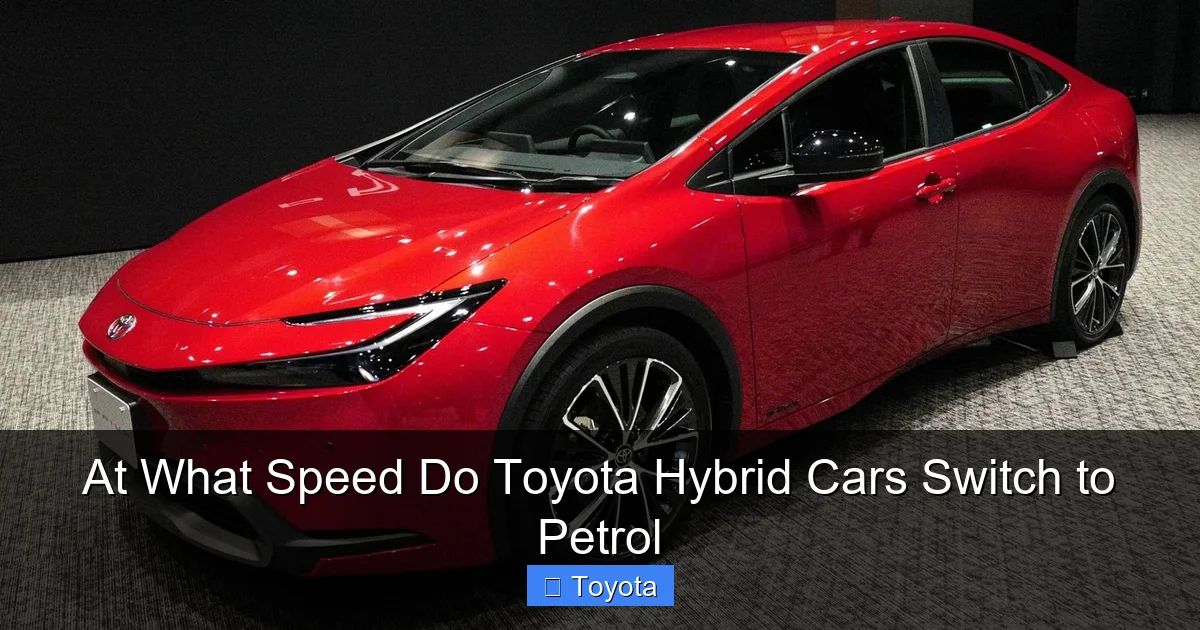
The iconic Prius is optimized for absolute fuel efficiency. It has the smallest, most efficient engine and a battery/motor combo tuned for low-speed, high-efficiency urban driving. You are most likely to experience extended electric-only periods in a Prius. Under gentle acceleration on a flat road, a modern Prius can often reach and sustain speeds up to 45-50 mph (70-80 km/h) on electric power alone if the battery is sufficiently charged. Its EV Mode button (if equipped) is quite restrictive, often limiting electric speed to 25 mph or so, but it’s designed for very low-speed, zero-emission zones like parking lots.
Toyota RAV4 Hybrid (The Popular SUV)
The RAV4 Hybrid balances efficiency with the power needed for a heavier SUV body. Its electric motor is more powerful to assist with acceleration from a stop. This means it can feel more eager on electric power, but the increased weight and aerodynamic drag mean the engine may engage at slightly lower speeds or under lighter throttle inputs compared to a Prius. You might see the engine come on around 35-40 mph during gentle acceleration if the battery is mid-range. Its EV Mode typically allows up to about 25-30 mph. The system is brilliant at seamlessly blending power, but the math for a heavier vehicle means the petrol engine is called upon more frequently to maintain efficiency at highway speeds.
Toyota Camry Hybrid (The Sedan Standard)
The Camry Hybrid sits between the Prius and RAV4. Its larger, more powerful petrol engine (a 2.5L vs. the Prius’s 1.8L/2.0L) means that when the engine is on, it’s often operating in its optimal efficiency band. The electric motor is robust. You can expect behavior similar to the RAV4 but with slightly better high-speed efficiency due to the sedan’s superior aerodynamics. The electric-only speed threshold under gentle conditions might be comparable to the RAV4.
Important Note: Always consult your specific vehicle’s owner’s manual. It will provide the most accurate details for your model year and trim, including the exact specifications of any EV Mode button.
Maximizing Your Electric-Only Driving: Practical Tips
Want to see that “EV” indicator on your dash more often and burn less petrol? It’s all about coaching the PCU. Here’s how:

Visual guide about At What Speed Do Toyota Hybrid Cars Switch to Petrol
Image source: ccarprice.com
Drive with a Light Foot and Look Ahead
This is the golden rule. Anticipate traffic flow. Accelerate slowly and smoothly from a stop. Maintain a larger following distance so you can coast more and brake less. Each time you press the pedal beyond a certain threshold (which varies by model and battery SOC), you’re inviting the engine to start. Gentle, early acceleration is your best friend for staying electric.
Use the “EV” Indicator as Coaching Feedback
Most Toyota hybrids have a dashboard indicator (often a light or icon) that illuminates when you are driving on electric power alone. Use this as real-time feedback. Try to keep it lit as long as possible during your commute by adjusting your driving style. It’s a great game to play with yourself to improve efficiency.
Understand and Use Your EV Mode Button (If Equipped)
This button forces the system to prioritize electric drive, but it has limits. It will not work if the battery is too low, if you exceed its preset speed limit (usually 25 mph), or if you demand too much power. Use it for short, low-speed trips like in a neighborhood or parking lot. Don’t expect it to work on the highway. It’s a tool for specific scenarios, not a magic “always electric” switch.
Manage Your Battery’s State of Charge
Help your battery stay in its optimal range. Use regenerative braking generously by braking earlier and more gently. On long downhill stretches, the battery will charge significantly. Conversely, if you know you have a long, high-speed drive coming up, consider that the engine will likely be on for most of it, and your battery may end the trip with a lower SOC. That’s normal and part of the system’s design.
Check Your Hybrid Battery Health
A failing or degraded hybrid battery will have reduced capacity and power output. This means it can hold less charge and may not be able to power the car alone for as long or at as high a speed. If you notice a significant, unexplained drop in fuel economy and the engine seems to run much more often, it could be a sign of battery wear. In such cases, understanding how to properly maintain and diagnose your Toyota hybrid battery is crucial for restoring performance.
Debunking Common Hybrid Myths and Misconceptions
The hybrid system’s complexity breeds myths. Let’s clear a few up.
“If I drive slowly enough, the engine will never start.”
False. If your battery is completely depleted (a rare event in normal operation, but possible), the engine must start to recharge it, even if you’re crawling along at 5 mph. The system’s priority is to maintain a minimum battery SOC for future power demands and stability.
“Using the ‘B’ gear mode keeps the engine off.”
False. The ‘B’ (engine braking) mode on the shifter increases the level of regenerative braking when you lift off the throttle. It’s designed for downhill driving to help control speed without overheating the brakes. It does not force electric-only mode and does not prevent the engine from starting when needed. In fact, on a steep hill, ‘B’ mode might see the engine start more often to provide additional braking force or to prevent battery overcharge.
“My hybrid is broken because the engine runs in winter.”
Probably not. As mentioned, in very cold weather, the engine runs more to provide cabin heat (using its efficient waste heat) and to warm up itself and the catalytic converter for optimal emissions control. This is normal operation and does not indicate a fault. However, if the engine runs constantly at all temperatures, even when warm, and you see a warning light like a “Check Hybrid System” message, it could indicate a problem. In that case, you should consult a guide on diagnosing check hybrid system warnings or seek professional help immediately.
“Hybrids struggle in extreme heat.”
They are designed for it, but you will see a change in behavior. The air conditioning compressor is often powered by the high-voltage battery in a hybrid, which is efficient. However, in scorching heat, the A/C load is so high that the system will frequently start the petrol engine to share the load and prevent the battery from draining too quickly. You may also see the engine run more to keep the battery in its optimal temperature range. This is normal. If the system detects an overheating condition in the hybrid components, it may also engage the engine as a cooling strategy. Knowing what to do if your car overheats is important for all vehicles, including hybrids.
Conclusion: Embrace the System, Don’t Fight It
The beauty of your Toyota hybrid is its intelligence. Trying to outthink it or constantly chase a mythical electric-only speed is futile and can lead to frustrating, inefficient driving. Instead, adopt a smooth, predictable driving style. Let the car’s computer do its job. Understand that the petrol engine is not your enemy; it’s a partner that works in harmony with the electric system to deliver outstanding real-world efficiency. The engine starting is not a failure of the electric mode—it’s the system working exactly as intended to meet your power demand while maintaining battery health. By respecting the factors that influence the switch—gentle throttle, battery charge, and conditions—you will naturally maximize your miles per gallon and enjoy the quiet, refined experience of electric drive whenever possible. Your Toyota hybrid is a masterpiece of integrated engineering. The best way to use it is to drive calmly, maintain it properly, and trust the process.
Frequently Asked Questions
Is there a specific speedometer number where my Toyota hybrid will always switch to petrol?
No. While many models can reach 45 mph or slightly higher on electric power alone under gentle acceleration with a charged battery, the petrol engine can engage at any speed if you press the accelerator hard or if the battery charge is low. Speed is just one of many factors.
What is the fastest I can drive on electric power alone?
It varies by model and year. For most modern Toyota hybrids (Prius, RAV4 Hybrid, Camry Hybrid), the maximum electric-only speed under ideal, gentle conditions is typically between 45 mph and 50 mph (70-80 km/h). However, achieving this requires a very light touch on the throttle and a well-charged battery.
Why does my hybrid’s engine start when I’m only going 20 mph?
This is most commonly due to one of three reasons: 1) You pressed the accelerator pedal firmly, demanding more power than the electric motor can provide alone. 2) Your hybrid battery’s state of charge is low, and the engine must start to recharge it. 3) You are using a high-power accessory like the air conditioning on max, which draws significant energy from the battery.
Can I force my hybrid to stay in electric mode all the time?
Not completely. While the EV Mode button (if equipped) maximizes electric drive, it has strict limits: it disables itself if you exceed a low speed (usually 25 mph), if you demand too much power, or if the battery is too low. The system’s primary programming always prioritizes efficiency and battery health, which sometimes requires engine engagement.
Does towing a trailer affect when the hybrid switches to petrol?
Yes, significantly. Towing adds substantial weight and aerodynamic drag, drastically increasing power demand. Your Toyota hybrid will engage the petrol engine much earlier and more frequently, even at low speeds and with light throttle input, to provide the necessary torque and to prevent the battery from depleting rapidly. Expect very little, if any, electric-only driving while towing.
My hybrid seems to use petrol more in cold weather. Is that normal?
Yes, it is completely normal. The engine runs more frequently in cold conditions to warm up itself and the catalytic converter for clean emissions. It also provides cabin heat more efficiently using its waste heat rather than draining the battery for an electric heater. This increased engine activity is by design and should subside once the engine and cabin are warm.
