
How to Reset Check Engine Light on a 2011 Toyota Camry

Resetting the check engine light on a 2011 Toyota Camry is straightforward, but it’s critical to first diagnose and repair the underlying issue—simply clearing the light will not fix the problem. You can reset it by either disconnecting the negative battery terminal for a few minutes or by using an OBD2 scanner to clear the codes. Be aware that if the problem persists, the light will return, indicating a need for professional diagnosis to ensure your vehicle’s safety and reliability.
How to Reset Check Engine Light on a 2011 Toyota Camry
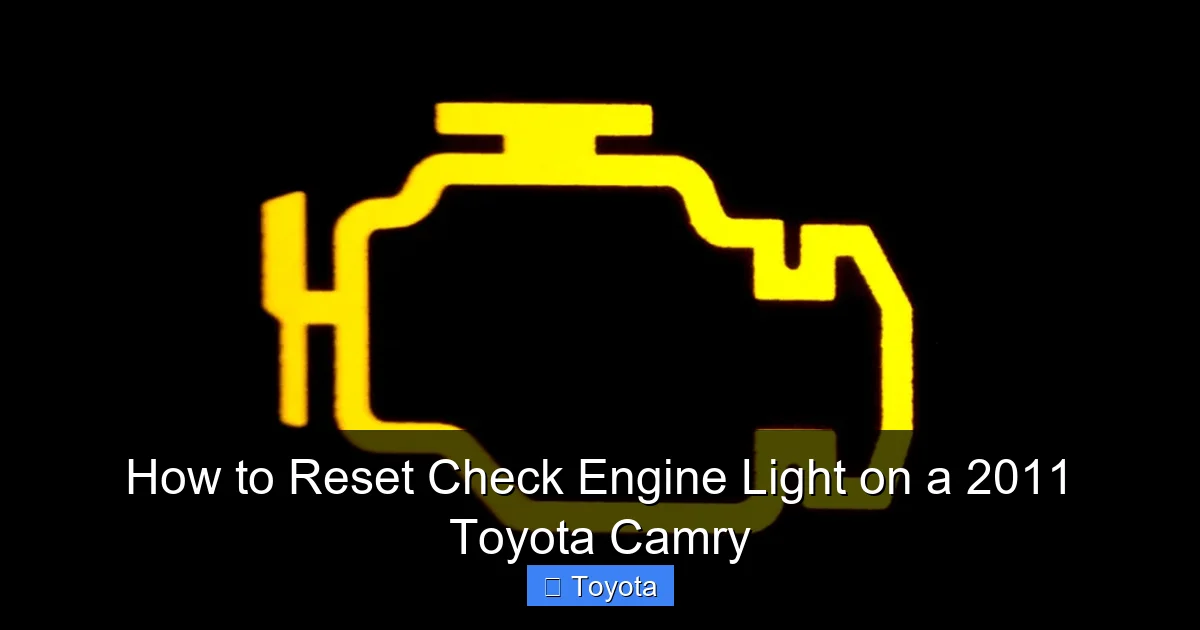
That little amber light on your dashboard – the one that looks like an engine with a squiggly line under it – has a knack for appearing at the most inconvenient times. Maybe you’re on your way to an important meeting, or you’re halfway through a long road trip. Your heart sinks a little. What does it mean? How serious is it? And more immediately, how do you make it go away? If you own a 2011 Toyota Camry, you’re not alone. This reliable sedan is one of the best-selling cars of all time, but even the most dependable vehicles sometimes trigger their Check Engine Light (CEL).
I remember the first time mine came on. I was driving my trusty Camry home from a weekend getaway, and the light just popped on, steady as could be. No strange noises, no performance issues – just that glowing reminder that something, somewhere, wasn’t quite right. The urge to simply “reset” it and forget about it is strong, but as I learned, that’s often the wrong first step. Resetting the light is easy; understanding *why* it came on is the real key to keeping your Camry running smoothly and avoiding costly repairs down the road. This guide will walk you through everything you need to know about the Check Engine Light on your 2011 Toyota Camry, from what it’s trying to tell you to the safe and proper ways to reset it. We’ll do it in a straightforward, no-nonsense way, just like a friend explaining it to you in the driveway.
Key Takeaways
- Always diagnose the underlying issue before resetting the check engine light.
- Use an OBD2 scanner for the most reliable and safe reset method.
- Disconnecting the battery is a last resort and can cause other system resets.
- Do not ignore a light that returns after a reset; it indicates an unresolved problem.
- Clear all stored diagnostic trouble codes to ensure the light stays off after repair.
- Perform a test drive after resetting to confirm the issue is fully resolved.
- Consult a professional mechanic for complex or persistent check engine light issues.
📑 Table of Contents
- What the Check Engine Light Really Means
- Before You Reset: The Golden Rules
- How to Reset the Check Engine Light on Your 2011 Toyota Camry
- Reading and Understanding Diagnostic Trouble Codes (DTCs)
- Common Culprits for the 2011 Camry’s Check Engine Light
- When to Wave the White Flag and Call a Professional
- Keeping Your Camry Happy: Preventive Maintenance
- Conclusion
What the Check Engine Light Really Means
First, let’s demystify this little light. It’s not a magic “something’s broken” indicator. Instead, it’s your car’s way of saying, “Hey, my computer (the Engine Control Module or ECM) has detected a parameter outside its normal range.” Since 1996, all cars sold in the U.S., including your 2011 Camry, have used the On-Board Diagnostics II (OBD-II) system. This standardized system monitors dozens of sensors and components related to emissions and engine performance.
It’s Not Just “Check Engine” – It’s a Diagnostic Tool
The official name is the Malfunction Indicator Lamp (MIL). When the ECM senses a problem, it stores a Diagnostic Trouble Code (DTC) in its memory and turns on the MIL. That code is a starting point – a clue – not a final diagnosis. For example, a code like P0171 means “System Too Lean (Bank 1),” which points to an air-fuel mixture issue. It could be a vacuum leak, a bad fuel pump, or a dirty mass airflow sensor. The light is the messenger; the code is the message. Resetting the light without addressing the underlying issue is like turning off a smoke alarm without finding the fire. The problem will almost certainly return, and you’ll be back to square one.
Steady vs. Flashing: A Critical Difference
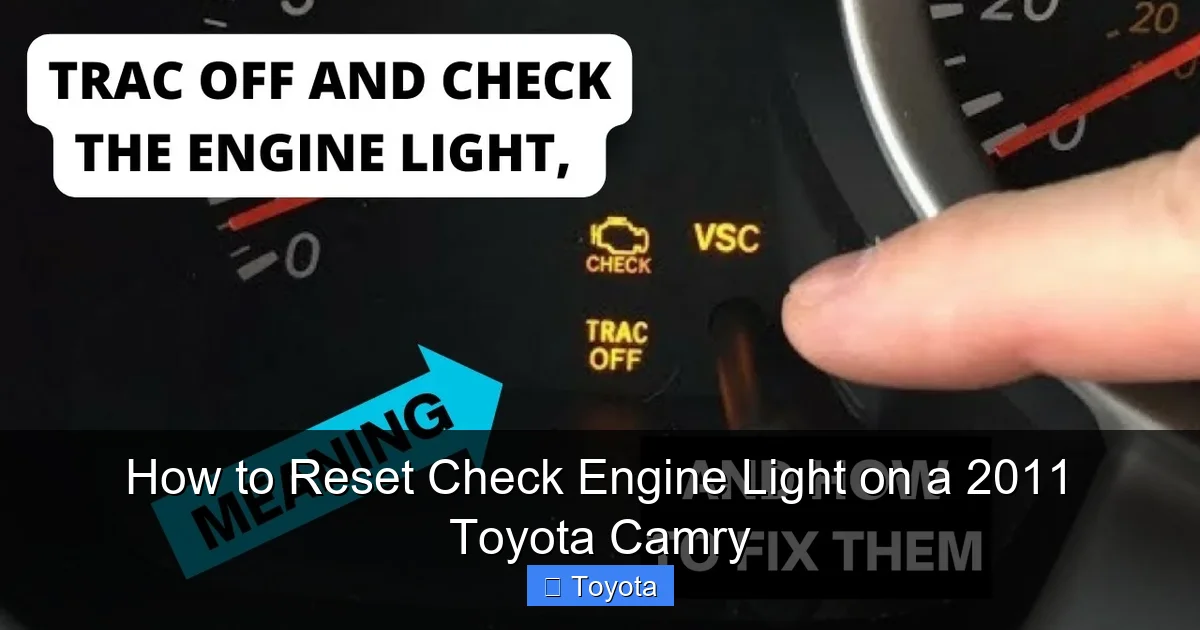
Pay close attention to how the light behaves. A steady, solid yellow or amber light indicates a non-emergency issue. It’s your car’s way of saying, “Get this looked at soon, but you can probably drive carefully for a little while.” A flashing or red light, however, is a severe warning. It means the ECM has detected a condition that could immediately damage your catalytic converter or engine, such as a severe misfire. If your light is flashing, do not reset it. Stop driving as soon as it’s safe, turn off the engine, and call for a tow or a mobile mechanic. Driving with a flashing CEL can destroy your catalytic converter, leading to a repair bill of $1,000 or more.
Before You Reset: The Golden Rules
Okay, so you’ve seen the light, and you’re itching to clear it. Slow down. Rushing to reset without a plan can waste your time and money. Here are the non-negotiable rules I follow every time.
Visual guide about How to Reset Check Engine Light on a 2011 Toyota Camry
Image source: dealerimages.dealereprocess.com
Rule #1: Diagnose First, Reset Later
This is the most important rule. You must retrieve the trouble codes before you clear them. Think of it like this: your car is telling you it has a headache. Would you just take a painkiller and hope for the best, or would you try to figure out if it’s dehydration, stress, or something more serious? You’d figure it out. Do the same for your Camry. Use an OBD-II scanner to read the codes. Even a basic $20 scanner from an auto parts store will pull the codes. Write them down. A quick internet search for “2011 Toyota Camry P0XXX” will give you a wealth of information on common causes and fixes. Only after you’ve addressed the problem should you consider resetting the light.
Rule #2: Safety First – Don’t Ignore Flashing Lights
As mentioned, a flashing CEL is a five-alarm fire. If your light is flashing, your Camry might be experiencing a severe cylinder misfire. Unburned fuel is flooding your exhaust system and overheating the catalytic converter. Continuing to drive can melt this expensive component. Pull over safely, shut off the engine, and seek professional help immediately. Resetting is not an option here.
Rule #3: Have Your Tools Ready
For a 2011 Camry, you’ll typically need just a few simple items. The most crucial is an OBD-II scanner. You can borrow one from some auto parts stores (like AutoZone’s “Borrow a Scanner” program) or buy an inexpensive Bluetooth scanner that works with your phone (like an OBDLink or BAFX Products scanner). You’ll also need a screwdriver or socket set if you plan to disconnect the battery, and possibly a code reader manual if your scanner doesn’t have a built-in database. Always work in a well-ventilated area and wear safety glasses if you’re popping the hood.
How to Reset the Check Engine Light on Your 2011 Toyota Camry
Once you’ve diagnosed and fixed the issue – maybe you tightened a loose gas cap, replaced an oxygen sensor, or cleared a clogged air filter – it’s time to reset the light. The 2011 Camry offers a few methods, ranging from old-school to tech-savvy. Here’s how to do each one properly.
Visual guide about How to Reset Check Engine Light on a 2011 Toyota Camry
Image source: i.ytimg.com
Method 1: The Battery Disconnect Trick (Old School)
This method works on almost any car, including your Camry, but it has some notable side effects. It’s essentially a “hard reset” for the car’s entire computer system.
- Step 1: Ensure your Camry is turned off, the keys are out of the ignition, and you’re in a safe, well-ventilated area.
- Step 2: Open the hood and locate the battery. It’s typically in the front-right corner of the engine bay.
- Step 3: Identify the negative terminal (marked with a minus sign “-” and usually connected to a black cable). Using the correct size socket or wrench (usually 10mm), loosen the nut on the negative terminal clamp.
- Step 4: Carefully lift the clamp off the terminal and tuck the cable away so it cannot accidentally touch the battery post.
- Step 5: Wait at least 15 minutes. This allows the ECM’s capacitors to fully discharge, clearing all stored data, including the trouble codes and the Check Engine Light.
- Step 6: Reconnect the negative clamp, tighten the nut securely, and close the hood.
- Step 7: Start the car. The Check Engine Light should be off. However, you may need to re-enter radio presets, and the car’s idle may be rough for the first drive as the ECM relearns fuel trims.
⚠️ Important Caveat: Disconnecting the battery will also reset other systems, like your power window calibration, steering angle sensor (which may trigger an airbag light), and radio security code. On some models, you might need a code to reactivate the stereo. This method is a bit of a sledgehammer and is best used if you don’t have an OBD-II scanner or if the light was triggered by a temporary glitch after a repair.
Method 2: Using an OBD-II Port and a Scanner (The Right Way)
This is the preferred, modern method. It’s precise, doesn’t reset other unrelated systems, and is what professional mechanics use. Your 2011 Camry’s OBD-II port is located under the dashboard, just below the steering column. It’s a trapezoidal-shaped connector.
- Step 1: With the ignition off, plug your OBD-II scanner’s cable into the port. It only fits one way.
- Step 2: Turn the ignition to the “ON” position (do not start the engine). You might need to press the brake pedal if your car has a push-button start.
- Step 3: Turn on your scanner. If it’s a basic code reader, it will usually communicate automatically. If it’s a Bluetooth scanner, open the companion app on your phone and pair it.
- Step 4: Navigate the scanner’s menu to find the “Read Codes” or “Diagnostics” function. Note any codes that appear (even if you already fixed the issue, they’ll be stored until cleared).
- Step 5: Once you’ve confirmed the issue is resolved, look for a menu option like “Clear Codes,” “Erase DTCs,” or “Reset MIL.” Select it. The scanner will send a command to the ECM to clear all stored codes and turn off the Check Engine Light.
- Step 6: Disconnect the scanner and turn off the ignition. Start the engine. The light should be off.
Pro Tip: Some advanced scanners also have a “Monitor Reset” or “Drive Cycle” function. After clearing codes, you may need to drive your Camry under varying conditions (city and highway, different speeds) for 15-30 minutes to allow the ECM’s readiness monitors to complete. The light will stay off only if the problem does not return during this drive cycle.
Method 3: The “Drive Cycle” Method (Letting It Clear Itself)
Sometimes, if you’ve fixed a minor problem (like a loose gas cap), the Check Engine Light might turn off on its own after a few successful drive cycles. The ECM continuously monitors systems. If it sees that the fault is no longer present over a series of specific conditions (engine warm-up, steady cruise, deceleration, etc.), it will set the monitors to “ready” and extinguish the light. However, this is not a reliable reset method. It can take days or weeks of driving, and during that time, you’ll be driving with an illuminated light, which in some states will cause you to fail an emissions test. It’s better to actively clear the code with a scanner after you’ve made a repair.
Reading and Understanding Diagnostic Trouble Codes (DTCs)
Before you ever clear a code, you should know what it means. A code is a five-character alphanumeric string. The first character is always a letter (P, B, C, or U). For engine/transmission issues, it’s almost always “P” (Powertrain). The next four digits provide specifics.
Visual guide about How to Reset Check Engine Light on a 2011 Toyota Camry
Image source: urbsgarage.com
Using a Basic Code Reader
Even the simplest scanner will pull the code. Write it down exactly. For example, you might see P0420. A quick Google search for “2011 Toyota Camry P0420” will tell you it’s “Catalyst System Efficiency Below Threshold.” This points to a failing catalytic converter, bad oxygen sensors, or an exhaust leak. Don’t assume the part named in the code is bad – it’s the system that’s out of spec. For a P0171, you’d look at air intake leaks, fuel pressure, or MAF sensor issues.
Common 2011 Camry Trouble Codes
Here’s a quick reference table for some of the most frequent codes you might encounter on a 2011 Camry with the 2.5L 4-cylinder or 3.5L V6 engine. These are general meanings; always confirm with a professional if unsure.
| Code | Definition | Common Causes on a 2011 Camry |
|---|---|---|
| P0171 | System Too Lean (Bank 1) | Vacuum leak (intake manifold gasket, PCV hose), weak fuel pump, clogged fuel filter, dirty MAF sensor. |
| P0172 | System Too Rich (Bank 1) | Leaking fuel injector, faulty fuel pressure regulator, dirty MAF sensor, bad oxygen sensor. |
| P0420 | Catalyst Efficiency Below Threshold | Failing catalytic converter, bad upstream or downstream O2 sensor, exhaust leak before the cat. |
| P0300 | Random/Multiple Cylinder Misfire Detected | Worn spark plugs, bad ignition coils, vacuum leak, low compression, faulty fuel injector. |
| P0301-P0306 | Cylinder X Misfire Detected | Same as P0300, but specific to cylinder 1, 2, 3, 4, 5, or 6. Helps isolate the problem. |
| P0455 | Evaporative Emission System Leak Detected (Large) | Loose or faulty gas cap, cracked or disconnected EVAP hose, bad purge valve, faulty charcoal canister. |
| P0441 | Evaporative Emission System Incorrect Purge Flow | Faulty purge valve, solenoid issue, or leak in the system. |
| P0131/P0132 | O2 Sensor Circuit Low/High Voltage (Bank 1 Sensor 1) | Bad oxygen sensor, wiring issue, exhaust leak affecting sensor reading. |
Common Culprits for the 2011 Camry’s Check Engine Light
Armed with a code, you can narrow down the likely suspects. On the 2011 Camry, a few issues are particularly common. Let’s break them down.
Loose or Faulty Gas Cap
This is the #1 cause of a Check Engine Light, and it’s incredibly easy to fix. A cap that’s not tightened properly or a worn cap seal will trigger an EVAP system leak code (like P0455 or P0441). The evaporative emissions system is sealed; if it can’t hold pressure, the ECM flags it. Solution: Remove the cap, inspect the seal for cracks, and reinstall it until you hear a definite click. If the light comes back, replace the cap (they’re about $15 at the dealer or auto store). This is a classic “reset and go” fix, but make sure the cap is truly fixed first.
Oxygen Sensor Failures
The 2011 Camry uses multiple oxygen sensors to monitor exhaust gases. Over time, they can become sluggish or fail, triggering codes like P0131-P0161. A bad O2 sensor reduces fuel economy, increases emissions, and can damage the catalytic converter. Signs: Poor fuel economy, rough idle, sulfur smell from exhaust. Solution: Replace the faulty sensor. Use an OEM or high-quality aftermarket sensor. Bank 1 Sensor 1 is the most common.
Catalytic Converter Efficiency
Code P0420 is a dreaded one. The catalytic converter is an emissions device that burns off unburned hydrocarbons. It can fail due to age, contamination from oil or antifreeze, or damage from prolonged misfires. On a high-mileage 2011 Camry, this is a possibility. Signs: Reduced performance, rotten egg smell, failed emissions test. Solution: This is an expensive repair ($1,000-$2,500). Before replacing, rule out other causes like bad O2 sensors or exhaust leaks. Sometimes a thorough fuel system cleaning or replacing spark plugs can restore converter function if caught early.
Mass Air Flow (MAF) Sensor Issues
The MAF sensor measures incoming air so the ECM can calculate fuel delivery. A dirty or faulty MAF sensor causes lean or rich conditions (P0171/P0172). Signs: Hesitation on acceleration, rough idle, poor fuel economy. Solution: Clean the sensor with MAF cleaner (do not use carburetor cleaner). If cleaning doesn’t help, replace it. It’s a relatively inexpensive part ($50-$150).
Spark Plugs and Ignition Coils
Worn spark plugs or failing ignition coils are classic causes of misfire codes (P0300-P0306). The 2011 Camry’s 4-cylinder uses coil-on-plug ignition; each cylinder has its own coil. A bad coil will cause a specific cylinder misfire code (e.g., P0302 for cylinder 2). Signs: Engine shaking, loss of power, noticeable misfire on acceleration. Solution: Replace spark plugs on schedule (every 30k miles for platinum, 60k for iridium). Swap coils between cylinders to see if the code follows the coil; if it does, replace that coil.
When to Wave the White Flag and Call a Professional
Not every problem is a DIY fix. Here’s when I’d put down my wrench and pick up the phone.
Flashing Light or Severe Symptoms
As stressed before, a flashing Check Engine Light means stop driving. This requires immediate professional attention. Also, if you experience severe symptoms like complete engine stalling, loud banging noises, or smoke from the exhaust, tow the car.
Multiple Codes or Complex Intermittent Issues
If your scanner pulls 5-6 different codes covering multiple systems (engine, transmission, ABS), it might indicate a major issue like a wiring harness problem, a failed ECM, or a severe vacuum leak that’s causing cascading failures. Intermittent problems that come and go are also notoriously difficult to diagnose without advanced tools and experience.
Lack of Tools, Time, or Confidence
Diagnosing an EVAP leak or a catalytic converter issue can be time-consuming and require specialized tools (like a smoke machine). If you’re not comfortable with electrical diagnostics or don’t have the tools, it’s smarter to let a pro handle it. A misdiagnosis can cost you more in parts and labor than the original problem.
Keeping Your Camry Happy: Preventive Maintenance
The best way to deal with a Check Engine Light is to prevent it from coming on in the first place. Your 2011 Camry will reward you with years of trouble-free service if you follow a disciplined maintenance schedule.
Follow the Factory Maintenance Schedule
Your owner’s manual outlines specific service intervals. Stick to them. This includes regular oil changes (every 5,000-7,500 miles), air filter replacements (every 30k miles), spark plug changes (as noted above), and transmission fluid checks. A well-maintained engine is a happy engine.
Pay Attention to the “Little Things”
That loose gas cap? Tighten it. That slight hesitation on cold starts? Don’t ignore it. Small issues often trigger the CEL early, giving you a chance to fix something cheap before it becomes a major repair. Regularly inspect hoses and belts for cracks. Use quality fuel from reputable stations.
Use Quality Parts and Fluids
When you do replace components, don’t cheap out. A subpar oxygen sensor or ignition coil will fail sooner and might cause other problems. For a car like the Camry, OEM or top-tier aftermarket parts are worth the investment.
By understanding your Check Engine Light, diagnosing properly, and resetting only after a fix, you’ll keep your 2011 Toyota Camry running reliably for years to come. Remember, the light is a helpful tool, not an enemy. Treat it as such, and you’ll save time, money, and a lot of unnecessary stress. If you own another Toyota model and need guidance, we’ve also put together detailed guides for vehicles like the Toyota Highlander and the Toyota Corolla. And while you’re maintaining your Camry, don’t forget about other service indicators – learning how to reset the maintenance required light on a Toyota is another useful skill for any owner.
Conclusion
Seeing that Check Engine Light illuminate on your 2011 Toyota Camry doesn’t have to be a moment of panic. Armed with the knowledge from this guide, you can approach the situation logically and calmly. Remember the core principles: the light is a diagnostic clue, not a death sentence; always read the codes before clearing them; and address the root cause. Whether you choose the battery disconnect method for its simplicity or, better yet, use an OBD-II scanner for a precise reset, you now have the steps to do it safely and effectively.
Your Camry is known for its longevity and reliability, and with proper care, it can easily surpass 200,000 miles. The Check Engine Light is just one part of the conversation between you and your car. Listen to what it’s telling you, respond appropriately, and you’ll enjoy many more miles of smooth, worry-free driving. Now, go pop that hood, grab your scanner, and take control of your car’s health. You’ve got this!
Frequently Asked Questions
How do I reset the check engine light on my 2011 Toyota Camry?
The most reliable method is using an OBD2 scanner to clear the trouble codes. Simply plug the scanner into the port under the dashboard, follow the on-screen menu to “Clear Codes” or “Erase Codes,” and the light should turn off.
Can I reset the check engine light by disconnecting the battery?
Yes, disconnecting the negative battery terminal for about 10-15 minutes can reset the vehicle’s computer and turn off the light. However, this method also resets other systems like radio presets and may not clear all stored codes on some models.
Will the check engine light reset itself on a 2011 Camry?
The light will not reset itself; it requires a manual command from a scan tool or a complete drive cycle where the vehicle’s computer verifies all monitored systems are functioning correctly. If the underlying problem persists, the light will simply come back on.
Is it safe to reset the check engine light without fixing the problem?
No, resetting the light without addressing the underlying issue is not recommended. The light is a warning that something is wrong, and ignoring it can lead to more serious, expensive damage and potentially unsafe driving conditions.
Why does my check engine light come back on after I reset it?
The light will return if the original problem has not been repaired. The car’s computer continuously runs tests and will relight the check engine light if it detects the same fault code again during its self-diagnostic checks.
What tool do I need to reset the check engine light on a 2011 Toyota Camry?
You need a basic OBD2 (On-Board Diagnostics) scanner or code reader that is compatible with your 2011 Camry. These are inexpensive, widely available at auto parts stores, and are the proper, safe way to communicate with the car’s computer to clear codes.
