
How to Fix Adaptive Headlight Malfunction Bmw

An adaptive headlight malfunction in your BMW can be caused by simple issues like dirty sensors or complex electrical faults. You can often fix it yourself by cleaning sensors, checking fuses, and resetting the system. However, persistent problems usually require professional diagnosis with specialized BMW tools. Addressing this issue promptly is crucial for your safety and the safety of others on the road.
There’s nothing quite like the feeling of confidence you get driving your BMW at night. A big part of that is the brilliant, adaptive illumination that swivels into corners, lighting up your path before you even turn the wheel. So, when that intelligent system fails and a warning light pops on your dash, it’s more than just an annoyance—it’s a serious safety concern and a hit to that premium driving experience. But don’t panic! An adaptive headlight malfunction BMW issue is often diagnosable and fixable without immediately mortgaging your house to pay the dealer. This guide will walk you through everything you need to know, from the basics of how the system works to practical, step-by-step fixes you can try at home. We’ll talk in plain language, focusing on what you can do and when it’s time to call in the experts.
Key Takeaways
- Understanding the System: BMW adaptive headlights use sensors, motors, and a control module to swivel with your steering, improving cornering visibility.
- Diagnosis is Key: Always start with a visual inspection and reading fault codes with a BMW-compatible scanner before replacing parts.
- Common Culprits: The most frequent causes are dirty/obstructed cornering sensors, damaged wiring, blown fuses, or failed headlight adjustment motors.
- Software Can Be the Fix: Many malfunctions are resolved by a simple system reset or, in some cases, a software update/re-coding via the iDrive system.
- Know When to Call a Pro: If basic fixes fail, or if the control module (JBE) is faulty, seek a BMW specialist to avoid costly mistakes.
- Safety First: Driving with non-functional adaptive headlights reduces visibility and may cause your low beams to aim incorrectly, creating a hazard.
- Prevention Matters: Regularly clean your front grille/bumper area and avoid pressure washing directly into headlight housings to protect sensors.
📑 Table of Contents
- How Your BMW’s Adaptive Headlight System Actually Works
- Recognizing the Symptoms: What Does a Malfunction Look Like?
- Your Diagnostic Toolkit: Finding the Root Cause
- Fixing the Most Common Problems: A DIY Guide
- Software Resets and Coding: The Digital Fix
- When to Wave the White Flag and Call a BMW Specialist
- Conclusion: Light the Way Forward
How Your BMW’s Adaptive Headlight System Actually Works
Before we start poking around, it helps to understand what we’re dealing with. BMW’s adaptive headlight system, often called “Adaptive Headlights” or “Cornering Lights,” is a clever piece of engineering. It’s not just a fancy bulb; it’s a coordinated dance of several components working together.
The Key Components
Think of it as a team. First, you have the headlight modules themselves. In many BMWs, especially from the 2000s onward, these are separate units that contain the bulbs (halogen, HID, or LED) and a small electric motor. This motor is what physically swivels the lower part of the beam (the “low beam” or “passing beam”) around the corner. Second, you have the sensors. These are typically small, black, rubber-covered modules mounted in the front bumper or behind the front grille. Their job is to sense your steering angle and vehicle speed. Finally, there’s the control module (often part of the JBE – Junction Box Electronics or a dedicated module). This is the brain. It takes the data from the sensors, processes it, and tells the headlight motors exactly how far and how fast to move.
The “Aha!” Moment: How It All Connects
Here’s the simple version: you turn the steering wheel. The sensor detects that movement and your speed. It sends that info to the control module. The module calculates the needed pivot angle and sends a signal to the motor in the headlight assembly. The motor moves the reflector or lens, and your light beam bends into the corner. It all happens in a fraction of a second. When any link in this chain breaks—a dirty sensor can’t “see” the steering input, a frayed wire severs communication, or a burned-out motor can’t move—the system shuts down and warns you with a malfunction message. Understanding this flow helps you pinpoint where to look.
Recognizing the Symptoms: What Does a Malfunction Look Like?
A malfunction isn’t always a single, obvious sign. It can manifest in several ways, and knowing them helps you describe the problem accurately if you need professional help.
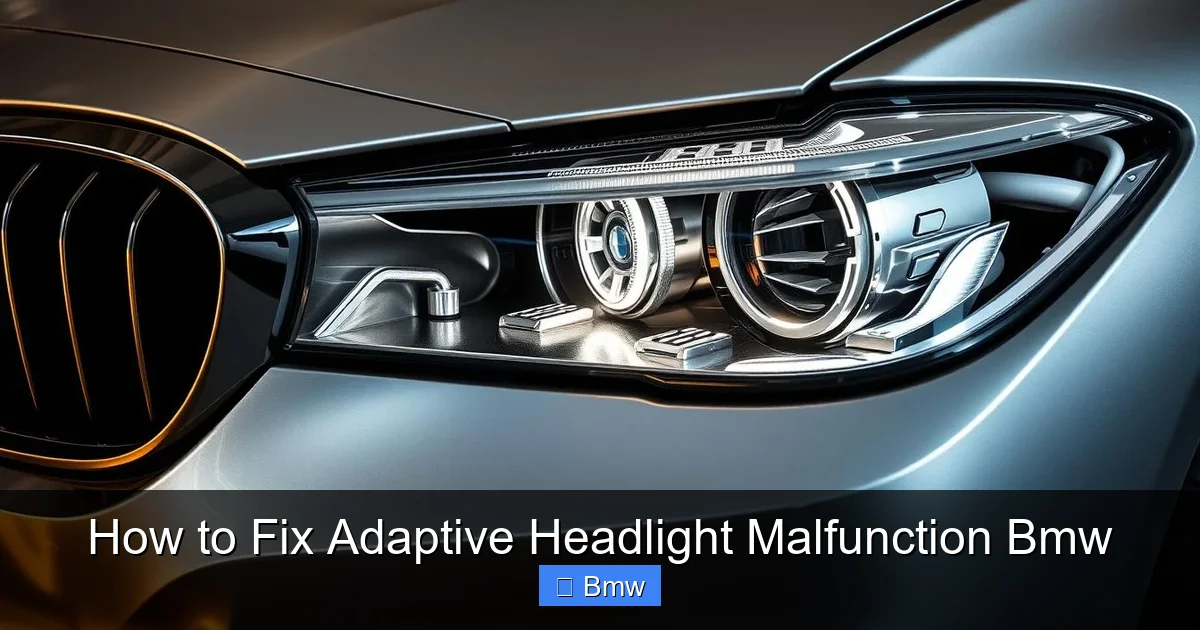
Visual guide about How to Fix Adaptive Headlight Malfunction Bmw
Image source: automotivesimple.com
The Obvious: Dashboard Warning Lights
The most common sign is a warning light on your instrument cluster. It might look like a headlight with an exclamation point, a bulb with an “X” through it, or a message that reads “Adaptive Headlight Malfunction” or “Check Front Headlights.” This is your car’s way of saying, “Hey, my smart lights are broken, and I’ve switched them off as a safety precaution.” Sometimes, the regular low beams will still work, but they will be fixed in place, not swiveling.
The Subtle: Performance Issues
Before a full warning, you might notice performance changes. The headlights might seem slower to react when you turn the wheel, or they might only swivel on one side. You might also notice that the beam pattern looks odd—perhaps too high, too low, or not spreading correctly. This can happen if a single headlight module has failed or if the system’s calibration is off. An intermittent issue, where the lights work perfectly one night and are dead the next, often points to a wiring problem—something is loose or rubbing and only fails under certain conditions like temperature or vibration.
The Hidden: No Visible Damage
Here’s the tricky part: there is often no obvious external damage. The headlight housing might look perfect from the outside. The problem is almost always internal—a failed motor, a corroded connector behind the headlight, or a sensor that’s just dusty. This invisibility is why diagnosis is so important; you can’t just look and guess.
Your Diagnostic Toolkit: Finding the Root Cause
You wouldn’t perform surgery without an X-ray. Similarly, you shouldn’t start replacing headlight modules without confirming they’re the problem. Diagnosis saves you money and frustration.
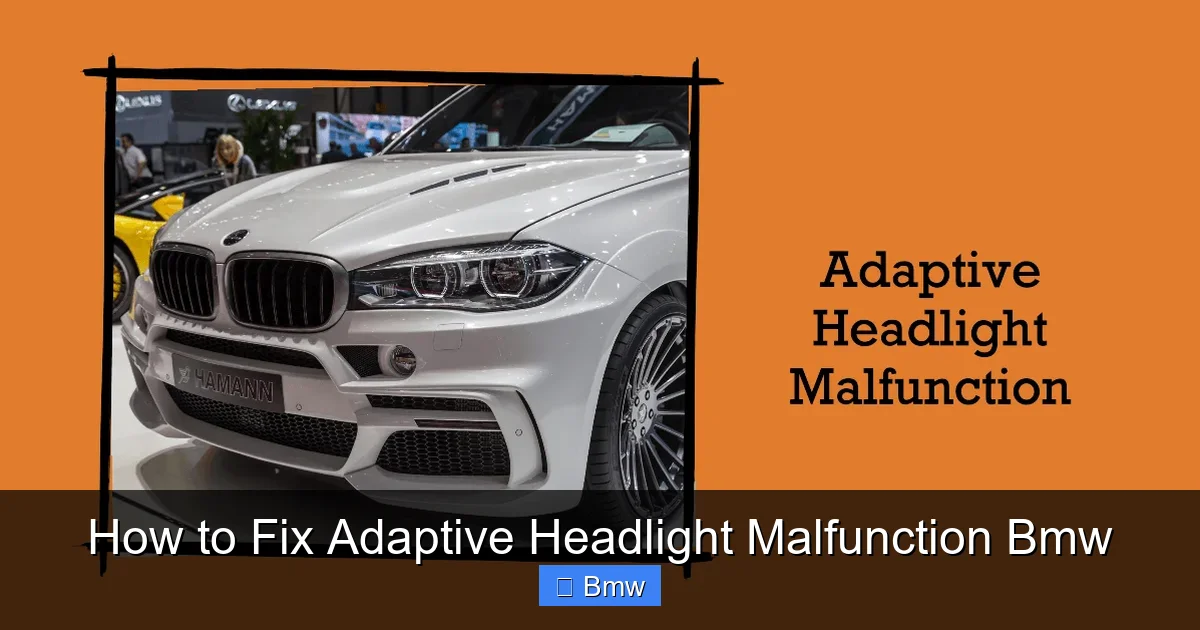
Visual guide about How to Fix Adaptive Headlight Malfunction Bmw
Image source: bmwinsights.com
Step 1: The Simple Visual Check
Start with the free and easy stuff. Pop the hood and look at both headlight assemblies. Are there any cracks or moisture inside? Condensation can kill electronics. Next, locate your cornering sensors. On most BMWs, they’re in the lower corners of the front bumper cover or behind the kidney grille. Are they caked with mud, bug splatter, or snow? A blocked sensor can’t detect steering angle. Give them a gentle clean with a soft cloth and mild cleaner. Also, check the wiring looms that run from the body to the headlight assemblies. These are common failure points due to constant movement. Look for cracked, frayed, or chafed insulation. Use a flashlight.
Step 2: The Essential: Reading Fault Codes
This is the most critical step. You need a diagnostic scanner that can access the BMW-specific modules, not just a generic OBD2 reader. A good choice is a used BMW-specific scanner from eBay, a cable with ISTA software, or a professional-grade tool like a Foxwell NT510. Connect it to the OBD2 port under the dash. Navigate to the “Body” or “Lighting” module and read for stored fault codes. You’ll get codes like 9B5D – Headlight Range Adjustment Motor or 9B5E – Headlight Vertical Aim Motor for a specific side (left/right), or codes related to the “Cornering Light” or “Adaptive Light” module. These codes tell you exactly which component the car’s computer is complaining about. A code for the “right headlight vertical aim motor” means that specific motor or its wiring is the likely suspect.
Step 3: Advanced Checks (For the Comfortable)
If you have the codes and a multimeter, you can do some basic electrical tests. With the key on and headlights switched on, you can check for voltage and ground at the headlight connector. But be warned: messing with electrical systems can cause more problems if you’re unsure. If the codes point to a sensor, you can sometimes test its resistance with a multimeter, but sensor logic is often more complex. For most DIYers, the code readout is the gold standard. It tells you what to replace.
Fixing the Most Common Problems: A DIY Guide
Armed with your diagnostic information, let’s tackle the fixes you can likely do at home with basic tools (screwdrivers, socket set, patience). Always disconnect the car battery before working on any lighting or electrical components.
Visual guide about How to Fix Adaptive Headlight Malfunction Bmw
Image source: bmwinsights.com
Fix 1: Clean Those Sensors!
This is the easiest and most overlooked fix. If your codes are vague or you just want to start simple, clean the cornering sensors thoroughly. They are usually held in by a clip or a single screw. Gently pry them out. Clean the rubber cover and the lens underneath with isopropyl alcohol. Make sure it’s completely dry before reinstalling. Blow out any debris from the sensor’s mounting hole in the bumper. Reconnect the battery and see if the system resets and the light goes out. This solves a surprising number of “mystery” malfunctions.
Fix 2: Hunting Down Wiring Issues
If your codes point to a specific headlight motor or you have an intermittent problem, the wiring is the prime suspect. The harness that connects to the back of the headlight assembly is prone to stress. You’ll need to remove the headlight to inspect it fully. This usually involves removing the inner wheel well liner (plastic clips and a few screws) and sometimes the bumper corner to get access. Once you have the headlight out, inspect the connector. Look for corrosion, bent pins, or melted plastic. Gently wiggle the wires while someone watches for the malfunction to reappear or use a multimeter to check for continuity. If the wire is broken inside the insulation, you’ll need to carefully splice in a new section of wire and heat-shrink the connections. This requires soldering skill.
Fix 3: Replacing a Faulty Headlight Module/Motor
If the codes are clear—say, a “vertical aim motor circuit” fault—and the wiring to the motor is good, the motor itself is dead. The entire headlight module (the whole assembly) often needs replacement, as the motors are not typically sold separately. You can source a used module from a salvage yard (ensuring it’s for your exact BMW model and year) or buy a new or remanufactured one from a parts supplier. The replacement process is mostly mechanical: unbolt the old headlight, unplug the connectors, bolt in the new one, and reconnect. You will then need to perform a basic headlight aim adjustment using the adjustment screws on the assembly. This is a good time to also check the ballast (for HID systems) if your headlights are xenon, as ballast failures can mimic headlight module issues.
Fix 4: The Simple Fuse Check
Never skip this! Your BMW has several fuse boxes. The headlight fuses are typically in the engine bay fuse box (often a black box near the battery) and sometimes in the trunk (under the rear deck). Consult your owner’s manual fuse diagram. Find the fuses labeled for “Headlight,” “Low Beam,” or specifically “Adaptive Light.” Pull them with a fuse puller or needle-nose pliers. Look for a broken metal strip inside. Replace with a new fuse of the exact amperage (e.g., 7.5A, 10A). A blown fuse can be a sign of a short circuit somewhere, so if the new fuse blows immediately, you have a deeper wiring problem to find.
Software Resets and Coding: The Digital Fix
Modern BMWs are as much software as they are hardware. Sometimes, the problem isn’t a broken part but a confused computer.
Performing a System Reset
After you’ve physically fixed something (cleaned a sensor, reconnected a plug), the system might still show the malfunction because the fault code is stored. You need to clear it. The easiest way is a soft reset. Turn the car completely off, remove the key (or fob if keyless), open the driver’s door (this fully powers down the car’s systems), wait 5-10 minutes, and then reconnect. Sometimes this is enough. For a more thorough reset, you can disconnect the negative battery terminal for 15 minutes. Note: Disconnecting the battery may require you to re-register your battery with the car (on newer models) and reset window/radio presets.
When Coding is Necessary
In some cases, especially after replacing a headlight module or control module, the new part needs to be “coded” or “initialized” to the car. This tells the vehicle’s central computer that a new component is present and configures it. This is not something the average owner can do without specialized software like ISTA (the official BMW diagnostic software) or ESYS with the correct ENET cable. If you’ve replaced a part and the light is still on, this is likely the reason. You’ll need to visit a BMW specialist or an independent shop with the proper coding tools. For simple resets after a repair, a BMW-specific scanner can often perform a “learn” or “initialization” function for the headlights.
When to Wave the White Flag and Call a BMW Specialist
Knowing your limits is a sign of a smart car owner, not a failed DIYer. Here are the scenarios where professional help is strongly advised.
Persistent, Unexplained Codes
If you’ve cleaned sensors, checked wiring, replaced a headlight module based on a code, and the same or new codes return, the problem is likely deeper. It could be a fault in the JBE (Junction Box Electronics) module or the FRM (Footwell Module) that controls lighting. These are expensive central components. Misdiagnosis here can cost you thousands.
Complex Electrical Gremlins
Intermittent issues that defy simple wiring checks often require advanced diagnostics like a voltage drop test or a scope to find a high-resistance connection. This is the realm of professional automotive electricians.
Module Replacement and Coding
As mentioned, replacing a JBE or FRM module is a major job. It often requires transferring data from the old module (like the VIN and vehicle configuration) to the new one via coding. Doing this wrong can brick the new module or cause a cascade of other electrical problems throughout the car.
Cost-Benefit Analysis
Get an estimate from a reputable independent BMW shop. Sometimes, the cost of their diagnosis ($100-$200) is worth it to avoid buying the wrong $800 headlight assembly. If the quote for the full repair is reasonable, it might be better to let them handle it. For context, a coolant leak on a BMW can vary wildly in cost, but a headlight module replacement is often in the $800-$1500 range for the part alone at a dealer, plus labor. An independent shop will be less. If you’re already facing multiple issues, it’s worth checking if they are related. For instance, persistent electrical faults could sometimes be linked to broader issues like a failing driver restraint system, which would also need attention.
Conclusion: Light the Way Forward
Fixing an adaptive headlight malfunction on your BMW is a journey of systematic elimination. Start with the simplest, free steps: clean the sensors and check the fuses. Then, invest in a proper BMW diagnostic scan to read the fault codes—this is your map. Follow the codes to inspect wiring and connectors, which are the most common failure points. Remember that software resets are often necessary after any physical repair. While replacing a headlight module is a very doable DIY project for the mechanically inclined, know when the problem has escalated beyond the headlight itself. A persistent fault may point to a costly central control module. Your safety on dark, winding roads depends on clear, adaptive illumination. By understanding your system and following this guide, you can solve the problem efficiently, whether you turn the wrenches yourself or become an informed client at your trusted BMW specialist. Keep those brilliant beams swiveling and enjoy the drive.
Frequently Asked Questions
What is the most common cause of an adaptive headlight malfunction in a BMW?
The most frequent culprit is a dirty or obstructed cornering sensor, usually located in the front bumper. These rubber-covered sensors can get caked with mud, bug splatter, or snow, preventing them from detecting your steering angle. A simple cleaning often resolves the issue. The second most common cause is damaged wiring in the harness that connects to the headlight assembly, which breaks from constant movement.
Can I fix an adaptive headlight malfunction myself, or do I need a dealer?
You can fix many common causes yourself, such as cleaning sensors, checking/replacing fuses, and even replacing a faulty headlight module if you’re comfortable with basic mechanical work. However, if the problem lies in the central control modules (JBE/FRM) or requires software coding, you will need a BMW specialist with the proper diagnostic and coding tools.
How do I reset the adaptive headlight system after a repair?
First, ensure the physical repair is complete (e.g., sensor cleaned, connector re-seated). Then, perform a soft reset: turn off the car, remove the key/fob, open and close the driver’s door to fully power down, wait 10 minutes, and restart. If the light persists, you will need to clear the fault codes using a BMW-specific diagnostic scanner. On some models, a reset can also be initiated through the iDrive menu under “Vehicle Settings” > “Lighting.”
How much does it typically cost to fix an adaptive headlight malfunction?
The cost varies dramatically by cause. A DIY sensor clean or fuse replacement costs nearly nothing. Replacing a single headlight module (the part with the motor) ranges from $300-$800 for an aftermarket or used part, or $800-$1500+ for a dealer part. If the JBE control module is faulty, parts and labor can exceed $2000. A professional diagnosis fee is usually $100-$200, which is a wise investment to avoid misdiagnosis.
Is it safe to drive with an adaptive headlight malfunction?
It is not ideal. While your standard low beams will usually still function, they will be locked in a fixed position. This means you lose the enhanced cornering visibility that helps you see turns earlier, which is a significant safety feature, especially on dark rural roads. Additionally, if the malfunction caused the headlights to aim incorrectly (too high or too low), you could be dazzling oncoming drivers or failing to illuminate the road properly. It’s best to address the issue promptly.
How can I prevent adaptive headlight problems in the future?
Regularly clean the front of your car, paying special attention to the cornering sensor areas in the bumper corners or behind the grille. Avoid using high-pressure washers directly into the headlight housings or sensor locations, as this can force water into connectors. During routine inspections, have a mechanic visually check the wiring looms that flex between the body and the headlights for signs of cracking or wear, as this is a known wear point on many BMW models.
