
Why Is My Jeep Leaking Oil?

Seeing oil under your Jeep is a red flag you shouldn’t ignore. Common culprits range from simple, cheap gasket failures to major, expensive seal repairs. Ignoring the leak leads to low oil, engine damage, and costly breakdowns. The first step is identifying the leak’s source and rate to determine urgency and the proper repair.
You love your Jeep. It’s your ticket to adventure, your rugged companion on trails and city streets alike. So, when you pull out of your parking spot and see a fresh drip or a dark puddle on the ground, your heart sinks. That familiar, acrid smell of burning oil might even follow you down the road. Why is my Jeep leaking oil? It’s one of the most common—and most anxiety-inducing—questions a Jeep owner faces. The truth is, oil leaks are almost inevitable as a vehicle ages, but understanding what’s causing yours is the critical first step to fixing it and protecting your engine.
Jeeps are wonderful, but they’re not magic. They’re complex machines with hundreds of moving parts under the hood, all bathed in lubricating oil. Gaskets, seals, and plugs are designed to keep that oil where it belongs—inside the engine. Over time, heat, vibration, pressure, and simply getting older take their toll. A tiny crack in a hose or a dried-out piece of rubber is all it takes for that precious oil to find a new path: onto your driveway, your garage floor, or worse, onto hot engine parts where it can burn and cause even bigger problems.
This guide will walk you through everything you need to know. We’ll identify the most common oil leak sources specific to Jeeps, from the simple to the serious. We’ll help you diagnose where the leak is coming from, what the symptoms mean, and what your repair options are. Whether you’re a DIY enthusiast with a JK or a JL owner who prefers to leave it to the pros, this article will give you the knowledge to tackle the problem head-on and keep your Jeep running strong for years to come.
Key Takeaways
- Valve cover gaskets are the #1 leak source: These rubber seals dry out and crack, especially on high-mileage Jeeps, causing slow, steady drips from the engine’s top.
- The oil pan is vulnerable to impact: Off-roading or hitting debris can dent or crack the pan or its gasket, leading to faster, larger leaks.
- The rear main seal is a big, costly job: A leak here means oil is coming from between the engine and transmission, requiring transmission removal for repair.
- Not all leaks are equal: A few drops a week is an urgent monitor; a steady stream or puddle requires immediate attention and no driving.
- Regular checks are your best defense: Frequently check your oil level and inspect your parking spot. Catching a small leak early prevents catastrophic engine failure.
- Simple fixes exist: Some leaks, like a faulty PCV valve or oil filter cap, are cheap, easy DIY repairs. Others absolutely require a professional mechanic.
- Jeep’s age and use matter: Older TJs and LJ models have known gasket issues, while newer JLs with turbos have additional potential leak points around the turbo and intake manifolds.
📑 Table of Contents
The Usual Suspects: Most Common Causes of Jeep Oil Leaks
Before you can fix a leak, you have to find it. Oil can travel from its source before it drips, so the puddle’s location is your biggest clue. Pop the hood, grab a flashlight, and start tracing. Here are the prime suspects, starting with the most frequent offender.
1. Valve Cover Gaskets: The Top Drip
If your Jeep is leaking oil from the top of the engine, look no further than the valve cover gaskets. This is, by far, the most common cause of oil leaks on Jeeps with the iconic 4.0L inline-6, the 3.6L Pentastar V6, and even the 3.8L V6 found in some JK models. The valve cover is the large, usually black or aluminum, lid on top of the engine. Its gasket is a rubber or cork composite seal that keeps oil from spraying out of the engine’s top end.
Why do they fail? Heat and age. The constant heating and cooling cycle causes the rubber to harden, shrink, and crack. On the 4.0L, the rear passenger-side gasket is notorious for leaking because it’s closest to the exhaust manifold, which bakes it. You might see oil dripping down the back of the engine block or pooling near the firewall. On the 3.6L Pentastar, both cylinder head covers have internal baffles that can also develop leaks at the seams. The good news? This is often a moderate DIY job for someone with basic tools and patience, though on some models, removing the intake manifold is necessary, which complicates things. A professional repair typically involves replacing the gaskets and any brittle bolts.
2. The Oil Pan and Its Gasket: The Bottom of the Barrel
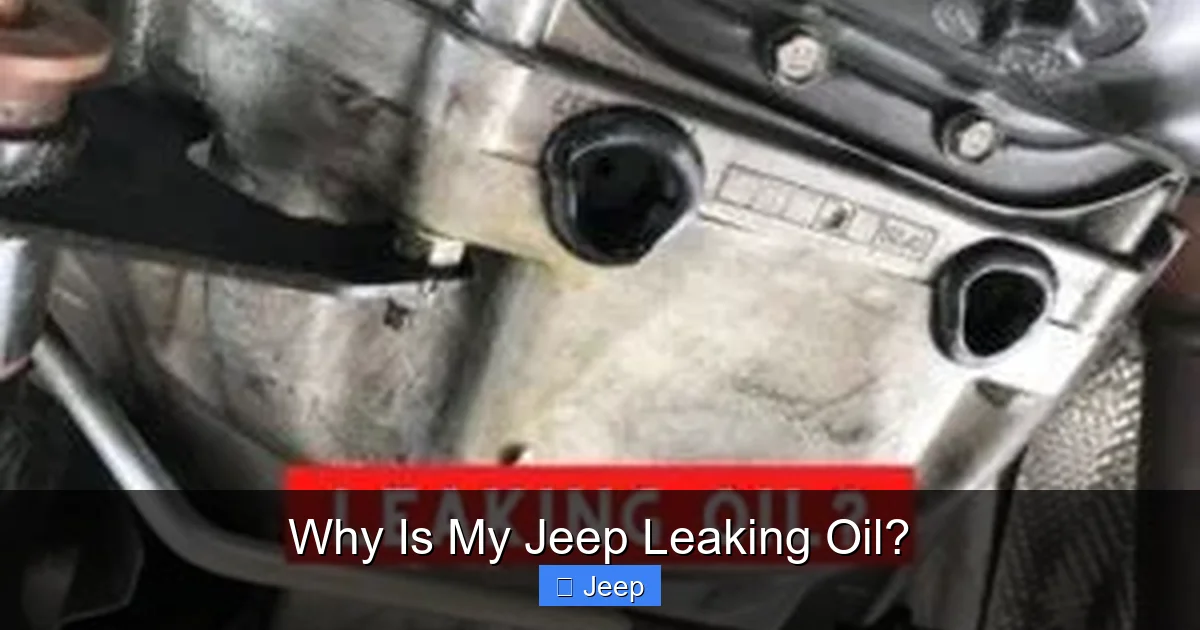
Oil collects at the bottom of your engine in the oil pan. A gasket seals this pan to the bottom of the engine block. This gasket can fail due to age, but more commonly on Jeeps, the pan itself gets damaged. The oil pan hangs down low, making it a prime target for rocks, stumps, and trail debris. A hard impact can crack the aluminum pan or bend it enough to break the seal.
Symptoms: A leak from the very bottom center of the engine. If you have a skid plate, you might not see the leak directly, but you’ll see oil accumulating on the skid plate or dripping from its seams. A severely dented pan might not leak until the engine is shut off and oil drains back to the lowest point. Fixing this usually requires removing the pan, cleaning the block surface, and installing a new gasket or sealant. If the pan is cracked, replacement is the only option. This is a job that often requires dropping the front drivetrain (axle) on many Jeep models for clearance, making it a significant undertaking.
3. Rear Main Seal: The Expensive Enigma
This is the one that makes Jeep owners wince. The rear main seal is the large, circular seal that sits where the engine’s crankshaft exits the block to connect to the transmission. Its job is to prevent oil from leaking past the back of the engine and into the bell housing. A leak here is serious because the seal is behind the flexplate/flywheel and directly against the transmission.
Diagnosis: Oil will be found dripping from the bottom of the bell housing, the area where the engine meets the transmission. You might see oil on the bottom of the transmission case or on the driveshaft yokes. It’s a slow, steady leak that often starts small. The repair is invasive and expensive because it typically requires removing the transmission (and often the transfer case) to access and replace the seal. If your Jeep has high mileage (150k+), a rear main seal leak is a strong possibility. For more on identifying leaks in this critical area, reading a complete guide to engine oil leaks can provide additional context that applies to your Jeep.
4. Front Crankshaft Seal: The Front-End Drip
Less common than the rear main, but still possible, is a leak from the front crankshaft seal. This seal sits right behind the harmonic balancer (crank pulley) at the very front of the engine. Its job is to keep oil in and contaminants out.
Symptoms: Oil will drip from the front of the engine, typically right below the crank pulley. You might see it on the front skid plate or the splash shield. The oil can also get flung around by the pulley and end up on the alternator, belts, and sides of the engine bay. Access is usually easier than the rear main, but it still requires removing the crank pulley and sometimes the timing cover. On Jeeps with the 3.6L, the timing covers themselves are also known to leak at their seams, which can mimic a front seal leak.
5. Other Gaskets and Seals: The Supporting Cast
A healthy engine has many other seals. On a Jeep, keep an eye on these:
- Oil Filter Adapter/Gasket: The area where the oil filter screws on. A loose filter or a damaged gasket can cause a fast drip right under the filter. Always check that the filter is hand-tightened properly after an oil change.
- Oil Pressure Sensor: This sensor screws into the engine block or head. Its seal can fail, causing a slow leak. It’s a cheap and easy fix.
- Camshaft and Crankshaft Position Sensors: Their seals can degrade, leading to small but persistent leaks.
- Turbocharger Seals: If you have a turbocharged Jeep (like the 2.0L turbo in the Wrangler 4xe or some Grand Cherokees), the turbo has its own oil supply lines and seals. A leak here will be near the turbo itself, in the exhaust or intake plumbing. Oil can also leak from the supply or return lines.
- Intake Manifold Gasket: While primarily an air/vacuum seal, some intake gaskets on certain engines also seal coolant passages. A failure can sometimes allow oil vapor to escape, but a pure oil leak from the manifold is less common.
6. PCV Valve and Hoses: The Pressure Relief Valve
The Positive Crankcase Ventilation (PCV) system is crucial. It vents pressure (and oil vapor) from inside the crankcase back into the intake to be burned. If the PCV valve is stuck closed or a hose is cracked, pressure builds inside the engine and can force oil out through the weakest seal—often the valve cover gaskets. It can also cause oil to be pushed out of the air cleaner or oil fill cap. Replacing a faulty PCV valve is one of the cheapest and easiest fixes you can do, and it might solve a seemingly mysterious leak.
How to Diagnose: Finding the Source of the Drip
Playing detective is key. Here’s your step-by-step plan to pinpoint the leak before you spend a dime on parts.
Visual guide about Why Is My Jeep Leaking Oil?
Image source: koala.sh
Step 1: The Park Test (Clean & Observe)
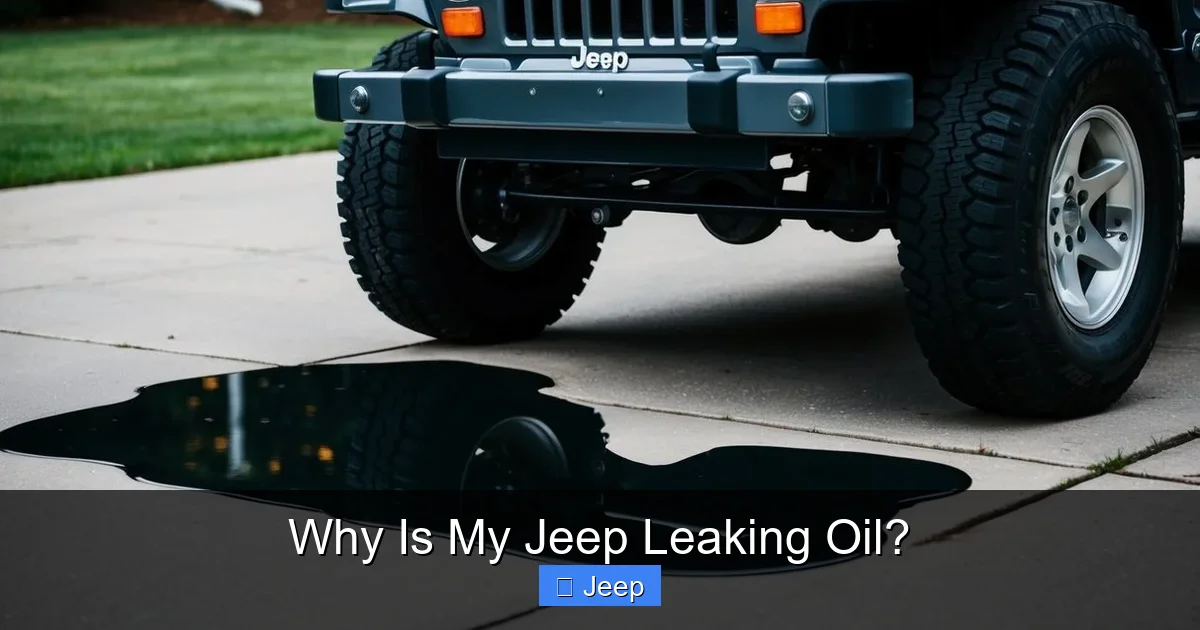
This is the golden rule. Thoroughly clean the entire engine bay and undercarriage with a degreaser (be careful around electrical components). Let it dry completely. Then, drive your Jeep normally for a short trip—enough to get the engine up to full operating temperature. Park it on a clean, light-colored surface (cardboard or a large sheet of paper/plastic works great) over a clean spot. Let it sit for at least 30 minutes to an hour. Then, inspect.
- Where is the fresh oil? Trace it upward. Oil flows down and back. The highest point you see fresh oil is almost always the source or very close to it.
- What does it look like? Is it a single drop? A steady stream? A messy smear? A steady stream points to a pressurized leak (oil filter, sensor, major seal). Slow drips are often passive gasket leaks.
Step 2: Use a UV Dye
For stubborn or multiple leaks, add a non-toxic UV (ultraviolet) dye to your engine oil. Drive for a day or two, then park and inspect with a UV flashlight (black light). The dye will glow a bright yellow-green at the exact source of the leak. This is a pro-level trick that’s very affordable for DIYers.
Step 3: Common Jeep-Specific Clues
- 4.0L (1997-2006 TJ/LJ): Check the rear of the valve covers and the oil pan gasket. Also, the oil pump pickup tube O-ring inside the pan is a known leak point that requires pan removal.
- 3.6L Pentastar (2009+ JK/JL, 2011+ Grand Cherokee): Check both valve covers, the timing covers (front and rear), and the oil cooler gasket (if equipped). The “MDS” (Multi-Displacement System) solenoid on the passenger-side head can also leak.
- 3.8L V6 (2007-2011 JK): Similar to the 4.0L, valve cover gaskets are the prime suspect.
- 2.0L Turbo (4xe models): Inspect all turbo oil supply/return lines, the turbo itself, and the charge air cooler (intercooler) connections.
The Risks of Ignoring That Puddle
“It’s just a few drops, it’ll be fine.” This is one of the most dangerous thoughts you can have about your Jeep. Oil is its lifeblood. No oil, no lubrication. No lubrication, rapid and catastrophic engine wear.
Visual guide about Why Is My Jeep Leaking Oil?
Image source: smartvehiclecare.com
The Domino Effect of Low Oil
Every drop that leaks out is a drop your engine is missing. As the oil level drops:
- Increased Friction & Heat: Metal parts that should glide on a film of oil start to rub. This creates immense heat and wears surfaces incredibly fast.
- Premature Component Wear: Bearings, piston rings, camshaft lobes, and lifters are the first to suffer. The damage is often silent until it’s terminal.
- Engine Seizure: In the worst case, an engine starved of oil will weld itself together internally in a matter of seconds or minutes. This means a complete engine replacement—a cost that dwarfs any repair for a leak.
Other Problems Caused by Leaks
- Fire Hazard: Oil dripping on the hot exhaust manifold or catalytic converter can smoke, smolder, and potentially ignite. This is a serious safety issue.
- Environmental & Legal Issues: Leaving oil stains on public roads or parking lots is illegal in many areas and harmful to the environment.
- Damage to Other Components: Oil can degrade rubber hoses (vacuum, coolant), belts, and motor mounts. It can also cause a mess that attracts dirt and grime, making other repairs harder.
- Failed Inspections: Most states will fail a vehicle for a significant oil leak during safety or emissions inspections.
For a broader look at why any car leak is a big deal, this article on whether it’s bad if your car is leaking oil explains the universal risks that apply directly to your Jeep.
From Quick Fix to Major Overhaul: Your Repair Options
The repair path depends entirely on the leak’s source and your budget/skill level.
Visual guide about Why Is My Jeep Leaking Oil?
Image source: vehiclers.com
The “Easy” DIY Fixes (Under $100)
If the leak is from a simple external component, you might tackle it yourself in an afternoon:
- Oil Filter & Drain Plug: Always ensure the filter is snug (hand-tight + 3/4 turn) and the drain plug washer is replaced. A stripped drain plug requires a larger plug or a helicoil insert.
- Oil Pressure Sensor/Thermostat Housing: These are usually simple bolt-on parts with a crush washer or O-ring.
- PCV Valve & Hoses: A $20 part that takes 5 minutes to replace.
- Valve Cover Gaskets (on some models): On older Jeeps without complex intake manifolds, this is a moderate job. On newer Pentastars, it’s much harder due to the intake. Assess your skill level honestly.
The “Intermediate” Shop Job ($300 – $800)
These require more labor and specialty tools but are common for mechanics:
- Valve Cover Gaskets (on complex engines): Labor-intensive due to intake removal.
- Oil Pan Gasket: Requires dropping the front axle/differential on most Wranglers and some Grand Cherokees for access.
- Front/Rear Main Seals: While the parts aren’t always expensive, the labor is massive. Dropping the transmission is a full-day job for a shop.
- Timing Cover Leaks: On the 3.6L, the rear timing cover seal is a known issue and requires significant disassembly.
The “Major” Repair ($1,500+)
If the leak is from the rear main seal, a cracked oil pan, or internal engine components (like a cracked block—rare but possible), you’re looking at major surgery. A rear main seal job on a JL Wrangler can easily hit $2,000+ at a dealership due to the transmission drop. Sometimes, with high-mileage Jeeps, it’s more cost-effective to install a used or remanufactured engine rather than pay for multiple large seal jobs.
If you’re noticing your Jeep is leaking oil more in cold weather, that’s a strong hint that a gasket or seal is brittle and needs replacement, as cold causes materials to contract and gaps to widen.
Prevention and Long-Term Care for Your Jeep
You can’t stop all leaks, but you can drastically reduce their likelihood and severity.
Use the Right Oil and Change It on Time
Always use the oil viscosity and specification (API SN, etc.) recommended in your owner’s manual. ModernJeeps, especially turbos, often require specific low-SAPS (sulfated ash, phosphorus, sulfur) oils. Using the wrong oil can degrade seals faster. Stick to a strict oil change interval. Old, sludge-contaminated oil accelerates seal wear and can clog the PCV system, increasing crankcase pressure.
Inspect Regularly
Make it a habit. Every time you fill your gas tank, do a quick visual check under the Jeep. Every few months, with the engine warm, check the oil level. A slow, steady drop in level between changes is your earliest warning sign. Catching a small leak when it’s just a damp spot is infinitely cheaper than waiting for a puddle.
Be Mindful of Impact
Your Jeep’s oil pan is its Achilles’ heel on the trail. Consider a durable, aluminum or steel skid plate to protect it from rocks and stumps. A billet aluminum oil pan is a popular upgrade for hardcore off-roaders as it’s much more resistant to denting than the stock stamped steel or cast aluminum pan.
Address Related Issues
If you have a PCV system problem, fix it. If your engine is running excessively rich (burning too much fuel), that extra fuel can wash down cylinder walls and contaminate the oil, harming seals. Keep your entire engine in good health.
Conclusion: Don’t Wait, Investigate
Finding oil under your Jeep leaking oil is not a matter of “if” but “when.” The key is your response. A small, slow leak from a valve cover gasket is a manageable repair. A fast drip from the oil pan or rear main seal is a serious issue that demands prompt action. The moment you ignore the drip, you gamble with your engine’s life. The cost of a new gasket or seal is a fraction of the cost of a new engine. Start with the clean-and-observe method. Identify the source. Then, make an informed decision based on the leak’s severity, your Jeep’s value to you, and your repair budget. Your Jeep’s next great adventure depends on a healthy, oil-filled engine. Protect it by addressing leaks immediately.
Frequently Asked Questions
Can I still drive my Jeep if it’s leaking oil?
It depends entirely on the leak’s severity. A very slow drip (less than a quart per month) might be okay for short trips if you check the oil level weekly. However, any steady stream, puddle, or leak that causes the oil level to drop noticeably between changes means you should limit driving and get it repaired immediately. Driving with low oil is the fastest way to destroy an engine.
How much does it typically cost to fix an oil leak on a Jeep?
The cost varies wildly. A simple oil filter cap or sensor seal might cost $50-$150 in parts and labor. A valve cover gasket job can range from $300 to $800 depending on the model and labor rates. The big-ticket item is the rear main seal, which often costs $1,500 to $2,500+ due to the transmission removal required. An oil pan gasket replacement, especially on a Wrangler, is typically in the $800 to $1,500 range.
Is a small oil leak on my Jeep a big deal?
Yes, a small leak is a warning sign that should not be ignored. While it might not cause immediate damage, it will worsen over time. It also indicates a seal or gasket is failing, and that failure can accelerate. More importantly, it creates a fire risk from oil on hot engine parts and will eventually lead to a low-oil condition if not monitored and topped off regularly.
Why is my Jeep leaking oil more when it’s cold?
Cold weather causes rubber and plastic seals, gaskets, and hoses to contract and become less flexible. This can create tiny gaps in older, hardened seals that weren’t there when warm. The oil itself is also thicker (higher viscosity) when cold, which can sometimes exacerbate a marginal seal leak until the engine warms up and the oil thins out. If a leak is distinctly worse in cold weather, it’s a strong indicator of brittle seals that need replacement.
Can I fix an oil leak myself?
You can fix some leaks yourself if you have mechanical skill. Replacing an oil filter, drain plug, oil pressure sensor, or PCV valve are excellent beginner projects. Valve cover gaskets on older, simpler engines are a moderate DIY task. However, jobs like the oil pan gasket (requiring axle drop), rear main seal (requiring transmission removal), or timing cover seals are complex, time-consuming, and best left to professional mechanics unless you have a well-equipped garage and significant experience.
What type of oil should I use to potentially prevent leaks?
Always use the exact oil viscosity and specification (e.g., 5W-20, 0W-20, meeting Chrysler MS-6395 or API SP standard) called for in your Jeep’s owner’s manual. Using the correct oil ensures proper lubrication and seal conditioning. Never use “high-mileage” oil as a cure-all; it has additives that can condition seals but won’t fix a mechanically failed gasket. The best prevention is using the right oil and changing it at the recommended intervals.
