
Can a Jeep Pull a Bayliner Element?

Whether a Jeep can pull a Bayliner Element depends entirely on your specific Jeep model’s rated towing capacity versus the boat and trailer’s combined weight. You must match a properly equipped Jeep with the correct hitch and braking system for the loaded trailer. Always consult your Jeep’s owner’s manual for its exact Gross Combined Weight Rating (GCWR) before attempting to tow.
Key Takeaways
- Your Jeep’s model and engine matter most: A Jeep Wrangler, Cherokee, and Grand Cherokee have vastly different towing capacities, ranging from 1,000 lbs to over 7,000 lbs.
- The Bayliner Element’s weight is the key variable: The boat itself weighs 1,100 – 1,800 lbs, but you must add the weight of the trailer (500-1,000+ lbs), fuel, and gear.
- A proper hitch class is non-negotiable: Towing any boat requires a Class III or IV receiver hitch and the correct ball mount for the trailer coupler height.
- Trailer brakes are likely required: For a loaded Bayliner Element, trailer brakes are essential for safe stopping and are legally required in most states once you exceed 1,500-3,000 lbs.
- Never exceed your Jeep’s GCWR: This is the total weight of the Jeep, passengers, cargo, *and* the fully loaded boat trailer. Exceeding it is dangerous and voids warranties.
- Setup and driving technique change: Towing a boat introduces trailer sway, longer stopping distances, and different turning dynamics that require practice and the right equipment like sway controls.
- Always verify your specific configuration: Two identical Jeeps can have different ratings based on engine, axle ratio, and whether they have a factory tow package.
📑 Table of Contents
- So, Can Your Jeep Actually Pull a Bayliner Element?
- Understanding the Numbers: Jeep Towing Capacity vs. Boat Weight
- Jeep Model Breakdown: Which Ones Can Handle It?
- The Essential Hitch and Trailer Brake Setup
- Real-World Towing Considerations and Tips
- Legal, Warranty, and Common Sense
- Final Verdict and Action Plan
So, Can Your Jeep Actually Pull a Bayliner Element?
It’s the classic American dream: a rugged Jeep and a sleek bowrider boat. The freedom to hitch up and head to the lake is powerful. But before you hook that Bayliner Element to your Jeep, you need to answer one critical question with cold, hard numbers. The short answer is: maybe. It depends entirely on the specific Jeep you own and the exact configuration of the Bayliner Element and its trailer.
Think of it like a puzzle. You have two main pieces: your Jeep’s maximum towing ability and the total weight of your boat, trailer, and everything on it. These two pieces must fit together perfectly. If your Jeep’s number is smaller than the boat’s number, you have a problem. If it’s larger, you have a potential solution—but only if you use the right hitch and follow safety rules. Let’s break down the numbers, the requirements, and what you need to know to make this dream a safe reality.
Understanding the Numbers: Jeep Towing Capacity vs. Boat Weight
This is the heart of the matter. You cannot guess or rely on hearsay. You must know two specific numbers: your Jeep’s Gross Combined Weight Rating (GCWR) and the Gross Vehicle Weight Rating (GVWR) of your boat trailer setup.

Visual guide about Can a Jeep Pull a Bayliner Element?
Image source: vehiclefreedom.com
Decoding Your Jeep’s Towing Rating
The GCWR is the maximum allowable total weight of your loaded Jeep (passengers, cargo, fuel) plus the loaded trailer. Your Jeep’s maximum conventional towing capacity is derived from this. But here’s the catch: not all Jeeps are created equal. A base model Jeep Wrangler Sport with a 2.0L turbo engine might be rated to tow only 3,500 lbs. A Jeep Grand Cherokee with the 5.7L V8 and factory tow package can be rated for 7,200 lbs. Even within the same model, engine choice, axle ratio, and whether you have the optional factory tow package (which often includes a heavy-duty cooling system and integrated wiring) change the rating dramatically. Your single source of truth is your vehicle’s official specification sheet or the tire information placard on the driver’s door jamb.
The Real Weight of a Bayliner Element & Trailer
You can’t just look at the boat’s dry weight. A Bayliner Element is a popular deck boat, and its weight varies by model year and length (common are the Element 20 and Element 22). The dry hull weight is typically between 1,100 and 1,800 lbs. But a “trailerable” boat includes:
- The Boat (Dry Weight): 1,100 – 1,800 lbs
- The Trailer: A basic single-axle trailer for a 20′ boat might weigh 600-800 lbs. A tandem-axle trailer for a 22′ boat can easily weigh 1,000-1,400 lbs.
- Gear & Fuel: A full fuel tank (50-75 gallons) adds 300-500 lbs. Add life jackets, anchors, coolers, fishing gear, and safety equipment, and you’re easily adding another 100-200 lbs.
Real-world loaded weight for a Bayliner Element on a suitable trailer is realistically in the 2,500 to 3,500+ lb range. You must get the actual weight of your specific boat and trailer combo. The best method is to drive the fully loaded rig onto a public scale (like at a truck stop or moving company).
Jeep Model Breakdown: Which Ones Can Handle It?
Let’s get practical. We’ll look at common Jeep models and their typical maximum towing capacities (always verify your specific VIN). We’ll compare against our 2,500-3,500 lb loaded boat estimate.
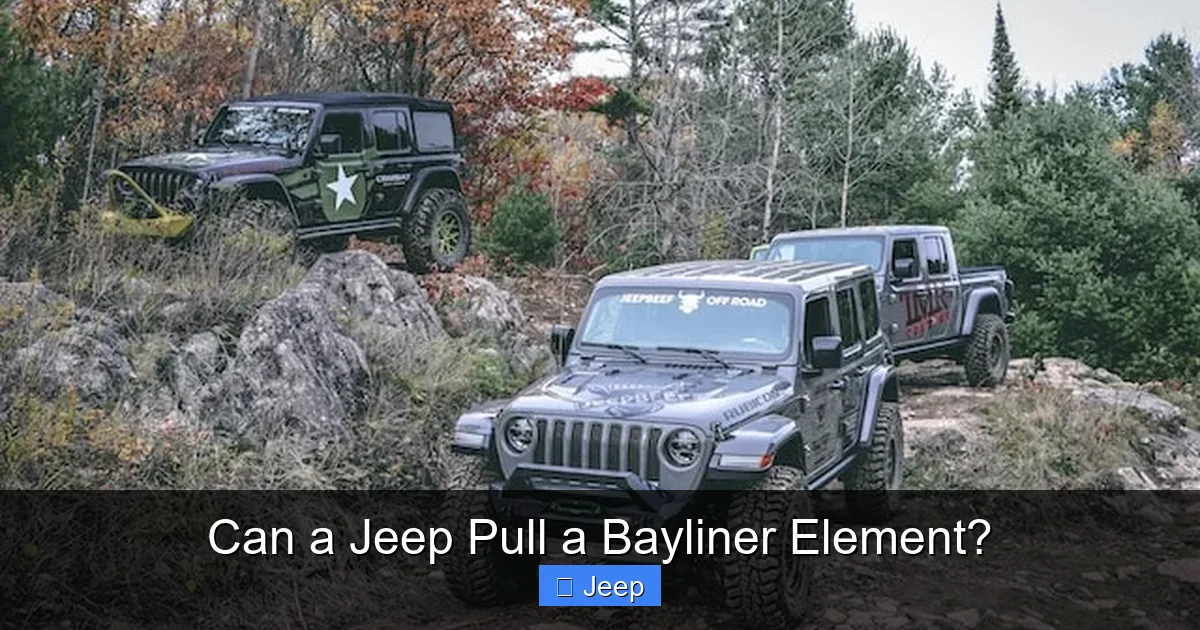
Visual guide about Can a Jeep Pull a Bayliner Element?
Image source: vehiclefreedom.com
Jeep Wrangler (JL/JT)
The iconic Wrangler is a capable off-roader, but its towing is limited. With the standard 4-cylinder turbo or V6, max towing is 3,500 lbs. The new Rubicon 392 with the 6.4L V8 is rated for 3,500 lbs as well. Verdict: A Wrangler could potentially pull a lightly loaded Bayliner Element 20 on a very light trailer at the absolute limit of its capacity. It would be a maximum-effort endeavor, requiring a Class III hitch and trailer brakes. It’s not the ideal tool for the job, but it’s possible for shorter trips on flat terrain. For the heavier Element 22, it’s not recommended.
Jeep Cherokee (KL)
The Cherokee offers more towing potential. The V6 model (3.2L) with the factory tow package is rated for up to 4,500 lbs. The 2.0L turbo model is typically limited to 2,000 lbs. Verdict: A V6 Cherokee with the tow package is a much better fit. It can comfortably handle a loaded Bayliner Element 20 and even the lighter configurations of an Element 22, staying well within its safe operating range. This is a more suitable and confident match.
Jeep Grand Cherokee (WL)
This is Jeep’s prime towing SUV. Depending on engine and package, capacities range from 5,000 lbs (V6) to a massive 7,200 lbs (5.7L V8 or 3.0L EcoDiesel with tow package). Verdict: This is the ideal Jeep for the job. Even the base V6 Grand Cherokee can easily manage the heaviest Bayliner Element setup with a significant safety margin. The V8 and diesel models make it trivial. You’ll have ample power for acceleration, merging, and hill climbing, and the vehicle’s stability at speed will be superior.
The Essential Hitch and Trailer Brake Setup
Assuming your Jeep’s numbers check out, you now need the physical hardware. This is where many first-time tower’s plans fall apart.
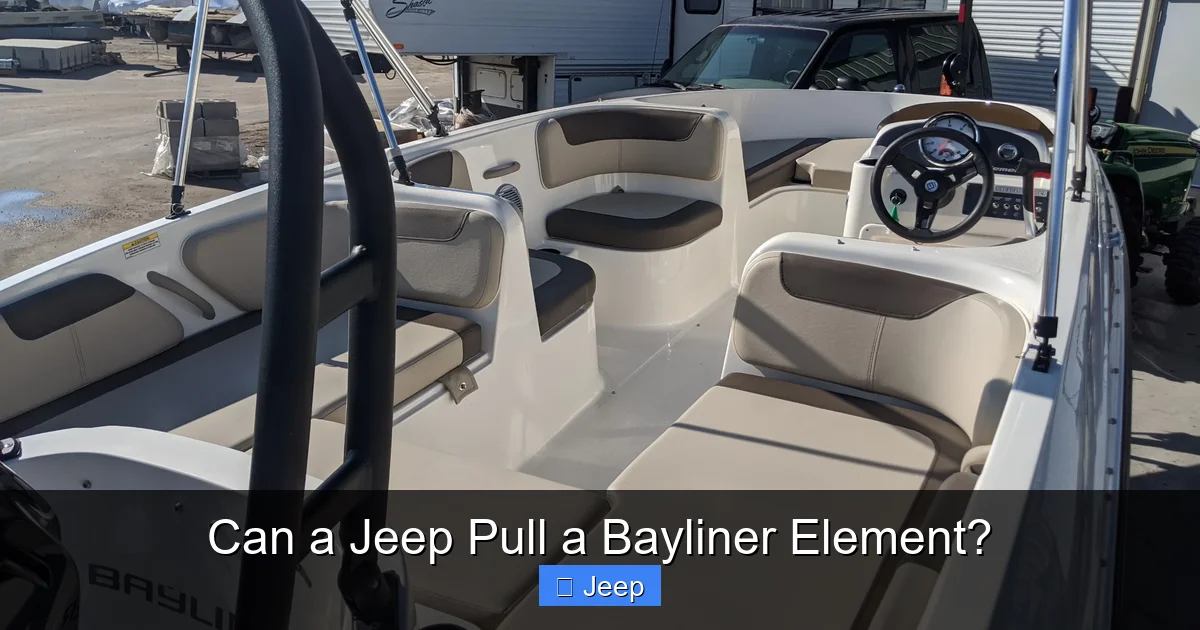
Visual guide about Can a Jeep Pull a Bayliner Element?
Image source: buddyboating.com
Hitch Class: Don’t Skimp Here
For a 3,000+ lb boat trailer, you need at least a Class III receiver hitch (2″ receiver). A Class IV (2.5″ receiver) is even more robust. These hitches are bolted to the Jeep’s frame, not just the bumper. The factory tow package on newer Jeeps often includes the hitch itself. If not, you’ll need a high-quality aftermarket hitch from brands like Curt, Draw-Tite, or Reese, properly rated for your Jeep model.
The ball mount you choose must be the correct height so the trailer coupler is level when hitched. An unlevel trailer puts dangerous strain on the hitch and affects handling. Measure the height from the ground to the top of your hitch ball and the height of the trailer coupler when on level ground. They should match.
Trailer Brakes: Not Optional
This is the most common mistake. A 3,000+ lb trailer without its own braking system will turn your Jeep’s good brakes into inadequate ones. Stopping distances will be terrifyingly long. Your trailer must have electric brakes. Your Jeep needs a trailer brake controller installed in the cabin. This device lets you manually apply the trailer brakes and automatically proportionally applies them when you press your Jeep’s brake pedal. Many Jeep factory tow packages include a integrated brake controller. If not, you must install an aftermarket unit (like from Tekonsha or Reese). Also, your Jeep’s factory wiring harness may need an adapter to communicate with the trailer’s brake system. This is a critical safety and often legal requirement.
Real-World Towing Considerations and Tips
Numbers on paper are one thing. The real-world experience is another. Here’s what to expect and how to prepare.
The Launch and Retrieve Dance
Towing to the lake is only half the battle. Backing a boat trailer down a steep, often slippery boat ramp is a skill. Your Jeep’s 4×4 system can be a huge asset here for traction. Practice in an empty parking lot with a trailer first. Use your mirrors extensively. Consider adding extended side mirrors for better trailer visibility. Go slow. A small mistake at the ramp can mean a costly accident.
Managing Trailer Sway
A wide, flat-sided boat acts like a sail. Crosswinds, passing trucks, or sudden steering inputs can cause trailer sway—a dangerous, oscillating fishtail. To combat this:
- Load your trailer correctly: Ensure 10-15% of the trailer’s weight is on the hitch ball (tongue weight). Too much or too little weight causes sway.
- Use a weight-distributing hitch: For heavier setups (often above 5,000 lbs GCW), a weight-distributing hitch with sway control is highly recommended. It distributes the trailer’s tongue weight across both axles of the Jeep and includes friction-based or cam-based sway dampeners.
- Drive proactively: Reduce speed in windy conditions, leave extra following distance, and avoid sudden steering movements. If sway starts, gently apply the trailer brake controller (never the Jeep’s brakes alone) and reduce speed.
For a deeper dive into towing best practices, you might read about how other vehicles handle similar loads, like our article on how much a Toyota Tacoma can pull, which covers similar weight classes and challenges.
Legal, Warranty, and Common Sense
Beyond the mechanical “can you?” there are the “should you?” and “are you allowed to?” questions.
Staying Within Legal Limits
Every state has laws regarding trailer braking requirements based on weight. Most require trailer brakes for anything over 1,500 or 3,000 lbs. You must comply. Also, your license requirements are usually based on the combined GCWR. For most Jeep/Bayliner combinations, a standard driver’s license is sufficient. However, if your GCWR exceeds 26,000 lbs (unlikely with a Jeep), you may need a CDL. Check your state’s DMV website for specifics. For reference, the thresholds for requiring a CDL without a special endorsement are much higher, but it’s good to be informed about general weight regulations.
Warranty and Long-Term Health
Overloading your Jeep isn’t just unsafe; it can void your powertrain warranty. Excessive strain on the transmission, engine, brakes, and suspension leads to premature wear and catastrophic failure. Towing at or near your maximum capacity consistently, especially in hilly or hot conditions, will shorten your Jeep’s life. The goal is to have a comfortable margin—ideally, your loaded trailer should be at least 500-1,000 lbs below your Jeep’s maximum rated capacity. This accounts for passengers, cargo, fuel, and the unpredictability of real-world conditions.
Final Verdict and Action Plan
So, can a Jeep pull a Bayliner Element? Yes, but not just any Jeep. The capable answer comes from the Grand Cherokee lineup. The possible answer comes from a properly equipped Cherokee V6. The marginal and not-recommended answer comes from the Wrangler. The impossible answer comes from any 4-cylinder Jeep without a factory tow package.
Your Action Plan:
- Find Your Jeep’s Exact GCWR and Max Towing Capacity. Look in the owner’s manual or on the door jamb sticker.
- Weigh Your Entire Rig. Take the loaded boat, trailer, fuel, and gear to a public scale. Get the total weight.
- Compare the Numbers. Is your loaded trailer weight + your Jeep’s curb weight + passengers/cargo less than your Jeep’s GCWR? If no, you cannot safely tow.
- Install the Correct Hardware. A frame-mounted Class III/IV hitch, a properly sized ball mount, a trailer brake controller, and the correct wiring are mandatory.
- Practice. Before your first real trip, hitch up and drive in a large, empty parking lot. Practice turning, braking, and backing.
The joy of hitting the water with your own boat is worth the homework. Do it right, and your Jeep will be a reliable launch partner for years to come. Do it wrong, and you risk your safety, your equipment, and your wallet. Choose the right Jeep, match it to the right boat, and tow with confidence.
Frequently Asked Questions
Can a Jeep Wrangler Sport tow a Bayliner Element 20?
At 3,500 lbs maximum, a Wrangler Sport is at the very absolute limit for a lightly loaded Element 20 on a basic trailer. It is technically possible but not recommended due to minimal margin for error, gear, or passengers. A Cherokee or Grand Cherokee is a far better choice.
Do I absolutely need trailer brakes for a Bayliner Element?
Yes. A loaded Bayliner Element and trailer will almost certainly exceed 3,000 lbs, making trailer brakes a legal requirement in most states. More importantly, they are a critical safety component, providing proportional stopping power and helping prevent trailer sway during emergency braking.
How do I calculate the exact weight of my boat and trailer?
The only accurate way is to drive the complete, loaded rig (boat on trailer, full fuel, all gear) onto a certified public scale, often found at truck stops, moving companies, or grain elevators. Do not rely on dry weights or estimates for safe towing calculations.
What’s the difference between a weight-carrying and weight-distributing hitch?
A weight-carrying (or “standard”) hitch simply supports the trailer’s tongue weight on the Jeep’s rear axle. A weight-distributing hitch uses spring bars to transfer some of that tongue weight to the Jeep’s front axle and both trailer axles. This improves steering, braking, and reduces rear sag, and is highly recommended for loads over 5,000 lbs total or if your Jeep’s rear sags significantly when hitched.
Will towing a boat damage my Jeep’s transmission?
Not if you are within the vehicle’s rated towing capacity and use proper driving technique. Always use the “Tow/Haul” mode if your Jeep has one, as it changes shift points to keep RPMs lower under load. Avoid excessive heat by not overloading and by using the correct transmission fluid. Regularly checking fluid levels and condition is wise for frequent towers.
What’s the single most important thing to check before towing my boat?
Beyond verifying weight limits, the single most important pre-trip check is your hitch connection. Ensure the trailer coupler is fully locked onto the ball, the safety chains are crossed and secured with proper slack, the trailer lights (brake, turn, running) are all functioning, and the trailer brake controller is powered and functional. A missed connection is a major hazard.
