
How to Tell What Size Lift Is on My Jeep

Figuring out your Jeep’s lift size is crucial for maintenance, tire fitment, and performance. You can often find clues through visual inspection of suspension components, by taking precise physical measurements, or by decoding factory build information. Always prioritize safety—if unsure, consult a professional mechanic or suspension specialist to get the correct measurement.
So, you’ve got a awesome Jeep that sits higher than the stock model. Maybe you bought it used and the previous owner was tight-lipped about the modifications. Or perhaps you did the work yourself years ago and can’t quite remember if you went with the 3.5-inch or the 4.5-inch kit. Knowing the exact lift size on your Jeep isn’t just bragging rights at the trailhead—it’s essential information for buying the right tires, understanding your drivetrain angles, performing maintenance, and even ensuring your vehicle is safe and legal. Don’t worry, you don’t need to be a master mechanic to figure it out. We’re going to walk through every reliable method, from simple visual sleuthing to precise measuring techniques, so you can confidently answer the question: “How much lift is on my Jeep?”
Key Takeaways
- Visual Cues Offer a Starting Point: Look for aftermarket components like lifted coils, extended control arms, or a dropped track bar to get a rough estimate of lift height.
- Precision Comes from Measurement: The most accurate method is to physically measure key suspension points, such as the distance from the axle to the frame or the height of the coil spring.
- Factory Documentation Can Help: Your Jeep’s build sheet or VIN can sometimes reveal if a factory-installed lift or off-road package was added when it was new.
- Aftermarket Parts Leave a Paper Trail: If the lift was installed by a shop, receipts or part numbers on components (like coil springs) will directly state the lift size.
- Lift Size Affects More Than Height: A proper lift involves more components than just taller springs; track bars, control arms, and driveshafts are all part of the equation and impact drivability.
📑 Table of Contents
- Why Knowing Your Exact Lift Size Matters
- Method 1: The Visual Inspection – Decoding the Clues
- Method 2: The Measuring Technique – Getting the Exact Number
- Method 3: Decoding the Paper Trail – VIN, Build Sheet, and Receipts
- Method 4: Consulting the Experts and Community
- Common Pitfalls and What Can Go Wrong
- Conclusion: Putting It All Together
Why Knowing Your Exact Lift Size Matters
Before we dive into the “how,” let’s talk about the “why.” Understanding your Jeep’s exact lift measurement goes far beyond satisfying curiosity. It has real, practical implications for your vehicle’s performance and your wallet.
The Ripple Effect of Lift Height
A lift kit does more than just raise the body. It changes the geometry of your entire suspension and drivetrain. A 2-inch lift might only require longer bump stops and slightly extended brake lines. A 4-inch lift, however, often necessitates a dropped front track bar, longer control arms, and possibly a new driveshaft or at least a repositioned slip-yoke. Knowing your precise lift helps you diagnose vibrations, unusual tire wear, or steering issues. It also tells you which aftermarket accessories—like larger tires, rock sliders, or skid plates—will fit without causing rubbing or other problems. For instance, if you’re planning to upgrade to 35-inch tires, you’ll need to know your current lift to calculate the necessary additional clearance.
Maintenance and Repair
When it’s time to replace worn-out ball joints, tie rod ends, or shocks, the correct replacement parts often depend on your lift height. A shock designed for a stock Jeep won’t work properly on a lifted one, and using the wrong part can lead to premature failure. Furthermore, your Jeep’s alignment specifications change with lift. A professional alignment shop needs to know your lift size to set the camber, caster, and toe correctly.
Resale and honesty
If you ever decide to sell your Jeep, being able to accurately state the lift size is a mark of a knowledgeable owner. It builds trust with a potential buyer and justifies your asking price. Conversely, if you’re buying a used Jeep, verifying the lift size is a critical step in the inspection process to ensure you’re getting what you pay for and to uncover any potential hidden issues from a poorly done installation.
Method 1: The Visual Inspection – Decoding the Clues
Often, the easiest place to start is by simply looking at your Jeep’s suspension and undercarriage. An experienced eye can usually spot the telltale signs of a lift kit and make an educated guess about its size. This method isn’t always 100% accurate, but it can quickly narrow down the possibilities from “stock” to “small lift” to “big lift.” You’ll want to get under the vehicle safely—use jack stands on solid ground, never rely on a jack alone.
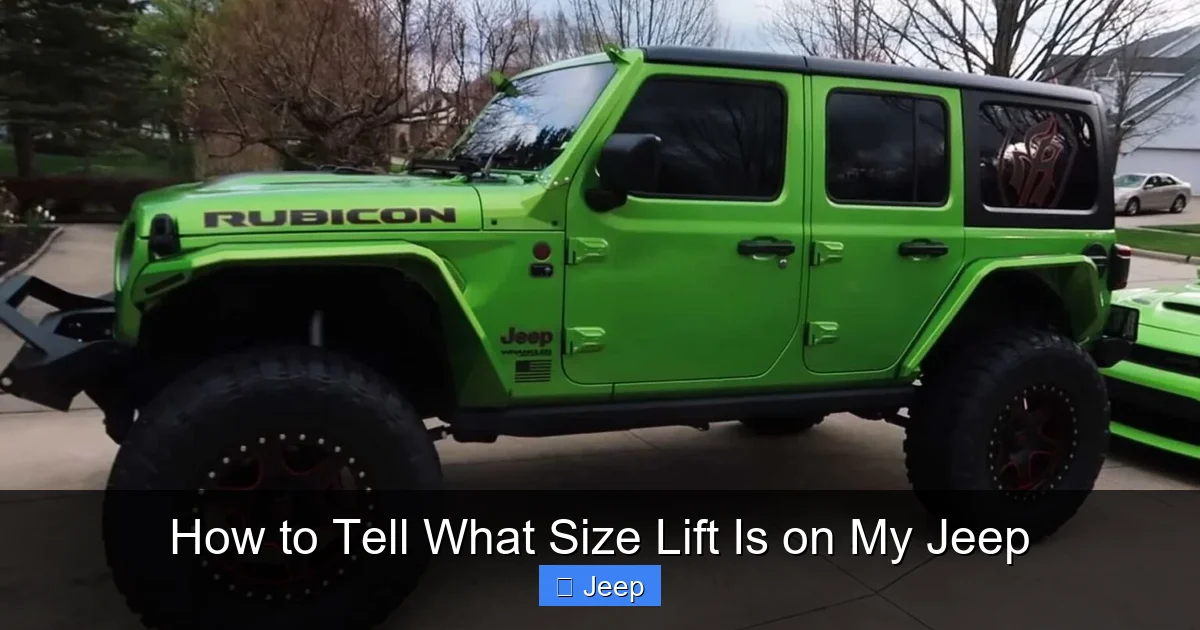
Visual guide about How to Tell What Size Lift Is on My Jeep
Image source: jeepmaven.com
What to Look For Underneath
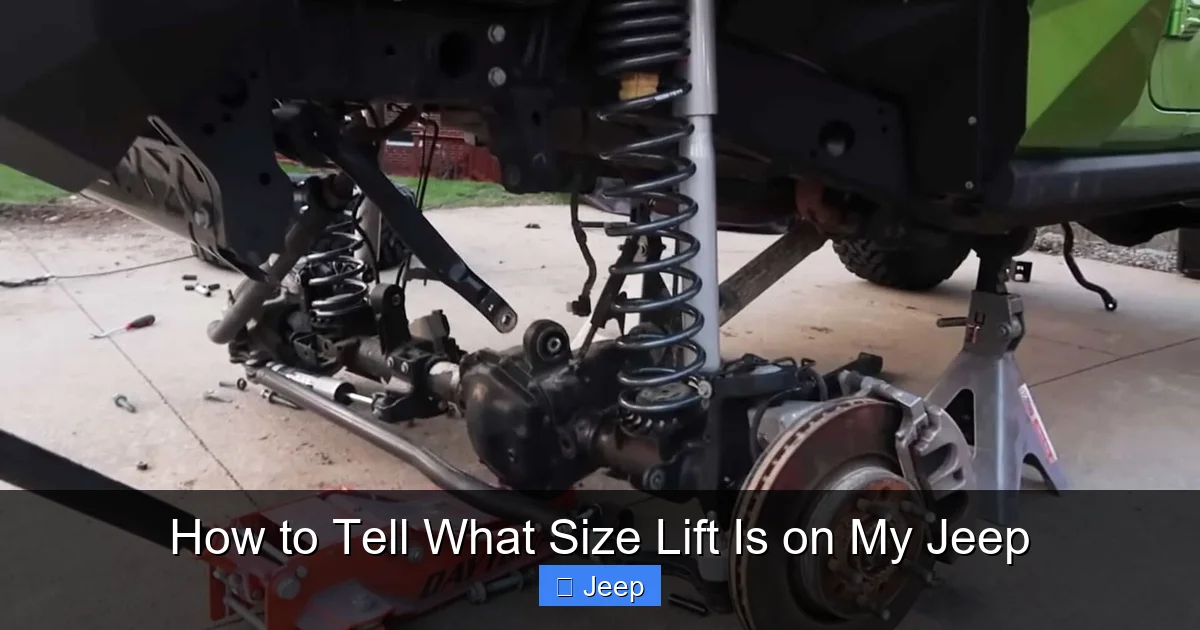
Begin your inspection at the front axle. Coil springs are your biggest clue. Compare the height and diameter of your front and rear coils to pictures of stock Jeep coils for your specific model year (a TJ, JK, JL, or JT will all have different stock springs). A taller, often more tightly wound spring is a dead giveaway. Aftermarket lift coils are usually silver or coated, while stock springs are often black. The height difference is often visible even without measuring. Next, look at the front track bar. On a lifted Jeep, the track bar (the bar that locates the axle side-to-side) will often be “dropped,” meaning it has a bend or an adapter that lowers its mounting point on the frame to correct for the changed geometry. A dropped track bar is a strong indicator of a lift of 2 inches or more. You should also check for extended or adjustable control arms. Stock control arms are a fixed length. If you see longer, often chrome or brightly colored arms replacing the stock ones, this points to a significant lift (usually 3+ inches), as longer arms are needed to reposition the axle correctly and maintain proper driveshaft angles. Finally, inspect the shock absorbers. They will be longer than stock. While you can’t always tell the exact inch count from shock length alone (as they vary by brand), a very long shock, especially one with a remote reservoir, suggests a higher lift intended for serious off-roading.
Exterior and Drivetrain Clues
Don’t forget to look at the driveshaft. On a JK or JL Wrangler, a lift over about 3 inches often requires a longer rear driveshaft or at least a new U-joint. If you see a different-looking rear driveshaft or a noticeable gap between the driveshaft and the transmission/axle yokes, it’s a sign of a substantial lift. Under the rear axle, check for shackle relocations or extended rear springs. A lift shackle that is longer than stock or positioned differently can add height. Also, look at your tire size. While not a perfect science, there are general guidelines. A stock JK/JL on 32-inch tires might have a 2-inch lift. A Jeep on 35-inch tires commonly has a 3.5 to 4.5-inch lift. A 37-inch tire usually means a 4+ inch lift. This is a rough correlation, not a rule, as tire size can be changed independently of lift. Finally, check the body mount bolts. Some very high lifts (5+ inches) require body lift blocks or taller body mount bolts. If you see spacers under the body mounts, that’s a clear sign of a body lift on top of the suspension lift.
Using visual clues is like being a detective. You gather evidence from multiple points—springs, track bar, control arms, driveshaft—to build a case for your estimated lift size. If all signs point to longer coils, a dropped track bar, and extended arms, you’re likely looking at a 4-inch or greater lift. If it’s just slightly taller springs and maybe a spacer, it could be a budget 1.5 to 2-inch lift.
Method 2: The Measuring Technique – Getting the Exact Number
If you want to be certain, you need to measure. This is the gold standard for determining lift height. The goal is to measure the distance from a fixed point on the axle to a fixed point on the frame/chassis. This measurement is called the “lift height” or sometimes “spring lift.” We’ll focus on the most common and reliable measurement: the axle-to-frame measurement at the control arm mounting points.
Visual guide about How to Tell What Size Lift Is on My Jeep
Image source: jeepmaven.com
Step-by-Step Measuring Guide
Safety First: Ensure your Jeep is parked on level, solid ground. Engage the parking brake and chock the wheels. For the most accurate and safe measurement, the vehicle should be sitting at its normal ride height, meaning it’s on the ground, not on a lift or jack stands. The suspension must be under its normal weight (the vehicle’s own weight).
Step 1: Identify Your Measurement Points. You need to find two points: one on the axle housing and one on the vehicle’s frame or unibody chassis. The best and most universal points are the front lower control arm mounting bolts. On the axle, locate the bolt that attaches the front of the lower control arm to the axle housing. On the frame/chassis, locate the corresponding bolt that attaches the other end of the same control arm. These two points are your reference. For the rear, you can use the rear lower control arm bolts or the leaf spring perches (the front and rear mounting points on the axle for the leaf springs).
Step 2: Take the Measurement. With your Jeep on the ground, use a rigid metal tape measure. Measure the straight-line vertical distance from the center of the axle-side control arm bolt to the center of the frame-side control arm bolt. Do this on both the driver and passenger sides and record both numbers. They should be very close, if not identical. If they differ significantly, your suspension may be out of alignment or damaged. Take the average of the two.
Step 3: Find the Stock Reference. This is the critical step. You now have a number, say 18 inches. Is that lifted or stock? You need the stock measurement for your specific Jeep. This is where research comes in. You must look up the stock axle-to-frame measurement for your exact Jeep (year, model, engine, etc.). Reliable sources include factory service manuals, reputable Jeep forums (like JeepForum.com, specific to your model), or suspension manufacturer websites that often list stock measurements for comparison. For example, a stock 2015 Jeep Wrangler JK Unlimited might have a front lower control arm bolt measurement of 16.5 inches. If you measure 18.5 inches, your lift is approximately 2 inches (18.5 – 16.5 = 2).
Alternative Measurements
If control arm bolts are hard to access or you’re unsure, you can measure other consistent points:
- Fender Height: Measure from the ground to the top of the front fender flare (a non-flexing point) and compare to stock specs. This is less precise due to tire size and fender design variations.
- Coil Spring Height: If you can safely measure the free height of your coil springs (with the axle supported), you can compare that height to a stock spring for your Jeep. This is tricky and requires removing the spring.
- Axle-to-Frame at the Spring Seat: Measure from the top of the axle tube (where the spring sits) up to the bottom of the frame rail directly above it. This is a good, solid measurement.
Remember, the key is comparing your Jeep’s current measurement to a verified stock measurement for the same model. A variance of an eighth of an inch is normal due to manufacturing tolerances and tire pressure.
Method 3: Decoding the Paper Trail – VIN, Build Sheet, and Receipts
Sometimes the answer is sitting in your glove compartment or can be requested from Chrysler (now Stellantis). This method is most effective if the lift was installed at a dealer as part of a factory package or if you have documentation from a professional installation.

Visual guide about How to Tell What Size Lift Is on My Jeep
Image source: jeepfixes.com
The Factory Build Sheet
Jeep Wranglers (JK, JL, JT) can come from the factory with an optional Rubicon or Sahara package that includes a mild lift (usually 1 inch) and off-road tires. More rarely, a special order might have had a MOPAR lift installed at the port. The definitive source for what your Jeep was born with is its build sheet. This is a detailed list of every option and component installed on your vehicle at the factory. You can obtain this by visiting a Chrysler/Stellantis dealer’s service department and providing them with your VIN. They can often print it out. Look for codes related to “suspension,” “axle ratio,” “tire size,” or specific package names. A Rubicon build sheet will explicitly list “Rubicon” suspension components. This won’t tell you about an aftermarket lift added later, but it will confirm your starting point.
The VIN Decoder
While a full VIN decode won’t say “2-inch lift,” certain characters in the VIN can indicate specific packages. For example, on some model years, the 8th character might denote the engine, and the 5th might denote the body style, but package information is often not that granular. Free online VIN decoders (like those from Stellantis or NMVTIS) are good for basic info (year, make, model, engine), but for detailed factory options, the official dealer build sheet is superior. However, if your VIN shows your Jeep is a “Sport” or “Sahara” model, you know it did not come with a factory Rubicon lift, so any lift is aftermarket.
Aftermarket Installation Receipts and Part Numbers
This is your best friend if the lift was professionally installed. Find the receipt. It should list the lift kit manufacturer (e.g., Rubicon Express, Teraflex, ARB, Skyjacker) and the specific kit name or part number. The part number almost always contains the lift size (e.g., RE-1225 for a 2.5-inch lift, TF-4355 for a 3.5-inch lift). If you don’t have the receipt, look for the part numbers stamped or sticker-ed on the components themselves. Lift coil springs often have a part number. Control arms and track bar adapters also have part numbers. Write these down and search them online or call the manufacturer. You’ll get the exact lift size and model application. If you installed it yourself, this should be easy—check your order history or old boxes.
Method 4: Consulting the Experts and Community
When all else fails, or if you want a second opinion, turn to the vast knowledge base of Jeep enthusiasts and professionals.
The Power of Jeep Forums and Groups
There is a massive, passionate community of Jeep owners online. Forums specific to your model (e.g., JL Wrangler Forum, JK-Forum, TJ-Forum) are treasure troves of information. The process is simple: take clear, well-lit photos of your suspension from multiple angles—front axle, rear axle, control arms, track bar, and the undercarriage. Post them in the “What’s My Lift?” or “Suspension” section of the forum. Include your Jeep’s year, model, and any known history. Within hours, you’ll likely have several experienced members giving you their educated guess, often based on having the exact same setup. Be sure to mention if you’ve already measured and what your numbers were—this helps them confirm or correct your findings. Facebook groups for your specific Jeep model are also excellent for this, though forum archives are better for long-term reference.
The Professional Inspection
Sometimes, you just need a definitive answer from someone who does this for a living. A reputable 4×4 or suspension specialty shop can look at your Jeep and tell you the lift size in minutes. They’ve seen hundreds of kits and can identify components by sight. They can also perform the precise measurement we discussed earlier. This is the best route if you’re planning new tires, a alignment, or further modifications and need absolute certainty. A professional opinion is also crucial if your Jeep has a homebrew or “cut-and-weld” lift, where previous owners may have fabricated their own components. These can be dangerous and inconsistent, and a pro can assess their safety and true height. A quick inspection at a good shop might cost an hour of labor, but it’s cheap insurance for your safety and your wallet.
Common Pitfalls and What Can Go Wrong
Even with these methods, there are traps for the unwary. Being aware of them will save you from misidentifying your lift.
The “Combo Lift” Confusion
Many Jeeps have a combination lift. This is when the owner uses a 2-inch spacer lift on the springs (cheap, easy) but then adds a 1-inch body lift. The total lift is 3 inches, but if you only measure the suspension, you’ll find 2 inches. If you only see the body lift blocks, you might think it’s just a 1-inch body lift. You must measure the entire system from the axle to the ground or frame and account for all height-adding components. Also, some kits come with a front coil spring lift and a rear add-a-leaf or block lift, resulting in different front and rear heights (e.g., 3-inch front, 2-inch rear). Your measurement might show a different number in the front versus the rear. Always measure both axles.
Sag and Worn-Out Components
A lift is measured when the suspension is new and the vehicle is unloaded. If your Jeep has worn-out springs, shocks, or bushings, it will sit lower than its intended lift height. You might measure 2.5 inches when the kit is actually a 3.5-inch. This is common on older Jeeps or those that have seen heavy use. In this case, the measurement tells you the *current* height, not the *kit’s* height. You’ll need to rely more on visual identification of the components (what model of coil spring is installed?) or find old receipts. Similarly, if your Jeep is heavily loaded with aftermarket bumpers, winch, or roof-top tent, the rear springs may be sagging, giving a false rear measurement.
Misidentified Components
Not all taller components are part of a lift kit. For example, aftermarket wheels with negative offset (like -12 offset) will stick out further and can give the *illusion* of a taller, wider stance, but they do not change the actual suspension lift height. Similarly, larger tires obviously increase ground clearance and overall height, but they are not a lift kit. You must measure the suspension geometry itself, not the overall vehicle height. Also, some Rubicon models come with a factory 1-inch lift via taller springs. An owner might add a 1.5-inch spacer on top of that, resulting in 2.5 inches total. Without knowing the factory baseline, you’d misattribute the full height to the spacer.
Conclusion: Putting It All Together
Determining your Jeep’s lift size is a process of deduction, measurement, and research. Start with a thorough visual inspection to gather clues about the components. Then, if possible, perform the critical axle-to-frame measurement and compare it to verified stock specs for your specific Jeep. This measurement is your most reliable number. Simultaneously, hunt for the paper trail—receipts, part numbers, or a factory build sheet. Finally, don’t hesitate to tap into the community or consult a professional for confirmation, especially if the setup is unusual or you suspect worn parts.
Remember, knowing your lift is about more than a number. It’s about understanding your machine’s capabilities and limits. It empowers you to make smart decisions about tires, maintenance, and future upgrades. It ensures your safety on the road and trail. So roll up your sleeves, grab a tape measure, and become the expert on your own Jeep. After all, that’s part of the fun of owning one—getting to know every nut, bolt, and coil spring under the hood. Now get out there and enjoy your properly understood rig!
Frequently Asked Questions
What is the single most accurate way to determine lift size?
The most accurate method is to physically measure the vertical distance from a fixed point on the axle (like a control arm bolt) to a corresponding fixed point on the frame/chassis, then subtract the verified stock measurement for your specific Jeep model. This eliminates guesswork.
Can I just measure tire size to figure out my lift?
No, you cannot rely on tire size alone. While larger tires often accompany larger lifts, they are independent modifications. You could have 35-inch tires on a stock Jeep with a fender trim, or on a 4-inch lift. Tire size indicates potential clearance needs, not suspension lift height.
My measurements show different heights in the front and rear. Is that normal?
Yes, it’s very common. Many lift kits are designed with a rake, where the front and rear lifts are different (e.g., 3-inch front, 2-inch rear) to level the Jeep’s stance or improve approach/departure angles. Always measure and record both front and rear separately.
If my Jeep is sagging, will my measurement be wrong?
Yes. Worn-out springs, shocks, or heavy loads will cause your Jeep to sit lower than its intended, brand-new lift height. Your measurement will show the *current* height, not the kit’s original lift size. In this case, you must rely more on identifying the installed components (spring part numbers, etc.) or finding documentation.
How much does it typically cost to have a professional identify my lift size?
A simple inspection at a reputable 4×4 shop might cost an hour of labor (often $100-$150), but many shops will do it for free if you’re a customer or if it’s a quick visual ID. It’s a small price to pay for certainty, especially before buying tires or major components.
Could my Jeep have a body lift instead of a suspension lift?
Yes, and it’s important to distinguish the two. A body lift uses spacers or blocks to raise the body off the frame, without changing suspension geometry. It’s identified by spacers under the body mounts. A suspension lift modifies the axle-to-frame relationship. Your measurement method (axle-to-frame) will tell you if there’s a suspension lift. A body lift adds height but does not change that measurement.
