
Is It Better to Charge Tesla at Lower Amps?

Charging your Tesla at lower amps is generally not “better” for the battery but can be a practical strategy for specific situations like overnight home charging or when your electrical panel has limits. It reduces stress on your home wiring and can be cheaper with time-of-use electricity rates, but it significantly increases charging time. For daily driving, using the highest safe amperage your setup allows is usually optimal for convenience. The real key to battery longevity is avoiding extreme charge states and extreme heat, not obsessing over amperage.
Key Takeaways
- Battery Health Priority: Tesla’s battery management system is designed to protect the battery regardless of charging amperage. The biggest factors for long-term health are avoiding constant 100% charges and extreme temperatures.
- Convenience vs. Time Trade-off: Lower amperage charging (like 16A or 32A) is gentler on your home’s electrical system but can take 2-3 times longer than higher amperage charging (48A-72A). Choose based on your daily mileage and schedule.
- Electrical System Safety: For homes with older panels or shared circuits, using a lower amp setting on a higher-capacity charger (like a Gen 3 Wall Connector) is a safe way to avoid tripping breakers or overheating wires.
- Cost Considerations: The cost to charge is based on kWh used, not amps. However, slower charging at night may align with cheaper off-peak electricity rates, potentially saving money. The cost to install a 220V outlet for higher amperage charging is a separate upfront investment.
- No “Magic” for Battery: There is no technical evidence that routinely charging at 16A preserves the battery more than charging at 48A, as long as the battery stays within its optimal temperature and charge window managed by the car.
- Use the Right Tool for the Job: Think of amperage like a water hose. A fire hose (high amps) fills the pool (battery) fast but needs a big pipe (heavy-gauge wire). A garden hose (low amps) is fine for a small kiddie pool (daily top-up) but frustrating for a big pool.
- Optimal Daily Strategy: For most owners with a dedicated home circuit, set your charger to the maximum amperage the circuit and wiring safely support. Use the “Scheduled Charging” feature to start at off-peak hours. Reserve lower amps for travel destinations with questionable electrical infrastructure.
📑 Table of Contents
- Introduction: The Great Amperage Debate
- Understanding the Basics: Volts, Amps, and Watts
- The Case for Lower Amps: When Slow and Steady Wins
- The Case for Higher Amps: Speed and Efficiency
- Debunking Myths: Does Lower Amps Preserve Battery Health?
- Optimal Charging Strategy: A Practical Guide
- Conclusion: It’s About Your Context, Not a Universal Rule
Introduction: The Great Amperage Debate
So, you’ve joined the electric revolution and are the proud owner of a Tesla. Congratulations! But now you’re staring at your charging settings, wondering: should I dial that amp number down? Is a slow, gentle 16-amp charge better for my expensive battery than a blisteringly fast 72-amp fill-up? It’s a common question, and the answer isn’t a simple yes or no. It’s a nuanced mix of battery chemistry, electrical engineering, personal convenience, and even your local utility’s pricing schedule.
Let’s cut through the noise. The idea that “lower is always better” is a well-intentioned myth, often carried over from older nickel-based battery lore. Tesla’s lithium-ion packs are sophisticated. They have a built-in Battery Management System (BMS) that is the ultimate guardian of your battery’s health. This BMS regulates voltage and current with extreme precision, whether you’re feeding it 5 amps or 80. The real culprits of battery degradation are heat, extreme state of charge (consistently at 0% or 100%), and time itself. Amperage, within the car’s designed limits, is not a primary degradation driver.
This article will unpack everything. We’ll dive into what amps really mean, how they interact with your car and home, the tangible pros and cons of charging slow versus fast, and give you a clear, actionable strategy. By the end, you won’t just have an opinion—you’ll have a plan tailored to your Tesla, your home, and your life.
Understanding the Basics: Volts, Amps, and Watts
The Water Hose Analogy
Before we go further, we need a quick electrical primer. Think of charging your car like filling a pool with a hose.
- Volts (V) is the water pressure. A standard US household outlet (NEMA 5-15) is 120V (low pressure). A 240V outlet (like a dryer outlet, NEMA 14-50) is high pressure.
- Amps (A) is the width of the hose, or the flow rate of electrons. More amps mean more electrons flowing per second.
- Watts (W) is the total power. Watts = Volts x Amps. This is what determines your charging speed.
So, charging at 240V and 48A gives you 11,520W (11.5 kW). Charging at 120V and 12A gives you 1,440W (1.44 kW). That’s an 8x difference in power! Your Tesla’s onboard charger converts this AC power to DC to store in the battery. The maximum AC charging rate varies by model (e.g., Model 3 Long Range can accept up to 11.5 kW, a Standard Range may be limited to 7.7 kW).
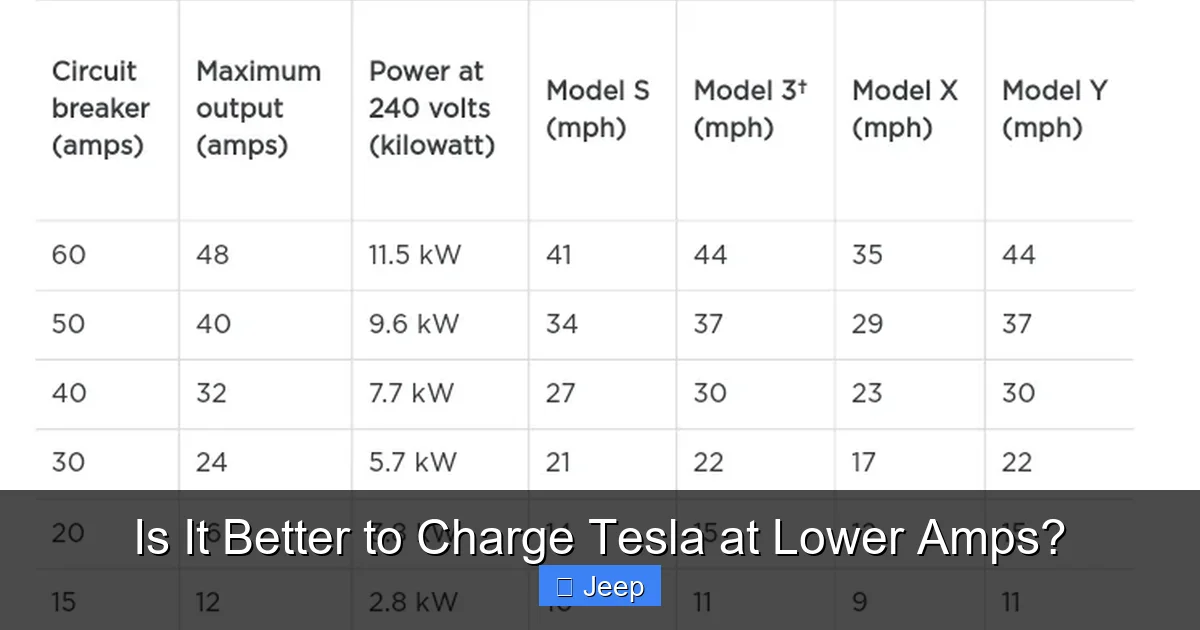
Visual guide about Is It Better to Charge Tesla at Lower Amps?
Image source: lh5.googleusercontent.com
The Case for Lower Amps: When Slow and Steady Wins
1. Protecting Your Home’s Electrical System
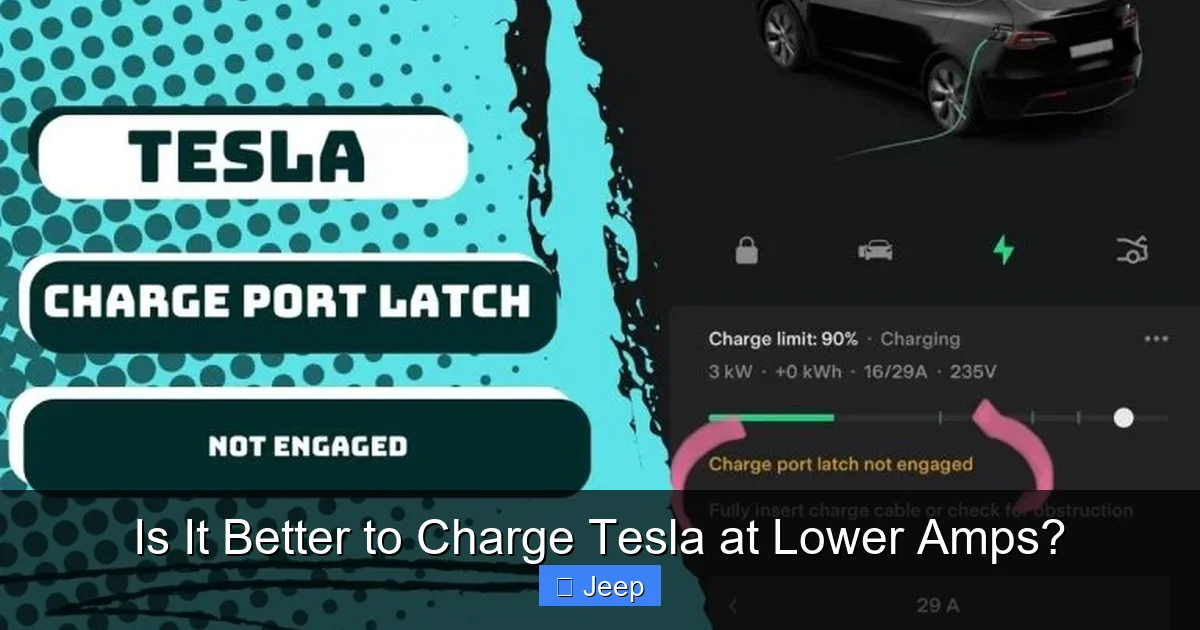
This is the #1 practical reason to use lower amps. Not every home is wired for a 60-amp, 240V circuit. Many people use a 14-50 outlet (50-amp circuit) but set their Wall Connector to 40-45 amps to be safe, or they use a 20-amp circuit (like a 14-20 outlet) and are limited to 16 amps. Pushing a circuit to its absolute maximum for hours on end can cause breaker fatigue, especially in older panels with older breakers. It also generates more heat in the wiring and connections. If you have a shared circuit (e.g., your charger is on the same panel as your oven or AC), running at a lower amperage prevents nuisance tripping. For peace of mind and electrical safety, derating (using a lower amp setting than the circuit’s max) is a very smart practice. You might even consider the cost to install a 220V outlet for Tesla if you’re starting from scratch, but once installed, you can choose your amperage within its limits.
Visual guide about Is It Better to Charge Tesla at Lower Amps?
Image source: evmotorr.com
2. The Overnight, Low-Mileage Scenario
Let’s say you drive 30 miles a day. That might use about 10 kWh of energy. On a 240V/16A circuit (3.8 kW), that takes about 2.5 hours. If you plug in at 10 PM and the car is done by 1 AM, who cares? The car will sit there topped off and ready by 6 AM. In this case, the slower charge is perfectly convenient and imposes zero burden on your daily routine. You’re not in a rush. The car’s BMS will manage the charge curve perfectly, tapering as it reaches the set limit. For people with predictable, low daily usage, lower amps are a simple, effective solution that works with any standard home outlet setup.
3. Cost Savings with Time-of-Use (TOU) Rates
Many utilities offer cheaper electricity at night. Your charging speed doesn’t change the total kWh used, but it changes the *duration* of that use. If your off-peak window is only 4 hours (e.g., 10 PM – 2 AM), a 72-amp charge might finish your weekly needs in one night. A 32-amp charge might need two nights to complete the same amount of charging within that cheap window. If your TOU window is very narrow, a higher amperage might be necessary to capture all your cheap energy. Conversely, if your off-peak window is long (8-10 hours), a lower amp setting will easily fill your battery within it, and you don’t need to worry about the speed. Analyze your utility’s TOU schedule. If the cheap period is sufficient for your needs at a lower amp, stick with it. If not, you may need to increase amps to fit the charging into the discount window.
The Case for Higher Amps: Speed and Efficiency
1. Convenience is King
Life happens. You come home from a long trip with a nearly dead battery. You need to go out again in 4 hours. A 16-amp charger will barely make a dent. A 48-amp charger can add 30-40 miles of range in that time. For anyone with variable mileage, road trips starting from home, or simply the desire to have their car “full” faster after an unexpected trip, higher amperage is a massive quality-of-life upgrade. It turns charging from an overnight necessity into a flexible, responsive utility. The frustration of a “slow charge” when you need range is real.
Visual guide about Is It Better to Charge Tesla at Lower Amps?
Image source: evseekers.com
3. Maximizing Renewable Energy Use
If you have solar panels, you might want to charge your car as directly as possible during peak sun hours. Solar production is variable and peaks midday. A higher amp charger can capture more of that solar energy in the few hours it’s at its maximum output. A low-amp charger might still be trickling charge when the sun goes down, forcing you to draw from the grid. Direct solar charging feels great and maximizes your green energy use. To do this effectively, you need a charger that can adjust its draw based on available solar power (like a SolarEdge or ChargePoint Home Flex with solar integration), and you need enough amp capacity to match your solar system’s output.
Debunking Myths: Does Lower Amps Preserve Battery Health?
The BMS is Your Battery’s Bodyguard
Here’s the critical truth: your Tesla’s Battery Management System is always in charge. It doesn’t matter if you request 16A or 72A. The BMS decides exactly how much current to accept at any given moment based on the battery’s state of charge, temperature, and health. When the battery is very low, it will accept the maximum current your charger provides (up to its own limit). As it gets fuller, the current tapers down dramatically. This happens on every charge cycle, at every amperage setting. The “gentle trickle” at the end of a charge is identical whether you started at 16A or 60A. The BMS is designed for the maximum charging speed the car is rated for. Using a lower setting simply means the BMS has to ask for the maximum less often, but the underlying charge profile it applies is the same.
What Actually Degrades a Lithium-Ion Battery?
- High Temperature: Heat is the number one enemy. Charging generates heat. Fast charging generates more heat *at the battery*. However, Tesla’s sophisticated thermal management system actively cools the battery during fast charging. The bigger risk is charging a hot battery (e.g., after a hard drive) at a high rate, or consistently parking in very hot climates. This is a climate/usage issue, not an amperage issue per se.
- High State of Charge (SoC): Keeping the battery at 100% for long periods (weeks) causes stress. Similarly, regularly deep-discharging to 0% is bad. The sweet spot for long-term health is between ~20% and ~80% for daily use. This is why the “Daily” charge limit setting is so valuable. Amperage doesn’t change this fact.
- Time and Cycle Count: Batteries degrade with time and charge cycles. This is inevitable. Slower charging might generate slightly less cumulative heat, but the difference is marginal compared to the effects of calendar aging and full cycle usage.
Conclusion on Health: There is no credible, peer-reviewed data or Tesla engineering document stating that charging at 16A vs. 48A results in a measurably different battery degradation rate over 5 years, provided the battery is kept within its optimal temperature and SoC windows. The BMS is built to handle its maximum designed input safely.
Optimal Charging Strategy: A Practical Guide
Now, let’s synthesize this into a simple decision tree for you.
Step 1: Assess Your Home Electrical Capacity
Do you have a dedicated 240V circuit? What’s the breaker size (20A, 50A, 60A)? What gauge is the wire? This dictates your maximum *possible* safe amperage. If you’re unsure, consult an electrician. The cost to install a 220V outlet for Tesla varies widely based on your panel’s distance and capacity, but it’s a one-time cost for great flexibility. Never exceed the circuit’s rating.
Step 2: Know Your Daily Driving Needs
Check your Tesla app. What’s your average daily usage? 20 miles? 50 miles? 100 miles? Calculate the kWh needed (roughly 3-4 miles per kWh for Model 3/Y, 2-3 for Model S/X).
Step 3: Match Amperage to Schedule & TOU Rates
– Low Daily Use + Long Off-Peak Window: Use the lowest amp setting that comfortably fills your daily need within the off-peak window. It’s safe, easy on your wiring, and gets the job done. No need for a bigger circuit.
- Example: 30 miles/day (~10 kWh). 16A @ 240V = ~3.8 kW. 10 kWh / 3.8 kW = ~2.6 hours. Set charging to start at 10 PM. Done by 1 AM. Perfect.
– Variable/High Use + Short Off-Peak Window: Use the highest safe amperage your circuit allows to maximize flexibility and ensure you can recharge fully during the discount period.
- Example: 80 miles/day (~25 kWh) and off-peak is only 5 hours (10 PM – 3 AM). 32A @ 240V = ~7.7 kW. 25 kWh / 7.7 kW = ~3.2 hours. That fits easily. 16A would take 6.5 hours, missing the off-peak window. You need the higher amp.
– Frequent Road Trips from Home: Definitely install the highest-capacity circuit you can (60A or 80A) and use a Wall Connector set to 48A or 72A. The time savings before a long drive are significant.
Step 4: Use the Tools Tesla Gives You
Scheduled Charging: Your best friend. Set it to start at the beginning of your off-peak rate period. This is more important than the amp setting for cost savings.
Charge Limit: Set a daily limit (e.g., 80% or 90%) for daily driving. Only charge to 100% when you need the full range for a trip. This is the single biggest thing you can do for battery health.
Preconditioning: Use the “Scheduled Departure” feature. It will start charging at the optimal time to have the battery at your desired SoC and temperature by your departure time, using the most efficient mix of grid and battery power.
Conclusion: It’s About Your Context, Not a Universal Rule
So, is it better to charge at lower amps? The answer is: it’s better for some things and worse for others, and “better” depends entirely on your priorities.
If your priority is minimizing any theoretical, minuscule extra electrical stress on your home’s aging wiring, and you have low, predictable daily mileage with a long off-peak window, then yes, a lower amp setting is a perfectly sensible and “better” choice for your situation.
If your priority is maximum convenience, flexibility for unexpected trips, or harnessing solar power, then a higher amp setting is unequivocally better.
For the vast majority of Tesla owners with a properly installed dedicated circuit, the simplest and most effective strategy is this: Set your charger to the maximum amperage your circuit and wiring can safely handle (often 32A, 40A, or 48A for a 50A circuit), use Scheduled Charging to align with off-peak rates, and set a daily charge limit of 80-90%. Then, forget about it. This balances convenience, cost, and the proven factors that actually affect battery longevity. Don’t lose sleep over the amp number. Your Tesla’s BMS has got it handled. Focus on the big picture: avoid extreme temps, avoid sitting at 100% for months, and enjoy the drive.
Frequently Asked Questions
Will charging at lower amps really make my Tesla battery last longer?
No. While it’s a common belief, there is no technical evidence that a lower amperage setting within the car’s designed range provides a meaningful benefit to long-term battery health. The Tesla’s Battery Management System carefully controls the charging process regardless of the requested amperage. Factors like avoiding frequent 100% charges and extreme heat are far more important.
What is the safest amperage to charge my Tesla at home?
The safest amperage is the maximum your dedicated home circuit and wiring are rated for, minus a small safety margin. For example, on a 50-amp circuit, setting your charger to 40-45 amps is a safe and common practice. Always consult the charger’s manual and consider having an electrician verify your setup. Never exceed your circuit breaker’s rating.
Is it cheaper to charge my Tesla at 16A vs. 72A?
No. The cost is based on kilowatt-hours (kWh) of electricity used, not amperage. Driving 50 miles will use roughly the same amount of energy (kWh) whether you charge slowly or quickly. Any potential cost savings come from aligning the charging duration with your utility’s time-of-use (TOU) off-peak rates, not from the amp setting itself.
How long will it take to charge my Tesla at 20 amps?
Charging speed depends on your car model and its onboard charger capacity. At 240V and 20A (4.8 kW), a Tesla Model 3 Long Range with a 75 kWh battery (typically 10-80% is about 50 kWh) would take approximately 10-11 hours to go from 10% to 80%. This is suitable for overnight top-ups but too slow for large daily needs.
Should I always use the highest amperage my charger allows?
Not always. Use the highest amperage that is safe for your home’s electrical installation and that fits your scheduling needs. If you have a 50-amp circuit, setting the charger to 48A is fine. But if you have a 20-amp circuit, you are physically limited to 16A. The “highest” should always be the highest *safe* setting for your specific hardware.
Does slow charging at home help avoid wear and tear compared to Supercharging?
Yes, but not for the amperage reason you might think. Supercharging uses extremely high DC power directly to the battery, generating more heat. The BMS must work harder to cool the pack. Home AC charging, even at 48A, is a much slower process that inherently generates less heat stress per unit of energy delivered. The difference between charging at home at 16A vs. 48A is negligible compared to the difference between any home charging and a 250 kW Supercharger session. For daily charging, home is always gentler than Supercharging, regardless of the home amp setting.
