
How to Open Tesla Model X Door from Outside

Opening a Tesla Model X from the outside relies primarily on its key fob or smartphone app, but several backup methods exist if those fail. The vehicle’s unique falcon doors and sensor-based system mean traditional handle pulls won’t work. Understanding all access options—including PIN entry, mechanical keys, and 12V battery jump points—is crucial for emergencies. Always keep your key fob charged and your phone connected to avoid lockouts.
So, you’re standing outside your Tesla Model X, groceries in hand, ready to hop in. You press the door handle… and nothing happens. The sleek, flush surface doesn’t pop out. Panic sets in for a second. Don’t worry. This is a common moment for new Model X owners (and even veterans in a pinch). The Model X, with its iconic falcon doors and sensor-driven “auto-presenting” handles, operates differently from any traditional car. Knowing how to open a Tesla Model X door from outside isn’t just a neat trick—it’s essential knowledge. This guide will walk you through every method, from the everyday to the emergency, so you’re never locked out.
Key Takeaways
- Primary Methods: Use the key fob or Tesla app for standard door and falcon door operation.
- PIN to Drive is Key: Your vehicle’s PIN provides emergency access when key fob/app fail.
- 12V Battery Powers Backups: A discharged main battery doesn’t prevent all access; the 12V battery runs essential systems.
- Mechanical Key Exists: A hidden physical key inside the fob can unlock the driver’s door in total power loss.
- Weather & Sensors Matter: Extreme cold/heat or ice/snow can interfere with sensors and auto-presenting handles.
- Frunk Access is Separate: The front trunk has its own manual release inside the car; it cannot be opened from outside without power.
- Regular Maintenance Prevents Lockouts: Keep fob batteries fresh, phone Bluetooth on, and know your PIN.
📑 Table of Contents
- Why the Model X Door System Is Uniquely Tesla
- Method 1: The Key Fob – Your Primary Physical Key
- Method 2: The Tesla Smartphone App – Digital Key on Steroids
- Method 3: PIN to Drive – Your Secret Emergency Code
- Method 4: Power Failures & Mechanical Key – The Last Resorts
- Troubleshooting: When Things Go Wrong
- Prevention & Best Practices
- Conclusion: Confidence Through Knowledge
Why the Model X Door System Is Uniquely Tesla
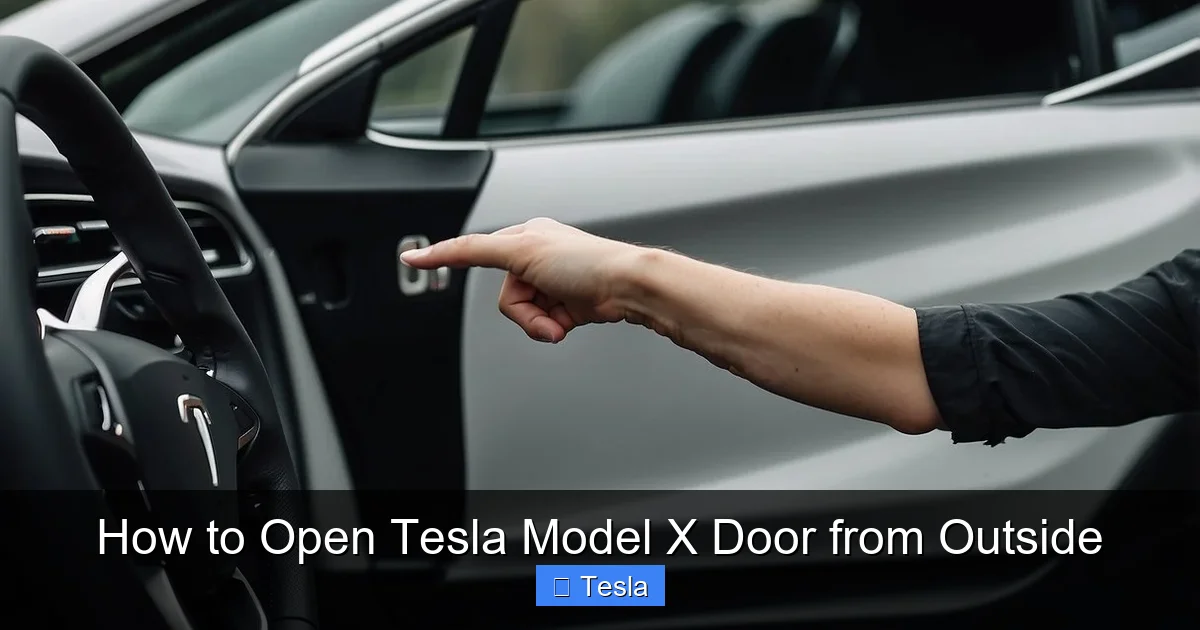
Before we dive into the “how,” let’s quickly appreciate the “why.” The Model X wasn’t designed with traditional door handles. Instead, it uses capacitive touch sensors and electric latches. When you approach with a valid key (fob or paired phone), the handle automatically extends (“presents”). A simple press on the extended handle opens the door. The rear falcon doors operate on a complex hinge system with sensors to avoid collisions. This system is brilliant for aerodynamics and aesthetics but creates a dependency on electronics and authentication. If the car doesn’t “see” your key, the handles stay flush. Our goal is to bypass that authentication loop when needed.
The Pillars of Access: Authentication & Power
Two things make a Model X door open: the car must recognize you have permission (authentication), and it must have power to operate the motors and latches. Your main methods provide both. Your backups often provide just enough power to a specific system for a specific action. We’ll break them down in order of reliability and frequency of use.
Method 1: The Key Fob – Your Primary Physical Key
The key fob is the original, dedicated hardware key. It’s a small, rectangular device with buttons. For the Model X, it’s your most straightforward tool.

Visual guide about How to Open Tesla Model X Door from Outside
Image source: teslord.com
Step-by-Step with the Fob
1. Ensure the Fob is Powered: Replace the CR2032 coin cell battery inside the fob every 1-2 years. A weak battery reduces range. You’ll know it’s dying if you have to be very close to the car.
2. Approach the Vehicle: Walk within about 3-6 feet of the driver’s door or rear falcon door. The handles should automatically extend. If they don’t, press the lock/unlock button on the fob once. The car will honk and flash lights, and handles should present.
3. Press the Handle: Once the handle is out, press it firmly inward. The door will unlatched and can be swung open manually. For the falcon doors, after pressing the handle, the door will begin its opening sequence automatically. Stand clear as it swings up and out.
Pro Tip: If the handles don’t present after pressing the fob button, press it again. Sometimes the first press just wakes the car’s Bluetooth module. If you’re in a heavy downpour or extreme cold, the car might be in a low-power state; a second press usually triggers it.
Fob Button Functions
- Top Button (Lock): Locks all doors and the frunk/trunk. Press twice quickly to fold mirrors and roll up windows (if configured).
- Middle Button (Trunk): Press and hold for 1-2 seconds to open the rear power liftgate (the trunk portion below the falcon doors). This does not open the falcon doors themselves.
- Bottom Button (Unlock): Press once to unlock all doors and present handles. Press and hold for 1-2 seconds to open the charge port door.
Remember, the fob’s unlock button is your direct command to the car to authenticate you and prepare for entry.
Method 2: The Tesla Smartphone App – Digital Key on Steroids
Your smartphone, with the Tesla app installed and Bluetooth enabled, is a digital key. For most daily use, this is now the primary method for many owners. The process is seamless.

Visual guide about How to Open Tesla Model X Door from Outside
Image source: automotiveglory.com
Getting It to Work
1. Prerequisites: Your phone must have Bluetooth turned on, location services for the Tesla app enabled (to detect proximity), and the app must be logged into your Tesla account. The car must also have a data connection (LTE) for initial handshake, but the actual unlock is Bluetooth-based and very low-power.
2. Walk Up: As you approach, the Tesla app on your phone communicates with the car via Bluetooth Low Energy (BLE). If your phone is recognized, the handles present automatically. You don’t even need to open the app.
3. Manual App Control: If handles don’t present, open the Tesla app. At the top, you’ll see a “Controls” section. Tap the “Lock” icon to toggle it to “Unlock.” The car will honk, lights flash, and handles present. You can also use the app to open the charge port, frunk, and trunk.
Common App Issues & Fixes
- “No Key Phone Detected” on Screen: Ensure Bluetooth is on, phone isn’t in Airplane Mode, and the Tesla app is running in the background (not force-quit). Restart your phone’s Bluetooth.
- Multiple Phones/Keys: The car connects to the closest valid key. If your spouse’s phone is closer, the car might ignore yours. Stand near the driver’s door.
- Phone Battery Dead: A dead phone is just a brick. You’ll need your fob or PIN. This is why carrying the fob is still mandated by Tesla for the Model X.
- App Needs Update: An outdated app can cause communication glitches. Update via your app store.
The app is fantastic, but it’s software. Software can glitch. That’s why your fob and PIN are non-negotiable backups. For those interested in customizing their Model X’s appearance, exploring options like how much does it cost to wrap a Tesla Model X can be a great project after you’ve mastered all its features.
Method 3: PIN to Drive – Your Secret Emergency Code
This is the most critical backup method and the one that saves people in true lockout scenarios. PIN to Drive is a security feature you set up in the car’s settings. It requires you to enter a 4-digit code on the touchscreen before driving. But it also doubles as an emergency access tool.
Visual guide about How to Open Tesla Model X Door from Outside
Image source: koala.sh
How to Use PIN for Door Access
1. Wake the Car: Press the brake pedal firmly. This wakes the 12V system and the main touchscreen. If the main battery is completely dead, you’ll need jump power to the 12V battery first (see Method 4).
2. Locate the Keypad: On the bottom center of the touchscreen, a keypad will appear. It’s a grid of numbers 1-9, 0, and a backspace arrow.
3. Enter Your PIN: Carefully tap your 4-digit PIN. As you enter each digit, it appears as a dot for security.
4. Access Granted: Once the correct PIN is entered, the screen will change, and the car will honk and flash its lights. The door handles will automatically present. You can now press the handle to open the door.
Important: This only works on the driver’s door. The falcon doors will not open via PIN; once you’re inside and the car is “on,” you can use the interior buttons or screen to open them.
Setting Up & Remembering Your PIN
Go to Controls > Safety & Security > PIN to Drive. Follow prompts to set a 4-digit code. Choose something memorable but not obvious (like your birth year). Write it down and store it separately from the car—in your wallet, not the glovebox. Test it periodically so you don’t forget the sequence under stress.
This method is foolproof as long as the 12V system has power. It bypasses all key fob and phone authentication.
Method 4: Power Failures & Mechanical Key – The Last Resorts
What if the main battery is dead, the 12V battery is dead, your phone is dead, and your fob battery is dead? It’s a worst-case-chain-reaction scenario, but it can happen if a car sits unused for months. There are still paths.
Jumping the 12V Battery
The Model X’s low-voltage 12V battery powers all the computers, locks, and handle motors when the main battery is off or disconnected. If it’s dead, nothing works. You can jump it.
- Locate the 12V Battery: It’s in the front trunk (frunk). To access the frunk, you normally use the touchscreen or app. But with no power, you can’t. There’s a manual release inside the driver’s footwell. Look for a small plastic flap or pull tab near the bottom of the dashboard, on the driver’s side. Pulling this releases the frunk latch. You may need to feel for it. Learning how to open a Nissan Altima hood from outside involves a different interior lever, but the principle of a manual secondary release is similar across many modern cars.
- Jumping: Once the frunk is open, the 12V battery is on the passenger side. Connect a standard 12V jump starter or booster cables (red to positive, black to a suitable ground point as described in your owner’s manual). Apply power for a minute. The car’s systems should boot. You can then use the touchscreen PIN method.
The Physical Key Hidden in the Fob
Your key fob has a hidden mechanical key inside. This is for total electronic failure.
- Extract It: Press the small button on the fob and pull out the valet/key blade.
- Unlock the Driver’s Door: There is a small, round, cap-like cover on the driver’s door handle, near the rear end. Carefully pry it off with the key blade or a fingernail. Underneath is a traditional keyhole. Insert the mechanical key and turn to unlock the door. This only works on the driver’s door.
- After Entry: Once inside, you can start the car by placing the key fob in the center console’s wireless charging pad. The car will detect it and allow driving. You can also then use the screen to open other doors.
Warning: The falcon doors have a manual release inside (a cord near the interior door panel), but it’s not designed for frequent use and requires significant force. Get the car powered up first if possible.
Troubleshooting: When Things Go Wrong
Even with all methods, you might hit snags. Here’s how to diagnose.
“Handles Won’t Present” Checklist
- Is the Car Asleep? Press the brake pedal hard. If the screen wakes, the 12V system is fine. Try the fob/phone again.
- Key Not Detected: Is your fob battery dead? Is Bluetooth on for your phone? Is the phone in a Faraday bag or thick pocket? Move the fob/phone closer to the driver’s door pillar.
- Extreme Weather: Ice or snow can jam the handle mechanism. Gently pull on the handle to break ice. The car may disable auto-present in very cold temps; you may need to press the handle firmly while also pressing the fob unlock button.
- 12V Battery Dead: If the car is completely unresponsive (no lights, no screen), the 12V battery is dead. You need a jump. The car will honk and lights flash when you connect jumper cables correctly.
- Main Battery at 0%: A completely depleted main battery will not allow any door operation, even with a key, until it receives a tiny amount of charge. If you suspect this, you need a tow to a charger or a service center. The 12V battery will eventually die too, as it’s charged by the main battery.
Falcon Doors Specific Issues
The rear doors are more complex. If they won’t open automatically after authentication:
- Obstruction: Sensors detect objects. Check for ice, snow, or a low ceiling/garage door. The door will retract if it senses contact.
- Manual Open Mode: You can force a slower, manual-style open. With the car on and in Park, go to Controls > Locks > Falcon Doors. There’s an option to “Open Manually.” This reduces motor power and lets you swing the door more like a regular door, but you must support its weight.
- Cold Weather: The doors may open slower. Ensure the door tracks are clear of ice.
Prevention & Best Practices
Never finding yourself locked out is the best strategy.
Daily Habits
- Always Carry the Fob: Don’t rely solely on phone. The fob is the guaranteed backup. Keep it in a consistent pocket or bag.
- Phone Management: Keep Bluetooth on. Don’t force-quit the Tesla app. Ensure your phone’s OS and the Tesla app are updated.
- Know Your PIN: Memorize it. Practice entering it on the screen when the car is on, just to reinforce the memory.
- Check 12V Health: If your car sits for more than 3 weeks, it can drain the 12V battery. Use a trickle charger or start/ drive it every 2-3 weeks. A healthy 12V battery is the linchpin of all backup systems.
Seasonal Preparation
In winter, handle mechanisms can freeze. Spray a silicone lubricant (like 303 Aerospace) on the handle seams *before* a freeze. After a snowstorm, brush snow and ice away from the door seams and handles. In summer, extreme heat can sometimes affect sensor sensitivity; park in shade when possible.
Understanding your Model X’s access systems turns a potential frustration into a non-issue. It’s a high-tech car that demands a little know-how. Master these methods, and you’ll appreciate just how clever and resilient the system truly is. For owners who love to personalize their ride, once you’ve got the access down, you might consider how much does it cost to wrap a Tesla Model X for a striking new look that’s all your own.
Conclusion: Confidence Through Knowledge
The Tesla Model X’s door system is a marvel of engineering, but it’s not magic. It’s a sequence of authenticated commands and electrical signals. By now, you should be confident that you can open a Tesla Model X door from outside under any circumstance. Start with the key fob or phone app. If those fail, your PIN is your golden ticket. In a total power loss, know where the 12V battery is and how to jump it, and remember the mechanical key in your fob. Practice these steps mentally, and maybe even test the PIN entry once a month. This knowledge transforms you from a potential victim of a lockout into a master of your vehicle’s entry systems. It’s part of the modern EV ownership experience—a blend of convenience, technology, and a touch of old-school mechanical backup. Stay prepared, and your Model X will always welcome you home.
Frequently Asked Questions
What if my Tesla Model X key fob battery is completely dead?
First, try replacing the CR2032 battery inside the fob. If you have no spare, use your smartphone with the Tesla app as the primary key. If your phone is unavailable, you must use your PIN to Drive on the touchscreen (if the 12V battery has power) or the mechanical key hidden inside the fob to unlock the driver’s door manually.
Can I open the falcon doors from outside using the PIN?
No. The PIN to Drive method only unlocks and presents the driver’s door handle. Once you are inside with the car “on,” you can use the touchscreen or interior buttons to open the rear falcon doors. There is no external keypad for the rear doors.
My Tesla app says “No Key Phone Detected” even though Bluetooth is on. What now?
Ensure the Tesla app is running in the background and not force-quit. Restart your phone’s Bluetooth. Stand very close to the driver’s door pillar (where the antenna is). If it still fails, use your key fob. The issue is likely a temporary software glitch or your phone’s Bluetooth being in a low-power state.
What happens if the main battery is at 0%? Can I still get in?
If the main high-voltage battery is completely depleted, the 12V battery will eventually drain as well, as it’s normally charged by the main battery. With a dead 12V system, you cannot open any doors or wake the car. You will need to have the 12V battery jump-started first. Once the 12V system has power, you can use the PIN to open the driver’s door and then call for a tow to charge the main battery.
Is there any way to manually open the rear falcon doors from outside in an emergency?
There is no external manual release for the falcon doors. The only way to open them from outside is through electronic control (key fob, app, or after entering via driver’s door and using interior controls). If all electronic systems fail and you have entry via the mechanical key to the driver’s door, you must then use the interior manual release cord (located near the door panel) to open the falcon doors from inside. This is difficult and not recommended for frequent use.
Can extreme cold prevent the door handles from presenting?
Yes. In very cold temperatures (typically below -20°F / -29°C), the car may disable auto-presenting handles to conserve power. The handles will remain flush. In this case, you must press the handle firmly while simultaneously pressing the unlock button on your key fob. This forces the latch to release. If ice has frozen the handle mechanism, carefully break the ice first. For other cold-weather car tips, like how to open a Toyota Corolla trunk from the outside in winter, the principles of dealing with frozen mechanisms are similar.
