
Is It Safe to Sit in a Tesla While Charging

Yes, it is generally safe to sit in a Tesla while it charges. Tesla vehicles are equipped with multiple redundant safety systems that monitor and manage the high-voltage battery and charging process. Electromagnetic field (EMF) exposure inside the car during charging is extremely low, comparable to or less than everyday appliances. The vehicle’s sophisticated thermal management system actively prevents battery overheating, and the high-voltage system is physically isolated from the passenger cabin. However, you should always remain aware of your surroundings, avoid charging with visibly damaged equipment, and follow Tesla’s specific guidelines for your model and charging type.
Key Takeaways
- Multiple Safety Systems: Teslas have high-voltage interlocks, insulation monitoring, and automatic shut-offs that make electrification during charging highly improbable under normal conditions.
- Minimal EMF Exposure: Scientific measurements show EMF levels inside a charging Tesla are very low, often lower than a kitchen microwave or hair dryer at a distance, and well below international safety limits.
- Active Thermal Management: The battery’s liquid cooling/heating system continuously regulates temperature during charging to prevent thermal runaway, a key safety feature.
- Cabin Isolation: The high-voltage battery and components are sealed and physically separated from the passenger compartment, preventing any direct exposure.
- Exceptions Exist: Safety relies on the vehicle and charger being in good condition. Sitting in a car with a damaged charging cable, compromised battery, or during an active fire is extremely dangerous.
- Manufacturer Stance: Tesla’s official literature does not prohibit occupying the vehicle during charging, implying their engineering considers it a safe, intended use case.
- Common Sense Prevails: While the systems are robust, staying alert, not ignoring warnings, and using proper charging equipment are essential personal safety practices.
📑 Table of Contents
The Charging Process Demystified: What’s Actually Happening?
Let’s start with the basics. When you plug your Tesla into a charger, whether it’s a slowLevel 1/2 AC charger at home or a powerful DC Supercharger, a sophisticated conversation happens between your car and the charging station. This isn’t like filling a gas tank where liquid simply flows in. It’s a carefully managed electrical transfer.
The charger first performs a “handshake.” It talks to your car’s Battery Management System (BMS) to verify everything is ready. It asks: “What’s your battery’s state of charge? What voltage do you support? How much current can you safely accept right now?” Your Tesla’s BMS, the brain of the operation, responds with precise instructions. This digital dialogue ensures the charger only delivers power within the battery’s safe limits.
AC vs. DC Charging: Does It Change the Safety Picture?
The type of charging—AC or DC—matters for speed but not for the core safety of sitting inside. With Level 1 and Level 2 charging (the kind you do at home or at hotels), the charger outside the car provides Alternating Current (AC). Your Tesla’s onboard charger converts this AC to the Direct Current (DC) the battery needs. This conversion happens inside the car, under the rear seats or front trunk, within sealed, cooled compartments.
At a Supercharger, the massive charging station does the AC-to-DC conversion *before* the power ever enters your car. It feeds raw DC power directly into the battery, bypassing the onboard charger. This allows for much faster rates. From a safety perspective while sitting inside, the principle is the same: the high-voltage current is tightly controlled and isolated within the battery pack and its dedicated electrical pathways. The only real difference is where the conversion happens, not the risk profile for the occupant.
Understanding this process is key. The power isn’t “rushing” into the cabin; it’s being meticulously managed in a dedicated, protected system. For those considering a home setup, the quality and professional installation of your outlet or charger, as discussed in our guide on how much it costs to install a Tesla charger, is the first line of safety, ensuring the external connection is flawless.
Built-in Safety: Tesla’s Multi-Layer Protective Shield
Tesla didn’t just adapt a gasoline platform for electricity; they designed an electric vehicle from the ground up with safety as a paramount concern. The result is a multi-layered defense system that makes the scenario of an occupant being harmed by the charging process extraordinarily unlikely during normal operation.
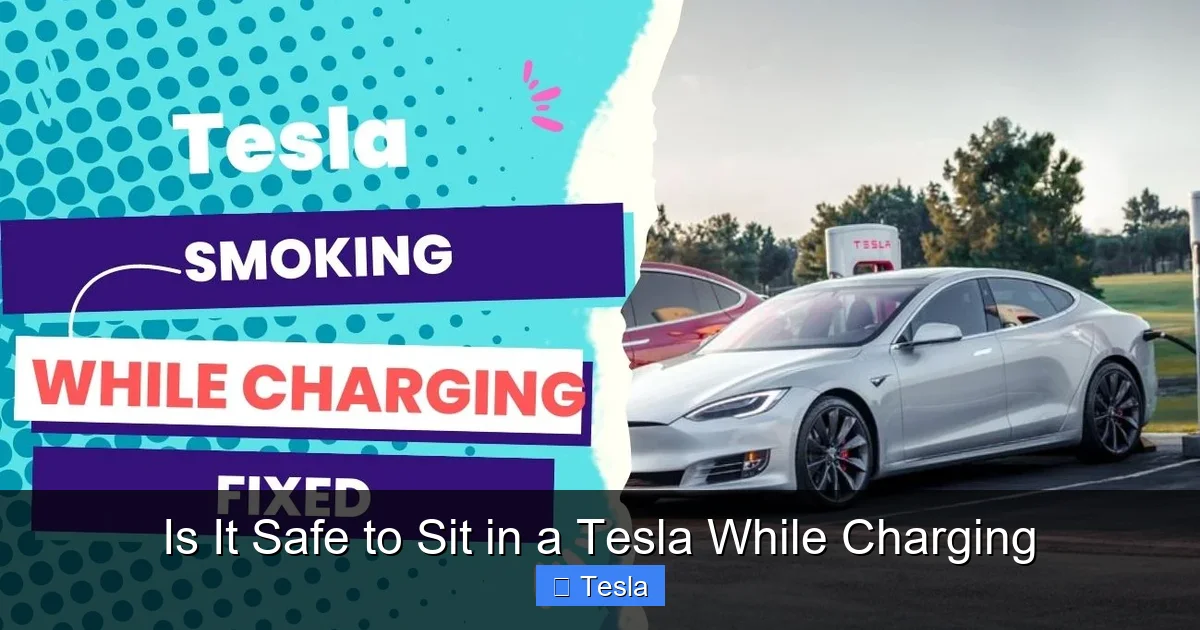
Visual guide about Is It Safe to Sit in a Tesla While Charging
Image source: evmotorr.com
The High-Voltage Interlock System
This is a critical, often overlooked, safety feature. Every single connector in the high-voltage system—from the charge port, through the cables to the battery pack—has an interlock loop. Think of it like a series of safety switches. If any connector is even slightly loose, disconnected, or compromised, the system instantly detects a break in the circuit and commands the vehicle to shut off all high-voltage power within milliseconds. It’s a fail-safe that physically prevents arcing or exposure. During charging, this system is continuously monitored. If you were to, hypothetically, open the charge port door while plugged in (which the car also often prevents), the interlock would break and stop charging immediately.
Insulation Monitoring and Ground Fault Protection
The high-voltage battery pack is a sealed, dry unit. But the system constantly monitors for any unexpected path to ground (like a fault where electricity could leak). The Battery Management System performs insulation resistance tests. If it detects a potential leak, it will de-energize the system. Furthermore, the charging station itself (especially Level 2 and Superchargers) includes Ground Fault Circuit Interrupter (GFCI) protection. If it senses a tiny imbalance in current—indicating some is leaking where it shouldn’t—it trips and cuts power in a fraction of a second. This dual protection (car and charger) is extremely robust.
Structural and Physical Isolation
The battery pack isn’t sitting under a thin sheet of metal. It’s a structural member of the car, located in the floor pan, surrounded by a rigid, crash-tested steel shell. This enclosure is designed to protect the battery from road debris, impacts, and intrusion
Frequently Asked Questions
What is Is It Safe to Sit in a Tesla While Charging?
Is It Safe to Sit in a Tesla While Charging is an important topic with many practical applications.
