
How Many Catalytic Converters Does a Jeep Patriot Have?

Jeep Patriots almost universally have two catalytic converters. This dual-cat setup is standard across most model years and engine options to meet federal emissions standards. The exact configuration—including whether it uses a single “dual-output” unit or two separate converters—can vary slightly by production year and engine type (2.4L vs. 2.0L). Always confirm for your specific vehicle using the VIN, as a 2007 model may differ from a 2016. Understanding your Patriot’s emissions system is crucial for diagnostics, repairs, and passing inspections.
You’re driving your trusty Jeep Patriot, and the check engine light flickers on. A diagnostic scan reveals a P0420 code—”Catalyst System Efficiency Below Threshold.” Your mind races. “How many catalytic converters does a Jeep Patriot even have?” It’s a critical question, not just for fixing this problem, but for understanding your vehicle’s emissions health. The short answer is almost always two. But the full story, involving model years, engine types, and exhaust design, is what truly matters when you’re under the hood or under the vehicle. Let’s crack this nut wide open.
First, a quick refresher. A catalytic converter is a metal canister filled with a honeycomb-like substrate coated with precious metals (platinum, palladium, rhodium). Its job is to act as a chemical factory in your exhaust stream, converting harmful pollutants like carbon monoxide, hydrocarbons, and nitrogen oxides into less harmful carbon dioxide, nitrogen, and water vapor. Federal law (the Clean Air Act) mandates their use, and automakers like Jeep design systems to strictly comply. For a compact SUV like the Patriot, produced from 2007 to 2017, the standard engineering solution was a dual-catalyst system. This means two separate converter units working in tandem to clean the exhaust from both banks of the engine. However, “two” doesn’t always mean two distinct, separate cans you can easily point to. The implementation is where details get interesting.
Key Takeaways
- Standard Setup: Nearly all Jeep Patriots (2007-2017) are equipped with two catalytic converters as part of their factory emissions system.
- Model Year Matters: While two is the rule, the physical design (one combined unit vs. two separate pipes) can change between model generations and engine types.
- Engine Dictates Details: The 2.4L World Engine and the 2.0L VW-sourced diesel (in limited markets) have different exhaust layouts and converter placements.
- O2 Sensor Partnership: Each catalytic converter is monitored by upstream and downstream O2 sensors; a failing converter often triggers specific diagnostic trouble codes.
- Replacement is Costly: Replacing one or both converters on a Patriot can be expensive due to parts cost and labor intensity, often totaling $1,500 – $3,000+.
- Location is Key: Converters are located in the exhaust system, typically one “front” (manifold/cat) near the engine and one “rear” (underbody) further down the pipe.
- VIN is Your Best Friend: For absolute certainty, use your Vehicle Identification Number to look up the exact emissions configuration for your specific Jeep Patriot.
📑 Table of Contents
Understanding the Standard Dual-Catalyst Design
For the vast majority of Jeep Patriots on the road—those with the 2.4L Tigershark (or earlier 2.4L World) inline 4-cylinder engine—the exhaust system features a two-stage catalytic conversion process. This is the industry-standard for a 4-cylinder engine with a single exhaust manifold that splits into two pipes (often called “dual exhaust” even if the tips merge).
The “Front” or “Pre-Cat”
Immediately downstream from the engine’s exhaust manifold, you’ll find the first catalytic converter. This is often called the “front cat” or “pre-cat.” Its primary job is to handle the hottest, most raw exhaust gases straight from the cylinders. It works quickly to reduce the most harmful pollutants before the gases cool down. On the Patriot, this front converter is typically integrated into a unit that also contains the upstream oxygen (O2) sensors. These sensors, located before the cat, measure the oxygen content in the exhaust to help the engine computer (PCM) calculate the perfect air-fuel mixture. A failing front cat will often cause the upstream O2 sensor to read abnormally, setting a code.
The “Rear” or “Main Cat”
After the exhaust travels through the front converter and a short section of pipe, it enters the second catalytic converter, known as the “rear cat” or “main cat.” This unit is located further back in the exhaust system, usually under the vehicle’s midsection or near the muffler. Its job is to perform a secondary “polishing” of the exhaust, catching any pollutants the first cat may have missed and ensuring the final output is well within legal limits. This rear converter houses the downstream oxygen (O2) sensor. The PCM constantly compares the readings from the upstream and downstream sensors. If the rear sensor’s readings don’t show a significant drop in oxygen (meaning the cat isn’t effectively processing gases), it triggers the P0420 or P0430 code. This sensor comparison is the primary way your car’s computer knows a converter is failing.
Visually, on a typical 2007-2016 Patriot with a 2.4L engine, you would see two distinct, cylindrical metal canisters in the exhaust system. The front one is closer to the engine, often shielded by a heat guard. The rear one is further back, sometimes integrated with a muffler or resonator in a single large canister. This is the classic two-cat setup.
Model Year and Engine Variations: The Important Exceptions
While “two converters” is the rule, the physical packaging isn’t identical across every single Patriot. The two main variables are the model year generation and the specific engine under the hood.

Visual guide about How Many Catalytic Converters Does a Jeep Patriot Have?
Image source: cartireinflator.com
First Generation (2007-2016): The Standard-Bearer
For the overwhelming majority of Patriots—the first generation sold from 2007 through the 2016 model year—the two-converter rule holds firm for the 2.4L engine. Whether it’s a 2007 Sport model or a 2015 Latitude, the engineering blueprint called for a front and a rear catalytic converter. The exact part numbers, heat shielding, and bracket designs might differ between early (2007-2009) and later (2010-2016) models due to emissions standard updates, but the fundamental two-unit system remains. If you have a 2.4L Patriot from this era, you can confidently expect two separate converter housings.
The 2.0L Diesel Anomaly (Limited Production)
Here’s where it gets niche. For a short period, specifically for the 2007 and 2008 model years, Jeep offered a 2.0L turbocharged diesel engine ( sourced from Volkswagen) in the Patriot for certain markets. This engine has a completely different exhaust system design compared to the gasoline 2.4L. Diesel engines and their aftertreatment systems operate on different principles. The 2.0L diesel Patriot uses what is often termed a “combined” or “dual-output” catalytic converter system. In this design, instead of two separate canisters, there is a single, larger converter housing that accepts exhaust from both cylinder banks via two separate inlets and processes it through a common substrate before a single outlet. Functionally, it still provides two stages of conversion within one canister, but physically, you would only see one major catalytic converter unit under the vehicle. This is the primary exception to the “two converters” rule, but it applies only to a very small fraction of Patriots.
Second Generation (2017): The Final Model Year
The 2017 Patriot was a carry-over “refresh” of the first generation, not an all-new platform. It continued with the 2.4L Tigershark engine. Therefore, its emissions system is consistent with the late-first-gen models, meaning it has two separate catalytic converters. There is no significant change for the final year of production.
Practical Tip: If you own or are looking at a Patriot and need to know for sure, your best tool is the Vehicle Identification Number (VIN). A reputable muffler shop or dealership can look up your exact VIN in their parts catalog to show you the precise factory exhaust diagram. This is the only way to be 100% certain, especially if you suspect a prior owner may have altered the system (which is illegal and will cause emissions test failures).
Location, Location, Location: Finding Your Converters
Knowing the theory is one thing; finding the parts on your actual vehicle is another. Here’s a step-by-step guide to locating the catalytic converters on your standard 2.4L Jeep Patriot.
Visual guide about How Many Catalytic Converters Does a Jeep Patriot Have?
Image source: guidemechanic.com
Safety First!
Never attempt to inspect or work on the exhaust system while the engine is hot. The exhaust manifold and pipes retain extreme heat for a long time after shutdown. Wait at least 2-3 hours after driving, or work on a completely cold vehicle. Wear safety glasses and gloves. Secure the vehicle on level ground with the parking brake set.
The Front Catalytic Converter
1. Open the hood and locate the exhaust manifold. This is the set of metal pipes bolted directly to the engine block, where the exhaust ports are. It’s usually on the side of the engine (front or side, depending on orientation) and is very hot when running.
2. Follow the manifold downward and rearward. You will see it connects to a larger pipe that curves down toward the underside of the vehicle.
3. The first catalytic converter is attached directly to this pipe, often within the first 12-18 inches from the manifold. It is a large, cylindrical metal canister, typically about the size of a small keg or larger soup can. It will have a distinct, sometimes ribbed, appearance and is often covered by a thin, perforated metal heat shield held on with bolts or clips.
4. You can usually see it from the top if you look down behind the engine, but a better view is obtained from underneath the front of the vehicle.
The Rear Catalytic Converter
1. Get under the vehicle (use jack stands on solid ground—never rely on a jack alone).
2. Look along the centerline of the vehicle, starting from where the front pipe descends.
3. The rear catalytic converter is located further back. You will see the exhaust pipe from the front cat running toward the rear.
4. The rear cat is another large cylindrical canister. On many Patriots, it is integrated with the muffler into a single, larger oval or round canister. You might see a single large unit with an inlet (from the front cat), an outlet (going to the tailpipe), and sometimes a resonator section in the middle. The catalytic converter substrate is within the front half of this large canister. The downstream O2 sensor will be threaded into this canister, usually near the inlet or in the middle.
5. The rear unit is typically located under the passenger compartment or just behind the rear axle.
Visual Cue: Both converters will have wiring connectors for O2 sensors attached. The front cat’s upstream sensor is usually before the cat’s inlet. The rear cat’s downstream sensor is after the cat’s substrate, on the outlet side of the canister.
Maintenance, Failure, and Replacement Realities
Catalytic converters are designed to last the life of the vehicle, but they can and do fail. Understanding why helps you diagnose and budget for repairs.
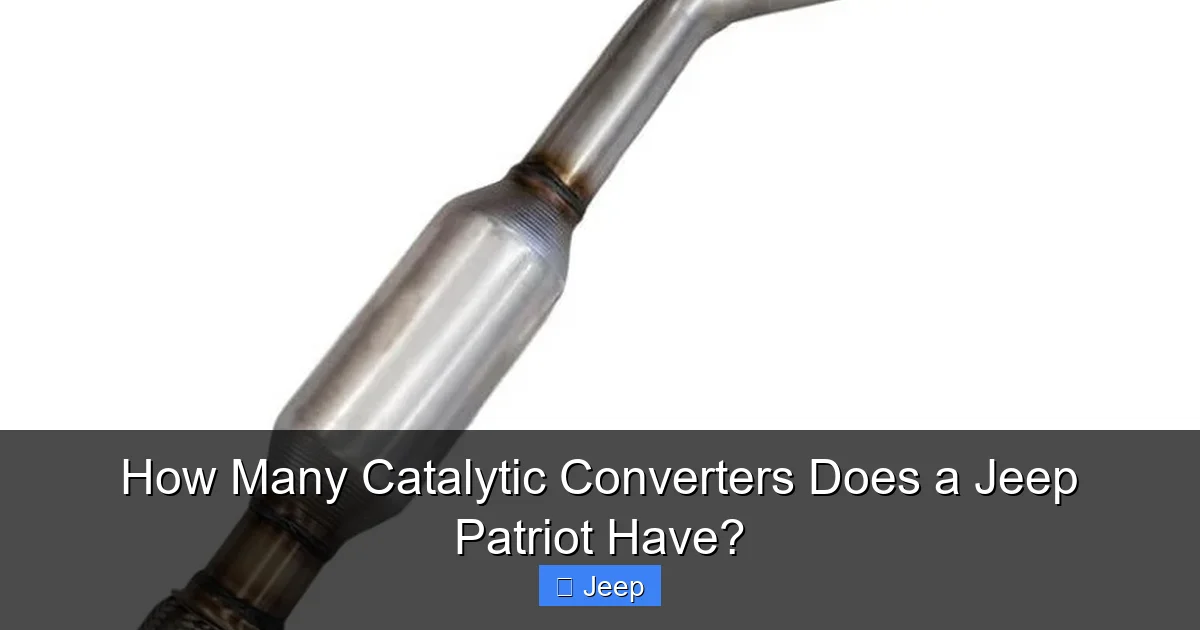
Visual guide about How Many Catalytic Converters Does a Jeep Patriot Have?
Image source: guidemechanic.com
Common Causes of Failure
- Engine Misfires: This is the number one killer. Unburned fuel enters the exhaust and ignites inside the hot converter, melting the precious metal substrate and ceramic honeycomb. This causes a catastrophic, immediate failure.
- Oil or Antifreeze Contamination: Worn engine rings or a failing head gasket can allow oil or coolant into the combustion chamber. These fluids burn and coat the converter substrate, rendering it useless.
- Physical Damage: Hitting a road debris, a deep pothole, or a curb can crack the converter’s ceramic internals or the metal shell.
- Age and Mileage: Over 150,000+ miles, the catalyst materials can simply degrade and lose effectiveness.
Symptoms of a Failing Converter
- Check engine light with codes P0420 (Catalyst System Efficiency Below Threshold – Bank 1) or P0430 (Bank 2—though Patriots are single-bank, some systems may use this).
- Noticeable rotten egg smell (sulfur) from the exhaust, especially under acceleration.
- Reduced fuel economy and engine performance, as a clogged converter creates backpressure.
- Failed emissions test during state inspection.
The High Cost of Replacement
Replacing a catalytic converter on a Jeep Patriot is rarely a cheap job. The parts themselves are expensive because they contain precious metals. An aftermarket “direct fit” converter for a Patriot might cost $800 – $1,500 for a front or rear unit. OEM parts are significantly more. Labor is also intensive. The front converter often requires moving or removing other components (like the front pipe, heat shield, or even part of the skid plate). The rear converter, especially if integrated with the muffler, may require unbolting the entire muffler assembly from the vehicle. Total repair costs for a single converter often range from $1,200 to $2,500. If both are bad, you’re looking at $2,500 – $4,000+. Always get a proper diagnosis first—sometimes a faulty O2 sensor or exhaust leak can mimic a converter problem. For comparison, the complexity and cost on a larger truck like a Dodge Ram 1500 can be different due to its V8 and dual exhaust setup.
Legal and Environmental Imperatives
It’s vital to understand that catalytic converters are not optional performance parts; they are federally mandated emissions equipment. The Clean Air Act prohibits their removal or tampering on any vehicle driven on public roads. If a converter is stolen (a sadly common occurrence due to the precious metals inside) or damaged, it must be replaced with a legal, CARB-compliant (for California and compliant states) or EPA-compliant unit. Installing a “test pipe” or straight pipe in place of the converter is illegal, will cause your vehicle to fail emissions testing instantly, and can result in significant fines. Moreover, you are releasing far higher levels of toxic pollutants into the air. Your Patriot’s entire emissions system, including the two catalytic converters and their monitoring O2 sensors, is a carefully engineered setup to protect the environment and public health. Maintaining it properly is a legal responsibility and an environmental duty.
Conclusion: Knowledge is Power (and Savings)
So, how many catalytic converters does a Jeep Patriot have? For the practical, wallet-caring Patriot owner, the answer is almost certainly two. One front, one rear, working together to keep your SUV clean and legal. The key nuances lie in the 2.0L diesel exception and the specific packaging (separate vs. integrated units) across the 2007-2017 production run. When faced with a check engine light pointing to the catalyst system, your first steps should be: 1) Get a professional scan to confirm the exact code, 2) Visually inspect the converters and O2 sensors for damage or theft, and 3) Consider other culprits like exhaust leaks or faulty sensors before jumping to the most expensive conclusion. Armed with this knowledge, you can have an informed conversation with your mechanic, understand a repair estimate, and ensure your Patriot continues to be the reliable, capable, and compliant companion it was built to be. Remember, when in doubt, your VIN is the ultimate source of truth for your vehicle’s specific configuration.
Frequently Asked Questions
Can I drive my Jeep Patriot with a bad catalytic converter?
You can drive it for a short period, but it’s not advisable. A severely clogged converter can cause engine overheating, stalling, and catastrophic damage. It will also fail emissions tests and likely trigger a constant check engine light. Get it diagnosed and repaired promptly.
How much does it cost to replace a catalytic converter on a Jeep Patriot?
Total replacement cost for one converter typically ranges from $1,200 to $2,500, depending on whether you choose aftermarket or OEM parts and your labor rates. Replacing both can double that cost. Always get multiple quotes.
Why does my Patriot smell like rotten eggs?
A strong sulfur or rotten egg smell from the exhaust is a classic symptom of a failing catalytic converter. The converter is no longer processing sulfur in the fuel properly, allowing hydrogen sulfide to pass through. This often accompanies a P0420/P0430 code.
Are the front and rear converters the same part?
No. They are different part numbers. The front converter handles hotter, dirtier gases and has a different substrate formulation. The rear converter does secondary cleaning. They are not interchangeable. The rear unit may also be integrated with the muffler, making it a more complex assembly.
Can I replace the catalytic converter myself?
It’s a very difficult DIY job requiring significant mechanical skill, specialty tools (like oxygen sensor sockets, sawzall for rusted bolts), and welding skills for exhaust work. The bolts are often rusted and seized. For most owners, professional installation is strongly recommended due to the complexity and risk of exhaust leaks.
Will removing the catalytic converter make my Patriot faster or louder?
While removing it might slightly reduce backpressure and increase exhaust volume, it is illegal. Your engine’s computer will detect the missing catalyst via O2 sensors and likely run in a “limp mode,” reducing performance. You will also trigger a permanent check engine light and fail emissions. Any perceived power gain is minimal and comes with major legal and environmental consequences.
