
Is Tesla Model 3 Rear-wheel Drive Good in Snow?

The Tesla Model 3 Rear-Wheel Drive can be a capable winter vehicle, but its performance hinges almost entirely on proper preparation. Unlike all-wheel-drive models, RWD sends power to the rear wheels only, which can lead to wheel spin on icy or snow-packed roads. Its success in snow depends overwhelmingly on installing high-quality winter tires, understanding how to modulate the instant electric torque, and using Tesla’s built-in stability controls wisely. Without winter tires, it can be treacherous; with them and practiced driving, it becomes a manageable and efficient commuter.
Key Takeaways
- Winter Tires Are Non-Negotiable: The single most critical upgrade. Quality winter tires dramatically improve grip, braking, and control, transforming the RWD Model 3’s winter capability more than any other factor.
- Weight Distribution Helps: The Model 3’s heavy battery pack low in the chassis provides a low center of gravity and near 50/50 weight distribution, which enhances stability compared to many gas-powered RWD cars.
- Regenerative Braking Requires Adjustment: In snowy conditions, the strong regen braking can cause rear-wheel lock-up. You must lower the regen setting or disable it for smoother, safer stops.
- Software Aids Traction: Tesla’s traction and stability control systems are sophisticated and work constantly to prevent wheel spin, but they cannot overcome a complete lack of mechanical grip from poor tires.
- Driving Technique Matters: Smooth inputs on the accelerator and steering are essential. The instant torque of an electric motor can easily break rear-wheel traction if you’re not gentle.
- Know the Limitations: For frequent, heavy snow or steep, unplowed hills, the Long Range AWD or Performance models with their dual motors offer significantly more sure-footedness and confidence.
- Pre-Conditioning is Key: Use the Tesla app to precondition the cabin and battery while plugged in before departure. This warms the battery for optimal performance and range, and clears the windshield without scraping.
📑 Table of Contents
- The Great Snow Question: Is Tesla Model 3 RWD a Winter Warrior?
- The Golden Rule: Tires Trump Everything
- Physics is Your Friend: Weight and Low Center of Gravity
- Tech to the Rescue: Tesla’s Software Arsenal
- Real-World Driving Techniques and Scenarios
- When RWD Might Not Be Enough: The AWD Comparison
- Practical Winter Ownership Tips Beyond Drivetrain
- The Verdict: A Conditional “Yes”
The Great Snow Question: Is Tesla Model 3 RWD a Winter Warrior?
So, you’re eyeing a Tesla Model 3. The sleek design, the tech, the instant torque—it’s an exciting package. But then a thought creeps in, especially if you live where the snow flies: “Is the rear-wheel-drive (RWD) version going to leave me stranded or sliding around like a hockey puck?” It’s a valid and very common concern. The stigma around RWD in winter is old, rooted in the era of heavy, unbalanced gas cars with powerful V8s. The Tesla Model 3 RWD is a different beast altogether. To answer “Is Tesla Model 3 rear-wheel drive good in snow?” we need to move beyond the old stereotypes and look at the physics, the technology, and the one absolute rule that defines winter driving in any car. Let’s break it down.
Understanding the Fundamental Challenge: RWD vs. AWD
At its core, the difference is simple. Rear-wheel-drive sends all the engine’s (or in this case, motor’s) power to the rear wheels. All-wheel-drive (AWD) distributes power to all four wheels, typically with a bias to the front or rear depending on the system. In low-traction conditions like snow or ice, AWD has a clear theoretical advantage: if one wheel slips, power can be sent to the other three. RWD has no such backup; if both rear wheels lose grip, you’re not going anywhere. This is the heart of the concern. The Tesla Model 3 RWD’s single rear motor produces a healthy 271 horsepower and 310 lb-ft of torque—all available instantly from a standstill. That kind of immediate, silent power can be a double-edged sword in winter. Apply too much throttle too quickly, and you’ll spin those rear wheels effortlessly. This is where the “good” or “bad” judgment hinges entirely on what you do next.
The Golden Rule: Tires Trump Everything
I cannot emphasize this enough. The quality of your tires is the #1 determinant of winter safety and capability, period. This is true for a Subaru with a legendary AWD system, a pickup truck with 4×4, and absolutely for a Tesla Model 3 RWD. The factory tires on the RWD model are typically all-season tires, which are a compromise. They are okay in light snow and cold wet pavement but become dangerously hard and slippery below 45°F (7°C), especially on ice or packed snow. Installing a dedicated set of winter tires is not a suggestion; it is the mandatory first step to making the Model 3 RWD “good” in snow.
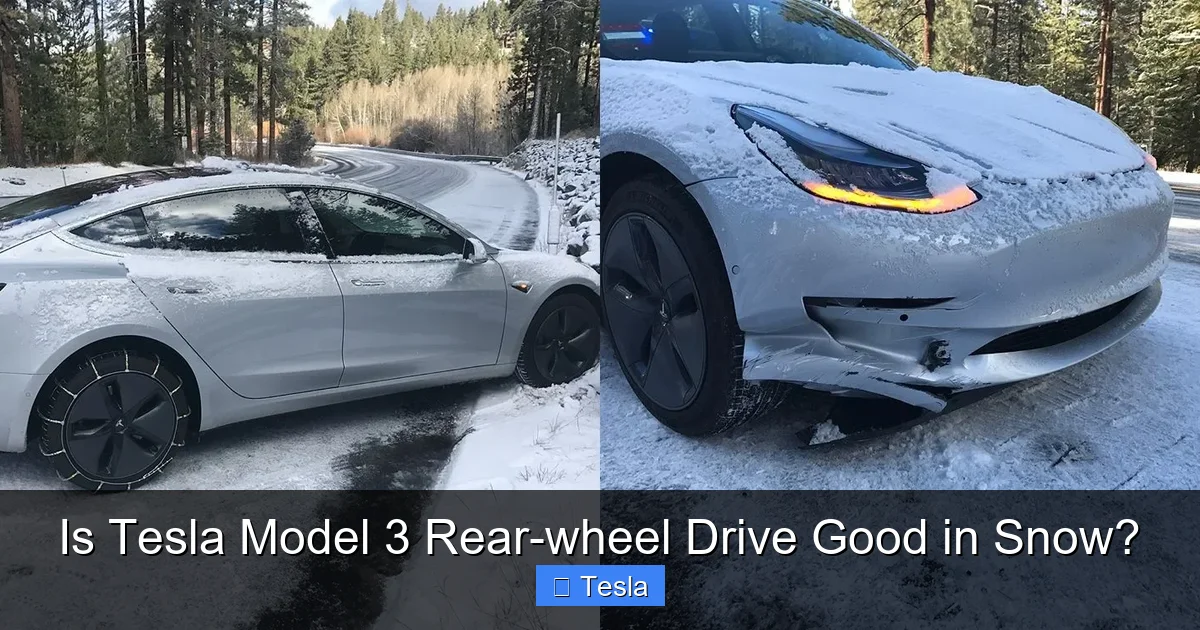
Visual guide about Is Tesla Model 3 Rear-wheel Drive Good in Snow?
Image source: lh5.googleusercontent.com
Why Winter Tires Are a Game-Changer
Winter tires are made from special rubber compounds that stay pliable in freezing temperatures. Their tread patterns are designed to bite into snow and slush, channeling it away to maintain contact with the road. The difference is night and day. On a set of proper winter tires, the Model 3 RWD transforms. The winter tires provide the mechanical grip that the car’s traction control systems need to work effectively. You’ll notice dramatically shorter stopping distances, the ability to accelerate without constant wheel spin, and—most importantly—the confidence to navigate turns without the rear end feeling loose. Think of it this way: AWD might help you *go* better in snow, but good winter tires help you *stop* and *steer*, which are far more critical for safety. For specific recommendations on sizes and brands that fit the Model 3’s 18″ or 19″ wheels, you’ll want to consult a trusted local tire shop or online resources dedicated to Tesla fitments. Some owners even opt for a second set of 18″ winter wheels and tires, which can be more affordable and protect their nice summer alloys from road salt.
The Real Cost of Winter Tires
Yes, winter tires are an additional expense. You’re buying a set of tires and likely a set of wheels (to avoid the hassle of mounting/dismounting twice a year). You also need to store them. But consider this: a set of winter tires will last you 3-4 seasons if stored properly. They are protecting your more expensive summer/all-season tires from winter’s harsh abrasives. More importantly, they are protecting you, your passengers, and your car from a potentially costly accident. When you look at the cost per mile over their lifespan, it’s a small price for the enormous safety and capability gain. If you’re budgeting for your Model 3, factor this in. It’s the best “mod” you can make for winter safety. You can find detailed cost breakdowns for a full set, including mounting, in our guide on how much it costs to wrap a Tesla Model 3—while that article is about wraps, the cost structure for a full set of winter wheels and tires is in a similar ballpark for many drivers.
Physics is Your Friend: Weight and Low Center of Gravity
The Tesla Model 3 has a secret weapon that most traditional RWD cars lack: its battery pack. The entire floor of the car is a massive, heavy slab of lithium-ion batteries. This gives the Model 3 an incredibly low center of gravity—lower than almost any sports car. This is a huge advantage in any cornering situation, including in snow. The car feels planted and resistant to body roll. It’s much harder to tip over, which is a non-issue on flat roads but a consideration on steep, snowy banks. Furthermore, the weight distribution is very close to 50/50 front-to-rear. In a RWD car, having weight over the driving wheels (the rear) is beneficial for traction. The battery’s weight sits directly over the rear axle, pressing those drive wheels down onto the road surface. This is the opposite of a traditional front-engine RWD car, which often has a light rear end prone to spinning. The Model 3 RWD’s weight bias actually *helps* its rear-wheel traction compared to many gas-powered RWD vehicles. This inherent stability is a quiet but major factor in its winter competency.
Visual guide about Is Tesla Model 3 Rear-wheel Drive Good in Snow?
Image source: lh4.googleusercontent.com
Instant Torque: Manage the Dragon
We’ve touched on it, but let’s dig deeper. An electric motor delivers 100% of its torque from 0 RPM. In a RWD car on ice, that means if you press the accelerator pedal with any firmness, the rear wheels will break loose immediately. There is no gradual power build-up like with a gas engine’s torque curve. This isn’t a flaw; it’s a characteristic. It demands a different driving style. You must become an expert in “pedal modulation.” This means using the very tip of your foot to apply pressure smoothly and progressively. Think of the accelerator as a light switch you’re trying to dim, not flip. Start moving with incredibly gentle pressure. The car will creep forward. As you feel grip, you can add more power. The goal is to keep the tires just at the edge of slip, never fully over it. The car’s traction control will intervene with a buzz in the steering wheel and a reduction in power if it detects excessive wheel spin, but it’s better to avoid triggering it in the first place with smooth inputs. This skill takes practice. Find an empty, snow-covered parking lot to get a feel for it.
Tech to the Rescue: Tesla’s Software Arsenal
While you control the pedal, Tesla’s software is constantly working behind the scenes. The Model 3 is packed with sensors and algorithms designed to manage power delivery and stability.
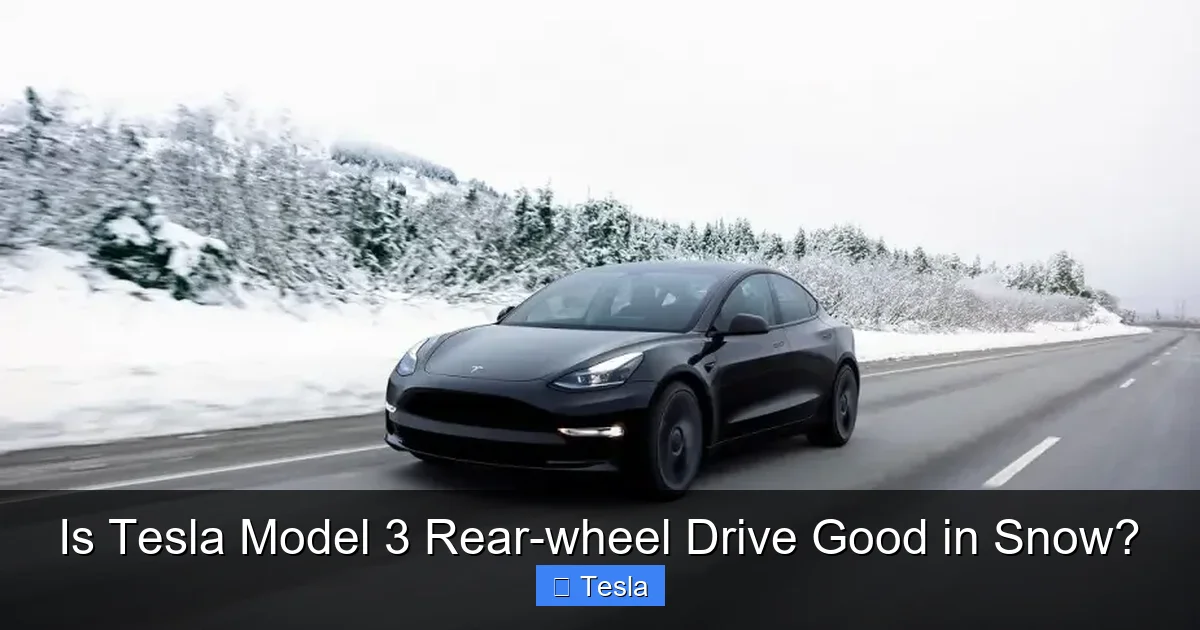
Visual guide about Is Tesla Model 3 Rear-wheel Drive Good in Snow?
Image source: motorbiscuit.com
Traction & Stability Control
The system is always active. It uses individual wheel speed sensors (from the anti-lock brake system) to detect when a rear wheel is spinning faster than the front wheels. It then automatically applies brake force to that slipping rear wheel and/or reduces motor power. This happens in milliseconds. It’s incredibly effective at preventing a full loss of traction during acceleration. However, it has its limits. On a solid sheet of ice, there is no amount of braking one wheel that will create traction where none exists. That’s where the tires come back into play. The system is a brilliant safety net, but it’s not a magic carpet. Do not rely on it to compensate for aggressive driving on poor surfaces.
The Regenerative Braking Snow Dilemma
This is a crucial and often overlooked point. When you lift off the accelerator in a Tesla, the motor acts as a generator, slowing the car down and sending energy back to the battery. This “one-pedal driving” is a fantastic efficiency feature. In dry conditions, it’s smooth and powerful. In snow and ice, it can be a hazard. The regen braking force is applied primarily to the rear wheels (since the motor is in the rear). On a slippery surface, this sudden deceleration can cause the rear wheels to lock up or skid, especially if you’re not prepared for it. The solution is simple: lower or turn off regenerative braking in snowy conditions. You can do this via the touchscreen: Controls > Driving > Regenerative Braking. Select “Low” or “Off.” This makes the car coast more like a traditional automatic when you lift off the throttle, allowing you to use the brake pedal more progressively and predictably. It’s a small change that makes a big difference in control. You can switch it back to “Standard” for efficient driving on clear, dry roads.
Chill Mode: Your New Best Friend
Another fantastic software feature for winter driving is “Chill Mode.” Found in the same Driving menu, Chill Mode softens the throttle response. It makes the accelerator pedal less sensitive and limits the maximum acceleration. It essentially tames the instant torque beast, making it much more difficult to accidentally break rear-wheel traction. It’s perfect for snowy mornings when you’re commuting cautiously or for new drivers getting used to the car. It doesn’t limit top speed, just the aggressiveness of launch. Using Chill Mode in conjunction with Low/Off regenerative braking and winter tires creates a very docile, predictable, and safe driving experience in poor weather.
Real-World Driving Techniques and Scenarios
So you have your winter tires on. You’ve set Chill Mode and Low Regen. Now, how do you actually drive?
Starting and Stopping
Starting from a stop: Use the creep mode (the car moves forward slowly when you release the brake) or extremely gentle throttle. If you feel a slip, immediately ease off the pedal. Let the traction control do its job. For stopping, with regen on Low/Off, you’ll use the brake pedal. Apply it smoothly and progressively, anticipating stops far earlier than you would in dry conditions. The brake-by-wire system in the Tesla is excellent and very responsive. Remember, your stopping distance will be significantly longer than on dry pavement, regardless of tires.
Climbing and Descending Hills
This is where RWD can show its limitations. When climbing a steep, unplowed hill, momentum is your friend. Get a running start if possible and safe. Once climbing, maintain steady, gentle throttle. If you lose traction going uphill, the car will stop and might even slide backward slightly. The traction control will try to help, but on a very steep, icy grade, a RWD car can struggle where an AWD car would plow through. For descending, use a low gear (you can select “Low” in the drive menu for a simulated low gear) or rely on your brakes with controlled, intermittent pressure (“snubbing”) to avoid overheating them on long descents. Do not ride the brakes continuously.
Handling a Slide
If the rear end does step out (oversteer), the standard corrective action applies: steer into the slide. If the rear slides to the left, you steer left to straighten the car. Do not slam on the brakes; this will worsen the skid. Modern stability control will likely intervene and help correct, but knowing the basic physics is essential. The low center of gravity helps prevent spins from becoming full rollovers, which is a major safety plus.
When RWD Might Not Be Enough: The AWD Comparison
Let’s be honest. For the absolute maximum confidence in deep, unplowed snow, ice-covered hills, or if you frequently tackle rural roads that aren’t promptly cleared, the Model 3 Long Range AWD or Performance is objectively better. The front motor provides two huge benefits: it pulls the car forward (helping with acceleration and hill climbing), and it adds significant weight over the front axle, improving front tire grip for steering and braking. The AWD system can seamlessly send power to the front wheels the moment the rear wheels slip. This results in more consistent forward progress, less wheel spin, and greater overall sure-footedness. The difference is most noticeable when launching from a stop on ice or climbing a slippery hill. The RWD car will work harder, require more finesse, and might need a running start. The AWD car will just go.
Is the Premium Worth It for You?
Ask yourself: How bad is your typical winter? How often do you drive on unplowed roads? Do you have a steep driveway? If your answer is “rarely” or “my area is well-plowed,” then the RWD with winter tires is likely perfectly adequate and saves you a significant amount of money upfront. If your answer is “often” or “my street is the last to be cleared,” the extra cost of AWD may be worth the peace of mind and reduced driver workload. It’s a personal risk/reward calculation. Many RWD Model 3 owners in snowy states like Colorado, Michigan, and Minnesota report being perfectly happy and safe with a good set of winter tires. They praise the car’s stability and the benefits of the low center of gravity. However, they universally cite winter tires as the make-or-break factor. For a broader look at how different drivetrains handle snow, you might read our analysis on if Subaru’s X-Mode is good for snow, which explains the principles of sophisticated AWD systems, or our piece on what the snow button does in a Toyota Highlander, which discusses traction aids for front-wheel-drive-based platforms.
Practical Winter Ownership Tips Beyond Drivetrain
Maximizing your Model 3’s winter performance involves more than just tires and settings.
Preconditioning: Warm Up the Smart Way
Lithium-ion batteries operate best in a moderate temperature range. Cold batteries have reduced capacity (range) and cannot accept charging power as quickly. The solution is Tesla’s brilliant preconditioning feature. Use the Tesla app on your phone to turn on cabin and battery heating while the car is still plugged in at home, 15-30 minutes before you leave. This warms the battery to its optimal operating temperature, maximizing range and performance for your drive. It also heats the cabin so you get into a warm car and defrosts the windows, saving you the scrape. This is a game-changer for winter ownership.
Range Anxiety in the Cold
Expect a 20-40% reduction in range in very cold weather. This is normal for all EVs. The battery’s chemical reactions are slower, and you’re using significant energy for cabin and battery heating. Plan your trips with this reduced range in mind. Keep your charge level higher than you would in summer (e.g., don’t let it drop below 20% if you can help it). The good news is that the RWD Model 3 is the most efficient model in the lineup, so its absolute range loss might be slightly less than the AWD models’ loss, though the *percentage* loss is similar. The instant torque and smooth power delivery remain unchanged in the cold.
Charging in the Cold
Charging speeds are slower when the battery is cold. This is why preconditioning before a fast-charging stop is so effective—it warms the battery so it can accept a higher charge rate. If you’re charging at a Supercharger on a cold day and notice a low kW rate, it’s likely because the battery is still cold. It will often warm up after 10-15 minutes of charging and the rate will increase. For home charging, the slower AC rate is less affected by temperature.
Protecting Your Paint
Road salt and brine are corrosive. A good wash, including an undercarriage rinse, is critical throughout the winter to prevent rust. Many owners apply a ceramic coating or paint protection film (PPF) to help guard against salt etching and road debris. While not specific to RWD, it’s a key part of winter car care. You can learn more about the costs and benefits of a full wrap, which offers similar protection, in our article on how much a Tesla Model 3 wrap costs.
The Verdict: A Conditional “Yes”
So, is the Tesla Model 3 RWD good in snow? The answer is: Yes, with the essential and non-negotiable caveat of high-quality winter tires. Without them, it is a liability. With them, it becomes a surprisingly competent, stable, and confidence-inspiring winter commuter. Its low center of gravity and weight distribution give it an inherent stability edge over many traditional RWD cars. The adjustable regenerative braking and Chill Mode allow you to tailor the car’s behavior to slippery conditions perfectly. The instant torque, once mastered with smooth pedal inputs, is a joy and never leaves you feeling underpowered on dry, cleared roads.
It will not be as effortless or as unflappable as the AWD versions when faced with deep, unplowed snow or steep, icy hills. It requires more driver engagement and anticipation. But for the vast majority of drivers who face maintained roads, packed snow, and ice, the RWD Model 3 equipped with a proper set of winter tires is more than up to the task. It is safe, efficient, and can be a complete joy to drive year-round. Do your homework on tires, adjust your settings, practice your technique in a safe area, and you’ll likely find your Model 3 RWD is a far better winter car than you ever expected.
Frequently Asked Questions
Can I drive a Tesla Model 3 RWD in light snow without winter tires?
You can, but it is strongly discouraged. The factory all-season tires become very hard and lose most of their grip below 45°F. Even in light snow, stopping distances will be long and acceleration will involve frequent wheel spin, making it unpredictable and unsafe. Winter tires are essential.
Does regenerative braking work differently in snow on the Model 3 RWD?
Yes, the standard “Standard” regen setting can cause the rear wheels to lock up or skid on ice because it applies strong deceleration force to the rear axle. You should always switch regen to “Low” or “Off” mode during snowy and icy conditions for smoother, more controlled stops using the brake pedal.
How does the RWD Model 3 compare to a gas RWD car like an older BMW 3 Series in snow?
The Tesla has major advantages: a much lower center of gravity from its floor-mounted battery and near 50/50 weight distribution that presses down on the rear drive wheels. It also has sophisticated, always-active traction control and no engine up front to cause a light rear end. These factors make it inherently more stable than most traditional RWD gas cars, but the tire rule still applies supreme.
Will the cold weather significantly reduce my Tesla Model 3 RWD’s range?
Yes, expect a 20-40% reduction in range in very cold weather. This is due to battery chemistry and the energy required to heat the cabin and battery pack. Preconditioning while plugged in before you drive helps mitigate this by warming the battery for optimal efficiency. The RWD model’s superior efficiency means its absolute range loss may be slightly less than AWD models.
Is the Tesla Model 3 RWD safe on icy hills?
It can be, but with caution. On steep, icy inclines, the RWD model will require more momentum and gentle throttle control than an AWD model. Without winter tires, it will likely struggle. With winter tires, it can manage, but you may need a running start. For frequently icy, steep hills, the AWD model provides more margin for error and easier climbing.
Should I use “Chill Mode” all winter in my Model 3 RWD?
Using Chill Mode is highly recommended for winter driving. It softens the throttle response, making it much harder to accidentally break rear-wheel traction with the instant torque. It’s an excellent tool for driving more smoothly and safely on slippery surfaces. You can switch back to “Standard” mode for more responsive driving on clear, dry roads.
