
How to Fix Car Cover Fitment Issues: Step-by-Step Guide
Quick Answer
To fix car cover fitment issues, first confirm the cover’s orientation, then center it over your vehicle and align the mirror pockets. Check both bumper hems, adjust the built-in straps, and compare your vehicle’s measurements with the manufacturer’s sizing chart. If the cover remains excessively tight or loose, follow a reliable car cover installation guide before deciding whether replacement is necessary.
Six Quick Fixes
- Check orientation: Find the front label and verify the cover isn’t backward.
- Center the fabric: Position the roof section evenly before securing either bumper.
- Align mirror pockets: Seat them naturally without stretching their seams.
- Adjust the straps: Remove loose fabric without overtightening the cover.
- Check accessories: Look for spoilers, roof racks, antennas, or unusual mirrors.
- Verify dimensions: Replace the cover if its shape or sizing is genuinely incompatible.
A car cover that won’t fit properly can be frustrating, especially when its packaging claims compatibility with your vehicle.
I’ve found that many fitment problems come down to positioning, overlooked accessories, or sizing differences rather than defective fabric. Here’s how I’d troubleshoot each problem, from simple adjustments to deciding when a replacement makes more sense.
In This Guide
- What Causes Car Cover Fitment Issues?
- How Do You Fix Car Cover Fitment Issues?
- How Do You Fix a Loose or Tight Car Cover?
- How Do You Fix Mirror, Spoiler, and Accessory Fitment Problems?
- How Do You Measure Your Car for the Right Cover?
- When Should You Replace an Ill-Fitting Car Cover?
- Frequently Asked Questions
What Causes Car Cover Fitment Issues?
Car cover fitment issues happen when the cover’s size, shape, or installation doesn’t match the vehicle’s exterior dimensions. Incorrect sizing, installation mistakes, accessories, and worn securing components are common causes.
Car cover fitment describes how well a protective cover follows a vehicle’s body shape while staying securely positioned.
Common Fitment Problems
A poorly fitted cover often reveals its problem before you even tighten the straps.
- Cover too small: The fabric struggles to reach both bumpers or leaves portions of the body exposed.
- Cover too large: Excess material gathers around the doors, hood, roof, or trunk.
- Incorrect orientation: Front and rear sections don’t match the vehicle’s contours.
- Misaligned mirror pockets: Pockets sit too far forward, backward, or outward.
- Accessory interference: Spoilers, roof racks, antennas, and other additions stretch the fabric.
- Loose retention system: Worn elastic hems or poorly adjusted straps allow movement.
What Does a Properly Fitted Car Cover Look Like?
A properly fitted car cover should follow the vehicle’s overall shape without excessive stretching. Its hems should remain seated, and the fabric shouldn’t flap heavily during ordinary conditions.
Some wrinkles are normal, particularly with universal covers. Perfectly skin-tight fabric isn’t necessary.
- Both bumper sections receive adequate coverage.
- The roof section stays reasonably centered.
- Mirror pockets align without pulling adjoining panels.
- Elastic hems sit securely around their intended edges.
- Straps hold the cover without distorting its shape.
- No sharp accessory creates excessive pressure against the fabric.
Fit matters for paint protection, too. Repeated movement can rub trapped dirt against painted surfaces.
Before installation, make sure the vehicle and the inner cover surface are clean. Never try to correct a fitment problem by dragging a dirty cover across the paint.
How Do You Fix Car Cover Fitment Issues Step by Step?
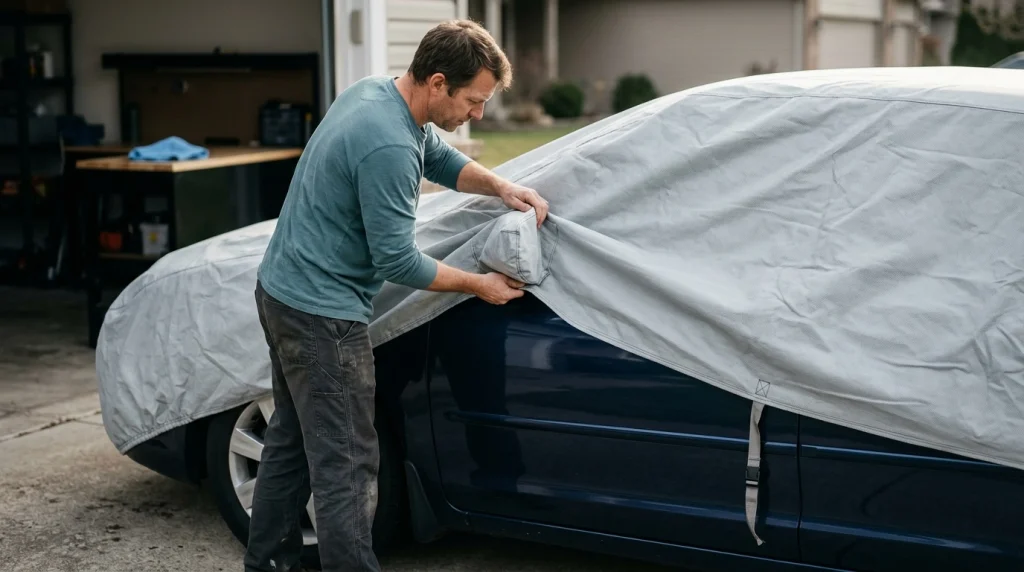
The most reliable approach is to remove the cover, check its orientation, and reinstall it from a centered position. Make small adjustments before deciding that the size is wrong.
Step 1: Prepare the Vehicle and Cover
Park on level ground and allow the vehicle to cool completely. Hot exhaust components can damage certain cover materials.
Check the manufacturer’s instructions before starting.
- Clean the exterior surfaces that will contact the cover.
- Allow the vehicle to dry completely.
- Remove loose items that might snag the material.
- Inspect the cover for damaged seams, torn fabric, and worn elastic.
- Find any front, rear, or orientation labels.
Don’t place the cover over a hot exhaust system or freshly painted surfaces without the paint shop’s approval.
Step 2: Position the Cover Correctly
Spread the cover over the vehicle’s upper surfaces before pulling the sides down. Follow the manufacturer’s recommended installation direction.
- Identify the front end using the sewn-in label.
- Position the fabric near the center of the roof.
- Lower both sides evenly.
- Align the mirror pockets where applicable.
- Check front and rear bumper coverage before tightening.
Don’t fully secure one end while leaving the other end loose. That can pull the entire cover out of alignment.
Step 3: Adjust the Elastic Hems
Elastic hems help the cover grip the vehicle’s lower edges. They aren’t designed to compensate for major sizing mistakes.
Work around the bumpers carefully, seating the elastic where the instructions specify.
- Make sure the front hem isn’t twisted.
- Check that the rear hem reaches its intended position.
- Distribute remaining fabric evenly between both ends.
- Stop if seams or mirror pockets begin stretching excessively.
Step 4: Secure the Straps and Buckles
Once the cover sits correctly, fasten its supplied retention straps. Use only the attachment points and routing recommended by the manufacturer.
For additional guidance, review the manufacturer’s wind strap installation instructions.
- Route straps away from hot exhaust components.
- Keep buckles and hard fittings from contacting paint.
- Adjust tension evenly.
- Avoid placing straps near moving vehicle components.
- Never crawl underneath the vehicle to install a cover strap.
Never start or drive the vehicle while it’s covered. Don’t use car-cover straps as transport tie-downs.
Step 5: Perform a Final Fit Inspection
Walk around the vehicle and inspect the cover from every side. Look for visible pulling, uncovered bodywork, and excessive loose material.
- Front: Check bumper coverage and fabric tension.
- Rear: Confirm the hem stays seated without stretching.
- Sides: Look for uneven hanging or bunching.
- Roof: Check whether the fabric sits centrally.
- Mirrors: Inspect pocket alignment and stitching.
- Straps: Confirm the hardware remains secure and clear of painted edges.
If the same problem remains after careful repositioning, investigate the actual size and pattern rather than applying more force.
Section Takeaway: Correct positioning comes before tightening. A cover that still strains or hangs excessively after adjustment may be the wrong fit.
How Do You Fix a Loose or Tight Car Cover?
A loose cover may improve with centering and proper strap adjustment. An excessively tight cover usually requires a sizing correction rather than stronger pulling.
How to Fix a Car Cover That’s Too Loose
Excess fabric commonly collects along the sides, around the bumpers, or across the roof. Large folds can catch moving air and cause the fabric to shift.
Start by repositioning the cover and checking the elastic hems.
- Loosen the existing straps.
- Center the cover from front to rear.
- Smooth major folds without stretching the fabric.
- Seat the bumper hems correctly.
- Retighten the supplied straps gradually.
- Check whether the cover still shifts excessively.
Manufacturer-approved wind straps can help control modest looseness. They won’t correct a cover that’s substantially oversized.
How to Fix a Car Cover That’s Too Tight
A tight cover often exposes its sizing problem at the bumpers, mirrors, or spoiler. Excess tension can strain stitching and shorten the cover’s usable life.
Check these areas before considering a replacement:
- Front bumper: Does the hem reach without forcing it?
- Rear bumper: Can both ends remain covered simultaneously?
- Side mirrors: Do the pockets fit without aggressive pulling?
- Roofline: Is the material stretched tightly over accessories?
- Seams: Do the stitches appear visibly strained?
Try reinstalling the cover after verifying its orientation. If the fabric remains too short, check the manufacturer’s next suitable size or vehicle-specific pattern.
Don’t stretch the cover over sharp accessories or cut openings without manufacturer approval.
Car Cover Fitment Problems Compared
This troubleshooting table helps distinguish adjustment problems from sizing mismatches.
| Symptom | Likely Cause | Recommended Fix |
|---|---|---|
| Large folds around doors | Oversized cover | Recenter, adjust straps, or exchange |
| Rear bumper exposed | Short cover or incorrect positioning | Reinstall and verify dimensions |
| Mirror pockets misaligned | Wrong orientation or pattern | Check vehicle application |
| Fabric flaps in wind | Loose fit or worn retention | Adjust or replace securing parts |
| Tension over spoiler | Accessory not included in pattern | Use accessory-compatible cover |
| Uneven side coverage | Off-center placement or poor sizing | Center and recheck height |
| Cover slips despite straps | Incorrect size or damaged hardware | Inspect hardware and fitment |
Section Takeaway: Small amounts of loose fabric are often adjustable, but major size mismatches aren’t. If the cover can’t fit without excessive tension, replacement is usually the safer option.
How Do You Fix Mirror, Spoiler, and Accessory Fitment Problems?
Exterior accessories change the shape a car cover must accommodate. A cover designed for the standard vehicle may not fit the same vehicle after modifications.
What If the Mirror Pockets Don’t Line Up?
Misaligned mirror pockets can indicate a reversed cover, incorrect positioning, or an incompatible pattern.
- Check the cover’s front label.
- Center the roof section.
- Align both mirror pockets before securing the bumpers.
- Check whether both pockets remain consistently misplaced.
- Confirm the vehicle’s year, model, body style, and mirror configuration.
If the pockets still don’t align, contact the manufacturer. Don’t stretch the stitching until it fits.
Can a Spoiler Make a Car Cover Too Short?
Yes. A spoiler increases the distance the fabric must travel over the vehicle’s rear profile.
Even a factory spoiler may require a different cover pattern, depending on the manufacturer.
- Check whether the cover listing includes your spoiler.
- Identify whether the spoiler is factory-installed or aftermarket.
- Avoid forcing fabric around sharp spoiler edges.
- Ask about a vehicle-specific pattern when necessary.
What About Roof Racks and Antennas?
Roof racks, crossbars, cargo carriers, and fixed antennas can create pressure points. They may also reduce how far the cover hangs along the sides.
Remove detachable equipment when practical and consistent with the accessory instructions.
For permanent equipment, choose a cover designed for that configuration. Never cut an antenna hole unless the manufacturer explicitly provides a safe method.
Why Do Modified Cars Need Special Attention?
Wide-body kits, custom bumpers, large spoilers, and unusual mirrors can change the vehicle’s dimensions significantly.
A cover sold for the original model may no longer follow its modified exterior.
For these vehicles, I’d compare actual measurements and accessory photographs with the cover manufacturer’s fitment requirements before ordering.
How Do You Measure Your Car for the Right Cover?
Measure the vehicle’s overall length, body width, and height, then compare those figures with the manufacturer’s sizing instructions. Use the exact measurement points specified by the cover maker.
A tape measure is usually enough for a basic universal-cover fit check.
Step 1: Measure Overall Length
Measure the horizontal distance between the vehicle’s frontmost and rearmost relevant body points. Include permanently mounted accessories when the manufacturer’s sizing directions require them.
Don’t substitute the vehicle’s wheelbase for its overall length. They’re different measurements.
Step 2: Measure Body Width
Measure across the widest relevant body section, generally excluding mirrors unless the manufacturer instructs otherwise.
Mirrors matter separately because their shape and location affect cover patterns.
Step 3: Measure Vehicle Height
Measure from the ground to the highest relevant body point using the manufacturer’s guidance. Consider whether permanent roof equipment changes the required cover dimensions.
Vehicle height can affect side coverage even when overall length looks correct.
Step 4: Confirm Vehicle Details
Dimensions alone don’t describe every exterior feature. Confirm the complete vehicle configuration before selecting a custom-fit cover.
- Model year
- Manufacturer and model
- Body style
- Trim level where relevant
- Factory aerodynamic accessories
- Aftermarket exterior modifications
- Mirror and antenna configuration
You can check vehicle identification information through the National Highway Traffic Safety Administration and research model specifications through Edmunds.
Should You Choose a Universal or Custom-Fit Cover?
A universal cover accommodates a range of similarly sized vehicles. A custom-fit cover uses a more specific vehicle pattern.
| Feature | Universal Cover | Custom-Fit Cover |
|---|---|---|
| Sizing approach | Vehicle dimension range | Vehicle-specific pattern |
| Body contours | Approximate match | Usually closer match |
| Mirror pockets | May be absent | Often vehicle-specific |
| Fit adjustments | More commonly needed | Usually fewer |
| Modified vehicles | Depends on dimensions | May require modified pattern |
Don’t assume custom-fit automatically means compatible with every accessory. Check the specific pattern before purchasing.
Section Takeaway: Accurate measurements identify sizing problems, while complete vehicle details reveal pattern problems. Both checks matter when selecting a replacement.
When Should You Replace an Ill-Fitting Car Cover?
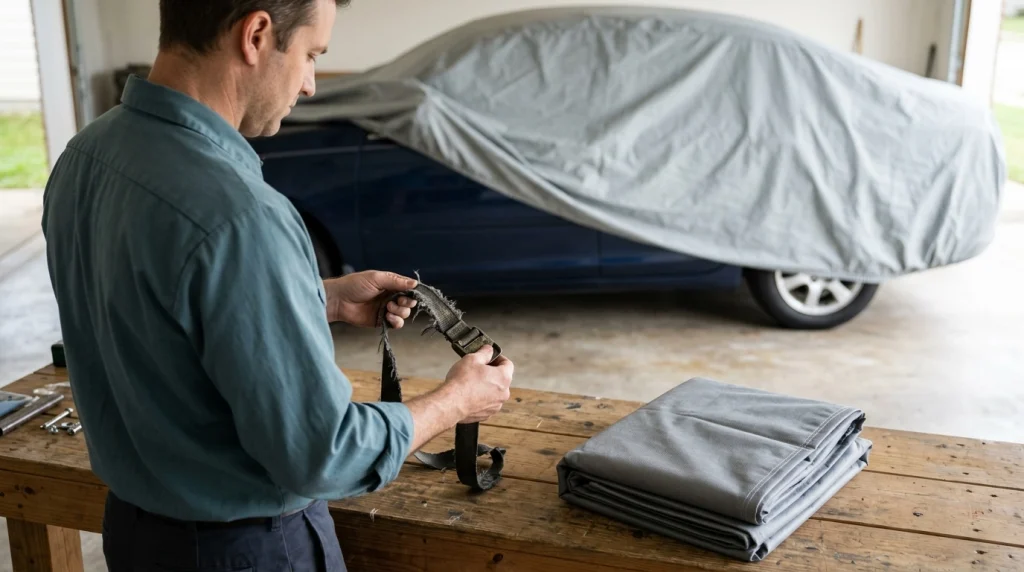
Replace or exchange the cover when adjustments cannot deliver secure coverage without excessive tension. Damaged seams, deteriorated elastic, and incompatible patterns can also justify replacement.
Signs That Adjustment Isn’t Enough
Repeatedly tightening straps won’t solve a major sizing mismatch. It can place additional stress on fabric and hardware.
- The cover cannot reach both bumpers.
- Mirror pockets remain misplaced after correct installation.
- Fabric pulls tightly against a spoiler or roof accessory.
- Large loose sections remain despite proper strap adjustment.
- Seams show tearing or excessive strain.
- Elastic hems have lost their ability to hold position.
- The cover repeatedly shifts across the vehicle.
Can You Repair the Cover Instead?
Some manufacturers offer replacement straps, buckles, or approved repairs. This can be worthwhile when the cover fits correctly but its securing hardware has deteriorated.
Inspect any damaged attachment points before considering repairs.
- Worn straps: Ask about compatible replacements.
- Broken buckle: Replace with manufacturer-approved hardware.
- Loose stitching: Check whether an authorized repair is available.
- Torn mirror pocket: Contact the manufacturer about repair or replacement.
- Incorrect size: Exchange rather than modifying the fabric.
A repair should restore proper fit and retention without creating hard contact points against the vehicle.
How Do You Prevent Fitment Problems in the Future?
A little preparation can prevent repeated fitting problems. Check the vehicle configuration before buying and inspect the cover regularly.
- Keep a record of your vehicle’s exterior dimensions.
- Confirm accessories when ordering.
- Inspect elastic and straps periodically.
- Clean the vehicle before covering it.
- Follow the cover manufacturer’s washing instructions.
- Dry the cover completely before storage.
- Remove or secure the cover before severe weather when recommended.
Proper sizing becomes especially important during windy outdoor storage. Excess movement increases the chance of fabric rubbing against dirty body panels.
If moisture remains trapped beneath the cover, investigate both the covering method and storage environment. A better-fitting cover alone cannot solve every condensation problem.
Section Takeaway: Repair worn retention parts when the underlying fit remains correct. Exchange a cover when the dimensions or pattern don’t match the vehicle.
Frequently Asked Questions
Can I fix a car cover that’s too big?
A slightly oversized car cover may improve after centering the fabric and adjusting its elastic hems and straps. Manufacturer-approved wind straps can help with minor looseness. If large sections continue hanging or shifting, exchanging the cover for a closer size is generally the better solution.
Can I stretch a car cover that’s too small?
You should not force an undersized car cover over the vehicle. Excessive stretching can damage seams, mirror pockets, and fabric. First verify the orientation and installation method. If the cover still cannot reach its intended mounting positions, choose the correct size rather than forcing the material.
How tight should a car cover fit?
A car cover should fit snugly enough to remain secure without stretching tightly across the body. Minor folds are acceptable, especially on universal covers. The important signs are adequate bumper coverage, correctly aligned pockets, and securely positioned hems without excessive tension.
Why does my car cover keep blowing off?
Incorrect sizing, loose elastic hems, damaged straps, and poor installation can allow wind to lift a cover. Recenter it, check the retention system, and secure it according to the manufacturer. If the cover continues ballooning, a better-fitting design may be necessary.
Why won’t my car cover fit over the mirrors?
The cover may be backward, off-center, or patterned for different mirrors. Check the front label and align the roof section before positioning the pockets. If the pockets still don’t fit naturally, confirm the vehicle’s exact body style, trim, and mirror configuration with the manufacturer.
Do universal car covers fit every vehicle?
No. Universal car covers are designed for specified vehicle-size ranges, not every model. Vehicles with unusual rooflines, large spoilers, aftermarket bumpers, or modified mirrors may fit poorly. Always compare vehicle measurements with the manufacturer’s chart instead of relying only on general size labels.
Can an incorrectly fitted car cover damage paint?
Yes, particularly if loose fabric moves repeatedly over dirt or debris trapped against the paint. Poorly placed buckles and excessive tension around protruding parts can also cause problems. Keep the contacting surfaces clean and correct significant fitment issues before using the cover regularly.
Should I replace a car cover that doesn’t fit?
Replace or exchange it when proper installation and strap adjustments cannot provide secure coverage. A cover that’s too short, substantially oversized, or incompatible with exterior accessories is unlikely to improve through ordinary adjustments. Check the seller’s return conditions before making alterations.
Final Takeaway: Get the Fit Right Before Tightening
Learning how to fix car cover fitment issues starts with identifying where the mismatch occurs. Check the orientation, roof alignment, mirror pockets, bumper hems, and securing straps before assuming the cover is defective.
Minor looseness may be adjustable. Persistent stretching, major folds, or incorrect pocket locations usually point to a sizing or pattern problem.
My recommendation is simple: don’t force the fabric to fit. Measure the vehicle, confirm its accessories, and choose a compatible cover that protects the paint without unnecessary movement or tension.
